Trelleborg Boosts Offering With Acquisition Of Coated Fabrics Specialists

SPARTANBURG, S.C. — November 3, 2014 — Trelleborg’s engineered fabrics operation in the United States has acquired the assets and businesses of coated fabrics specialists, Uretek Archer LLC Group, comprising Uretek LLC and Archer Rubber Company LLC. This significant transaction will strengthen Trelleborg’s existing offering in rubber-coated fabrics, while broadening its range of urethane-coated fabrics.
 
Thomas Caldwell, Director of Sales and Marketing within Trelleborg’s engineered fabrics operation, said: “The demands placed on our coated fabrics vary depending on the application, but each solution has to meet challenging and stringent performance requirements. We place a lot of importance on constantly innovating and developing our product offering, to ensure that our materials can cater to even the harshest environments.
 
“It is this philosophy that drives our commitment to investment in specialist technology and expertise, which will enhance and grow our offering and meet our customers’ developing needs. Uretek Archer LLC Group has a strong level of technical knowledge, a keen focus on R&D and product development, as well as solid customer partnerships. We believe that together, we can strengthen relationships with raw material suppliers to build a stronger supply chain.”
 
Uretek specializes in lightweight laminated polyurethane and is a market leader in North America within this segment. Products are mainly used for inflatable applications in industries such as aerospace, medical and recreational.
 
Archer specializes in rubber-coated fabrics in North America. It is a market leader in butyl-coated-fabrics and some lightweight neoprene applications, for use in slides, rafts and life vests.
 
Caldwell continued: “The merged enterprise will allow us the opportunity to accelerate and build on significant innovations and broaden our material science, applications and products. In addition, the strong capital provided by Trelleborg will serve all product lines by supplying financial support for quality improvements, as well as preparing the next steps in technology development.”
 
Stuart Press, President at Uretek Archer LLC Group, said: “We are delighted to announce the integration of Uretek and Archer coated fabrics technology with Trelleborg’s. We are certain that our new joint expertise and industry connections will provide customers with an enhanced portfolio of urethane and rubber products to choose from, as well as exciting new, innovative technology. We look forward to merging the Trelleborg and Uretek Archer LLC Group businesses.”

Posted November 4, 2014

Source: Trelleborg
 

DuPont Fluoropolymer Solutions And Old Toledo Launch Teflon™ Brand Apparel Line Of Clothing

WILMINGTON, Del. — November 3, 2014 — DuPont Fluoropolymer Solutions and Old Toledo Brands have launched DuPont Teflon brand apparel, a new line of clothing which extends the Teflon® brand beyond an ingredient textile finish. The lifestyle line of apparel is designed and manufactured by Old Toledo Brands for people who want to be able to live, work and play.

The Teflon brand apparel collection includes pants, shirts, fleece and jackets. The new menswear collection of Teflon brand apparel will be launched on Amazon.com and sold by other retailers. There are plans to expand into other categories including uniforms, women’s and kids’ apparel, and home textile products.

“Teflon™ brand apparel has a built-in technology that creates a molecular shield around the fibers,” said Marc Kaufman, chief executive officer of Old Toledo Brands. “This provides an invisible force field for the fabric to protect against spills, dirt and stains.”

The Teflon® brand has been in the textile market since the early 1960s, communicating the benefit of repellency and ease of care. Although the Teflon® brand has been around many years, it continues to be a highly regarded and recognized brand at the consumer level and to ensure the brand presence in this market. DuPont believes that a clothing line carrying the Teflon® brand would be a new compelling story to tell. In fact, recent consumer research indicates that more than 75 percent of shoppers found the Teflon™ brand apparel concept appealing and were willing to pay more for these garments.

“We are excited to launch this new collection of Teflon™ brand apparel and to be working with Old Toledo Brands, our exclusive Teflon™ brand apparel licensee,” said Ella Rabil, Teflon® brand licensing manager. “This line will provide consumers with easy-to-care for clothing that does not compromise the look, color or breathability of the fabric and meets the Teflon® brand promise.

Posted November 4, 2014

Source: DuPont Fluoropolymer Solutions
 

Fabric Structure Construction In Second Tier Cities In China Supports Architectural Membrane Market

With the increasing construction of fabric structures, architectural membranes are gaining increasing prominence in China due to their combination of positive qualities such as heat insulation, sound insulation, light weight for easy transportation, hydrophobic properties that allow rain to create a self-cleaning effect and the semi-transparency that allows ultraviolet (UV) light from sunlight to create an automatic bleaching effect and more qualities. With increasing income level in China, booming demands for leisure and travel will drive up the demand for fabric structure. Given that the majority of current fabric structure projects that use membrane materials are public investment projects, such as stadiums and airports, and do not generate much profit directly, the growth in this sector is mainly supported by the government’s public infrastructure growth strategies and is subject to high volatility from policy changes. However GCiS believes that it is not likely to be a major concern for the industry’s development in the near future as China is still investing heavily into its second-tier cities.
 
Membrane Material Used in China
Though fabric structures have existed for thousands of years, modern day architectural membranes are a relatively new type of building material that has only been around for a few decades, and only started gaining prominence in China in recent years around the time of the 2008 Beijing Olympics. One iconic membrane structure in China is the Water Cube, which is made of the highest quality membrane ethylene tetrafluoroethylene (ETFE). Two other key membrane material widely used in China are polyvinyl chloride (PVC) and polytetrafluoroethylene (PTFE). With the exception of ETFE, membranes actually derive  flexibility from the fabric underneath — such as polyester or fiberglass — while the plastic is what gives these fabrics the additional protection they need to stand against natural weathering; ETFE can be directly shaped into sheets. In terms of the differences between products, PVC membrane is a type of synthetic thermoplastic coated on polyester fiber and is one of the cheapest membrane products. PTFE is a plastic with strong carbon-fluorine bonds usually coated on fiberglass material to give improved properties and durability compared to PVC. ETFE is a fluorine-based plastic and is considered the highest quality product among architectural membranes with the best durability and resistance against natural weathering, but it is also the most expensive, with average prices five times that of PVC membranes. There are two main types of membrane structures, tensile structures that are shaped through tension, compression or bending and pneumatic structures that are supported by internal pressurized air.
 
Material Chosen by Different City Tiers
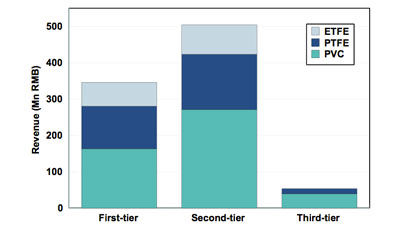
The largest difference in revenue stream between the different city tiers can be seen in the PVC product segment, where second-tier cities dominate over half of the total PVC product revenue. This is likely due to a combination of the lack of demand for expensive high quality products in second-tier cities and the lack of large-scale iconic projects in first-tier cities. Because second-tier cities are not as wealthy, the budget of iconic city projects is not likely to be as high as the ones found in first-tier cities. This may cause some end-users to opt for the cheaper PVC, which could be up to 10 times lower than the price of PTFE membranes. Additionally, many of the large-scale iconic membrane structures have already been developed in the first-tier cities and what remains are smaller-scale projects that do not require large quantities of architectural membrane, thus further restricting the revenue from these cities.

As for the overall difference in revenue between first- and second-tier cities, the obvious explanation is that there are four first-tier cities — Beijing, Shanghai, Guangzhou and Shenzhen — compared to 19 second-tier cities across China. Thus, there simply are many more projects in second-tier cities with a much greater demand for architectural membranes. This difference is likely to become even bigger in the future as second-tier cities become more developed. As for third-tier cities, it is still in an early stage of development and the trend using architectural membranes in the variety of structures across the different application sectors has yet to reach these cities. And higher-end ETFE membrane has yet to penetrate to this city tier.


Figure 1: Revenues of City-tier Breakdown by Product
Source: GCiS

Click on figure to view larger
 
Competition Landscape
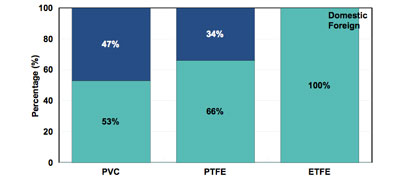
The ETFE and PTFE product segments are expected to grow the fastest as developers in China demand for stable high quality products. However, given architectural membranes have only been in the country for a short period, domestic suppliers still have a lot of catching up to do in terms of technology to compete with  foreign firms in the high-end markets with the highest profit margins. This difference in product quality results in much higher prices charged by foreign suppliers, which may see prices as high as five times the price of the cheapest product in the PVC market, thus foreign suppliers are able to gain significant revenue market share with limited output. However, domestic suppliers are expected to have the advantage in the long run  because they can enjoy the benefits of producing locally while essentially all the foreign suppliers still import their products into the China market. This phenomenon is largely due to foreign supplier’s fear of losing their technical advantage as a result of technological piracy; given China has a reputation for its ability to replicate foreign technology at low costs. Unstable quality products from domestic suppliers coupled with the high prices of foreign products, have been major inhibitors to the industry’s growth.
 

Figure 2: Market Shares by Product Segment and Ownership
Source: GCiS

Click on figure to view larger
 
Types of Projects
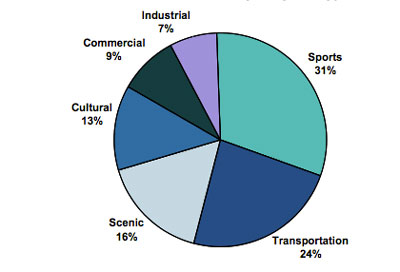
Sports and transportation structure applications are two of the biggest market segments for architectural membranes in China and are also expected to have the highest potential growth in the near future. Scenic structure application is also expected to have high growth as a result of the improving living standards in China. Although the cultural segment is not much smaller than the scenic structure application in terms of segment size, but it is expected to have a relatively slower growth in the near future as they only appeal to a small portion of the population and this segment is already quite developed. Commercial and industrial structure applications are expected to have one of the slowest growths due to the many substitute products that are deemed more appealing. Overall the membrane industry is forecasted to grow at a compound annual growth rate (CAGR) of approximately 10 percent for the next five years as China’s economy continues to grow.
 

Figure 3: Breakdown of Architectural Membrane by Project Types
Source: GCiS

Click on figure to view larger
 
Conclusion
In summary, the demand for fabric structures in China is growing very rapidly with an expected CAGR of around 10 percent over the next five years as the government continues to invest heavily in sports structures and expand the country’s transportation network. Through the last few years of rapid development in China, the use of architectural membranes is becoming saturated in first-tier cities and main demand is already shifting towards second-tier cities, where there are much more new projects that can take up this product. Together with the potential future applications of fabric structures and the government’s incentive for a greener country, the prospects for architectural membrane are looking very optimistic.


Editor’s note: Jason Kong is an analyst, and Xi Jiang a senior analyst for China-based GCiS China Strategic Research, a market research and advisory firm focused on business to business markets.


October 21, 2014
 

Fruit Of The Loom Announces Strategic Yarn Partnership With Parkdale America

BOWLING GREEN, K.Y. — October 29, 2014 — Fruit of the Loom, Inc. and Parkdale America, LLC, announced today they have signed an agreement to form a strategic partnership that will provide state-of-the-art technology in ring and open-end spinning of cotton and cotton blended yarns to be utilized in Fruit of the Loom’s vast assortment of underwear and casualwear products. As part of the agreement, Fruit of the Loom will sell its U.S. yarn spinning operations to Parkdale, which will then convert those plants to the very latest technology in ring and open-end spinning capabilities.

“We are happy to join Parkdale in this strategic partnership,” said Rick Medlin, President & CEO, Fruit of the Loom. “Parkdale is one of the largest spinners in the world and Fruit of the Loom has been purchasing yarns from them for many years. This new model will position us to provide our customers with even more innovative products with the great quality and value that consumers expect from the Fruit of the Loom brand.”

“We are excited to have this opportunity,” added Anderson D. Warlick, Vice-Chairman and CEO, Parkdale. “By working together with Fruit of the Loom, we can take advantage of our combined demand and invest in technology that will yield the highest quality at the lowest cost.”

Fruit of the Loom employees currently working at the facilities will have the opportunity to remain as employees of Parkdale.

The strategic partnership agreement is expected to close in the first quarter of 2015.

Posted October 29, 2014

Source: Fruit of the Loom
 

The Rupp Report: Wake Up, Western World!

Today, the global economy is probably facing its biggest transformation since the start of the industrial revolution in the 18th century. In this context, the development of modern communication is not taken into consideration, because there is nothing related to production, just communication.
 
As reported in the Rupp Report last week, the entire textile industry value chain recently met the International Textile Manufacturers Federation’s (ITMF’s) annual summit in Beijing. Seeing a modest slow down in the Chinese growth, perhaps the world thought that China was having problems. It is not. Most of the Western world has no idea what’s going on in the soon-to-be largest economy of the planet. The Middle Kingdom is shifting from a mass production country to a place where quality products are in the spotlight, and the Western world is arguing that China’s gross domestic product (GDP) is slowing down 1 percent. In the 3rd quarter of 2014, the economy rose by 7.3 percent — there are not many countries around the globe that can show such growth.
 
Shift From Mass Production To High-end Products
It was also reported last week that the new ITMF President Wang Tiankai, president of the China National Textiles and Apparel Council (CNTAC), said in his opening speech that “China is in a strong transformation. China is shifting from a mass production country to a place where we put much more emphasize on quality.” The reasons were also mentioned: high labor costs; rising environmental awareness; the lack of efficiency to use the natural resources; and the energy efficiency. Wang clearly defined the priorities of the Chinese textile industry: “To improve basic research and development projects; to bolster technical innovations; to improve environmental conditions for a better climate; and to establish consistent recycling of textile waste.” And at the end of his very open speech, Wang said, “But with our own strength, a different attitude and the help of our global business partners, we are sure to achieve the targets.”
 
Is It True?
Telling the world a story is one thing, proving it is the flip side of the coin. In many Chinese newspapers there are lots of examples that proudly describe recent efforts: For example Chinas is challenging the European Organization for Nuclear Research (CERN) and its flagship facility, which houses the large Hadron Collider underground in a 27-kilometer-long tunnel. Recently, China presented plans to build a 52-kilometer (!) particle collider to study the Higgs boson, a mysterious and highly difficult-to-detect subatomic particle. This is physics at the highest level. The Chinese are convinced they will succeed, and the Rupp Report agrees.
 
It Is True
On the other hand, the world’s biggest chemical company, Germany-based BASF, is investing in a US$110 million extension of its Innovation Campus Asia Pacific at its Pudong site in Shanghai. A key part of the extension will be a regional research and development (R&D) building. BASF says that by 2020, around 25 percent of BASF’s R&D staff will be based in Asia — most of them in China. Bruno Lanvin, executive director of INSEAD’s European Competitiveness Initiative, said that, “China is shifting its focus from just putting things together. China knows that if it wants to play in the top league, it needs to create and innovate, and they can do that only with a highly educated population.”
 
Long Time Gone
One should know that China was not always a nation with a very low income and an underdeveloped infrastructure. If one thinks about the 5,000 years of history of the country and a more than 2,000-year-old history of the Chinese emperor, one must take a look back to the year 960 A.D. That was the time when the economy friendly Song Dynasty came into power, which opened a time full of dynamism and profit. The emperor built a fleet to protect China’s merchants on the seven seas. The country flourished, and by the year 1000, its income-per-head was the highest in the world. The Chinese even invented paper money — in Europe, bank notes were only printed many centuries later. However, in 1270 this successful time ended with the invasion of the Mongolians, and China dropped back in poverty for ages.
 
Back To The Top
However, in more recent times, things are changing — even the slogan “Made in China.” Wang and other speakers at the ITMF conference said quite often that the “Made in China” label must be changed into a “Created in China” label. The plan is to transfer China from a manufacturing-focused country into an innovation-based economy by the year 2020. A survey said that last year, China overtook Japan in terms of R&D spending. In 2013, the Japanese GDP dropped heavily because of yen depreciation. The inverted money for R&D compared to the GDP fell from US$202 billion in 2012 to US$164 billion in 2013. Unbelievable, especially when one realizes Japan was the inventor total quality management. Meanwhile, the total Chinese investment for R&D rose from US$148 billion in 2012 to US$166.5 billion in 2013.
 
Analysts expect that by 2018, China will overtake the combined R&D spending of Europe’s 34 countries. And by 2022, the nation’s R&D spending is expected to match that of the United States, when the two countries are expected to spend some US$600 billion each on R&D.
 
The list could be extended with more examples. Many experts say that China has the fastest growing expenditure in R&D. They mention that China has grown at an average annual rate of 20 percent per year over the last decade. Much of the investment is concentrated in six regions: Beijing; Shanghai; Guangdong; Tianjin; Shaanxi; and Zhejiang. One should bear in mind that the United States still leads the way in R&D spending globally. However, according to a report released early this year by the National Science Board, China is constantly closing the gap. The report adds that knowledge-based economic activity is gradually shifting toward Asia, particularly China.
 
Asia Is Rearming
The report says “Asia’s share of total global R&D spending has risen from 25 percent a decade ago to 34 percent today, reflecting rapid economic growth in the region.” Many large Asian economies are boosting their R&D expenditure to build their competitive advantage in leading-edge industries such as technology and pharmaceuticals.
 
Wake up, Western world! It would be a big advantage if fortune tellers accept that “the East” in general, and China in particular, is closing the gap. It could be a rough time in the future for many already established businesses. Don’t forget: When the going gets tough, the tough get going.

October 28, 2014

Domotex 2015 – Both A Global Showcase And A Trend Barometer

HANNOVER, Germany, and CHICAGO — October 23, 2014 — The gates are opening on DOMOTEX 2015 from January 17 to 20, when some 1,300 exhibitors from more than 60 countries will be showcasing their product innovations and collections for the coming season at the world’s leading trade fair for carpets and floor coverings in Hannover, Germany. Visitors can look forward to a highly international and innovative event. As a global meeting place and driving force behind the industry, Domotex 2015 is guaranteed to provide fresh impetus and generate business. With Innovations@DOMOTEX, Domotex offers a unique showcase to highlight selected innovations in a concise and targeted way. In 2015, the trade fair is expanding its successful concept and will for the first time also feature innovations in applications and installation technology. These will be showcased in one of the three special display areas, which will also include textile and resilient floor coverings, parquet and laminate flooring, as well as modern hand-made rugs and carpets. In addition, internationally renowned architects and designers such as Stefan Diez, Ross Lovegrove and Roberto Palomba will be discussing the latest developments and applications in the flooring sector at the Innovations@DOMOTEX Talks.

“In terms of the breadth and diversity of products, innovations and trends, there is no alternative to Domotex. It is both a global trend barometer and a showcase,” says Dr Jochen Köckler, Member of the Managing Board at Deutsche Messe in Hannover. Nowhere else do so many foreign trade visitors from the retail and wholesale trades, skilled trades, architecture and interior design come to find out about new products and trends in the industry. More than 90 percent of these visitors are involved in their companies’ purchasing decisions.

The world’s leading suppliers of floor coverings will be represented at Domotex in January, with more than 85 percent of the companies coming from outside Germany. Exhibitors at Domotex show products and innovations ranging from textile and resilient floor coverings for the residential and commercial sectors to rugs, carpets, parquet and laminate flooring and floor coverings for outdoor areas, as well as installation, maintenance and application techniques.
 
Following its successful debut this year, Innovations@DOMOTEX will be back for a second time in January 2015. “The concept of providing visitors with more orientation, which significantly helps to initiate business contacts at the exhibitors’ stands, has been well received by the industry,” says Köckler. The coming year will also see innovations in applications and installation technology featured in one of the three special exhibition areas for the first time. On November 5, 2014, a jury of ten chaired by internationally renowned industrial designer Stefan Diez will be selecting the best ideas from those submitted.

Berlin architectural firm Matter puts innovations center stage
Headed by André Schmidt, Berlin-based architectural firm Matter is responsible for the creative presentation of the innovations in the three special display areas. Schmidt has developed a customized design for each Innovations@DOMOTEX area relating to the particular qualities of the product categories in halls 6, 9 and 17. As a central meeting place and highlight of the trade fair, the areas provide an inspiring overview of the product innovations and their design options.

Special guests: top designers Stefan Diez, Ross Lovegrove, Roberto Palomba
A series of presentations and discussion forums complete the program. With the focus increasingly shifting towards the design of striking floors, internationally renowned architects, interior designers, planners and designers, such as Stefan Diez, Roberto Palomba and Ross Lovegrove will discuss tomorrow’s trends and the effects on their work at the Innovations@DOMOTEX Talks in Hall 6. In addition, architects and designers participating in the presentation program will lead visitors on Guided Tours from the special areas to the exhibitors’ stands.

Luxurious and exclusive hand-made rugs are featured in Hall 17, where renowned designers and manufacturers – including Rug Star, Floor to Heaven, Jan Kath Design, Makalu, Obetee, Reuber Henning, Hossein Rezvani, Wool & Silk Rugs and Zollanvari – will be showcasing their latest creations. Classic hand-made rugs can be found mainly in halls 15 and 16. Hall 14 will also include an exhibition space for antique rugs, which provide an exciting contrast in modern home interiors.
 
Carpet Design Awards 2015 presented in conjunction with Innovations@DOMOTEX
For the first time, the Carpet Design Awards will be presented as part of Innovations@DOMOTEX in 2015. “Uniting the two will offer exhibitors significant added value for the presentation and promotion of their exclusive creations,” underlines Köckler. The renowned competition is regarded as the most prestigious international award for modern hand-made carpets. Chaired by London-based designer Michael Sodeau, an international jury will select three carpets in each of eight categories. These will be featured in the Innovations@DOMOTEX area in Hall 17. The winners in each category will be announced on Sunday, January 18, 2015 during the official award-giving ceremony.

A more hands-on approach will be taken in Hall 7, where parquet layers, floorers, interior decorators, painters and carpenters can find out all they need to know about innovative installation, maintenance and application techniques as well as useful information for their day-to-day professional lives. Moreover, visitors can obtain comprehensive information about parquet, wooden and laminate floors and also outdoor flooring in halls 8 and 9.

Posted October 28, 2014

Source: Domotex

 

Chomarat Opens New North American Facility

LE CHEYLARD, France — October 27, 2014 — CHOMARAT has just celebrated the opening of its new 58,500-square-foot factory in South Carolina. This new plant will specialize in developing Chomarat’s advanced composite business and is equipped with a LIBA MAX5 100-inch (variable width) machine designed to produce carbon, spread-tow, multiaxial reinforcements and carbon looms.

This new production capacity will enable Chomarat to offer innovative solutions in advanced composite textiles throughout the United States in the industrial, automotive and aerospace markets. “Our aim is to promote our latest innovations and to develop new partnerships in order to provide the North American market with advanced reinforcements, thanks to our highly skilled staff and state of the art machinery,” explains Florent Troubat, President of Chomarat Group.

C-PLY offers significant advantages to the aerospace and automotive industries. “The C-PLY offerings are touted as completely gap-free, a feat normal aerospace woven fabrics cannot yet claim,” says Michel Cognet, Chomarat’s General Manager. “Chomarat has a unique ability to use 50k large tow carbon fiber to make 100 g/m2 fabrics with virtually no defects. This overall quality capability makes Chomarat’s advanced composite textiles ideal for the most demanding applications, including visual quality surfaces. This is important for most of our customers, but it is a driving force in automotive structures and in the luxury markets for example,” he concludes.

Growth Strategy To Support The Group’s Business Development
This new facility confirms both the Group’s development strategy and Chomarat’s collaborative R&D strategy, sparked back in 2011 by an encounter with Professor Steve Tsai of the University of Stanford. The opening marks an important stage in Chomarat’s global expansion into the advanced composites market.

Posted October 28, 2014

Source: Chomarat
 

Applied DNA Sciences to Provide “Fiber Forward” Supply Chain Protection for Extra Long Staple Pima Cotton

STONY BROOK, N.Y. — October 28, 2014 — Applied DNA Sciences, Inc. (APDN), a provider of DNA-based anti-counterfeiting technology and product authentication solutions, announced today a commercial agreement with a textile manufacturer to purchase a SigNature T® DNA mark, in order to protect and authenticate Extra Long Staple Pima cotton starting October 27, 2014. This agreement will enable the textile manufacturer and its large retail partners to assure quality and preserve the integrity of the textile supply chain, starting from the grower to the consumer.

The SigNature T commercial program involves the creation of a unique, SigNature T DNA marker that will be used to mark the customer’s annual demand of Extra Long Staple Pima cotton at the ginning stage. Once marked, the premium Pima cotton fiber may be authenticated for textile identity along any node in the supply chain, from grower to ginner to spinner to manufacturer to distributor to retailer. The company calls this approach to managing textile identity in the supply chain “Fiber Forward.”

Pima or Extra Long Staple (ELS) cotton is a highly valued, luxuriously long fiber. It represents about 5% of the overall U.S. cotton output, the equivalent of an estimated $1.25 billion per year industry in the United States. Production of all types of cotton fiber is a $25 billion-per-year industry in the United States, employing over 200,000 people.

Once the Pima cotton is marked following each step of the process, its textile identity will be tested accumulating “provenance data” linking the original cotton fiber to finished product, preserving the authenticity of the product and the integrity of the supply chain.

MeiLin Wan, Executive Director for Apparel and Textiles, Applied DNA Sciences, said, “The kind of value that comes from a trusted, traceable and transparent supply chain is immeasurable, and we know consumers respond well to brands they trust, and even more to products they know will wear and launder well. Every moment of our daily lives involves a textile — from the bed sheets you woke up in, to the wrinkle free cotton oxford shirt you wear with that wool suit, to the upholstered fabric in the car you drove to work in, to the carpet in your office,” commented Wan.

The SigNature T DNA marker, an advanced technology based on botanical DNA, is robust, long-lasting, and uncopyable. APDN’s platform also includes a unique test for Extra Long Staple Pima cotton identity called fiberTyping, and can also include a cloud-based track and trace system called digitalDNA.

Applied DNA Sciences is a security provider in the form of a biotechnology platform. Many of its customers are protected under confidentiality.

“We have found in all our businesses — electronics, plastics, and many others — that supply chain participants must work together,” said Dr. James A. Hayward, President and CEO, Applied DNA Sciences. “There is no substitute for communication, trust and information exchange. We can help empower, with our DNA solutions, all supply chain stakeholders in building this kind of community.”

Posted October 28, 2014

Source: Applied DNA Sciences
 

Joint Statement Of The Ministers And Heads Of Delegation For The Trans-Pacific Partnership Countries

SYDNEY, Australia — October 27, 2014 — We, the Ministers and Heads of Delegation for Australia, Brunei Darussalam, Canada, Chile, Japan, Malaysia, Mexico, New Zealand, Peru, Singapore, the United States, and Vietnam have completed our three-day ministerial meeting to lay the groundwork for the conclusion of the Trans-Pacific Partnership Agreement negotiations.  Our meeting followed a week of officials’ level discussions in Canberra, from 19-24 October 2014.

We are pleased to report that, over the past weeks, we have made significant progress on both component parts of the TPP Agreement: the market access negotiations and negotiations on the trade and investment rules, which will define, shape and integrate the TPP region once the agreement comes into force.

Over the course of our weekend meeting, we have spent a considerable portion of our time in one-on-one discussions.  That has allowed us to make further progress in the negotiations on market access for goods, services and investment.  We met in a plenary format to make decisions on a range of issues that will help set the stage to bring the TPP negotiations to finalization.

We consider that the shape of an ambitious, comprehensive, high standard and balanced deal is crystallizing.  We will continue to focus our efforts, and those of our negotiating teams, to consult widely at home and work intensely with each other to resolve outstanding issues in order to provide significant economic and strategic benefits for each of us.

We now pass the baton back to Chief Negotiators to carry out instructions we have given.

We will continue to build on the progress we made at this meeting and will meet again in the coming weeks.

Posted October 28, 2014

Source: USTR
 

Hollingsworth & Vose To Increase Prices On High Efficiency And Specialty Filtration Products

EAST WALPOLE, Mass. – October 22, 2014 – Hollingsworth & Vose, a global leader in the supply of advanced materials for filtration, battery separator, and industrial applications, today announced a price increase on high efficiency and specialty products globally. Escalation in fiber, resin, and energy costs, were cited by Hollingsworth & Vose as a basis for the price increases on its high efficiency filtration products.

New prices for media will be effective with shipments starting January 1st, 2015, or as contracts allow. The increase will vary by product and will range from 3% to 5%.

H&V remains committed to providing its customers with the best combination of products, quality, consistency, value and support despite market fluctuations.

Posted October 28, 2014

Source: Hollingsworth & Vose
 

Sponsors