Brückner Names Fi-Tech Representative For Its Textile Machinery Range

LEONBERG, Germany/ RICHMOND, Va. — January 23, 2015 — Brückner Textile Technologies GmbH & Co. KG, Germany, has named Fi-Tech Inc. of Richmond, Va., its representative for sales, parts and service in the United States and Canada for their textile machinery product range. Fi-Tech has represented Brückner since 2011 in the field of nonwovens machinery and products. In 2013, the coating sector was added to Fi-Tech’s responsibility and now from January 2015, Fi-Tech will additionally represent Brückner in the field of textile machinery.
 
For more than 65 years, Brückner is the worldwide leading manufacturer of complete coating and finishing lines for woven and knitted fabrics, technical textiles, nonwovens and other coated products. The product range comprises of stenters, relaxation dryers, compactors, sanforizing machines, coating and laminating lines, nonwovens bonding ovens, through flow dryers and others.
 
In their own technology center in Leonberg, Germany, Brückner conducts tests and fabric trials together with their customers in order to find the best solution and machine configuration for each application. Lowest energy consumption, easy maintenance and high production output are the main targets of the research and development work at Brückner. 
 
“We are very proud to be represented by Fi-Tech, an absolutely professional team of specialists. Both companies, Brückner and Fi-Tech, are focused on the customer’s request and provide intelligent solutions for their optimum production results. We are looking forward to a long-lasting and successful partnership,” says Gerd Kolmer, Sales Director of Brückner Textile Technologies.
 
“We are honored that Brückner has extended their cooperation with Fi-Tech to include their product range for the Textile Industry. We are looking forward to a successful partnership with Brückner in the North American Textile Industry,” adds Todd Bassett, Managing Director of Fi-Tech Inc.
 
For over 40 years, Fi-Tech has represented European-based companies in North America, providing technologically advanced equipment to manufacturers in the nonwoven and textile industries. Brückner had a great benefit from the Fi-Tech experience and could increase their sales figures in the United States thanks to the big efforts of the Fi-Tech team. Fi-Tech is also handling the complete Brückner spare parts service for the North American market through their dedicated team in Richmond.

Posted January 27, 2007

Source: Brückner
 

The Rupp Report: You May Call It Faith

Every mutual agreement is based on confidence, trust or faith in your partner. This is the case for business deals as well as for deals in the private sector. Even if your are sure you will buy model X as your next car, if you don’t trust the salesman you will not buy anything and will walk out of the shop. This is even more the case in the modern money world. Since it became common sense to gamble on stock exchanges, some more serious people are looking for a safe haven for their money.
 
The World Is Upside Down
In times of modern and globally connected communication, information on everything is available on the Internet or elsewhere. Institutions, banks, and people with a lot of money, are carefully watching exchange rates for the most important currencies in order of the importance of the markets — the US Dollar, the Euro, maybe the Chinese Renminbi and the Japanese Yen. These countries, except China, are partners in the G8 group. So, if one lives in one of these countries, and has trust in his own financial system, he will leave his money in the banks of his own country.
 
Investors are carefully watching the whole economical and political situation in a country — the list of things to take into consideration is rather long — but stability is probably one of the most important issues. But if one has concerns about stability, he wants to find a more secure place and starts looking for a safe (money) haven. There are a lot of other countries besides the G8 members that have not the same sometimes questionable economical situations and governments.
 
Typically, Switzerland has fulfilled all the desired banking requirements and the old fairy tale says that every Swiss citizen is a rich citizen. And, dear reader, as a Swiss, the author of this report can assure you the fairy tale is not true at all. But since the Euro was introduced in Europe, a lot of money came into the Swiss banks, which led the US Dollar and particularly the Euro to weaken. In 2011, the Euro was under so much pressure that it lost 25 percent of its value compared to the Swiss Franc, and the Swiss National Bank (SNB) was forced to support the currency with a fixed exchange rate at CHF 1.20 to 1.00 Euro over an undefined period of time. And now the surprise after three years …
 
The SNB cancelled the Euro minimum exchange rate of CHF 1.20. With the abolition of the minimum price, the SNB has changed its monetary policy because of an increasing divergence of the major currency blocs. SNB President Thomas Jordan said that he could only announce the end of the minimum rate policy at once. Otherwise this would have been an invitation to insider trading.
 
The abolition of the minimum exchange rate is for some sectors a terrible shock. However, as Jordan said, the overvaluation of the Swiss Franc has decreased since the introduction of the minimum exchange rate in September 2011. On the other hand, the domestic economy was able to use the three and a half years of a planning security to take measures for a time after this period. Jordan said that it was clear from the beginning that the minimum rate was a temporary measure that would not continue endlessly.
 
The Message
There are some more facts involved, however, this is not the basic message of this Rupp Report. The message is that faith and confidence are still the essence of every prosperous industry. And despite troubles and losses of an estimated 500 billion Swiss Francs for the domestic industry, the SNB president is convinced that the domestic industry will face these severe problems and find solutions for a positive future. “Switzerland is now in a much better shape; the export figures, economic growth and an employment rate of some 3 percent are positive,” said Jordan. “The economy had its time to adapt to these conditions and the minimum rate has stabilized the economy. But now we are in a different situation and the SNB cannot meet all requested conditions at any time. It is better to realize that at the right time as to generate a much bigger shock later.” Strong words.
 
But it means he has faith and confidence in the domestic industry. Sometimes people from outside Switzerland are wondering about the ongoing success of such a small country with such an expensive cost of living and high wages. The reasons are no secret, here’s just a few hints: mind your own business; be a reliable partner to all your business partners; don’t accept second best, whatever that may be; use your brain and hands and don’t talk, do it.
 
See For Yourself
Jordan said that “Postponing the decision into the future would not have been less uncomfortable; it would even generate more severe side effects. Finally, Switzerland is not a monetary paradise where high interest rates for savers, a low Swiss Franc for the export sector and the absence of risks can be brought together at the same time forever.”
 
Conclusion? Help yourself, and don’t rely on other people. As the late U.S. president John F. Kennedy once said: “Ask not what your country can do for you — ask what you can do for your country.”
 
Let’s hope that all exhibitors at the forthcoming textile machinery events will go there with such a spirit of honesty and confidence. Because despite all positive thinking, the job must be done first. To be continued …
 
January 20, 2015

Polartec Launches Power Wool With Partner Brands

LAWRENCE, Mass. — January 19, 2015 — Polartec, announced the launch of Polartec® Power Wool, the new fabric collection that optimizes the natural performance of wool with synthetic fibers in patented, plated bicomponent knit constructions for superior comfort that only Polartec can deliver. The Polartec Power Wool launch partners include 66º North, Athleta, Beretta, Brooks-Range, Cabela’s, Crazy Idea, Eider, Gornik, Ibex, Kitsbow, Mammut, Millet, Mission Workshop, Mountain Force, QOR, Roeckl, Ternua, Teton Bros, Trangoworld, Under Armour and Westcomb.

Unlike other wool/synthetic blends on the market, Polartec Power Wool is a highly engineered plated construction which precisely places wool and synthetic yarns to achieve performance much greater than the sum of the parts, effectively creating a layering system within a single textile. Highly breathable Polartec Power Wool fabrics optimally place naturally wicking, odor resistant, temperature-regulating high quality merino wool next to skin with hydrophobic synthetic fibers on the outside for shape retention, durability, and improved dry-times. The resulting products more reliably manage the often-divergent demands of many environments – hot or cold, wet or dry – for superior comfort and durability.

Polartec Power Wool fabrics are currently available in multiple styles, including primary next-to-skin, form-fitting stretch, and patented grid construction based on Polartec’s original synthetic grid fleece technology, Polartec Power Dry® High Efficiency, which is now called Polartec Power Grid®.

The launch of Polartec Power Wool follows the introduction of Polartec’s latest innovations, Polartec Alpha, the first-ever breathable puffy insulation, and Polartec NeoShell, the most breathable waterproof fabric on the market.

Posted January 20, 2015

Source: Polartec
 

Techtextil Innovation Award 2015: Call For Entries

FRANKFURT — January 20, 2015 — Entries are invited for the Techtextil Innovation Award. On the occasion of Techtextil, Leading International Trade Show for Technical Textiles and Nonwovens — to be held May 4-7, 2015 — Messe Frankfurt will give awards for innovative ideas and future-oriented developments in the field of technical textiles, nonwovens and functional apparel textiles. The previous competitions for the Techtextil Innovation Award and the Avantex Innovation Award are being continued together under the new name. The Techtextil Innovation Award is also open to non-exhibitors.

The deadline for receipt of entries for the Techtextil Innovation Award is February 20, 2015. The jury will accept all developments that have neither been on the market for more than two years nor chosen for any other award. The competition is open to exhibitors of Techtextil 2015, as well all other companies, institutes, universities and individuals. All award-winning projects will be on show at a special exhibition during Techtextil. Entries can be made online at www.techtextil-award.com.

The projects entered must be in relation to the production or use of technical textiles, nonwovens or textile-reinforced materials. The Techtextil Innovation Award will be given in the following categories:

  • Research;
  • New materials, products, means of production, manufacturing and finishing technologies for use in one of the 12 Techtextil areas of application, i.e., Agrotech, Buildtech, Clothtech, Geotech, Hometech, Indutech, Medtech, Mobiltech, Ökotech, Packtech, Protech and Sporttech;
  • New materials and products for technical applications based on / in combination with natural fibers;
  • New material, technological, processing and finishing developments, e.g., new fibers and years, new finishes, nano-technology, electronic systems in garments;
  • Fashion aspects combined with new technologies and new materials, design concepts and aesthetic considerations;
  • Potential medical applications with textiles and apparel;
  • Combination of comfort and functionality in sportswear and activewear;
  • Innovations for safety and protection at work; and
  • Smart textiles, intelligent textiles.

The awards in the various categories will be presented during the opening ceremony of Techtextil in Room Dimension, Hall 4.2, on May 4, 2015. All award-winning products will also be on show throughout the show at a special exhibition in Hall 6.1.

Details of the various award categories and the full rules can be found on the internet at www.techtextil.com.
Parallel to this, the Texprocess Innovation Award for new technological developments will be presented at the concurrent Texprocess, Leading International Trade Show for Processing Textile and Flexible Materials.

Posted January 20, 2015

Source: Techtextil
 

Enhanced Filter Performance Thanks To Viscose Speciality Fibers From Kelheim

KELHEIM, Germany — January 20, 2015 — At the world’s biggest filtration event, the FILTECH conference and exhibition, Dr. Philipp Wimmer from the R&D team of the German viscose speciality fibre manufacturer Kelheim Fibres will present a paper on how beer can be filtered in an environmentally friendly manner by using sustainable viscose speciality fibres and avoiding the use of potentially hazardous diatomite.

Unlike other cellulosic fibres such as cotton or wood pulp, viscose fibres are distinguished by their well-defined and reproducible properties that allow them to be designed to meet the needs of processing steps and adapted to each application. For example, the porosity and surface of a filter can be precisely controlled by adding viscose fibres with different cross-sections. The incorporation of functional additives into viscose fibres allows the optimization of the fibres in respect of the intended application, for example for the removal of tannins from beer.

The advantage of functional viscose fibres: as the additives are incorporated in the fibres they do not impact the physical properties of the filter and can not migrate into the filtered product but can still function effectively.

The use of viscose speciality fibres from Kelheim is completely safe both for people and for the environment, and this is one of the reasons why the fibres have been used for decades in medical products. The fibres are certified for food contact by ISEGA and the absence of harmful substances in the products is confirmed by their certification to the OEKO-TEX® 100 standard in the most demanding product class. Viscose fibres are taste neutral and are currently used in food and beverage applications, for example in coffee pads and tea bag papers.

Kelheim Fibres’ research team is working on many other possible filtration applications for the use of viscose fibres. As a result of the wide product range Kelheim Fibres offers – from extra high absorbent to water repellent, from flame retardant to ion exchange fibres – there are almost no limits to the imagination. As viscose fibres are manufactured from renewable raw materials incineration at the end of filter life is CO2 neutral, or – if the residue in the filter allows – they can be composted, an ideal disposal route for precoat filter cakes in the beverage industry.

Posted January 20, 2015

Source: Kelheim Fibres

Akcros Chemicals Invests In Bringing Customers High Quality, Safe And Reliable Biocide Product Line

NEW BRUNSWICK, N.J. — January 8, 2015 —  Akcros Chemicals Inc. today announced the successful startup of isothiazolone-based biocide solid carriers manufacturing for the global market at its New Brunswick facility, capping off a more than $1 million dollar investment designed to bring customers enhanced quality control, regulatory approvals and reliability of supply for INTERCIDE biocides in pellet form.

Last year, Akcros Chemicals and Dow Microbial Control, a business of The Dow Chemical Co., extended their strategic relationship for biocides for plastics applications on a global basis. Under this agreement, Dow Microbial Control transferred manufacturing equipment and provided Akcros with additional expertise to manufacture an enhanced line of Isothiazolone based solid carriers for protection of polymers. These products, previously under the Dow VINYZENE  Biocide tradename now will be manufactured in New Brunswick as part of the Intercide biocide product line for polymers and brought to market by Akcros Chemicals. Intercide customers now are offered a continuing, high quality, reliable source of supply and a supply partner dedicated to bringing effective biocide technology to the plastics market in an easy to use solid pellet form.

According to Vini Shah, Biocide Product Manager, the Intercide isothiazolone product line manufactured at the New Jersey site consists of OIT and DCOIT active biocide in both liquid and now solid polymer carriers.  The products are typically used in the construction & home goods markets to inhibit the growth of harmful micro-organisms on flexible PVC products. Production of the solid biocides at the New Brunswick, NJ plant will enhance control over quality of the product, ease of EPA/ BPR/ Canadian approvals & consistent supply.

“The installation and startup of the in-house production of solid biocide shows our commitment to the New Brunswick plant and employees as well as our push for more sustainable, environmentally friendly biocide products” said George Turk, New Brunswick Plant Manager.  “With our New Brunswick based Supply Chain and Customer Service, and comprehensive Distribution Channels, we will be able to service the global market efficiently.”

Posted January 16, 2015

Source: Akcros Chemicals
 

Pharr Invests In Advanced Space Dye Technology To Support Supply Chain Partners

MCADENVILLE, N.C. — January 15, 2015 – Pharr Yarns, one of North America’s leading manufacturers of carpet yarns and high performance yarns, announced today that it has invested in innovative space dye technology for its McAdenville, N.C. facility to meet retailers’ and the consumer’s growing demand for sophisticated design options.
 
The equipment underscores Pharr’s $70 million capital investment strategy – deployed over the past decade – that is driving modernization and efficiency while ensuring superior production and value for its customers.
 
“Pharr’s new technology will allow us to provide a broader range of color and patterns to create distinctive atmospheres for residential and commercial spaces,” said Joe Rankin, vice president of Pharr’s Carpet Yarn division. “Just like a new spice can improve an old recipe in the kitchen, colors and patterns created with space dye technology enhance carpeting’s aesthetics in ways consumers have never imagined.”
 
The new space dye equipment made by Belmont Textile Machinery allows Pharr to achieve greater manufacturing efficiency while creating improved styling, versatility and color clarity. Space dyed yarns provide significant benefits to all of Pharr’s carpet manufacturing customers who have relied on Pharr’s expertise and technological superiority throughout the company’s 75-year history. Each of Pharr’s customers will now have the ability to differentiate their products in the market and maintain a leading-edge position in the design and manufacture of multi-color carpets.
 
“The new technology will maximize production flexibility resulting in more rapid product launches, improved manufacturing efficiencies and superior quality,” said Pharr Yarns Business Director Rich Pattinson. “This important investment is yet another demonstration of Pharr’s continuing commitment to our associates, communities and customers and we are excited to be featuring this technology at Domotex in Hanover, Germany later this week.”

Posted January 15, 2015

Source: Pharr Yarns
 

SDL Atlas Launches Second-Generation Moisture Management Tester

ROCK HILL, S.C. — January 14, 2015 — SDL Atlas, a global leader in textile testing solutions, is excited to introduce the 2nd generation of the MMT® Moisture Management Tester. The new design offers an attractive new look while incorporating several improvements.
 
The open design for the test area allows the use of larger samples and even a portion of a completed garment to be tested. It also makes routine cleaning of the test sensors easier. The metal housing makes the instrument more robust, while a new motorized upper sensor and sample positioning light make the test procedure even simpler.
 
“While the MMT has been around for a number of years, it is still considered an innovative test instrument,” said Chuck Lane, president of SDL Atlas.  “We feel the improvements in this 2nd generation model will make the MMT a feature instrument in any laboratory.”
 
The SDL Atlas MMT measures the moisture management properties of knitted, woven, and nonwoven fabrics by measuring the liquid transport through a fabric and on both faces. Measurements include absorption rate, one-way transport, wetting time of top and bottom faces, maximum wetted radius on both surfaces, and an overall moisture management capacity.
 
 “Today’s performance-driven markets require vendors to provide products that adequately transport moisture throughout the structure in order to keep the wearer comfortable,” said John Crocker, SDL Atlas Business Development Manager.  “Vertical and Horizontal wicking tests historically used in the industry simply do not provide enough information to make a realistic claim for the market.”

Posted January 14, 2015

Source: SDL Atlas
 

Gerber Technology Introduces High Capacity Pivex® Punch For Taurus® And Taurus Ii Leather Cutting Systems

TOLLAND, Conn. — January 14, 2015 — Gerber Technology announces a new accessory for its line of Taurus and Taurus II Leather Cutting Systems, the High Capacity Pivex Punch.  Now, Taurus and Taurus II systems can cut and punch heavy leathers (up to 12 ounces) when utilizing Gerber’s patented Pivex reciprocating knife head with the new High Capacity Pivex Punch.

Designed with apparel and accessory manufacturers in mind, the High Capacity Pivex Punch is ideal for Taurus users who produce items that require precisely placed and consistently sized holes in heavier leather hides, such as belts, footwear, handbags, watchbands and jackets.

“The Taurus II Leather Cutting System represents a very strategic product line for Gerber and we will continue to drive innovation for this segment of the market,” said Tom Gordon, director of Industrial Products, Gerber Technology. “The High Capacity Pivex Punch is just another way we’re helping Taurus and Taurus II users maximize their return on investment by providing expanded functionality to their production automation capabilities.”

High Capacity Pivex Punch Starter Kits are available in 2 size ranges: 2-4mm and 5-7mm.  Each kit includes 2 punches of each size (2, 3 and 4mm for the small starter kit and 5, 6 and 7mm for the large starter kit), and all hardware required to operate two punches simultaneously. The kits can be installed by the customer in a matter of minutes.   

The High Capacity Pivex Punch option can be installed on any Taurus XD/XM or Taurus II SLD/SLS with Pivex. Pivex upgrades are available for Taurus XD/XM and Taurus II SLD/SLS customers currently operating Taurus 4-tool systems seeking to gain the precision, throughput and yield of the Pivex reciprocating knife head in their production.

Posted January 14, 2015

Source: Gerber Technology
 

The Rupp Report: Are Cheap Prices Too Expensive?

Sometimes it is not easy to understand global markets. On the one side, people from Main Street are complaining about never-ending rising costs in everyday life. On the other side, the relevant markets are complaining that prices are too low. At the moment, this particularly is the case for crude oil and therefore the stuff to fuel heaters around the globe. Hmm.
 
It is understandable that oil producing countries — dependable on this precious raw material — are complaining about the current low prices, while people from Main Street are more happy than ever about purchasing cheap fuel. Experts, fortunetellers and (probably) wise men are asking the question: Why all this? And what about another raw material, cotton? It its latest report, the International Cotton Advisory Committee (ICAC) wrote that low cotton prices could be a long-term problem? Why?
 
Production Surplus
The Rupp Report has informed its readers more recently about volatile cotton prices. Since last spring when they were above 90 cents per pound (cents/lb), international cotton prices have fallen to under 70 cents/lb in December. To counter low prices, cotton consumption is forecast to increase by 925,000 tons to 24.4 million tons in 2014-15, after falling 1 percent to 23.5 million tons in 2013-14. “Lower international and domestic prices are expected to bolster consumption in China by 6 percent to just under eight million tons,” said a recent press release from the ICAI. “The contraction in China’s demand for cotton yarn imports is expected to cause India’s cotton consumption growth to slow to 4 percent reaching 5.3 million tons. This is down from 5 percent in 2013/14 and 14 percent in 2012/13 when demand for Indian yarn exports was much stronger.
 
“Despite expected growth in cotton consumption this season, a world production surplus of 1.7 million tons is still anticipated,” continued the ICAC press release. “This will bring 2014/15 world ending stocks to 21.3 million tons, up 9 percent from 2013/14 and up 147 percent from 2009/10 when stocks reached a 15-year low. The average world stock-to-use ratio in the 25 years before China began its reserve policy in 2011 was 47 percent. However, the volume of ending stocks would represent 87 percent of the projected consumption in 2014/15, and is weighing heavily on prices this season. Even assuming reasonably lower production and higher consumption in the next few years, it will take several seasons for the significant volume of stocks to reach a more sustainable level, and low cotton prices are likely to persist while the market adjusts.”
 
Yes, But …
The ICAC report continues: “However, world production is estimated down 1 percent to 26.1 million tons due to reductions in China and the Southern Hemisphere. As a result of the contraction in area caused by changes in its cotton policy and falling domestic cotton prices, China’s cotton production is projected down 7 percent to 6.4 million tons. In response to low world prices, Brazil’s production is forecast to fall by 10 percent to 1.5 million tons. Meanwhile, low prices and a significant drought are expected to reduce Australia’s production by 47 percent to 470,000 tons. India’s production is expected to remain stable at 6.8 million tons due to less favorable monsoon weather this season despite an expansion in the cotton area by 5 percent to 12.3 million hectares. However, its production will surpass China’s by over 300,000 tons, making it the largest cotton producer in 2014/15. Production in the United States is looking to rebound 23 percent to 3.5 million tons, partially offsetting declines in the other major producing countries.
 
How is the global situation? Have a look at the table:
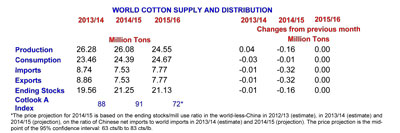
United Kingdom-based Plexus Cotton Ltd., one of The Rupp Report’s preferable sources for cotton news, said in its Market Report dated January 8, 2015: “NY futures continued to trade sideways last week, with the March contract edging up 29 points to close at 60.56 cents. So far, around 7.6 million bales have been freed from the loan, which means that including beginning stocks of 2.5 million bales there are now 10.1 million bales outside the government loan system. U.S. export sales ended the year on a firm note, as 158,800 running bales of Upland and Pima cotton were sold during the week of December 26 to January 1. China was once again the major force in the market with 78,500 running bales, followed by Vietnam with 34,700 bales. Total commitments for the current marketing year now amount to 7.9 million statistical bales, whereof 2.6 million bales have so far been exported.”
 
It’s The Market. What Else?
Probably the best explanation for all these ups and downs is quite simple: It’s the market, in most cases, that dictates the price. Today, when OPEC is weak and some countries are able to drill or use fracking to obtain oil for much less money than other countries, then they want to have the advantage of more competitive prices.
 
The January 8 Plexus Market Report states: … the magnitude of this drop in energy prices — which includes other energy sources such as natural gas and coal — is mindboggling! When crude oil was trading at US$100/barrel, the global annual production value amounted to around US$3.4 trillion dollars, which means that at US$50/barrel, producers are losing about US$1.7 trillion dollars in revenue per annum, while users are saving that same amount. About half of global oil production crosses borders and therefore the trade value would drop by around US$850 billion dollars a year if the price of crude were to remain near current levels. Countries like the U.S. and China are both big producers as well as importers, which means that certain sectors of the economy will take a hit.”
 
And if the Chinese are sitting on some 10 million plus metric tons of cotton, and stop buying, the result is clear as well. Plexus estimates that by the end of the season, stocks held outside of China will rise by 20 percent, to nearly 9 million tons, the second largest volume (after 2004-05) in the last 30 years. Much of this increase will be held by producing countries, and likely will cause world exports to fall 15 percent to 7.5 million tons.
 
However, having US$1.7 trillion dollars in the pocket of the global consumers is not a bad thing. Let’s hope that this money will be spent this year, maybe at the ITMA Europe in Milano; or at the very least, in buying more cotton products!
 
January 13, 2015

 

Sponsors