Epson Hosts Digital Couture Event At NY Fashion Week

Long Beach, Calif.-based Epson will partner with 11 fashion designers from North and South America during New York Fashion Week for the Digital Couture project. The event will feature collections from each designer created using fabrics printed on the Epson® SureColor® F-Series dye sublimation printing machine. The fashion show aims to illustrate the capabilities and design possibilities offered by the technology.

“We’re excited for today’s fashion designers to bring their creative visions to fabric in new and versatile ways with advanced digital technologies during New York Fashion Week,” said Agustin Chacon, vice president, subsidiary sales and operations, Epson America. “Epson’s dye sublimation printing technology provides another level of creativity and functionality for young fashion entrepreneurs and well established fashion brands looking to produce their art in a more efficient and affordable manner.”

January/February 2015

Yarn Market: Spinners Have High Hopes For 2015

By Jim Phillips, Yarn Market Editor

As 2015 begins, the U.S. textile industry and its yarn spinners find themselves in a highly competitive global marketplace — one in which quality, customization and supply chain optimization are likely to play ever-more important roles.

Even though 2014 had more bumps in the road for some spinners than much of the previous two years, yarn manufacturers, overall, reported solid results.

“The first half of the year was super-solid,” commented one spinner. “The last half was a bit spottier — but it still wasn’t bad.” Added another spinner: “If 2013 was, say, an A, I would put 2014 at an A-. The order pipeline became shorter, but we still managed to stay busy.”

One spinner noted that the continuing decrease in cotton prices played a large part in the shorter order pipeline the last part of the year. “As cotton prices began dropping, I think a number of companies began aggressively moving any inventory that had been built up, temporarily saturating the market in some instances. At the same time, customers were acutely aware of falling prices and placed shorter orders.”

As has been the case for much of the past four or five years — mainly due to capacity — ring-spun yarns were in very high demand, and there were times, especially earlier in the year, where positions were hard to come by.

As one yarn broker commented earlier this year, “I’ve lost a number of contracts simply because I could not find the yarn. I have even had a lot of inquiries about OE yarn, and that usually doesn’t happen in my business. When customers are asking if I can find OE for them, I know that the market is very tight.”

Spinners Optimistic About 2015
Looking ahead, spinners say the conditions are conducive — barring unforeseen economic issues — for a very good 2015. “It looks like it could be a very solid year,” quipped one industry observer. “The economy is continuing to shake off the hangover from the 2007 recession, raw material prices are falling for many industry segments, and energy prices are decreasing.”

Another spinner said, “Cotton prices are falling to the point where we believe that some customers that moved to blends a few years ago might come back. Additionally, reduced fuel costs make it more efficient to get yarn to customers in both a timely and cost-efficient manner.”

Added one industry executive: “We see no reason for the momentum we have established over the past several years to slow. Our industry is in the midst of one of its most stable periods in recent memory. If this continues, it will provide only the opportunity to build profitability, but will also enable us to continue to invest in the most modern equipment. This, in turn, will further increase productivity and reduce costs for the manufacturer, its customers and the end-consumer.”

Despite the optimistic stance of many in the industry, several potential issues could create significant challenges by the end of the year. As advantageous as low cotton prices are for manufacturers and their customers, they can be devastating for cotton farmers. “The past year has not been a good one for cotton farmers,” commented one expert. “In fact, it was a bad year for many row crops. The likely outcome is less acreage planted in the next few years, which could eventually lead to a raw material shortage and sharply escalating prices.”

Additionally, the U.S. dollar has increased in value versus other currencies. Since June 30, the dollar has jumped 16 percent against the Japanese yen, 18 percent against the euro and nearly 20 percent against the Brazilian real. “This is a causing a significant hit in profit to those companies with substantial overseas business,” said one observer. “Additionally, it means imported goods can be bought even more cheaply in the United States, compared to domestically produced products.”

As a result, spinners agree that maintaining the competitive advantage of yarn produced in the western hemisphere will be contingent upon maintaining superior quality, creating innovative new products and maximizing the inherent advantages of the domestic supply chain. “Going forward, quick-turnaround and delivery of superior products will be our best weapon in an environment in which pricing could be a major issue.”

January/February 2015

DOE Announces $2.5 Million Grant For NatureWorks

The U.S. Department of Energy’s (DOE’s) Office of Energy Efficiency and Renewable Energy, Bioenergy Technologies has awarded a grant to Minnetonka, Minn.-based NatureWorks LLC. Worth up to $2.5 million, the grant will be used to support an ongoing joint development program between NatureWorks and Calysta that aims to sequester and utilize the problematic greenhouse gas methane as feedstock for NatureWorks’ Ingeo biopolymer and its intermediates. The collaboration is researching how to transform renewable biomethane into lactic acid — the building block for Ingeo — through a fermentation process, leveraging Calysta’s Biological Gas-to-Chemicals® platform for biological conversion of methane to high-value chemicals.

Calysta has already demonstrated lab-scale production of lactic acid from methane, and the companies are hoping to reach pilot-scale production in the next three to five years.

“If proven through this collaboration, methane to lactic acid conversion technology could be revolutionary, providing sustainable alternative feedstocks for Ingeo,” said Ken Williams, NatureWorks, and program leader for the Calysta-NatureWorks collaboration. “When coupled with NatureWorks’ proven commercial process for lactic acid to Ingeo, the methane to lactic acid process would transform a harmful greenhouse gas into useful and in-demand consumer and industrial products. This disruptive platform could support high-value chemicals and liquid fuels.”

January/February 2015

Pharr Yarns Invests In Space-Dyeing Technology

McAdenville, N.C.-based Pharr Yarns LLC reports it has purchased space-dyeing technology for its carpet division from Mount Holly, N.C.-based Belmont Textile Machinery. The machinery gives Pharr the ability to offer its customers improved styling, versatility and color clarity.

“Pharr’s new technology will allow us to provide a broader range of color and patterns to create distinctive atmospheres for residential and commercial spaces,” said Joe Rankin, vice president, Pharr’s Carpet Yarn division. “Just like a new spice can improve an old recipe in the kitchen, colors and patterns created with space dye technology enhance carpeting’s aesthetics in ways consumers have never imagined.”

“The new technology will maximize production flexibility resulting in more rapid product launches, improved manufacturing efficiencies and superior quality,” said Rich Pattinson, business director. “This important investment is yet another demonstration of Pharr’s continuing commitment to our associates, communities and customers …”

January/February 2015

Innovations In Textile Machinery: Wet Processing

As the 2015 ITMA in Milan approaches, a review of the current offerings in textile wet processing machinery is in order. A representative group of manufacturers of preparation, dyeing, printing, and finishing equipment provided current innovations on offer from their companies. As might be expected, most of the machinery changes are incremental and evolutionary rather than revolutionary, but a few manufacturers have come forth with truly new ideas.

Preparation Machinery
Switzerland-based Benninger AG has redesigned its Fortracta prewasher to maximize removal of surface contaminants. A novel vertical counterflow arrangement optimizes use of water and energy. Trikoflex, Benninger’s low-tension washer, is intended for elastic knits and crease prone wovens. Improved washing efficiency is provided by the unique grooved drum surface.

Dyeing Machinery
The new Pulsar package-dyeing machine from Italy-based Loris Bellini S.r.l. comes with a circulation pump and hydraulic circuit that can provide 70-percent energy savings with 30-percent fewer chemicals and water while operating at a liquor to goods ratio of 3.8:1.

Italy-based Brazzoli S.p.A. offers Innowash, an enhanced washing process for its 3.8:1 liquor to goods ratio Ecologic translational flow piece-dyeing machine. The amount of washing required is determined automatically to minimize water usage.

Dyeing polyester in supercritical carbon dioxide has been commercialized by The Netherlands-based DyeCoo Textile Systems BV. Both Nike and adidas have developed programs using fabric dyed in the DyeCoo process with dye press cakes from Singapore-based Huntsman Textile Effects. Significant savings in energy and process time have been realized by both companies — 60 percent and 40 percent respectively.

Germany-based Erbatech GmbH has optimized its Scout Color® cold pad batch dyeing system for low utilities use. Additional improvements include adjustable nip pressure to insure uniform wet pickup.

Italy-based Flainox S.r.l. has declared a focus on sustainability with its NRG-DL garment dyeing machine. The NRG-DL processes garments at a low 5:1 liquor to goods ratio and can measure energy, water, and chemical usage in real time, allowing for process optimization with minimal utility and chemical use. Flainox has introduced a novel dyeing system designed for use with natural dyes. The AOM/C-WOOL, is actually an extraction-dyeing-dyebath recycle system where the chosen plant material is extracted just prior to application. After the textile has been dyed, the dyebath is recovered for further use, a typical practice with natural dyes. Flainox has demonstrated a further commitment to sustainability by reducing the carbon footprint in its manufacturing plant by 50 percent.
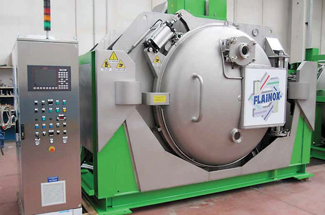


NRG-DL garment dyeing machine from Flainox S.r.l. dyes at a low 5:1 liquor ratio.

Fong’s National Engineering Co. Ltd., Hong Kong, offers the Allwin, a package-dyeing machine with a very low 4:1 liquor to goods ratio and expected savings of 50 percent in process time and water usage. The Jumboflow piece dyeing machine from Fong’s claims 40-percent savings in water and steam, 50-percent less energy requirements, and a 33-percent process time savings while dyeing in a 5:1 liquor to goods ratio.
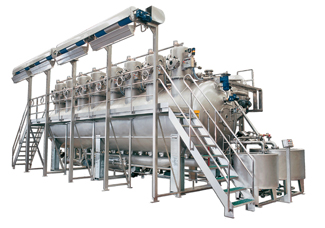

Fong’s National Engineering Co.’s Jumboflow piece-dyeing machine was designed with water, energy and time savings in mind.

The use of air to dilute dyes and chemicals prior to application has been championed by Gaston Systems Inc., Stanley, N.C. Its CFS® Chemical Foam System enables denim to be dyed with indigo and sulfur dyes at 8- to 15-percent wet pickup while cotton can be continuously dyed with fiber reactive dyes at 10- to 40-percent wet pickup without tailing.

Germany-based Then Maschinen GmbH, a Fong’s Europe GmbH company, has improved upon the Then-Airflow Synergy® system with two machines, the DSYN G2 for dyeing under pressure and the SYN A G1 for atmospheric pressure dyeings. Both machines provide significant savings in water, energy, steam and salt.

The iMaster series from Thies GmbH & Co. KG, Germany, includes the iMaster H2O designed to dye elastic containing cotton and cotton blends at a 3.7:1 liquor ratio at temperatures of up to 140°C. An improved internal support reduces fabric tensions during processing and a combined cooling and rinsing system significantly reduces process time. The iMaster F was specifically designed to dye terry cloth at a 4.5:1 liquor to goods ratio with vat dyes using the proVAT system. Thies’ soft-TRD SIII is said to be a universal dyeing machine with flexible liquor to goods ratios from 10:1 to 4.5:1. For package dyeing, the iCone was redesigned to minimize floor space requirements while operating at a 3.6:1 liquor to goods ratio. Optimized circulation, rinsing, and heating systems were incorporated into the redesign.

Printing Machinery
Switzerland-based Jakob Müller AG offers the MÜPRINT MDP2 E, an ink-jet printer designed for elastic and non-elastic narrow polyester woven, knit, and nonwoven fabrics. The machine prints with disperse inks and heat sets the printed fabric in one continuous operation.


Jakob Müller’s MÜPRINT MDP2 E is an ink-jet printer for narrow fabrics.

An ink-jet printer from Reggiani Macchine S.p.A., Italy, the ReNOIR-Compact, was designed to print paper for transfer printing. The ReNOIR-Compact is capable of printing paper at a production speed of 4,000 square feet per hour.
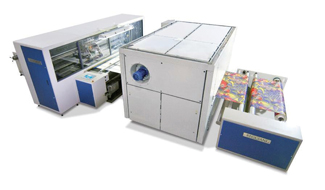


Reggiani’ Macchine’s ReNOIR-Compact ink-jet printer prints paper for transfer printing.

The Netherlands-based SPGPrints BV has announced an as yet unnamed digital printer that was shown to select customers in December 2014 and displayed at ITMA 2015. The six- to nine-color high-speed single-pass printer is predicted to provide the lowest cost ink-jet printing cost per linear meter.

Digital ink supplier Xennia Technology Ltd., England, has announced two new lines of inks — the Agate® line of acid dye inks for nylon, wool, and silk; and the Corundum® line of disperse dye inks for transfer printing paper. These inks join the fiber reactive Amethyst® and ultraviolet curable Moissante® inks in Xennia’s product line.

Austria-based J. Zimmer Maschinenbau GmbH has expanded its Colaris digital printing system to tufted carpet — up to a 4.2 meter width at 5 meters per minute (m/min) — terry towels — a 2.2 meter width with up to 16 colors at 72 dpi and 120 square meters per hour (m2/hr) — and needlepunch polyester nonwovens — up to a 4.2 meter width at 1,000 m2/hr. The Zimmer Chromojet provides 10-color digital printing of blankets at 6.3 m/min. Zimmer reports it soon will introduce a digital printer for yarns.
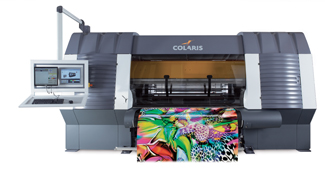

Zimmer recently extended its Colaris digital printing system to tufted carpet.

Finishing Machinery
Italy-based Biancalani S.r.l. offers the Airo®24, a tumble dryer with processing speeds to 2,500 m/min with evaporation rates of 750 kilograms per hour. The Brio® from Biancalani, a relaxation dryer for knits, sports high-capacity drying without causing pilling.

Germany-based Brückner Trockentechnik GmbH & Co. KG is promoting the Power-Frame, a tenter frame that claims 33-percent energy savings with redesigned nozzles, automatic lint screen cleaning, and independent upper and lower air flow controls. Brückner’s Leonberg, Germany, location houses production scale machinery for customer evaluation of finishing, coating, heat setting, and laminating processes.

The Allround® Coating Head from A. Monforts Textilmaschinen GmbH & Co. KG, Germany, provides multiple coating options on full-width fabrics. The Thermex Econtrol T-CA process for dyeing polyester/cotton blends reduces the number of processing steps while providing high quality dyeings with significant cost saving. The Matex ECO applicator allows for precision low wet pickup application of chemical finishes with the potential of producing dual sided treatments. The Montex 8000 tenter frame incorporates the Eco Booster HRC heat recovery system and a split thermal system to allow different upper and lower fabric temperatures. Production trials can be run at the Monforts Advanced Technology Center in Mönchengladbach, Germany.
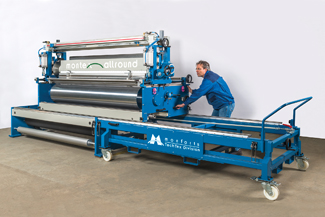

Monforts’ Allround® coating technology offers multiple options for full-width fabrics.

Morrison Textile Machinery Co., Fort Lawn, S.C., has announced Morrison On Call, a web based remote access system to allow software and firmware downloads and remote diagnostics and machine monitoring.

Textile processing from liquid carbon dioxide is available from Tersus Solutions from CO2Nexus Inc., Littleton, Colo. Textiles can be cleaned and treated with high value chemical finishes with using less water and energy.

From a sampling of the current textile wet processing machinery, ITMA 2015 should be a very interesting and exciting event. The textile machinery industry is sure to continue to introduce textile wet processing equipment that will reduce the industry’s use of water and energy while providing high quality textiles.


Dr. Peter J. Hauser is a professor and Interim Head at North Carolina State University’s College Of Textiles, Department of Textile Engineering, Chemistry and Science. This article is based on Hauser’s presentation given at the 2014 Textile World Innovation Forum.


January/February 2015

Atlas Copco Compressors Save Energy

Rock Hill, S.C.-based Atlas Copco Compressors LLC estimates its variable speed drive (VSD) technology has saved customers $300 million in energy costs since 1994.

“According to greenhouse gas calculations by the Environmental Protection Agency, the amount of kilowatt-hours saved annually by our VSD compressors is equivalent to avoiding the carbon dioxide emissions of 51,029 homes’ electricity use, or removing 78,101 passenger vehicles from the road,” said Robert Eshelman, vice president, Atlas Copco’s Industrial Air division.

According to the company, based on the number of VSD compressors operating in the U.S., approximately 538 million kilowatt-hours and $53 million in energy savings are realized annually.

January/February 2015

Oeko-Tex® Debuts New “Made in Green” Label

Switzerland-based Oeko-Tex® Association has introduced the “Made in Green by Oeko-Tex”
label, which replaces the Oeko-Tex Standard 100plus and “Made in Green by Aitex” labels. Oeko-Tex recently acquired rights to the “Made in Green” label and now is the exclusive issuer. The new label certifies
the textiles have been manufactured in an environmentally friendly and socially responsible manner.

“As a logical enhancement of our product portfolio, the ‘Made in Green by Oeko-Tex’ label offers companies in the textile industry the perfect tool for communicating to the consumer their commitment to sustainability directly on the product,”said Dr. Jean-Pierre Haug, secretary general, Oeko-Tex. “The basic difference and added value when compared to its predecessors, is in the transparency of the new ‘Made in Green by
Oeko-Tex’ label for the consumers.”

January/February 2015

The Rupp Report: Evergreen Industrial Fabrics

For the Western textile industry in general, and for European producers in particular, technical textiles were and are the main anchor of prosperity over the past 25 years. Growth rates remain steady.
 
Today, there are virtually no areas where technical textiles could not be applied in any some form. However, there are a few things to be considered to be successful in the nonwovens sector. Parallel to the sector’s growth, the specialized exhibition Techtextil in Frankfurt along with its associated events in other cities around the world, has become the number one event for this sector of the industry.
 
Techtextil 2015
In the beginning in 1986, the show was not accepted at all by the industry. It was wishful thinking was the least negative comment made about the show back then. At that time, only DuPont with a big booth was sure this will be the future. Today, everybody knows, this is the future. Exhibitors and visitors are looking forward to the biggest Techtextil ever May 4-7, 2015. According to show organizers Messe Frankfurt, by now the floor space booked already is 10-percent higher than the total space occupied in 2013. In addition to international market leaders, numerous new exhibitors have already signed up for Techtextil 2015.
 
For the third time, Techtextil will be held concurrently with Texprocess, an international trade fair for processing textiles and flexible materials. The following countries will be represented by their own pavilions: Belgium; China; France; Great Britain; Italy; Portugal; South Korea; Taiwan; Turkey; and the United States. New is a Swiss pavilion.
 
Apparel People
“Quite remarkable is the fact that apparel manufacturers too from all over the world will present their latest developments in the sectors of functional apparel and smart textiles”, says Michael Jänecke, director, Brand Management Technical Textiles & Textile Processing, Messe Frankfurt, at a recent Techtextil press conference. According to Jänecke, there is a remarkable array of companies, which are by now known to be very active in the field of apparel, such as Huntsman Advanced Materials, Klopman International, Outlast Europe, Schoeller Textil and Toray GmbH.
 
Modified Program Of Events
For the first time, the show will last four days. For many years, the Rupp Report has complained that this event should take place over four days, instead of three, because the number of side events has increased. Many exhibitors claimed that they don’t want to pay for floor space and the visitors are going to attend more seminars than visit booths.
 
The Techtextil program of events has now been expanded and optimized for 2015. The new center of Techtextil and the concurrent Texprocess is the “Innovative Apparel Show” — four universities and fashion schools will present their innovative designs on all four days of the fair. This also should illuminate synergies with Texprocess, the Trade Fair for Processing Textile and Flexible Materials, parallel to Techtextil.
 
The concept of the Techtextil Symposium also has been modified: The themes of the third event, the Avantex Symposium for functional apparel textiles, have been integrated into the four-day congress. Instead of concurrent lectures, the Techtextil Symposium is now split into six successive lecture blocks in hall 4.2, the middle of the fair.
 
Subjects to be covered at the Techtextil Symposium 2015 include thermoplastic composites, bio-based polymer composites, hybrid yarns, self-cleaning textiles, 3-D printing, 3-D spacer fabrics for personal protective equipment, multiaxial technologies for customized technical textiles, smart fabrics, and a lecture on the Spacetex project.
 
The Commerzbank Report
Despite all the positive news, it is difficult to get real facts and figures about the technical textiles and nonwovens markets. The most prominent reason is possibly the fact that such a task is very expensive and difficult to achieve. However, at the recent Techtextil press conference, Jürgen Grebe, corporate sector analyst with Germany-based Commerzbank AG, presented an outstanding report, which provides comprehensive insights into the growth perspectives of the technical textiles sector.
 
Also Commerzbank realized that technical textiles are conquering more and more new application areas and are superceding conventional materials. Examples of this are reinforcement materials made of textiles in concrete construction, artificial arteries in medical technology, and textile sandwich materials in vehicle construction and sporting equipment. And this is just a few insights into this extraordinary work. The Rupp Report will come back to this work in a future column.
 
Nonwovens With A Substantial Contribution
In the period from 2007-2013, European manufacturers of technical textiles saw stronger growth than the European economy as a whole. In the crisis years 2008, and in particular 2009, above-average slumps were visible, however. The subsegment nonwovens, the production of which has increased by 11 percent since 2011, made a substantial contribution to this growth. According to Grebe, for 2015, it is to be assumed that this area, as well as the other technical textiles, will see a moderate rise of some 2 percent in the production index. However, with the textile-reinforced fiber composites – the so-called composites – the high level seen in 2007 will not be attained again due to weak demand in France, Spain and Italy. In contrast, German, British, and Eastern European manufacturers posted considerable increases in production.
 
With a smile Grebe explained that the winning goal in the 2014 World Cup final was scored by Mario Götze from Germany who was wearing a “knitted” soccer shoe — showing that new manufacturing methods constantly are being developed. Technology leadership is, therefore, a key success factor. “The German sector is regarded as the global technology market leader, also thanks to the excellent networking with the German research sector, which is itself unique worldwide,” said Grebe. He also stated the focus was on high-quality, sophisticated product areas, and the sector was avoiding to the greatest possible degree competition with suppliers of mass-produced goods and low-quality products, that were primarily based in Asia. “Looked at that way, the German sector is predominantly the result of a successful structural change on the part of producers of traditional textiles to become highly technical and specialist manufacturers of high-quality textile products,” he added.
 
Favorable Growth Rates
Through to 2018, the global market for conventional textiles is set to grow from somewhat more than $130 billion at present to as much as $160 billion, states the report. In this respect, the most important buyer area remains the automotive industry. Yet sectors such as construction textiles and geotextiles, as well as niches such as ecotextiles, are gaining in significance. For nonwovens, it is expected that worldwide sales will increase from $33 billion at present to more than $42 billion by 2017. Here, the biggest buyer area remains the hygiene sector, Grebe stated. Higher growth rates are believed to be possible for composites — in particular due to strong demand in the buyer sectors vehicle construction, wind energy and aviation. At present the global market volume for composite materials is estimated to be just less than $100 billion. In total, the global market volume for technical textiles is currently more than $250 billion.

January 27, 2007

Open House Event At BB Engineering Showcased World’s First Bottle-to-POY Spinning Line VarioFil R+

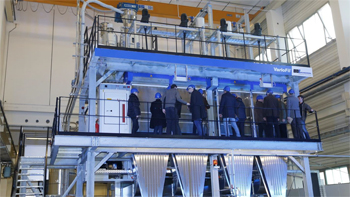
REMSCHEID, Germany — January 21, 2015 — More than 120 customers from all around the world followed BB Engineering GmbH’s (BBE) invitation to join the unveiling of its new machine during an Open House Event at its facilities in Remscheid, Germany, on January 21, 2015. Visitors saw the world’s first “VarioFil R+” bottle-to-POY line in operation, producing 150f48 dope-dyed black yarn.

The new VarioFil R+ is the world’s first POY spinning line which uses recycled bottle flakes as feedstock for dope-dyed textile POY. The line — developed by the subsidiary company of Oerlikon Barmag — provides several technological features such as a special extrusion system for bottle flake materials, the latest metering and blending technology for dope-dyeing and an advanced 2-step melt filtration. The result is a high quality dope-dyed POY. The turnkey machine comprises 4 spinning positions, each equipped with an Oerlikon Barmag 10-end WINGS® POY winder.

Bottle flakes instead of rPET chips: VarioFil R+ reduces spinning process for one step
PET has become the primary material for beverage packaging, billions of PET bottles are used worldwide each year. This huge quantity of PET bottles, usually disposed as waste after initial use, is a perfect source of raw material for the sustainable production of synthetic fibers. Furthermore, the reutilization of resources and raw materials, along with energy saving production processes, are becoming increasingly popular. The VarioFil R+ concept combines all these trends. It uses PET bottle flakes as a raw material, which avoids the additional pelletizing of bottle flakes into rPET chips. This leads to a significant advantage in terms of investment and energy costs. It also provides the latest technology for dope-dyeing, which is the most resource-saving dyeing process. Hence, the development of VarioFil R+ underlines the trend of increasing demand for textiles made from yarns which have a ‘sustainable background’. It also provides the possibility for recycling companies to sell high-quality yarns instead of bottle flakes, therefore generating added value.

Downstream with Oerlikon Barmag’s eAFK texturing machine proves yarn quality
Further Open House attractions were the live presentation of the texturizing process, converting the manufactured rPOY into DTY on Oerlikon Barmag’s eAFK texturizing machine, as well as BBE’s brand-new cleaning system for melt filters, known as White Filter Cleaning WFC. WFC allows the cleaning of melt filters, but also of other melt-contaminated parts without any chemical solvents and is a good complementary system for the VarioFil R+ line to clean its filtration equipment.

A virtual tour through the new VarioFil® R+ line as well as an impressive insight into the winder assembly department of Oerlikon Barmag, the origin of the famous WINGS POY winder, and several technical presentations covering the fields of recycling, yarn production from recycled feedstock and dope-dyeing all made the Open House an informative day for all participants.
 

Posted January 27, 2007

Source: BB Engineering
 

Lectra And Aubade Working Together To Prepare Future Designers And Pattern Makers

PARIS — January 22, 2015 — Lectra, a leader in integrated technology solutions dedicated to industries using soft materials—fabrics, leather, technical textiles and composite materials—and Aubade, the renowned French lingerie brand have announced the results of the Lectra/Aubade 2014 competition. The award shines the spotlight on design and pattern making students from De Monfort University (DMU), UK by tasking students with designing a small lingerie collection that reflects the Aubade brand. Students were required to both design and develop their collections with Lectra’s product development solution, Modaris®.

The inaugural edition of this was open to final-year DMU students. The aim is to get students to develop a 6-piece collection using Lectra’s pattern making solution Modaris, underlining the famous lingerie brand’s DNA, and within the theme of English handwriting. The jury decided to award two students instead of just the one as initially planned because of the exceptional creativity and execution of design. Aubade is pleased to welcome both Ellie Balwako and Hannah Jones, from beginning summer 2015, for 6 month internships in Paris. The first student won for product development and the second one won for design and their internships will reflect this.

“The competition is a reflection of Lectra’s commitment to education, Aubade’s involvement in transmitting the brand’s DNA and DMU’s efforts to favor their students’ employability,” explains Anastasia Charbin, Fashion and Apparel Marketing Director, Lectra.

“This contest with one of Lectra’s education partners represents a great opportunity to meet promising talent, who are immediately operational,” underlines Annie Bureau, Operations Director at Aubade. “De Monfort University has a lingerie program which is specifically adapted to industry needs; students are trained on Lectra’s pattern-making solution, which we’ve used for years,” says Marie-Béatrice Pereira, Development office Manager at Aubade.

“This contest is a true opportunity for our final-year students who were really motivated. They’ve demonstrated great creativity, drawing from Aubade’s brand spirit and concentrating on technical aspects to obtain a perfect fit. They used Lectra solutions, which are at the core of our program and which are an undeniable advantage when looking for a job,” explains Gillian Proctor, Principal Lecturer & Programme and Leader for Contour Fashion.

“This is the story of a wonderful project between Lectra, De Monfort University and Aubade. It is a true exchange between professionals and students. We are very pleased to welcome and to work with young talent who bring a fresh eye and their unique personalities to the Aubade team,” concludes Claire Masson, global brand Director at Aubade.

Founded in 1947, De Monfort University’s 3-year curriculum called “Contour Fashion” is the oldest lingerie diploma in the world. Students are trained on Lectra’s Modaris it is extremely powerful for lingerie, corsetry, activewear, swimwear and underwear.

Posted January 27, 2007

Source: Lectra
 

Sponsors