Valdese Weavers Announces The Acquisition Of Dicey Mills

VALDESE, N.C. — January 6, 2015 — Michael Shelton, president and CEO of Valdese Weavers LLC, announced that the company has purchased Dicey Mills Inc. Valdese Weavers will begin the integration of Dicey immediately, with the expected completion of an orderly and deliberate transition of the Dicey business into the company’s facilities in Valdese by the end of December 2015. Valdese Weavers did not purchase the Dicey factory in Shelby. “Along with the asset purchase, we have negotiated a transition services agreement for the right to operate in the Shelby facility as needed until the end of the year. This will help to ensure a seamless integration and high level of service to all Dicey customers during the transition. Further, Valdese Weavers intends to offer employment to as many as possible of the highly skilled artisans who currently work for Dicey Mills,” according to Shelton.
 
“The addition of the Dicey fabric line complements the existing Valdese Weavers’ brands unique style very well. It will extend the breadth of our product diversity and market reach by utilizing different yarn systems and weave techniques that achieve the specific Dicey look. And while Dicey’s fabrics are somewhat different in nature to our current mix of products, technically they are remarkably compatible and therefore will integrate nicely into our vertical manufacturing operations in Valdese,” Shelton said.
 
Dicey Mills was founded in 1956 by Paul M. Neisler Sr., and has been owned and operated by the Neisler family since its inception. The current management of the company and primary shareholders have been brothers David C. Neisler, W. Hayne Neisler and H. Parks Neisler. Parks Neisler has headed up sales and marketing functions at Dicey for many years, and will join Valdese Weavers to help lead the creation of the new Dicey Fabrics brand of Valdese Weavers, and the sales effort. “I have known the Neisler family for a long time, and have had the utmost respect for Dicey Mills,” said Shelton. “For several years, I worked alongside Henry Neisler on industry trade and regulatory issues in conjunction with the American Textile Manufacturers Institute and the National Textile Association, through which I gained tremendous regard for him and the well- respected company he and his brother Charles had developed.” Henry was the father of David, Hayne and Parks Neisler. Shelton further stated, “I am extremely happy that Parks Neisler will be joining Valdese Weavers and become an integral part of our team as we move forward into a new era for Dicey.”
 
“Our intention is to apply all the necessary resources to the Dicey Fabrics brand to fully realize the potential that we believe exists for the fabrics that Dicey is well known for, and couple that with the reputation for industry leading quality and service that Valdese Weavers represents. Our hope is that we will properly honor the legacy of Dicey Mills, and the Neisler family, through our future development of their rich heritage,” Shelton stated.
 
On behalf of the Neisler family, Parks Neisler said, “Dicey is excited about becoming part of an outstanding company like Valdese Weavers. Like us, they are a family business with deep roots in the textile industry and we look forward to growing the Dicey Fabrics brand with them in the years ahead.”

Posted January 6, 2015

Source: Valdese Weavers
 

2015: Italian Textile Machinery Industry Looks Ahead To ITMA Milano

MILAN, Italy — January 6, 1015 — Italy’s textile machinery producers are preparing to experience an intense year, with its apex arriving in Milan at the upcoming edition of ITMA, returning to Italy after a 20 year hiatus. Compared to the previous edition, Italian exhibitors have increased their overall exhibition surface area by 46 percent.
 
For Italy’s textile machinery sector, 2015 will primarily revolve around ITMA, the industry’s global trade fair that makes a return to Italy twenty years after the last edition held here. From November 12-19, Milan will host the 17th edition of ITMA. For Italian textile machinery manufacturers, it has meant a year-long race to get themselves ready for the event that is held in Europe every four years.
 
Over 380 Italian exhibitors are slated to be present in Milan, a 19 percent increase compared to those on participating four years ago in Barcelona, where the last edition of ITMA was held. Even greater is the surface area of exhibition space already booked for the show (+46 percent). As ACIMIT President Raffaella Carabelli confirms, “These figures don’t just place Italy as the leader among the countries exhibiting at the trade fair; above all, they testify to the vitality of our industry and the belief in all of us that Italy’s textile sector is enjoying a period of good health.”
 
While machinery manufacturers have focused on technology innovations to showcase at what has always been considered the preeminent international event for the industry, ACIMIT (the Association of Italian Textile Machinery Manufacturers), thanks to the support provided by the Ministry of Economic Development and the Italian Trade Agency, has implemented a whole range of activities aimed at promoting Italy’s textile machinery sector and its participation at ITMA 2015. Among the various initiatives planned are the incoming missions of foreign delegations which will bring to Italy during the course of 2015 close to 200 textile operators hailing from around a dozen countries (including Bangladesh, Iran, Egypt and Pakistan), in order to present to them the best of what Italian textile technology has to offer.
 
Thanks to the ITMA 2015 Awards, about ten students from foreign universities (Ethiopia, India, Russia and Vietnam) will get the opportunity to visit the ITMA pavilions and discover the innovations proposed by Italian textile machinery sector. All of this will be complimented by an intense press communications campaign and two media events, in

“The importance of the event has been seized by the Deputy Minister Carlo Calenda” states Carabelli “recognizing the significance of the textile machinery industry, a sector that exports over 80 percent of its production to more than 130 countries, representing Italian excellence worldwide. The support offered by the Ministry and by the Italian Trade Agency makes us proud, allowing us to confidently present the combination of tradition and innovation that has always distinguished our textile sector and made us a global leader, to all of the industry operators who will flowing into Milan in November 2015.”
 
“Export represents for the Italian textile machinery industry a well-established vocation, almost an innate characteristic” says Roberto Luongo, General Director of Italian Trade Agency, “and for this reason we usually support ACIMIT and the companies of the sector. We are  aware that ITMA 2015 is for all Italian companies, operating in the sector, a great opportunity. So a special project to support the presence of Italian companies at the show has been prepared with the support of the Ministry of Economic Development”.

Posted January 6, 2015

Source: ACIMIT
 

Vietnamese Retailer And Woolmark Licensee Canifa Launches Its First Woolmark-certified Collection

SYDNEY, Australia — December 18, 2014 — Vietnamese apparel manufacturer and retailer Canifa has released a range of Woolmark-certified apparel in time for winter in the northern hemisphere and as part of The Woolmark Company’s ‘Out of Vietnam’ project.

After sell-out success last winter with Woolmark Blend knitwear, Canifa has produced a 53-piece collection for men, women and children which not only includes Woolmark Blend apparel, but also clothing made from 100-percent Merino wool, gaining Woolmark certification.

As the first Woolmark licensee to come out of Vietnam, Canifa is also the first to produce 100-percent Merino wool apparel to sell in the domestic market. The collection was officially launched December 20 with a fashion show in Hanoi, sending models down the runway dressed top to toe in Australian Merino wool.

“Canifa’s Woolmark-certified collection is a significant advancement for The Woolmark Company’s Out of Vietnam project, which was launched in 2012,” says The Woolmark Company Chief Strategy and Marketing Officer Rob Langtry.

“Initially launched to develop a sustainable supply chain in Vietnam and expand its current manufacturing sector, Canifa’s retail success extends far beyond the trade sector, opening doors to the consumer market and introduces Australian Merino wool to customers previously unaware of the fiber’s infinite potential.”

Comprising sweaters, cardigans, dresses, vests, skirts and scarves, the collection used fine Merino wool with a micron of 19.5 and was designed by the two winners of Project Runway Vietnam: Hoang Minh Ha and Ly Giam Tien. Canifa’s Merino wool collection embodies minimalism with elegant style, creating pieces which transition office attire to elegant everyday wear.

“Canifa’s slogan is fashion for all, meeting the demands of consumers of all ages and for all occasions,” explains Canifa CEO Ms Doan Bich Ngoc.

“Thanks to The Woolmark Company’s introduction to wool in Vietnam, the domestic apparel market has seen some great changes, benefitting consumers with fashionable products meeting international standards.

“Canifa is honoured to be the first Vietnamese fashion brand certified to use the Woolmark and Woolmark Blend logos. The fashion show will launch the Australian Merino Wool collection; the first successful step in cooperation between Canifa and The Woolmark Company, bringing new opportunities for both Canifa and the Vietnamese textile industry.”

Posted January 5, 2014

Source: The Woolmark Co.
 

SPGPrints Gives Sneak Preview Of New Single-pass Printing Solution

BOXMEER, The Netherlands — December 18, 2014 — SPGPrints has opened its doors to key customers for  ‘sneak’ preview of its new single-pass digital textile printer, scheduled for launch at ITMA 2015 in Milan, next November. Over a two-week period visitors from around the world were able to view the prototype of the new Pike® printer at the company’s headquarters in Boxmeer, the Netherlands.

The Pike is based on a full-width array of Fujifilm Samba print heads, specially modified in a joint project for optimum performance in textile printing. The heads are incorporated in a highly accurate but user-friendly print-bar technology, called Archer®.

One essential advantage of the technology is that the Archer Technology can jet accurately across a distance much greater than can other heads widely used in current digital-textile applications. The head plates in the Archer array will typically be 4 millimeters (mm) away from the surface of the substrate, compared with the typical 1.5 mm of other print heads – so greatly reducing the risk of head strike, which can damage these expensive components.

SPGPrints has also developed Pike Reactive inks, with a formula that eliminates the mist problem, which might have arisen with this greater firing distance.

The first Pike printer is a 6-color machine in which each colour is represented by an Archer print bar containing 43 print heads, giving a printing width of 1850 mm. The print bar has a native resolution of 1200 x 1200 dpi, variable drop sizes from 2-10pl and a jetting frequency of 32 kHz, which together deliver typical productivity of 40 linear metres a minutes, with a maximum of around 75 meters per minute. The modular construction will allow models with up to 9 colors.

Wider Versions Of The Pike, Up To 3200 mm, Are Also Planned
The Archer print bar has been designed to retract fully for easy maintenance. Heads can be purged in narrow segments and a faulty head can be replaced by users in less than an hour, with no need for manual alignment – simply software-based registration. The heads are manufactured by a MEMS process, which means they are less liable to degradation and can be refurbished.

With the cost of head replacement identified as a major concern for investors in fixed-array machines, SPGPrints proposes a unique arrangement in conjunction with Pike inks, in which the customer will initially receive a number of spare heads and any faulty heads returned will be replaced free of charge.

Jos Notermans, SPGPrints’ commercial manager for digital textiles, said: “We researched what users want in the next generation of digital textile printing technology and discovered that the essentials include solid blotches, fine geometrics and – above all – a robust industrial solution. That’s what the Pike delivers, at high speed and with low, predictable costs.

“We are able to achieve the quality of Epson DX-based machines with the productivity of the faster machines based on Kyocera heads.”

The Pike’s fabric-infeed system is by Erhardt + Leimer and the transport blanket has been specially designed in conjunction with Habasit. The in-line dryer has the extra capacity to handle disperse inks, which – along with acid inks – are in development and scheduled for launch in 2016.
 
Wider versions of the Pike, up to 3200mm, are also planned.
 
Posted January 5, 2015

Source: SPG Prints
 

Sioux Corp. Receives Pillar Of The Industry Award

BERESFORD, S.D. – December 19, 2014 — Sioux Corp. received the Pillar of the Industry Award from the Association of Equipment Manufacturers for its dedication and support of America’s manufacturing industry and the I Make America campaign. Sioux was one of 34 companies nationwide to receive the award at the AEM’s annual conference.
 
Sioux Corp. — a manufacturer of application specific, industrial pressure washers, steam cleaners, water heating and cooling systems, steam generators and related custom equipment — is a very active supporter of the I Make America campaign. I Make America is a national grassroots campaign that supports policies to support and increase manufacturing in the United States. Manufacturing is vital to improving the economy and keeping America globally competitive.
 
Jack Finger, Sioux’s President and CEO stated: “For several decades Congress failed to understand and appreciate the positive contribution US manufacturers have made in providing great jobs with great benefits, and paying taxes. Only recently, since the loss of countless manufacturing jobs, has Congress seemed to realize this and has just started to help reverse the negative trend. This campaign helps get the word out and Sioux Corporation is pleased to support this program which helps support US manufacturers and the US economy. Given a level playing field, US manufacturers are highly competitive.”
 
I Make America is a free campaign dedicated to dramatically increasing jobs for those who grow and build America.
 
Posted January 5, 2015

Source: Sioux Corp.
 

INDA Announces Four Companies To Compete For Prestigious RISE® Durable Product Award

CARY, N.C. — December 18, 2014 — Four unique finalists have been nominated as finalists for the prestigious fourth annual Research, Innovation & Science for Engineered Fabrics Conference (RISE®) Durable Product Award. The RISE Durable Product Award will be awarded to a durable nonwoven product chosen for their innovative use of nonwoven fabric and/or technology that is commercially sold and used in the consumer or industrial marketplace. The finalists will make presentations during the second day of the three-day RISE & N3M Conference. The event is organized by INDA, the Association of the Nonwoven Fabrics Industry. Elmarco Inc., a manufacturer of electrospun nanofiber equipment, will be a Platinum Sponsor of the N3M symposium.

Attendees who are composed of technical and marketing executives in the nonwoven/engineered fabrics industry who are charged with finding new applications, new technology, and new ideas to help grow their businesses will cast their vote for the recipient of the 2015 RISE Durable Product Award following the presentations.

The recipient of the RISE Durable Product Award will be announced Wed. afternoon, February 11.

The four RISE Durable Product Award finalists are:

FITESA: Fitesa Biobased Spunbond Nonwoven Fabric: A 100 percent biobased spunbond performance nonwoven for the hygiene and personal care markets in a sheath-core, bicomponent configuration featuring softness and robust strength. The product is the result of a three way collaboration using entirely plant-based materials from Fitesa, Braskem, and NatureWorks. 

Conversion Technologies International: CT melt blown filter cartridges can be specified with a variety of thermally bonded end caps and springs eliminating the need for resins and adhesives resulting in a completely “Green construction”. The cartridges are FDA compliant and approved for food and beverage use.

Louis P. Batson Co:  TEXNOLOGY Elliptical Needle Loom ELLITTICA increases the speed of the web material in the needling zone. Needles push/pull the web forward eliminating the need to draft. This is revolutionary for needling of light materials, airlaid products, or any product with low tensile features says the company.

Polymer Group, Inc.: Highly Breathable AAMI 4 Laminate is a 60 gram per square meter breathable and fully impervious laminate that passes AAMI 4 standard – the highest level of protection against virus in the surgical gown and protective apparel industry. The material delivers outstanding barrier properties and comfort while moving moisture away from the body to the outer fabric surface.

RISE® has been connecting technical innovation in engineered fabrics with practical applications since 2010. It is a conference growing in appeal to Business/Product Development Professionals, Innovation Teams, Product Managers, Research Engineers, and other Technical Scouts.

For more information or to register for the RISE2015 & N3M Conference visit: inda.org/events/rise15

Posted January 5, 2015

Source: INDA
 

Südwolle Group Reports New Mount Airy Warehouse Exceeds Service Expectations For 2014

NURNBERG, Germany — December 19, 2014 — Südwolle Group, the worldwide leader in pure wool and wool blend worsted spun yarns for weaving and circular and flat knitting, reports that its new Mount Airy, N.C., distribution center has exceeded the company’s expectations for service levels for U.S. textile, legwear, and apparel customers. The 18,000 square foot facility which opened in July 2014 came up to speed quickly and efficiently, providing improved service to U.S. customers. The company, which is headquartered in Nürnberg, Germany, has operations in Germany, Poland, Italy, Romania, Australia, and China. The Mount Airy facility is Südwolle Group’s first U.S. location.
 
“The warehouse came online so successfully due to our dedicated employees and the supportive business environment provided in Mount Airy,” says Hans von Schuh of Südwolle Group. “Our textile, apparel, and legwear customers in the US have responded very positively to the increased service provided by this conveniently located distribution facility.”
 
The Mount Airy distribution center is just one facet of Südwolle Group’s increased focus on the American market.

Posted January 5, 2015

Source: Südwolle Group
 

Herty Launches CRADA With The Nonwovens Institute To Develop Specialty Fibers

SAVANNAH, Ga. — December 16, 2014 – The Georgia Southern University Herty Advanced Materials Development Center (Herty) and the Nonwovens Institute at North Carolina State University (NWI) announced today the launch of a Cooperative Research and Development Agreement to the accelerate the development of novel specialty fibers including islands-in-the-sea and other advanced bi-component fibers.

Specialty, tailor-made fibers could have an immediate impact on technical textiles as global nonwovens sales continue their explosive grow from $26 billion in 2014 to $46 billion in 2020. Performance bi-component (bico) fibers could have particular impact in the medical and filtration industries with 2014 sales of $1.5 billion and $3.5 billion, respectively.

The CRADA brings together two world-class research organizations to overcome the technical challenges in commercializing specialty fibers. Specific technical areas that will be addressed include: the continuous spinning of specialty fibers; the chemical and mechanical processes needed to economically utilize INS fibers in both fiber and fabric forms; and rapid prototyping of novel product concepts, such as high performance filtration media and medical fabrics.

“Islands-in-the-sea (INS) fibers represent a game-changing platform for product development ranging from water purification to homeland defense,” said Dr. Walter Chappas, Herty Director of Advanced Material. “Although a small number of these kinds of fibers have been commercialized, major technical hurdles separate their use from broader applications in large industrial markets.”

“The CRADA allows the two organizations to bring together their unique expertise and capabilities in materials development as well as product development,” said Dr. Behnam Pourdeyhimi, Director of The Nonwovens Institute. “This scale up will bring about novel solutions to address many critical needs. This cooperation will help bridge the gap from bench scale to commercialization.”

The CRADA leverages the unique strengths and capabilities of two leading organizations in an effort to scale up basic research in fiber technology. The NWI will provide the overall approach to polymer processing and Herty will provide for rapid prototyping using Herty’s wetlay capabilities. “This CRADA is a reflection of Georgia Southern University’s commitment to becoming a leader in applied research and development and an excellent example where Herty can translate basic research ideas into commercial reality,” said Herty President Dr. Alexander Koukoulas.

Posted December 17, 2014

Source: Herty Advanced Materials Development Center
 

The Rupp Report: Santoni – A Seamless Success

Knitted fabrics have been around for more than 1,000 years. Over the centuries, and particularly in the last 200 years, knitwear has become a cornerstone of the textile industry. Knitted socks were even the subject of an advertising campaign during World War I, when the American Red Cross orchestrated a poster campaign with the slogan “Our boys need sox, knit your bit.”
 
The Italian Job …
In the last 20 years, parallel to the development of cutting-edge software, flat and circular knitting machines have made tremendous progress. However, it was always the knitter’s dream, and in particular hosiery knitter’s dream, to produce seamless products for reasons such as time and money savings (as always). That was a very big challenge for the manufacturers of knitting machinery — to combine a standard circular knitting machine with the technology of a hosiery machine. The demand for seamless products was the outcome of a crisis and the subsequent large drop in production in the hosiery industrial segment in the 1980s. Santoni, as a member of the Italian Lonati group, accepted the challenge. At that time, Lonati introduced the LM1 machine, a prototype of knitting machine built using a technology that was similar to technology used in hosiery machines.
 
… Was A Revolution
The introduction of seamless products revolutionized global knitting production. Seamless was indeed an innovation and dream come true that allowed manufacturers to knit ready-made apparel — something totally different from what was produced before. The innovation became reality using two different series of (Santoni) machines: On the one side, single jersey SM8 machines; and on the other side, double jersey SM9 machines. This combination of machines opened a direct path to finished products ready to be put into retail distribution channels. Additionally, even more important for the producers, was the reduction of steps in the production process to a minimum, resulting in high savings of industrial and labor costs.
 
The innovation was the fusion of hosiery and knitting technology. In 1997, the Lonati Group diversified when Santoni’s core business focused on the development and the production of electronic circular knitting machines for “seamlesswear,” as it was called at that time.
 
The Company
Santoni was founded in 1919 as the first Italian manufacturer of machines for socks. In 1988, the company was acquired by the Lonati Group, one of the world leaders in the production of socks and pantyhose machinery. Since then the company has become the undisputed leader in the production of electronic knitting machines for garments without seams.
 
Talking to Patrick Silva, head of marketing at Santoni, on a recent trip to Brescia, he mentioned that seamless production was kind of a phenomenon. “Seamless production is at the same time strongly connected with the story and the evolution of Santoni as a Company,” Silva said. Today, the Lonati Group is present in 72 countries and claims to satisfy 97 percent of the global demand for seamlesswear machines. However, the company is active in different fields of applications such as underwear, sports, beach, medical and outerwear.
 
New Machine With High Production …
Silva also mentioned that Santoni recently launched a new high production seamless machine with very low energy consumption. At the same time, the company is modernizing its complete range of circular knitting seamless machines. “We have just launched on a global scale the completely updated SM8 TOP2V seamless machine,” Silva said. “This product will replace the current SM8 TOP2 model. It is a brand new machine with the latest concept that includes many exclusive patents. We offer with this machine exceptional productivity, which is on average 30 percent higher than the current model with incredible energy efficiency requiring the same floor space.” The product is said to incorporate an innovative technology combined with an improved ergonomic design for easy maintenance and service.
 
… And Reduced Energy Consumption
The machine is an electronic single jersey circular machine with eight feeds and two selection points per feed. Gauges range from 16 to a very fine 40. It is designed for the efficient production of single jersey seamless garments for under- and outerwear, beach- and sportswear as well as products for medical applications. Silva explained: “The SM8 TOP2V is not only about increased productivity. Our engineers also achieved an excellent low energy consumption level. If one combines all the advantages of this new model with a 15 percent lower energy consumption, the result is a machine with considerably improved environmental sustainability.”
 
Advanced materials are applied in the construction of the new model such as carbon fiber to reduce the movement of parts, resulting in lower energy consumption. The machine also is said to be very user friendly, with completely newly developed strategic knitting parts such as the yarn fingers group and a new sinker cap for top quality wool and natural yarn plating so that an improved final product fabric quality can be obtained. It seems the seamless success story will continue.

December 16, 2014
 

Business & Financial: An Industry Report Card

By Robert S. Reichard, Economics Editor

How well are the U.S. textile and apparel industries doing these days? And more specifically, what kind of grade do they rate — A, B, C or D? The answer, of course, depends on whom you talk to. There are, for example, still a few prophets of doom and gloom who see the glass as half empty rather than half full with little hope of recouping the big losses of previous years. On the other hand, TW editors and most industry analysts view things in a much more favorable light — citing increasingly positive signs in such key areas as: (1) demand, which is being sparked by an improving macro-economic climate and the introduction of more and more niche products; (2) costs of production, which have actually been trending lower; and (3) earnings, which have been increasing steadily. On this last point, current profit numbers are a lot better than they were a few years back when many U.S. firms were either close to their break-even points, or experiencing some actual losses. More about all these upbeat developments below.

Improving Demand
The good news here is that year-to-date mill and apparel shipments are running better than 2-percent above comparable year-earlier readings. And little change is anticipated as 2014 draws to a close — assuming of course that latest projections calling for a solid 4-percent jump in holiday buying is anywhere near correct. As such, 2014 should be one of the few times in recent memory that industry totals have ended up in the plus column. To be sure, this expected increase is still far under the impressive gains currently being reported in some high-tech areas. On the other hand, the textile and apparel industries’ growth should pretty much match the U.S. overall economic gross domestic product increase, which for 2014 is put at around 2.5 percent. It should also be noted that this anticipated overall textile and apparel advance is even a bit larger than that being projected for all nondurables — a combined group containing, in addition to textiles and apparel, a representative mix of normal growth industries like chemicals, paper and plastics. In any event, it clearly no longer makes sense to include the textile and apparel industries in any up-to-date listing of shrinking industries.

Better Cost Performance
There’s now increasing evidence that our industries’ production costs actually have been falling over the past two years. On the labor front, for example, productivity — now rising at a better than 3-percent annual rate — has been more than able to offset small hourly pay hikes. The implication is clear — namely that labor costs per unit of output are now actually edging lower. The productivity role is further highlighted by the fact that our mills at last report were spending more than a billion dollars a year for new, more efficient plants and equipment. And even more significant as far as overall costs are concerned has been the recent declines in fiber tags. In manmade, this is due to both overcapacity and weaker petrochemical feedstock tags. As for cotton, reduced costs pressure is traceable to both to recent bumper crop years and a growing inventory overhang. In any event, overall fiber outlays now are far under where they were a few short years ago. To sum it all up, the cost element of a typical textile and apparel shipment dollar has probably fallen a lot more than in most other manufacturing sectors.

Stronger Bottom Lines
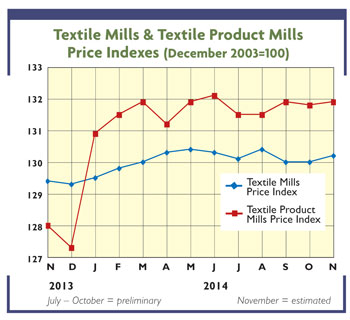
Factor in all the above, plus relatively stable selling prices, and it should come as no surprise that U.S. mills now are more than holding their own as far as earnings are concerned. Latest available after-tax profits (Q2 2014) were running close to 50 percent above a year earlier. That’s far better than the 6 percent gain noted for all U.S. manufacturers and the relatively flat pattern reported for all nondurables. And it’s basically the same story when zeroing on profit margins. Domestic mills after-tax profits per dollar of sales, for example, now are put at near 7 percent — again well above the 5 percent return noted a year earlier — with similar gains noted when profits are compared to stock holder equity. These latest margins also are a lot higher than noted just before the recent great recession. And the future could well see more overall profit improvement, with major economic consulting firm IHS now projecting additional gains for 2015, 2016 and 2017. In short, the textile and apparel industries have come a long way over the past few years — enough to ensure they’ll remain significant world-class producers through the foreseeable future.

December 16, 2014

Sponsors