Even in an election year, interest in investing and expanding the U.S. textile industry continues to make the news — and for good reasons.
Often cited is that the level of automation demands a high level of labor — engineers, technologists and operators that can handle automation. Relatively inexpensive and stable power sources are not a problem in the United States. Close sources of raw materials and good ports expedite manufacturing. Finally, being close to the customer and the market is not a bad thing.
Recent newsmakers in the first quarter include a $31.6 million invest in a new nonwovens facility in Grover, N.C. Uniquetex LLC intends to build a 150-person workforce over the next five years to manufacture nonwoven fabrics for use by medical and healthcare providers, as well as other industries. The company is a joint venture between two China-based companies (See “Nonwovens/Technical Textiles News,” TW, this issue).
Also in the nonwovens category, Fitesa Simpsonville Inc., a designer and manufacturer of nonwoven fabrics for the global hygiene market, will invest $52 million to expand its existing facility in Simpsonville, S.C., and increase production capacity. The investment is expected to create an additional 38 jobs over the next five years. The Simpsonville facility represents one of the company’s 11 plants located in eight countries worldwide.
Meridian Specialty Yarn Group Inc. (MSYG) — yarn manufacturer and producer of package-dyed and space-dyed yarns — announced a major expansion of its current manufacturing operations in Valdese, N.C. MSYG plans to construct a new 113,000-square-foot manufacturing plant at the current site. The $8 million investment will bring final production and warehouse space to 260,000 square feet.
In other news, Marriott International announced that it will supply “Made in USA” towels and bath mats in every guest bathroom in nearly 3,000 U.S. hotels. “Buying ‘Made in USA’ towels and bath mats benefits U.S. manufacturing communities such as Thomaston, Ga., and Union, S.C., where manufacturing company Standard Textile is producing them with 100 percent cotton fiber grown in the U.S.” reported the company. “Marriott’s commitment to buy ‘Made in USA’ guestroom terry products creates 150 new jobs in Standard Textile’s facilities in Thomaston and Union, as well as at the company’s Cincinnati headquarters and through its supply chain.” (See “Textile News,” TW, this issue).
In the composites category, Albany International Corp. agreed to acquire Harris Corp.’s composite aerostructures division for $210 million including the assumption of a $23 million capital lease. According to the Albany International, Harris’ division has significant positions on Lockheed’s Joint Strike Fighter (JSF), Boeing’s 787, and Sikorsky’s CH-53K, as well as other businesses (See “Nonwovens/Technical Textiles News,” TW, this issue).
These are just a few mentions — it looks like 2016 is off to a good start!
Bowling Green, Ky.-based Fruit of the Loom recently was honored with two partner awards from Walmart.
The Omni Channel Supplier of the Year award — an annual award given to the company that demonstrates the best performance in connecting the shopping experience between Walmart.com, mobile, and brick and mortar locations — was awarded to Fruit of the Loom by Walmart Apparel.
In addition, Walmart Mexico awarded the company the 2015 Supplier of the Year Award in the Apparel Supplier Category. This award recognizes Fruit of the Loom for its sales growth, analytical approach and innovation.
“It is an honor for our teams to have been recognized with these awards by one of the world’s largest retailers,” said Rick Medlin, president and CEO, Fruit of the Loom. “It’s truly a team effort, and the culmination of a lot hard work. We are proud to be a Walmart partner and look forward to building on the success of this year.”
The Board of Directors of the Arlington, Va.-based American Fiber Manufacturers Association (AFMA) voted to formally support the Trans-Pacific Partnership (TPP) at its winter meeting in Tampa, Fla.
“Inclusion in the final TPP text of the yarn-forward rule of origin so critical to U.S. fiber and yarn producers underpins our endorsement,” said William McCrary Jr., AFMA chairman. “This important trade provision is now intact in U.S. free trade agreements with over 20 countries, a consistent outcome that assures an integrity in U.S. trade policy so important to America’s manufactured fiber producers, workers, and communities.”
Québec, Canada-based Duvaltex Inc. has acquired Grand Rapids, Mich.-based True Textiles Inc. including all of its business units — True, Guilford of Maine and Teknit. The purchase makes Duvaltex the largest manufacturer of commercial or contract interior fabrics in the United States and Canada.
“This acquisition brings together two of the industry’s most established and successful companies, recognized for their dedication to innovative product design and commitment to sustainability,” said Alain Duval, president, Duvaltex. “The True Textiles brands are respected worldwide, and we are looking forward to continuing to maintain that reputation, while also exploring new opportunities for growth and diversification. We believe customers of all of the brands will see the benefits as we move forward to this exciting new chapter for both companies.”
For the 10th consecutive year, Milliken & Company, Spartanburg, S.C., has been named a World’s Most Ethical Company® by the Ethisphere Institute, a global leader in defining and advancing the standards of ethical business practices. Milliken is one of 14 companies to receive this honor every year since Ethisphere’s inception in 2007 and one of 21 privately held companies to be recognized in 2016.
Bethesda, Md.-based Marriott International has announced it will stock every guest bathroom in nearly 3,000 U.S. hotels with towels and bath mats that are made in the United States.
The company’s commitment results in a need for 2.6 million bath towels and 4.9 million hand towels annually. An agreement with Cincinnati-based Standard Textile to fill these needs will create approximately 150 jobs in Standard Textile’s Thomaston, Ga., and Union, S.C., plants, as well as at the company’s headquarters and throughout its supply chain.
“As a global company based in the USA, we’re proud to be the first hospitality company to commit to providing our guests with ‘Made in USA’ bathroom towels in our U.S. hotels,” said Arne Sorenson, president and CEO, Marriott.
“Marriott’s desire to provide guests with terry bath products made by U.S. textile artisans speaks to the heart of why Standard Textile is thriving and creating new jobs after 76 years,” said Gary Heiman, president and CEO, Standard Textile. “Our commitment to technology driven manufacturing and innovation has enabled us to expand our operations in the U.S., creating a sustainable infrastructure for Marriott’s ‘Made in USA’ products.”
Marriott has committed to stock only “Made in USA” towels and bath mats in every guest room in almost 3,000 U.S. hotels.
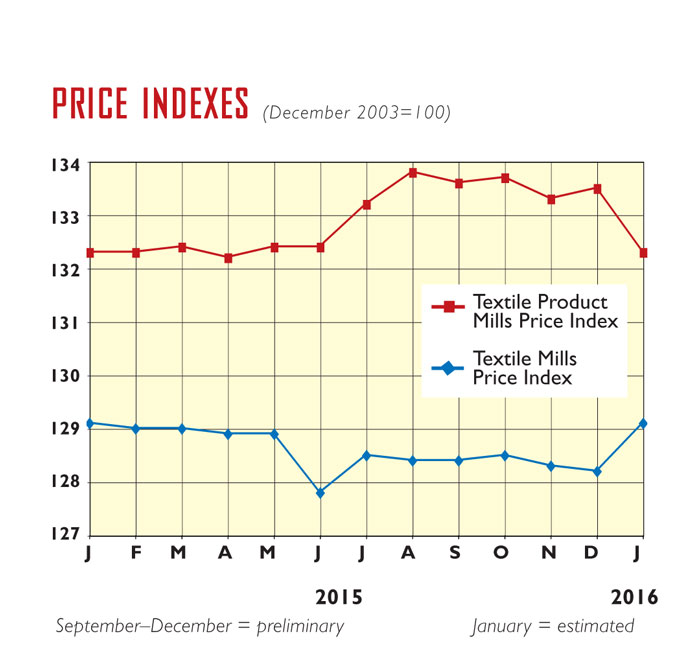
Keeping up with ever-changing textile and apparel trends is becoming increasingly difficult in today’s volatile world marketplace. To address this problem, Textile World is revising its regular monthly barometers table making it not only more comprehensive, but also easier to spot any last-minute shifts that might be occurring in key sectors of the industry.
Principle changes include the introduction of more detailed industry numbers on apparel — the key downstream market for textile mills — and profits, both in dollar and margin terms. Note, too, that more attention is being given to international trade and macroeconomic numbers that project the overall business climate. Do not hesitate to contact TW if there are any questions.
For the past several years, the negotiation of the Trans-Pacific Partnership (TPP) free-trade agreement hung over the collective head of U.S. yarn spinners like the mythological sword of Damocles. As the sword of King Dionysius hung over the head of Damocles, suspended by the single hair from the tail of a horse, the courtier became intimately acquainted with the sense of foreboding spun by such a precarious position.
And so it has been for yarn spinners, wondering if enough protection would be built into the TPP — a yarn-forward rule, chief among other items — to keep apparel-producing giant Vietnam from disrupting the U.S. market with a flood of apparel fashioned from yarn manufactured in non-TPP member country China. As one spinner noted before details of the agreement were released: “If Vietnam is allowed to enter the TPP without a yarn-forward rule, it would be devastating for the U.S. industry. It would give China almost unlimited access to the U.S. market — without China having to abide by any of the provisions of the TPP.”
Fortunately, U.S. negotiators held firm, crafting an agreement that organizations within the textile industry say allows the domestic industry to compete fairly. At its winter meeting in February, the Board of Directors of the American Fiber Manufacturers Association (AFMA) voted to formally support the TPP, the final text of which was signed by member nations on Feb. 4, 2016, in Auckland, New Zealand. “AFMA’s Board recognized the special care given to fiber producer’s analysis and advice by United States Trade Representative Michael Froman and his team across more than five years of intense and complicated multi-country negotiations,” the AFMA noted in a news release. “Inclusion in the final TPP text of the yarn-forward textile rule of origin so critical to U.S. fiber and yarn producers underpins our endorsement.”
In January, the National Council of Textile Organizations (NCTO) gave its blessings. In a news release, NCTO said: “On January 20, 2016, the [NCTO] voted to formally support the [TPP] free trade agreement. The decision to support TPP came after an exhaustive analysis determined that NCTO’s principle objectives were met as part of the finalized terms of the agreement. These objectives include:
A strong yarn-forward rule of origin for the vast majority of textile and apparel products.
Reasonable, multi-year tariff phase-outs for sensitive textile and apparel products.
Terms that provided for the stability of the Western Hemisphere textile and apparel production chain.”
Exports Versus Imports
Much has been said over the past three decades about the flood of imports and the impact on the U.S. industry. And in 2015, that deficit continued. According to figures from the U.S. Department of Commerce Office of Textiles and Apparel (OTEXA), total textile and apparel imports in 2015 totaled just over $126 billion — $50 billion of which was from China — while total textile and apparel exports amounted to just under $24 billion.
This significant deficit, however, does not apply to the yarn industry. In 2015, total yarn imports accounted for $3.8 billion, while exports were more than $4.9 billion. NAFTA nations were the largest beneficiaries of U.S. yarn exports, with product shipped to Mexico valued at $665 million, and to Canada, $420 million. China was the largest importer, at $828 million. In 2013 and 2014, the OTEXA data reveals the trade surplus for yarns was even greater: $5.1 billion in exports in 2013 versus $3.7 billion in imports; $5.2 billion in 2014 versus $3.8 billion in imports. Note: the data accounts for the value of products and does not represent volume of goods imported or exported.
Fabric exports have been relatively equivalent to imports year-to-year since 2013, the data shows. However, it is commonly known the apparel trade picture is entirely different and represents the most significant portion of lost opportunity for U.S. manufacturers in every segment of the industry. In 2015, the U.S. exported only $6.8 billion of apparel while importing nearly $88 billion. Of the import value, China accounted for $32 billion, with the next largest importer, The Association of Southeast Asian Nations — Brunei Darussalam, Cambodia, Indonesia, Laos, Malaysia, Myanmar, Philippines, Singapore, Thailand and Vietnam — accounting for almost $21 billion.
Georg Stausberg, CEO, Oerlikon Manmade Fibers, discusses developments in the industrial nonwovens sector.
TW Special Report
Germany-based Oerlikon Neumag will present its comprehensive product portfolio for manufacturing nonwovens from polyester (PET), polypropylene (PP) and other raw materials to an international audience at the upcoming IDEA show to be held in Boston, May 3-5, 2016. The company’s competencies lie in the development and implementation of engineering solutions for the production of industrial nonwovens. Textile World spoke with Georg Stausberg, CEO, Oerlikon Manmade Fibers segment, about the latest developments in this sector.
Textile World: Oerlikon Neumag focuses its spunbond technology on industrial applications. What market potential do you see for this application in the future?
Georg Stausberg: Today, almost 50 percent of all nonwovens already are produced directly from polymer chips, and this share is growing. Although the majority is used in hygiene, medical and wipe products, spunbond and meltblown products are on the rise in industrial applications, increasingly replacing classical materials such as wovens and films, but also carded nonwovens, as a result of their technical and commercial benefits. In building construction, for example, the share of spunbond products is already over 80 percent and more than 50 percent in the case of filter nonwovens, while geotextile applications are also growing in significance.
TW: PET is increasingly popular as a raw material for industrial spunbonds. What benefits does PET offer over other polymers?
Stausberg: Raw material and manufacturing costs, and the actual material properties play important roles in manufacturing nonwovens. Here, PET has clear advantages. On one hand, the global market price of PP, frequently used as the raw material to date, has been consistently higher than that of PET. On the other hand, sustainability, heat protection, energy consumption and insulation are hugely important to users in the construction industry, for instance. PET nonwovens often satisfy the corresponding requirements with the minimal use of materials and without additives. They protect against cooling, absorb only minimum moisture, can be easily used as insulating materials, are recyclable, and hence, are an alternative to plastic foams, glass wool or mineral wool.
TW: You mentioned minimal use of materials and no additives. What does that mean?
Stausberg: The strength of the nonwoven is frequently hugely important in industrial applications. They need to be extremely tear-resistant and simultaneously very extensible. These properties must be achieved with the lowest possible weight and optimized raw material usage, because the raw material costs make up around 75 to 85 percent of the manufacturing costs in the case of spunbonds. Here, benchmark comparisons with conventional products in Europe have shown that considerably higher nonwoven strengths can be achieved with comparable weights using Oerlikon Neumag’s innovative spunbond technology.
TW: Can you name concrete figures with regards to the savings?
Stausberg: Yes, we can, thanks to the process-optimized solutions of our engineers. Raw material savings of more than 5 percent are possible.
TW: What other benefits can be achieved by deploying Oerlikon Neumag technology?
Stausberg: In addition to the quality of the end product, low operating costs play an important role in the decision to invest in modern spunbond systems. We have comprehensive developments in our portfolio aimed at keeping these operating costs as low as possible. Our focus has been on reducing energy consumption, the second largest operating cost. In this way, our new generation of spunbond systems saves almost 20 percent in terms of energy requirements. This optimization can make a difference of around 30 percent compared to conventional PET spunbond processes.
TW: Thirty-percent lower energy requirements results in significant savings, does it not?
Stausberg: That’s right. Together with raw materials savings and further optimizations in our technology, the conversion costs are up to 30-percent below those of conventional spunbond systems.
TW: How has Oerlikon achieved these savings?
Stausberg: By focusing on industrial applications for our spunbond technology, we have built up comprehensive know-how covering the overall process, including the necessary in-line further processing. In collaboration with well-known companies, we have been able to considerably expand our further processing knowledge and draw conclusions for the spinning process and hence the overall process. Within this context, we have once again considerably expanded our applications research and development center in Neumünster, Germany, over the past three years.
TW: As part of the Oerlikon Manmade Fiber segment, Oerlikon Neumag is a company offering a broad range of technologies for the most diverse applications. Do these technologies profit from each other?
Stausberg: The three Oerlikon Neumag technology divisions — BCF, staple fiber and nonwovens — benefit heavily from each other. Add to this the experience from PET, PP and polyamide filament spinning systems at Oerlikon Barmag. With this knowledge and expertise, we have adapted our extensive know-how in manufacturing bicomponent staple fibers to the spunbond process, which has considerably simplified optimizing the bicomponent nonwovens process. To this end, we can today also offer our customers requirements-oriented production solutions for these applications. Furthermore, the process know-how acquired from spinning high-tenacity fibers while improving the spunbond spinning system has enabled us to offer solutions for demanding products.
TW: In addition to spunbond technology, Oerlikon also offers other nonwoven technologies. What is the situation with these products?
Stausberg: We are needless to say constantly further developing our meltblown and airlaid technologies as well. Current installations at leading manufacturers show that Oerlikon is a coveted partner when it comes to these technologies. We are very much looking forward to showing our customers our latest product developments at IDEA.
Atlanta and the Georgia World Congress Center will host a textile industry trifecta of events in May.
TW Special Report
It’s back to the east coast for Techtextil North America in 2016. The show, along with Texprocess Americas 2016 and JEC Americas 2016, will again collocate in Atlanta’s Georgia World Congress Center (GWCC) for a three-day event that offers something for just about everyone involved in the textile industry. The technical textiles and nonwovens sectors, traditional textile sector, sewn products sector and composites value chain all will be represented May 3-5, 2016, at this trifecta of events.
The 2014 three-in-one event hosted 759 exhibitors from 29 countries and attracted more than 9,000 visitors.
“We’re excited to once again offer the North American textile industry a vast product offering through the co-location of Techtextil North America, Texprocess Americas and JEC Americas as the platform that will blend together the technical textile, sewn products and composites value chain with a goal of enhancing the visitor experience,” said Dennis Smith, president, Atlanta-based Messe Frankfurt Inc.
In 2016, Techtextil North America moves back to the east coast for the collocated event with Texprocess Americas and JEC Americas.
Techtextil North America
Techtextil North America is produced by Messe Frankfurt Inc. The 13th edition of the show will assemble all vertical aspects of the technical textile and nonwovens industries including research and development, raw materials, production processes, conversion, further treatment, and recycling.
Visitors will see a wide variety of product groups at Techtextil representing the entire value-added chain in the technical textiles and nonwovens sectors including fibers; yarns; woven fabrics; laid webs; braiding; knitted fabrics; nonwovens; coated textiles; canvas products; composites; adhesives and bonding; research; development; planning; consultation; technology; machinery; and accessories.
Techtextil North America exhibits are classified according to 12 application areas: Agrotech; Buildtech; Clothtech; Geotech; Hometech; Indutech; Medtech; Mobiltech; Oekotech; Packtech; Protech; and Sporttech.
As in past years, the show floor also will feature country pavilions to gather exhibitors from the same country including Italy, Germany, China, Taiwan, Belgium, and France.
Texprocess Americas
Texprocess Americas is coproduced by Messe Frankfurt and the Sewn Products Equipment & Suppliers of the Americas (SPESA), Raleigh, N.C.
Now in its third edition in the United States, the show is promoted as the largest North American trade show displaying equipment and technology for the development, sourcing and production of sewn products.
Product groups and services covered include: computer software and information technology; contract manufacturing and sourcing; cutting, spreading and ancillary equipment; digital, screen, transfer printing and ancillary equipment; embroidery, monogramming and ancillary equipment; laundry, finishing and ancillary equipment; pressing, fusing, vacuum and ancillary equipment; product identification, labeling and ancillary equipment; sewing and ancillary equipment; other supplies and equipment; fabrics and materials; findings, trimmings, components and accessories; manufacturers;recycling and sustainability; services, associations, publications and academia; supplies; supply chain services; and warehousing, distribution and materials handling.
Texprocess Americas will feature country pavilions from Germany, China and Taiwan; a Cool Zone highlighting the latest technologies, products and processes in the sewn products industry; and a Supply Chain USA Pavilion sponsored by SEAMS, the National Association for the Sewn Products Industry.
Symposiums
Messe Frankfurt also offers visitors to Techtextil and Texprocess an educational opportunity through its Techtextil North America Symposium and Texprocess Americas Symposium, which are held concurrently with the trade show. The symposiums addresses market developments, technological information, new technical processes and products, as well as international industry trends.
An advisory council comprised of Dr. Behnam Pourdeyhimi, The Nonwovens Institute; Mike Clements, Huesker Inc.; Sam Buff, Textile Technology Center at Gaston College; Dr. Anselm C. Griffin, Georgia Institute of Technology; Bipin Kumar, UC Davis; and Marc Shellshear, Gale Pacific Inc., were selected to develop and facilitate the 10 Techtextil presentation sessions featuring more than 40 speakers over the three days.
Topics include tension structures, textile testing, nonwovens, new fiber technologies, smart textiles, auxetic and protective textiles, geotextiles, fabric welding, and sustainability.
The Texprocess advisory council includes Yoram Burg, Optitex USA; Will Duncan, [TC]2; Dave Gardner, SPESA and Gardner Group Inc.; Ram Sareen, Tukatech; Larry Stone, Weissman; and Dr. Pat Trautman, Global Garment Engineering.
Topics to be covered at the Texprocess Americas symposium include automation and robotics, technology in apparel, wearables, reshoring, 3-D technology, and sewing room technology.
Visitors who purchase a one-, two- or three-day symposium pass also gain access to two free bonus symposium sessions, as well as the show floor.
In addition, attendees have the opportunity to engage with graduate students who will present their technical textiles, nonwovens and sewn products research projects through a poster program and also live presentations.
“We continue to experience extremely positive feedback from the industries we serve,” said Kristy Meade, show director, Messe Frankfurt North America. “You will see this from the increased size of the exhibit hall to the experts presenting during the symposiums.”
SPESA’S VIP Event
The evening of May 3, the College Football Hall of Fame adjacent to the GWCC will play host to the SPESA 2016 Tailgate Party. This dinner and networking event with a denim jeans dress code, gives attendees the chance to develop and maintain business relationships and create new partnerships. Tickets may be purchased in advance, and the event supports the American Apparel & Footwear Association Education Foundation.
JEC Americas
The JEC Americas Composites Show & Conferences will collocate with Techtextil and Texprocess for the second time at the GWCC in Atlanta. The event is organized by France-based JEC Group whose mission over the past 58 years has been to exclusively serve the complete value chain of composites producers and end-users.
Show organizers report Atlanta is a perfect strategic location because JEC Americas is the only major composites event to be held on the east coast in 2016. The Atlanta show will focus on innovations in composites manufacturing related to the automotive and aerospace industries. According to JEC Group, there are more than 300 facilities in the state of Georgia that are dedicated to aerospace parts and products manufacturing and air transportation activities. In addition, Georgia gathers most of the key automotive original equipment manufacturers within in a 500 miles radius. The Southeast is now the fastest growing auto corridor.
The show badge also gets JEC attendees free access to the conference, which features five sessions and more than 20 speakers in two rooms over the three-day show. The main topics to be covered at the JEC conference include thermoset resins and glass fiber industry challenges, aeronautics, carbon fiber in the automotive industry, and 3-D printing.
JEC Americas also includes the Innovation Awards, which recognize new products, processes and applications in the composites industry. Live demonstrations and an Innovation Corner will showcase innovative industry capabilities; and a free technical poster session gives students, researchers and companies the opportunity to display a poster on any composites-related subject.
JEC Americas offers some exclusive programs including leadership circles, a VIP Lounge and Press Club, a private exhibitor reception for business and networking opportunities as well as a composites plant tour of selected industry leaders in the Atlanta area.
Show hours for the collocated events are from 10 a.m. until 5 p.m. May 3 and 4, and from 10 a.m. until 3 p.m. on May 5. Visitors need only register for one of the three shows to have access to all three show floors at the GWCC.
“The synergy we have created through the collocation of our events, has positioned this year’s event to be the strongest B2B platform for the technical textiles, sewn products and composites industries in the Western Hemisphere,” Meade said.
To learn more about Techtextil North America, Texprocess Americas and JEC Americas and to register, visit techtexilna.com, texprocessamericas.com and jeccomposites.com/events/jec-americas-2016-atlanta.

 By James M. Borneman