LE Textile Develops The First Stretch Warp-Knitted Textile From Tencel® Yarn

OBERTSHAUSEN, Germany — June 17, 2016 — With its special collection based on Tencel® lyocell fiber, LE Textile GmbH is offering a soft, supple handle, the typical look of a natural-fiber product, and outstanding comfort. These soft fabrics also offer advantages for the environment. LE Textile has focused on the environmental aspects in its use of materials and production processes.

A pioneer in the production of warp knits labeled “sustainable”

LE Textile has been known for some time on the market under its old name of Elastic Textile Europe. This company, which is based in Neukirchen, produces stretch fabrics and lace for lingerie, swimwear and sportswear. Products produced by LE Textile are also used in the medical sector and industry such as in the automotive sector. This warp knitting specialist has many years of experience and a history of dynamic development — strengths that it has brought to its association with the Lauma Fabrics Group. Since 2013, the company has belonged to this Latvian-based manufacturer, and is now known as LE Textile. The Lauma Fabrics Group fully supports the ecological ethos of its German subsidiary.

In 2006, Elastic Textile Europa, as it was then known, developed a stretch knitted fabric from eco-cotton and the elastomer, Dorlastan® Type V550, which was awarded the Cradle to Cradle® Certificate of the EPEA Internationale Umweltforschung GmbH (Environmental Protection Encouragement Agency). Triumph was involved in the subsequent processing stages. This making-up company produced the first, and so far, the only recyclable bra, which attracted the interest of the public at the Nutec trade fair in November 2008 in Frankfurt, when a film was also shown: “cradle to cradle. Nie mehr Müll – Leben ohne Abfall” (Cradle to Cradle. No More Rubbish – Life Without Waste).

2014 saw the next phase of the development, when Lenzing’s Tencel fibres were used instead of eco-cotton. The first prototype was premiered at Interfilière in Paris in July 2014, and other production-ready products were shown at the next Interfilière in January 2015. Many conversations were held at these fairs concerning the collections made from Tencel. “We were showing something completely new with these fabrics, which stimulated the interest of the visitors we met,” explained Harald Mai, the Director of Development at LE  Textile. This experienced warp knitting specialist gathered many new ideas from these conversations, which he incorporated into the further development of the Tencel collection. The results of his work are clear to see. The fabrics made from Tencel were being shown in the Show Room at the recent Fabric Start exhibition in Munich in February of this year. They were one of the reasons why many of the visitors, who were particularly interested in their environmentally friendly features, paid a visit to Lauma’s stand.

A full range of lingerie and apparel textiles

Lace raschel machines and high-speed raschel machines in the RSE series are used to produce the extremely comfortable, environmentally friendly fabrics made from Tencel fibers. Top-quality spun yarns having first-rate mechanical properties are used. These ensure that fiber fly does not cause any problems during processing.

The previously used Dorlastan Type V550 elastomer, was used to provide elasticity in the sustainably produced warp-knitted textiles. This product from Asahi Kasei was granted the Environmental Compatibility Certificate by the Hohenstein Laboratories in November 2013. A special line in the collection also contains polyamide to ensure that the fabrics can mould to the body.

The next opportunity to see and sample these innovative fabrics will be at the next Interfilière fair from 9 to 11 July in Lyon, stand number 5L41 in the FABRICS section.

Posted June 17, 2016

Source: KARL MAYER Textilmaschinenfabrik GmbH
EFI Acquires Optitex To Extend Its Leadership In The Digital Transformation Of The Textile Industry

FREMONT, Calif. — June 16, 2016 — Electronics For Imaging Inc. (EFI) has acquired Optitex — an emerging, fast growing global leader in integrated 3-D design software that enables the textile industry’s digital transformation and accelerates the adoption of fast fashion. Privately held Optitex will be integrated into EFI’s Productivity Software business unit.

Optitex’s 3-D technology and best practices enable the textile industry’s leading retailers, brands and manufacturers to transform how they do business, gaining benefits of significantly improved time to market, cost and efficiency gains, as well as enabling new capabilities for their design, sales and marketing activities.

“We are thrilled to add the Optitex team and it’s fast growing base of industry leading customers to the EFI family,” said Gabriel Matsliach, senior vice president and general manager, EFI Productivity Software. “Optitex technology, combined with EFI Reggiani digital printers will expand our textile ecosystem and help our customers set new standards for time-to-market, on-demand manufacturing, cost efficiency and automation in the Textile industry”

Well known for its superior customer service and consulting capability, Optitex develops strong partnerships with its customers, serving as their trusted advisor for their digital transformation.

“We are very excited to join the EFI family,” said Asaf Landau, CEO of Optitex. “EFI’s global presence, holistic solution approach, strong professional services abilities, and growing portfolio of innovative textile industry-specific products, will be of great benefit to the leading companies we serve worldwide in the fashion, automotive, aerospace and technical textiles industries. I am truly enthusiastic about what is to come for these industries in the years ahead.”

Optitex’s 3D digital apparel simulation, combined with its 2D pattern making software, provides a robust solution that accelerates the fashion industry’s high volume product development. Additionally, these technologies deliver scalable and transformational benefits throughout the organization, digitally optimizing the global supply chain, merchandising and wholesaling. Leading retailers, brands, and manufacturers can now:

  • Iterate designs in minutes, instead of waiting weeks for a new prototype;
  • See and validate entire collections 3 weeks after design, instead of waiting 4 to 6 months;
  • Reduce sampling by more than 50%, reducing product development costs;
  • Significantly shrink overall cycle times, and consequently, time to market;
  • Present and market collections’ sales samples 4 months earlier than previously possible;

Replace photography with on-demand photorealistic digital images for eCommerce, catalogs, and packaging at a fraction of the time and cost.

Landau and the Optitex team have joined EFI, with Landau serving as EFI Optitex’s general manager. Optitex has offices in the U.S., Italy, India, Hong Kong and Israel.

Posted June 17, 2016

Source: Electronics For Imaging, Inc.

Alvanon’s Ed Gribbin Cites Disruption, Risk-Taking As Keys To Advancing Fashion Development, Fit And Speed To Market 

NEW YORK CITY — June 17, 2016 — Alvanon president and global fashion business authority Ed Gribbin expressed concern over the industry’s slow reaction to the technology demands of “today’s empowered consumers” at the company’s Technology Trends Event seminar, held June 8 at NYC’s Hotel Eventi.

The seminar, attended by managers of leading brands, such as Lord & Taylor, JC Penny, Calvin Klein and Under Armour, also featured panel guests from retail specialist EDITED, information without programming supplier BeProduct and data provider Fit Analytics. Together, the panel addressed a variety of hot button fashion business issues ranging from “how to stock winners and price perfectly” to “converting more online shoppers” and “growth strategies for new markets.”

In his keynote speech, Alvanon’s Gribbin stressed the need for breaking away from outdated processes and putting technology to work in ways that enhance product development, improve fit and accelerate speed to market.

“If you think about the product development processes that we employ today, they are very similar to the practices we’ve known for the past 50 or 60 years,” Gribbin said. “We tend to think that fashion is all about change, and yet we are one of the most change resistant industries in the world.”

Gribbin’s talk went on to address the entire product development cycle, from planning and designing to producing the product itself, and then marketing and educating customers about the product so that they can make the right decision about the color, size, fit and style that best flatter them.

“Consumers are far more empowered today than even two years ago,” he noted. “The retailer once owned us, the consumer. If you wanted a piece of apparel, you had to go to a store when that store was open, look at the selection of merchandise that some merchant decided you would want to buy and, if you found something you liked, hopefully they had it in your size.

“Technology has turned that around. Today, the consumer is the center of everything. Many of our business models are broken and some beyond repair.”

Gribbin added that there are “disrupters” today who are finding different and better ways to serve the customer, and that these new ways “have everybody shaking.”

“By June of next year, Amazon will surpass Macy’s as the largest seller of clothing in the U.S.,” he said. “In 2010, they sold virtually zero clothing. So nontraditional retailers are coming in and taking market share. There’s a 57% decline in retail traffic over the past five years.”

Gribbin cited risk taking, cultivating technology-savvy talent and innovation as essential dynamics necessary to prosper in today’s rapidly changing and increasingly tech-driven fashion marketplace.

“Innovation and omni-channel engagement were key themes at this year’s World Retail Congress,” he said. “Yet less than 30% of retailers today are equipped to bring a full omni-channel experience to their customers. Too often, they don’t have RFID, they can’t track inventory, their logistics are not up to speed, and customers are getting frustrated.

“Ideas are the currency of the future of the fashion business,” he continued. “But we squash ideas. We shy away from taking risks. We are inhospitable to innovation. The disrupters are not afraid to take risks. They have a bias for action. We need to educate our people and seek out the right talent to use the technology out there or we will not be able to engage our customers on a regular basis.”

Gribbin noted that in recent years, fashion industry priorities have included cyber security and sustainability, and that speed to market currently occupies the top rung of industry leaders’ priority lists.

“Speed to market is a huge theme, but at the end of the day, they all have to do with growth and they all involve a certain amount of risk,” he says.

“If you are looking for places to grow, you can’t wait until you have all your ducks in a row before trying a new strategy. When you have a couple of facets in place, and you have the will, then test it. Experiment. Failure is okay. You can’t disrupt if you don’t fail.”

Posted June 17, 2016

Source: Alvanon

ANSI’s Fran Schrotter Honored With ASTM International 2016 Cavanaugh Award

WEST CONSHOHOCKEN, Pa. — June 16, 2016 — Fran Schrotter, senior vice president and COO, American National Standards Institute (ANSI) in New York City has received the prestigious ASTM International 2016 William T. Cavanaugh Memorial Award.

The Cavanaugh Memorial Award honors W.T. Cavanaugh, CEO of ASTM from 1970 to 1985, who established ASTM as the world leader in developing and disseminating voluntary consensus standards.

Schrotter is honored for her sustained leadership in the U.S. and global standards community, exemplifying a commitment to consensus, collaboration, and professionalism.

“Nearly everyone in the global standards community has been positively affected by Fran’s contributions,” saidASTM president James Thomas. “Clearly her work has supported standards that have improved the lives of millions of people in both the U.S. and around the world. She truly embodies the spirit of the Cavanaugh Award.”

Schrotter has been with ANSI since 1976, working with a variety of domestic and international committees and organizations that develop standards in dozens of industries, including information technology, homeland defense and security, nuclear energy, nanotechnology, and many more. As senior vice president, she is primarily responsible for ANSI’s activities supporting U.S. participation in domestic and international standardization activities.

In addition, she has held numerous leadership roles in other organizations. For example, she was a member of the U.S. Department of Justice National Commission on Forensic Science, and she was appointed to the U.S. National Institute of Standards and Technology Organization of Scientific Area Committees Quality InfrastructureCommittee on Forensic Sciences.

With the Cavanaugh award, Schrotter is named as an honorary member of ASTM.

Posted June 16, 2016

Source: ASTM

INDA’s World Of Wipes® 2016 Conference Delivers Strong WOW Factor

CARY, N.C. — June 15, 2016 — INDA, the Association of the Nonwoven Fabrics Industry, recently wrapped up its 10th annual World of Wipes® (WOW) International Conference held June 7-10 with attendees and board members giving the program content, speaker presentations, and networking high praise.

This year’s conference held at the Sheraton Grand Hotel in Chicago attracted more than 400 registrants to discuss business in wipes, and receive information from over 25 valuable presentations, and interact during receptions, breaks, and organized dinners. Coming on the heels of IDEA16, the world’s preeminent event for nonwovens and engineered fabrics, the turnout demonstrated the strength of the nonwovens wipe sector.

“The attendance surpassed all prior WOW Conferences held during an IDEA year, which was just five weeks earlier,” said INDA President Dave Rousse.  “The strong growth and innovation in the wipes industry continues with no signs of abatement.  We’re seeing wipes with extreme creativity in usage and design, as well as elegant inline converting with multifunctional packaging and enhanced performance.”

Attendees reported that they valued the new connections they made with participants who were unique in their interest of wipes.  WOW is the only conference dedicated entirely to wipes.

According to INDA, WOW participants were engaged and attentive, gaining valuable insights in the global wipes business spanning all facets of the value chain, including flushability, manufacturing, packaging, standards, consumer awareness, equipment, and market trends.

Kicking off with an indoor and outdoor welcome reception sponsored by Kimberly-Clark Professional, featuring seafood and pasta stations along with a string quintet playing popular rock songs, the atmosphere throughout WOW encouraged face-to-face interactions.

Participants connected directly with hundreds of wipes professionals during receptions, tabletop displays, networking breaks, and optional opportunities for a Speed Networking luncheon and Dinner with an Industry Thought Leader, which participants said presented an “amazing opportunity for networking.”

Preceding the conference, INDA’s Wipes Academy was presented by Rob Johnson, PE, Principal, Smith, Johnson & Associates. The Academy is the first and only comprehensive wipes training for the entire wipes supply chain.

Tec Laboratories’ Tecnu Bites & Stings Medicated Itch and Pain Relief Wipes was the recipient of this year’s World of Wipes Innovation Award®.  The annual award recognizes the product that most expands the use of nonwovens and demonstrates creativity, novelty, uniqueness, and technical sophistication within the entire nonwoven wipes value chain. Other finalists were: Kleenex Facial Cleansing Wipes from Kimberly-Clark Corporation and Keyser Cleaning Wipes from Kyser Musical Products.

Speaker highlights of WOW16 included:

  • Walmart’s U.S. Manufacturing Initiative – Joe Quinn, Senior Director, Public Affairs and Government Relations of Walmart Stores gave the keynote address to a standing-room only audience.  His compelling presentation focused on how the world’s largest retailer is supporting U.S. manufacturing by working with companies to manufacture onshore, boost sales of U.S.-made products, and source locally for materials and products.
  • Flushability Opportunities and Challenges – INDA’s Rousse provided an update on the progress being made through collaboration, and perspectives on the threats to its flushable wipes sector, including lawsuits, legislative and regulatory activity, and global standards development, with a more optimistic view of potential end-points to the major issues.
  • A “Fireside Chat” on Navigating the Regulatory Minefield with five experts in the area, from microbiologist to EPA Team Leader.
  • Packaging Insights and Ideas – Presentations that were particularly timely and relevant included: Scott Hetherton of HFM Packaging, Ltd. on label bonds for peel and reseal packaging; Martin Johnson of Nypro on connecting to the Internet for reordering; and Stacy Fields, DOW Packaging and Specialty Plastics, on recyclable flexible packaging for wipes.

INDA announced WOW 2017 will be held June 12-15, at the Gaylord Opryland Resort in Nashville, Tenn.

Posted June 15, 2016

Source: INDA

Nester Hosiery Names Kelly Nester CEO

MOUNT AIRY, N.C. — June 15, 2016 — Nester Hosiery has announced that company President Kelly Nester has been promoted to the position of CEO, effective immediately. The current CEO and company founder Marty Nester will continue to chair the company’s Board of Directors.

“We have been moving toward this change for some time and I am confident that under his leadership Nester Hosiery will continue to grow and thrive,” said Marty Nester.

Nester Hosiery was founded in 1993 and employs more than 200 people in its Mount Airy, NC facilities, where it produces socks for many of the world’s leading outdoor, performance, and lifestyle brands.

In 2013 Nester Hosiery launched its own brand, Farm to Feet™ whose guiding principle is a 100% American transparent supply chain. The brand is sold at better outdoor retailers across the county and through its website, www.farmtofeet.com.
“Marty has created a strong foundation for us by instilling a company culture committed to tireless product innovation and development of the best manufacturing processes,” said Kelly Nester. “I am fortunate and excited to carry this forward.”

Kelly Nester joined the company in 1996 and has been president since 2008.

Posted June 15, 2016

Source: Nester Hosiery

Research Refutes Misconceptions About Down And Feather Products

BREGENZ, Austria — June 7, 2016 — Newly published research on the global down and feather industry reports that the down and feather used in bedding, apparel and outdoor gear comes from ducks and geese raised for human consumption and that the material is simply a byproduct of the enormous global food industry.

The Sustainable and Humane Practices of the Down and Feather Industry, commissioned by the International Down and Feather Bureau (IDFB), notes that from 2009-2013 alone, approximately 2.7 billion ducks and 653 million geese were raised for consumption globally, resulting in an estimated 410 million pounds (186 million kilograms) of excess down and feathers each year. These materials, the document says, would otherwise serve only as a waste product—however, after the production of duck and geese meat, feather and down is cleaned and sanitized and then traded for use in products like pillows, comforters, duvets, mattress toppers, winter jackets and outdoor sports gear, instead of contributing to worldwide landfill issues.

“Down and feather products are highly sustainable, making them superior to synthetic materials since they have a lower carbon footprint. However, when materials derived from animals are used in manufactured goods, it’s common for the source of these materials to come into question,” said Stephen Palmer, president of IDFB. “The down and feather industry is highly regulated, contrary to many misrepresentations that have been made. Any deleterious methods of down and feather procurement are neither supported nor condoned.”

In fact, the document also notes that, in visiting more than 2,000 geese and duck farms across the world and conducting approximately 400 traceability audits since 2008, the International Down and Feather Testing Laboratory (IDFL) has found deleterious procurement to be so rare that it represents less than one percent of the industry.
The paper further addresses:

  • Global regions and countries from which the majority of down and feather is gathered;
  • Methods by which down and feather is procured;
  • Legal and regulatory bodies that govern these regions regarding down and feather procurement;
  • The sustainability of down and feather products in relation to polyester substitutes.

Posted June 15, 2016

Source: International Down and Feather Bureau (IDFB)

HanesBrands Announces Executive Leadership Succession Plan

WINSTON-SALEM, N.C. — June 13, 2016 — HanesBrands, a leading global basic apparel marketer, today announced that its Board of Directors has approved a leadership succession plan, with Chairman and Chief Executive Officer Richard A. Noll narrowing his role to executive chairman and Chief Operating Officer Gerald W. Evans Jr. assuming the role of chief executive officer, both effective Oct. 1, 2016.

Evans, 57, has been appointed to the company’s Board of Directors, effective immediately. With his appointment, the Hanes board has been expanded to 11 members.

Noll and Evans each have held leadership positions at Hanes spanning more than 30 years and have guided the company to become the world’s largest basic apparel company in the nearly 10 years since its 2006 spinoff into an independent publicly traded company.

“The past decade has been a phenomenal journey, and I am very proud of the amazing accomplishments of our 65,000 employees,” Noll, 58, said. “This is the perfect time to transition our leadership. Our business is healthy, our acquisitions are performing well, and we have a very bright future. I have full confidence in Gerald’s readiness, ability, and vision to drive the business to even greater heights as CEO.”

The executive transition is expected to be seamless as a result of the Board’s continuous leadership succession planning for the company’s senior ranks.

“Each board member has the utmost respect for Rich Noll and Gerald Evans as accomplished leaders of this company,” said the Board’s Lead Director Ronald L. Nelson. “Under Rich’s leadership, the company has increased its annual sales from $4 billion to $6 billion, grown EPS at a compounded rate of 20 percent per year, and quintupled shareholder value from $2 billion to $10 billion. We are grateful for Rich’s decade of leadership and success, and we are thrilled to have such a capable leader as Gerald to build the business even further.”

Evans, who joined the company in 1983, has a long track record of leadership success in marketing, sales and supply chain. As chief operating officer since 2013, he has had responsibility for the day-to-day running of the $6 billion company with direct oversight of all global commercial businesses and supply-chain operations.

Under his leadership, Hanes has strengthened its world-class brands through the company’s Innovate-to-Elevate initiative, created a low-cost global supply chain that spans the Western Hemisphere and Asia, and has overseen acquisition integrations, including Gear for Sports, Maidenform, Knights Apparel and Hanes Innerwear Europe.

“I am honored to become CEO and look forward to driving the organization to the next level of success,” Evans said. “Our brands are primed for growth, our acquisitions are adding significant value and scale, and our product development and innovation pipeline are stronger than ever. Along with our worldwide employees, I am committed to maximizing the value we can create as the very best basics apparel company in the world.”

Posted June 14, 2016

Source: HanesBrands

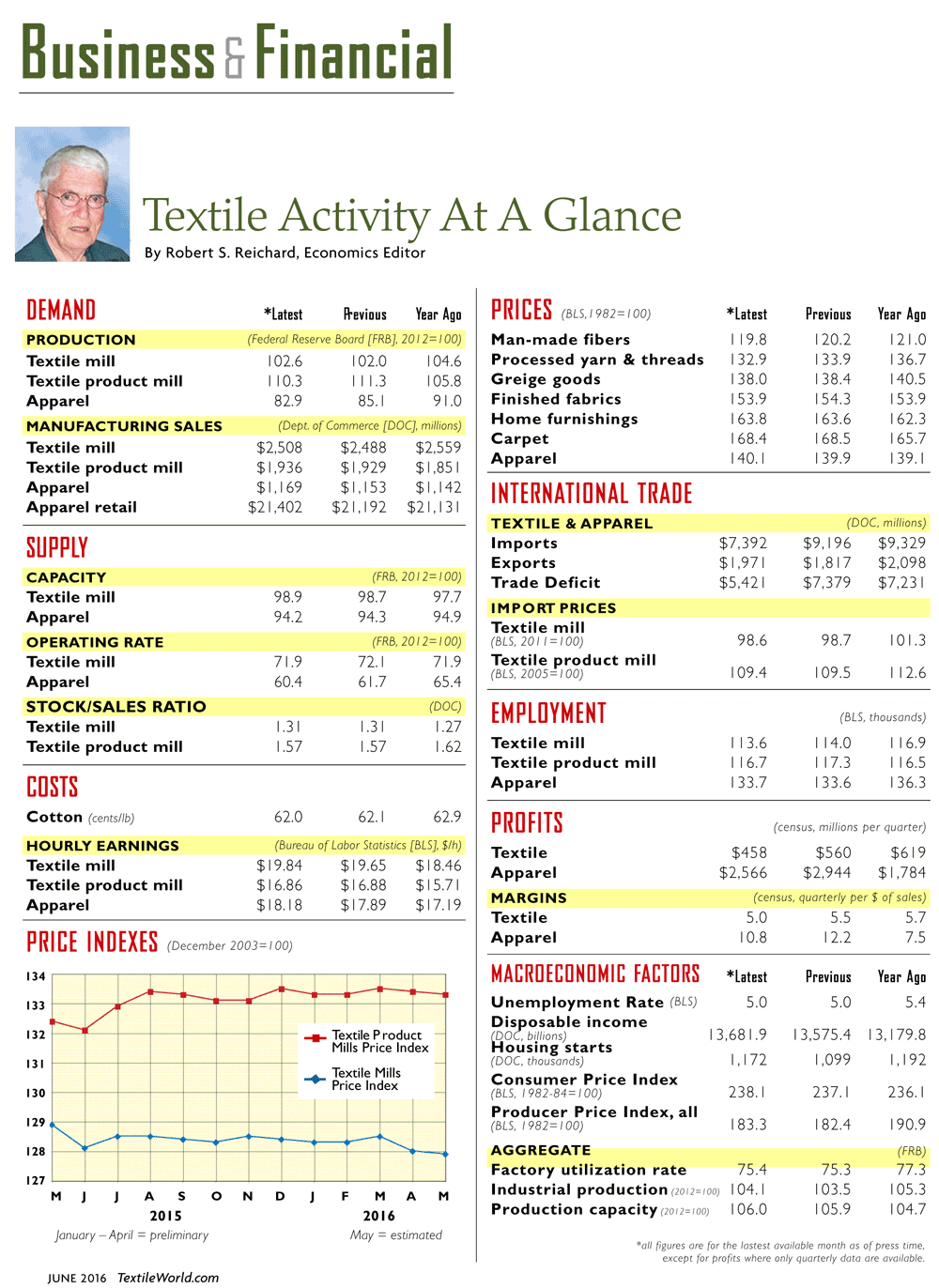
June 2016: Textile Activity At A Glance

BFJune16online

June 2016

Mixed Bag For Spinners

Jim-Phillips-colorBy Jim Phillips, Yarn Market Editor

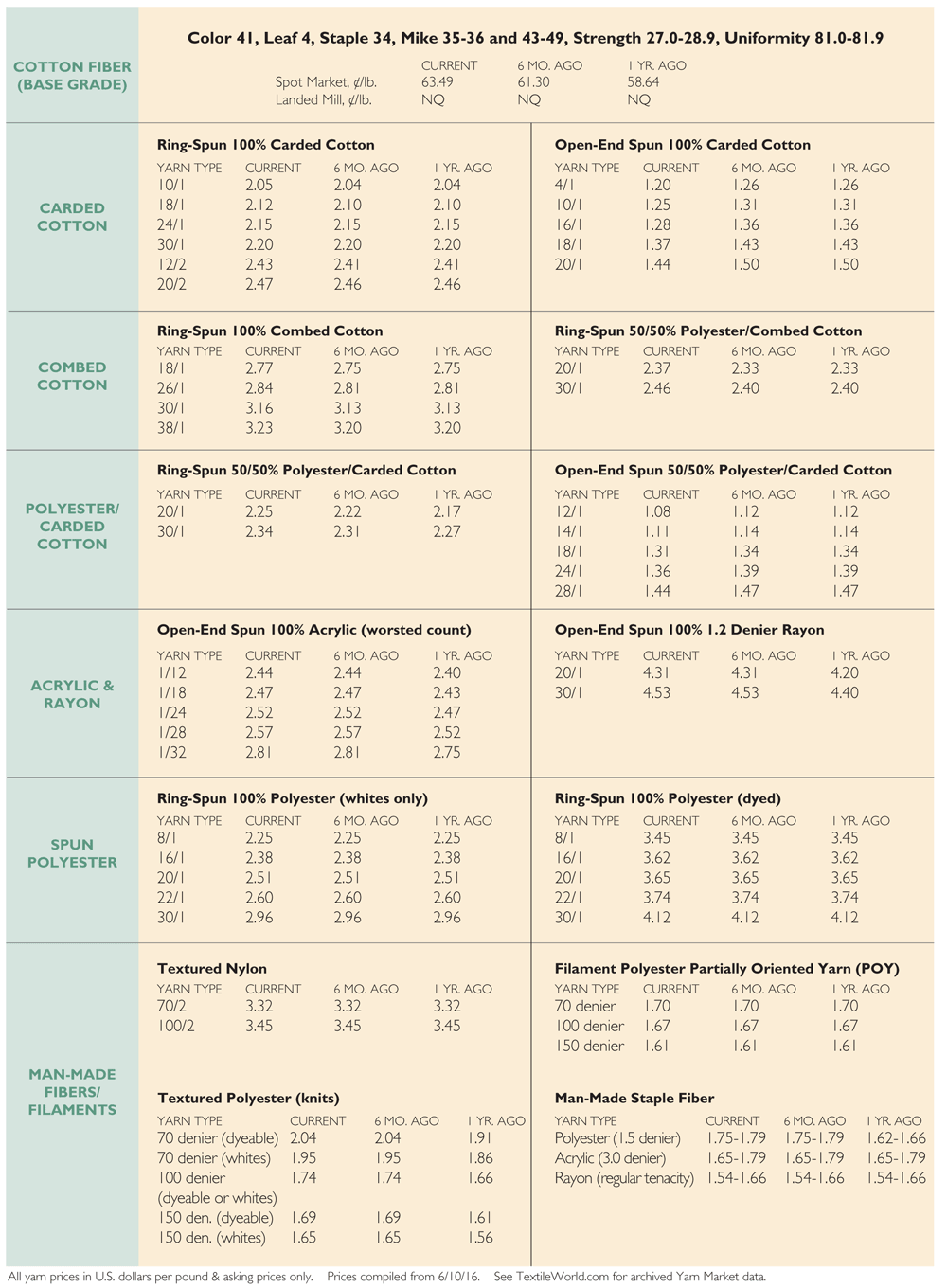
Demand for specialty yarns continue to be brisk mid-year, as spinners report a steady stream of orders. However, the commodities business continues mired in the unexpected slump that began earlier this year.

And even for those that have noticed no appreciable decline in volume, orders are smaller than usual and the pipeline is shorter than they would prefer.

“Business for us is stronger than what commodity yarn sellers are experiencing,” said one broker who focuses on specialty yarns. “In fact, my business this year is ahead of where it was this time last year. But I can’t move the commodity yarns that I have acquired.”

Added another spinner: “What we have are relatively small volume orders. We keep hearing that a lot of program business is coming back to the hemisphere, but we haven’t seen it to any big degree. In fact, I keep hearing where inquiries are made and then, for whatever reason, they just fizzle out.”

Another specialty spinner said: “Everyone wants something different, something unique. We have a lot of very small orders. It seems we spend more time changing out than running.”

For the most part, with the exception of specialty yarns, spinners are disappointed with where they are at this point in the year. “We did not expect to experience an extended slowdown in orders,” said a southeastern spinner. “All indications were that the volume of business we had experienced over the past couple of years would continue. However, no one is panicking. While business is down, it is certainly not dreadful, and we are optimistic that it will not get to that point.”

Spinners and industry insiders point to a number of factors for current business conditions. “First, I believe, there was an inventory correction, especially with ring-spun yarns,” said one spinner. “Positions have been hard to come by for several years as ring-spun demand outstripped capacity. I believe a lot of companies over-ordered, some by a significant degree. They focused on depleting their inventory before initiating further orders.”

Another spinner said: “We have always experienced a slowdown around July 4. That is when back-to-school orders have been delivered and holiday orders have not yet been placed. It seems, over the past few years, that the July 4 slowdown has been moved back to early June and even late May.”

Despite recent downturns, spinners are, overall, optimistic about their future, and growth is still on the minds of many. However, the means to grow are not readily apparent to all. “I know a lot of people were surprised by recent announcements that job growth in the United States was less than expected. While that might surprise some government analysts and economists, it does not surprise hiring managers. It’s not that jobs aren’t available; it is that people don’t want them. It is my experience that nearly everyone today who wants a job has one. I know, particularly of one company that would love to start a third shift, but was unsure it could find enough people to staff it.”

And, finally, there is the election. “Election years are always fraught with uncertainty,” said one industry expert. “And that is more true than ever this year, as many people feel the choice they will have to make is between the lesser of two evils. No one is really sure what the country is going to look like in January 2017. As a result, they sit on their hands and their money and just wait and see.”

Cotton Prices Rise To 10-Month High

As of the week ended June 9, spot-market cotton prices for the base quality of cotton (color 41, leaf 4, staple 34, mike 35-36 and 43-49, strength 27.0-28.9, uniformity 81.0-81.9) in the seven designated markets measured by the USDA averaged 63.49 cents per pound, up 169 points from the previous week and the highest weekly average since August 20, 2015, when the average was 64.11 cents. The weekly average was up from 61.80 cents the previous week, and 62.55 cents reported the corresponding period a year ago. Daily average quotations ranged from a low of 62.12 cents Friday, June 3 to a high of 64.07 cents Tuesday, June 7. The ICE July settlement prices ended the week at 64.96 cents, compared to 62.87 cents the previous week.

YMJune16chart

June 2016

Sponsors