COLUMBUS, Ga. — November 28, 2017 — Due to sagging demand and low selling prices, DNA Textile Group will be exiting the denim business by the end of January 2018.
We regret having to make the decision to cease denim operations and are profoundly grateful to our denim team members who have invested their incredible talents and loyalty to DNA over these past 15 years. It is because of their outstanding efforts, willingness to change, and most importantly their commitment to innovation that our denim business carried on much further and longer than conventional wisdom called for, and for that I will always be grateful.
DNA Textile Group will be pivoting quickly and focusing on our five year old Technical Fabrics and Custom Finishing Divisions which have been steadily growing and have a bright future. Despite our smaller footprint going forward, we will continue to invest more resources, talent and energy towards growing these businesses. We have professional teams and terrific manufacturing capabilities in place and we’re excited about our significant growth potential.
DNA will honor all existing and open denim orders as of November 28, 2017. We would like to thank the denim industry for their business over the years and wish each of our denim partners the very best. DNA Denim suppliers will be paid in full and the company will continue on as DNA Technical Fabrics. DNA will continue producing FR Denim and other specialty performance denims within our Technical Fabric Division.
The company will be working closely with state and local agencies to assist those affected in finding new employment. Layoffs in the Denim Division will conclude by the end of January 2018.
Sad news comes to the U.S. textile industry as a piece of textile history comes to a close. As announced by parent company International Textile Group (ITG) (see “Textile World News,” this issue), Cone Denim will shutter the famous White Oak Plant in Greensboro, N.C., after a 112 year run.
When Cone celebrated its 125-year anniversary in 2016, the company stated: “The history of Cone Denim dates back 125 years when two brothers, Moses and Ceasar Cone, born to Bavarian immigrants, first set into motion their vision of a marketing-based textile company.
“The Cones purchased more than 2,000 acres in Greensboro and built the first plant, Proximity, named for its close ‘proximity’ to the cotton fields which supplied its denims. The Revolution mill was built in 1899 expanding the company’s offerings with new flannel styles.
“At the turn of the century the brothers embarked on what would become the largest denim plant in the world, and White Oak began operations in April 1905.”
Today, Cone is a global denim producer with plants in Mexico and China. But the White Oak Plant was unique — producing heritage selvage denim on 1940s-era American Draper X3 shuttle looms.
When people think of White Oak Denim, feelings of history, legacy, vintage Levis® and authenticity are evoked. Unfortunately, it appears that today’s demand for White Oak Denim didn’t call for the volume necessary to support the 200-person operation.
One industry observer praised the job Cone did creating and celebrating the White Oak heritage with the White Oak brand, but noted the denim business is an uphill battle on a global scale.
In addition, appreciation for these fabrics is a fashion issue. “Made in the USA” jeans made using White Oak Denim will face some sourcing difficulties as White Oak produces the last selvage denim made in the United States.
The White Oak website states: “In the original shuttle weaving process, a small bobbin of yarn is carried inside a shuttle that travels back and forth across the loom. Since the yarn is not cut after each weft insertion, the tightly bound edge cannot unravel. If used as part of a garment, it will maintain its integrity throughout the life of the garment.”
The selvage also is important to the look of the jeans when worn cuffed and the selvages are exposed on either side of the inside seam.
Some in the industry look for a way to continue the White Oak brand by downsizing the operation, but it would be a very difficult task. It also would be nearly impossible to maintain the 112 years of history that is the foundation of the brand. Global players will be able to source selvage denim from outside the United States, but have to give up the street-cred immediately earned by the White Oak brand.
It is difficult to see some of the rich industrial and textile industry chipped away, and the heritage of White Oak will be missed.
The old saying goes, “If you don’t like the weather in (insert city/state name here), just wait a few minutes and it will change.” Some spinners would claim that same saying applies to yarn orders in 2017.
As is customary, Yarn Market offers a review of the year in spinning for the last printed issue of the year. And for 2017, the word for many was “change.” As one spinner said in September: “This is just a funny business. You never really know what to expect. Overall, our orders have been fine. We don’t have a huge backlog, but that has been the case for most of the year. But just when we expect business to fall off some, it picks up. And just the opposite happens. We see the signs that say to expect big things and then nothing happens.”
Another spinner said: “Late last year, and into the second quarter of this year, business was really spotty. It would be good one week and terrible the next. Now it is just steady, and we hope it remains that way. We are certainly optimistic about prospects for the rest of this year and into the first quarter of next year.”
For many, the year started off slower than they had hoped. As one spinner noted in January: “Our order pipeline is not very long right now. We have numerous inquiries from customers, but not a lot of sales activity.”
In fact, for most of the first quarter business was slower than what has been the norm over the past few years. However, for some, orders began picking up in March and remained steady for the rest of the year. “I wouldn’t say business is great right now,” a spinner told Yarn Market in March, “but it is certainly better than it was. We’ve been getting a steady stream of orders for the past five or six weeks and inquiries are on the rise.” Another commented: “It looks like we are beginning to return to normal. We’ve had a noticeable increase in interest. The sizes of the orders are getting a little bigger. We are beginning to build a little bit of a backlog again.”
Product Mix Changes
Several spinners noted changes in product mix as the year progressed. For the first half of 2017, blended yarns were garnering a lot of interest. As one spinner said, “A lot of customers moved to blends a few years ago, when the price of cotton skyrocketed. But even after cotton prices came back down to normal ranges, a number of customers have stuck with the blends. End customers like blends because of how easy they are to care for.”
However, as the year progressed, some companies noted an increased demand for cotton. “Over the course of the summer, we had a lot of orders for blends,” one spinner said in September. “In fact, that has been the bulk of our business for a few months. But now, heading into the end of the year, we are seeing a lot more orders for cotton yarns.”
Just A “Typical” Year
When asked how they would characterize 2017 as a whole, several spinners said it was just a typical year. “In this business, there are always going to be ups and downs,” said one industry insider. “There are so many things that affect our business that are not in our control. For example, what happens in Washington can cause consumer confidence to either soar or drop. And that affects retail sales, which, in turn, affects our customers.”
Said a southeastern yarn broker: “The business has its ups and downs, but they are not as severe as they used to be. As I have said before, what has gradually happened is that the number of spindles in the United States has decreased to the point where supply and demand are relatively equivalent. We had many years of decline, and now we are starting to see some growth, with new capacity coming online. The key is to take a smart approach to growth and make sure that we do not overgrow our market.”
Atlanta-based Messe Frankfurt Inc. recently signed an agreement with Raleigh, N.C.-based SPESA — Sewn Products Equipment & Suppliers of the Americas — to extend the contract to coproduce Texprocess Americas through 2032.
“Messe Frankfurt prides itself in focusing on a long-term commitment to the industries it serves,” said Dennis Smith, president and CEO, Messe Frankfurt Inc. “As the largest organizer of textile events globally, extending the ongoing collaboration agreement with SPESA is special for us and underlines our dedication to the sewn products industry in the Americas.”
“This agreement with our long-standing and valued partner, Messe Frankfurt, will have a positive impact on the industry that both organizations serve,” said Benton Gardner, president, SPESA. “SPESA is pleased and excited to continue this important collaboration.”
Dalton, Ga.-based Engineered Floors LLC reports it has completed the purchase of substantially all of the operating assets of Beaulieu Group LLC, Dalton. Beaulieu Group, with a history reaching back to the mid-1970s, had entered bankruptcy proceedings back in the summer to better position itself for the future.
“We are pleased with the quick approval of the bankruptcy court of our purchase agreement,” said Robert E. Shaw, founder and CEO, Engineered Floors. “We can now move forward building an even strong floorcovering industry in our community.”
According to a statement from Engineered Floors, the company: “… is now in the process of determining the integration of Beaulieu America personnel, as well as physical and intellectual property assets and brands for its continued growth. The company will make announcements over the next few months regarding these decisions.”
Wichita, Kan.-based INVISTA reports it has entered into a definitive agreement with China-based Shandong Ruyi Investment Holding for Invista’s Apparel & Advanced Textiles business. Closing is anticipated no later than mid-2018, and the deal is subject to customary closing conditions and clearances from competition authorities. The sales price was not disclosed.
Included in the transaction are Invista’s apparel brands and fibers including LYCRA®, LYCRA HyFit®, COOLMAX®, THERMOLITE®, ELASPAN®, SUPPLEX® and TACTEL®; TERATHANE® polytetramethylene ether glycol, 1,4 butanediol and tetrahydrofuran production; related global manufacturing assets, research and development centers and sales offices; and approximately 3,000 global employees in technical, operations, commercial and administrative roles. Invista will focus on its three remaining major business units — Intermediates, Performance Solutions and Invista Performance Technologies.
“The Apparel business has always been a strategic and valued part of our portfolio,” said Jeff Gentry, chairman and CEO, Invista. “We engaged the market because we want this business to be owned by the company that can create the greatest value for customers, employees and stockholders. In this case, we believe that Shandong Ruyi Investment Holding has the knowledge and capability that will enable this business to thrive the most and succeed over the long term.”
Marking the end of an era, Greensboro, N.C.-based International Textile Group (ITG) has announced it will close its flagship denim operation — Cone Denim’s White Oak Plant — effective December 31, 2017. Production at White Oak officially began in 1905, and the plant was in continuous operation for more than 110 years.
According to ITG, demand and volumes have decreased in recent years, and the large plant offers more capacity than is needed and cost reduction measures have not brought costs to a level that is sustainable moving forward. The plant will work with customers to fulfill orders and then wind the operation down by the end of the year. Cone will offer severance packages to affected employees as well as assistance to find other jobs with ITG or through other local employers.
“We truly regret having to take this action and to close operations, and we deeply appreciate the loyalty and dedication of all current and former employees of the White Oak Plant,” said Ken Kunberger, president and CEO, ITG. “Their talent, effort, innovation, dedication, and customer focus all combined to create a White Oak brand, heritage, and legacy that will forever be the heart of the Cone Denim business.”
The City of Greensboro issued a press release stating that it is committed to assisting displaced employees find new jobs through the Guilford County Workforce Development. “This loss is regrettable, as Cone Denim has long been an important part of our City’s history and heritage,” said Mayor Nancy Vaughn.
The 56th International Dornbirn Man-Made Fibers Congress (Dornbirn MFC) held recently in Dornbirn, Austria, attracted more than 700 participants from 40 different countries. Organized by the Austrian Fibers Institute — formerly known as the Austrian Man-Made Fibers Institute — the event is held annually to support the launch of new fibers and fiber products, enable information and experience exchange, and to allow collaboration with organizations and universities with similar goals.
More than 100 expert lecturers from both industry and academia shared presentations at the event. In addition, the day before the congress began, 3 panel discussions, a workshop and forum were held to increase the learning opportunities.
Themes at this year’s congress focused on fiber innovations; fibers, textiles and nonwovens for hygienic and healthcare applications; fibers, textiles and nonwovens for protective applications; and fibers, textiles and nonwovens for sports and leisurewear.
During the event, the Paul Schlack/Wilhelm Albrecht Prize 2017 was awarded to two Institut für Textiltechnik of RWTH Aachen University employees — Dr. Gisa Wortberg for the “Development of Polyethylene-based Precursors for Thermochemical Stabilisation for Carbon Fibre Production,” and Dr. Andreas De Palmenaer for “Determination of Process Parameters for Continuous Production of Polyethylene-based Carbon Fibre.” The organizers appreciate the support and participation of the event sponsors including long-time supporters the City of Dornbirn and the Vorarlberg economic region; Austria-based Lenzing AG; the European Man-Made Fibres Association (CIRFS); EDANA – the Brussels-based international association serving the nonwovens and related industries; and Germany-based Industrievereinigung Chemiefasern Deutschland. More than 25 other companies and organizations also sponsored this year’s event.
Organizers report they have worked to strengthen the congress, and changes include incorporating natural as well as man-made fibers at the next event. The 57th Dornbirn congress will be held September 12-14, 2018. Topics to be covered at the event include fiber innovations, transport and mobility, recycling, energy storage, surface modification and additives, and additive technologies. Organizers now are accepting submissions for the 2018 event and interested parties may submit presentation proposals to the Austrian Fibers Institute.
Leib Oehmig takes the helm at Glen Raven as the first non-family member to hold the position of CEO.
By Stephen M. Warner, Contributing Editor
Glen Raven, N.C.-based Glen Raven Inc.’s story is a success story for the U.S. technical textiles industry. The company is privately held by the Gant family, and throughout its 137-year history, it has been led by a member of the Gant family. Leib Oehmig began his career with Glen Raven in 1989 and steadily moved into increased management responsible positions. In October, Oehmig became the first non-family member named CEO of Glen Raven. Textile Worldrecently had the opportunity to interview Oehmig.
Textile World: It’s been four years since the management transition from Allen Gant, Jr. to you was first announced. During this time, you have served as president/COO of Glen Raven Inc. Why such a long transition period?
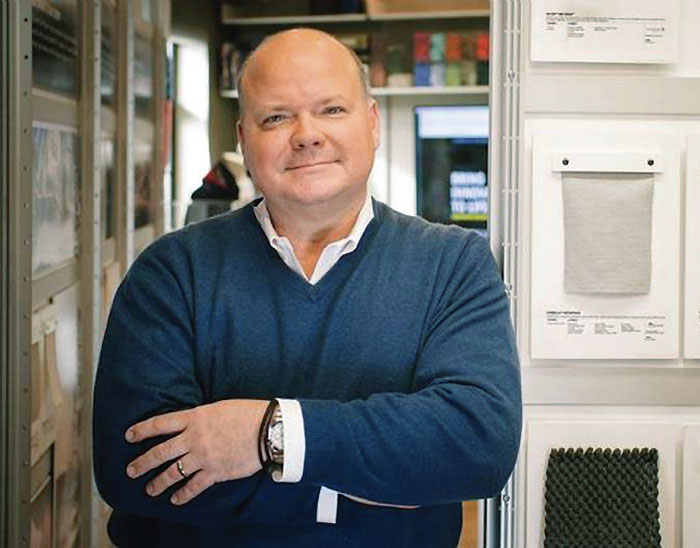
Oehmig
Oehmig: We began the transition during the post-recession period in which we were focused on both stabilizing our business globally, and executing numerous growth opportunities. Therefore, it was “all hands on deck” and we wanted to ensure that our team remained focused. Additionally, this has been a big transition for Glen Raven’s family shareholders. Although I have spent my career with Glen Raven, Allen had the foresight to understand the ownership dynamics of this very privately held company and wanted to pace the transition in a manner that would ensure the success of our leadership team. In the end, Thursday, October 5, 2017, was the date selected for the change.
TW: Since largely leaving the pantyhose business in the 1970s and tying the company’s fate to woven acrylic Sunbrella® fabrics, Glen Raven’s “bread and butter” has been the traditional markets like awning and marine boat cover applications. In the last decade or so, we’ve seen Sunbrella expand into other areas such as outdoor furniture. What currently is the largest end market segment for Sunbrella, and what do you see as its next big market?
Oehmig: Glen Raven’s core markets are shade, marine, automotive, furniture, safety, value-added military and geosynthetics. We also own a software company and have additional investments in a range of other industries. Therefore, I would certainly not agree that we are tied to a woven product or specific raw material. We do remain 100-percent committed to our core markets and are equally executing strategies to grow these markets, along with our position in these markets globally. Our focus is to introduce products, services and technologies with unique attributes that will allow our current and prospective customers be successful. If we can help our customers achieve their goals, then everyone in the value chain wins.
TW: Staying on the subject of Sunbrella for a moment, there seems to be a greater push recently to emphasize the Sunbrella brand as the company rather than Glen Raven Custom Fabrics. At the recent IFAI Expo in New Orleans, Glen Raven Custom Fabrics wasn’t even listed as the exhibitor; rather, it was Sunbrella. What’s behind that strategy?
Oehmig: Although Glen Raven is the parent company, we focus on putting forth the presence that is most relevant to our customer, and that is often a product or service we provide under a different brand than Glen Raven.
At IFAI Expo, for example, our Trivantage business unit has a visible presence as the leading distributor of fabrics and hardware
to the market. The show attendees — whether they purchase through Trivantage or another distributor — are also using Sunbrella, which is the leading shade fabric brand, which is why Sunbrella has a strong presence. It’s all about focusing on customer needs.
TW: In August, Glen Raven announced its intent to acquire Sunbury Textile Mills, a manufacturer of decorative jacquard fabrics. Glen Raven has been a close partner with Sunbury for more than 20 years. Why was the decision made to acquire them? Was there something you saw changing in the industry?
Oehmig: Sunbury has been a strategic partner of Glen Raven’s for more than 20 years. We are operationally and culturally aligned, and our teams have always worked well together. However, the pace of business today is faster than at any other time in our history. Therefore, our commitment to our customers meant that we needed to further align ourselves to take advantage of opportunities and to be able to execute faster and more efficiently than ever before. Bringing Sunbury and Glen Raven together gives us a great opportunity to better service our customers.
TW: What are your thoughts on the U.S. economy right now?
Oehmig: We are in the ninth year of economic expansion since the Great Recession. However, for many of us, this period of economic expansion has felt different from previous expansions. The run up in the S&P likely has more to do with a lack of meaningful alternatives than true market dynamics and consumers remain more cautious. At Glen Raven, we remain focused on maintaining a solid balance sheet while continuing to make significant investments in the business. We routinely review our market portfolio for any signs of weakness, but we remain optimistic.
TW: How about current specific end markets for technical textiles such as shade, marine, military, casual furniture, geosynthetics and automotive?
Oehmig: When we speak about the opportunities and market conditions in technical textiles, we are market, submarket and geographically specific. For several years, the global shade and marine markets have not been growing at a desired rate. Therefore, we are pushing innovation through programs such as “The Future of Shade” and the “Marine Design Challenge” to inspire creativity, new products and new applications in these markets. For the balance of the other markets you mentioned, we are seeing a wide range of market growth rates depending on industry and geographical location. Therefore, we continue to push innovation while also expanding our global footprint in support of our growing customer base.
TW: Do you see a “market disruptor” out there or will growth be more evolutionary?
Oehmig: I am sure that every business is imagining how they can be a disruptor versus being disrupted. This is the reason that we spend a great deal of time strategizing around not only “what’s now”, but more importantly “what’s next.” In some industries we serve, the technology is changing so fast that the next disruptive technology or application may be just around the corner. In other markets, change seems to be more evolutionary. However, in every market, the pace of change and the customer’s expectations for innovation is increasing faster than ever before.
TW: How do you feel about the Trump Administration’s announced intention to revisit the North American Free Trade Agreement (NAFTA) and the Korea U.S. Free Trade Agreement (KORUS)? Do they need to be revisited?
Oehmig: I support the Administration’s intention to revisit the NAFTA agreement if the desired outcome is a modernization of the 24-year old agreement. However, I would not support a comprehensive renegotiation. The same would be true for KORUS. Improved customs enforcement of the current agreements is an issue that must be addressed.
TW: Gant guided the company through a period of unprecedented expansion in Europe, Asia, India and Brazil. Glen Raven also merged the two primary technical textile distributors in North America into a new subsidiary called Trivantage. The company has also moved into previously unfamiliar markets like geosynthetics. When the time comes, what do you hope will be your legacy at Glen Raven?
Oehmig: I am passionate about this industry, the markets and customers we serve and the incredible group of people that I have had the pleasure of working beside for the last 28 years. Amazing opportunities remain in this industry, and I will hope to have made a contribution in Glen Raven reaching its full potential by remaining customer focused and conducting business in an ethical and socially responsible manner. There will be challenges, but we will remain focused on our customers and how we can help them achieve their goals.
Editor’s note: Stephen M. Warner, Arden Hills, Minn., is publisher of BeaverLake6 Report, beaverlake6.com, a Web-based newsletter reporting on trends, data and issues that he feels influence the technical textiles industry. He also is former president and CEO of Industrial Fabrics Association International.