J.Crew Group Provides Strategy And Leadership Update

NEW YORK CITY— April 11, 2019 — J.Crew Group Inc. today provided a strategic update, including the announcement of a review of strategic alternatives for the company, as well as certain leadership and governance changes.

The company, in consultation with its legal and financial advisors, is actively exploring strategic alternatives to maximize the value of the company, including a potential initial public offering (IPO) of its Madewell business, which, if pursued, could be completed as early as the second half of 2019. The company is considering an IPO of Madewell as part of its previously-stated initiatives to maximize value, position both the J.Crew and Madewell brands for long-term growth, and deleverage and strengthen the company’s balance sheet.

Separately, Michael J. Nicholson, president and CEO, has been named Interim CEO of J.Crew Group Inc., effective immediately. Additionally, Jack Weingart, co-managing partner of TPG Capital, has been appointed to the company’s board of directors, replacing Carrie Wheeler, who will be transitioning off the board after eight years with the company. Nicholson’s appointment replaces the Office of the CEO, previously comprised of four executives, which has led the company since November 2018. Libby Wadle will continue as president & CEO of Madewell, and Lynda Markoe will continue as the chief administrative officer of the company. Both Nicholson and Wadle will report to the board of directors. Separately, Adam Brotman, president and chief experience officer, has decided to resign from his position for personal reasons and will be leaving the company effective April 19, 2019.

Chad Leat, chairman of the Board of Directors, remarked: “Today’s announcement regarding the decision to review strategic alternatives reflects our continued focus on maximizing the value of our company and our conviction in Madewell’s long-term growth potential, which we believe will further enhance our financial flexibility to support a turnaround at J.Crew. The board is confident in Mike’s ability to lead the company in this dynamic retail environment during this transition period. His appointment reflects the key role he has played leading the company and directing strategies positioned to improve performance and maximize value.”

“On behalf of the Board, we would like to thank Libby, Lynda, Adam, and Mike for their leadership during this transition period, and we thank Carrie for her leadership and dedication to the company on the board of directors,” Leat continued. “We wish Adam the best in his future endeavors, and we look forward to Mike’s leadership during this important time for the company and to Libby and Lynda’s continued contributions.”

Michael Nicholson, interim CEO, commented, “I look forward to working with the board of directors and our team to build on the decisive actions we have taken to date to refocus our strategy and improve performance in 2019 with the goal of returning J.Crew to profitability, while working with Libby to continue the strong growth at Madewell.”

“We believe a potential IPO of Madewell, which had another record year of performance in 2018, could unlock significant value and generate meaningful proceeds that would strengthen our balance sheet and increase our overall financial flexibility to address our 2021 debt maturities, giving us an improved platform to support J.Crew’s turnaround and allowing Madewell to achieve its full potential over the long-term.”

Nicholson joined J.Crew in 2016 as president, COO and CFO, bringing extensive experience across all aspects of retail. Prior to joining J.Crew, Nicholson was executive vice president, COO, CFO and treasurer of ANN Inc. from December 2012 until August 2015. Previously, from 2007 to 2012, he served as executive vice president, CFO and treasurer of ANN Inc., and prior to that, held leadership positions at Limited Brands Inc. and Victoria’s Secret Beauty Co. Earlier in his career, Nicholson held senior positions at Colgate Palmolive and Altria Group Inc.

Jack Weingart is the co-managing Partner of TPG Capital, TPG’s U.S. and European private equity platform with approximately $35 billion of assets under management. He is also a member of the firmwide executive committee of TPG Global. Between 2006 and 2017, Weingart served as managing partner of the Funding Group, which comprises the firm’s capital markets and fundraising activities. Prior to joining TPG in 2006, Weingart was a managing director at Goldman, Sachs & Co., responsible for managing the firm’s West Coast leveraged finance and financial sponsor business.

Posted April 11, 2019

Source: J.Crew

Prym Fashion To Open A New Fastener Finishing Facility In India

STOLBERG, Germany — April 11, 2019 — Prym-Fashion has announced that it will open a new fastener finishing facility, known as Prym Fashion India Pvt. Ltd., in Chennai (Tamil Nadu), India.  The new facility, which will begin operations in the month of April, will enamel the company’s popular Gripfix fasteners for the children’s and baby wear markets.  By stamping the fasteners in Germany and providing made-to-order enamel finishing at Prym Fashion India, the company will reduce lead times to India-based producers of children’s and baby wear by more than 50 percent.

“Tamil Nadu is home to the largest number of textile mills in India, and the location of Prym Fashion India puts us closer to our Indian customer base,” said Brian Moore, CEO, Prym Fashion. “Color is so important to the appeal of children’s and baby wear, and new collections are being introduced with greater frequency throughout the year. Our ability to significantly reduce lead-times on our Gripfix fastener with dyed-to-match colors will provide added value to customers based in the area.”

Gripfix is Prym Fashion’s top seller in the company’s baby wear range, and has a secure five-prong system that will neither tear nor come off. The flat design of Gripfix fasteners maximizes comfort, and the company’s commitment to product quality and reliability make them both durable and safe for use with clothing designed for infants and children.

Prym Fashion India will be located within the fast-growing Chennai Free Trade Zone, allowing Prym Fashion to export enameled fasteners to apparel manufacturers in South Asia, including Sri Lanka and Bangladesh.

“This facility is a great starting point from which to enlarge our presence in this important and growing apparel region, and we are already developing plans to expand our services in India in the near future,” added Moore.

Posted April 11, 2019

Source: The Prym Group

STA Hosts “Future Focused: Charting The Course For 2019 And Beyond”

SMITHBURG, Md. — April 11, 2019 — STA recently concluded its Winter Technical Seminar held at the Textile Technology Center in Belmont, N.C. The meeting opened with welcome comments by STA President Andrew Barker of Matrix Yarns and the program was introduced by STA First Vice President Matt Shannon of Greenwood Mills.

The program featured seven presentations of broad interest to members of the industry.

Presentation included:

  • “2019 Economic Outlook: The Fed is Pausing?
    • Presented By Jim Campbell, CFP® – Campbell Rooks Wealth Management LLC
  • “Apprenticeship and Collaboration: Elastic Therapy’s Experience”
    • Presented By Chris Harrington –  Elastic Therapy
  • “International Trade Resources”
    • Presented By Mike Hubbard – Economic Development Partnership of North Carolina
  • “ITMA 2019 Tips For Success In Barcelona “
    • Presented By Clay Tyeryar – Trade Associations Division at Association and Society Management International, Inc.
  • “Accelerate Learning With Reality + Augmented Reality:  Handsfree/Smart Glasses/HoloLens”
    • Presented By Philip Riddle – SeeDaten
  • “Synthetic Fibers: Trends & Innovations”
    • Presented By Anna Watts – Triad Polymers

The STA Southern Division Spring Meeting is scheduled for May 15, 2019, at The Madren Conference Center, Bellsouth Auditorium in Clemson, South Carolina.

Posted April 11, 2019

Source: The Southern Textile Association (STA)

The Most Valuable Global Retail And Apparel Brands 2019

valuable-retail-and-apparel-brandsTW Special Report

According to Brand Finance, in its report Global 500 2019, a brand should attract custom, build loyalty, motivate staff and make money. After all, huge investments are made in brand design, launch, and ongoing promotion. Considering the potential financial value of a strong and successful brand, like Amazon, this makes sense.

In fact, per Brand Finance, Amazon maintains its title as the world’s most valuable brand. Growing in the last year by nearly 25 percent, to an inspiring $187.9 billion; over $30 billion more than Apple in 2nd place.

Interested in exploring brand value in added detail, British marketplace OnBuy.com analyzed the Global 500 report to discover the eight most valuable retail and apparel brands in the world 2019.

OnBuy found the United States is hugely successful in retail and apparel, holding 6 of the 8 highest brand values, 2019. In number one place is Walmart, with a brand value of $67,867 million — 10.4 percent change over 2018.

This is closely followed by Home Depot ($47,056 million; a 39.4 percent change over 2018), apparel brand Nike ($32,421 million; a 15.7 percent change over 2018) and Lowe’s, with a brand value of $23,938 and a change of 49.4 percent over 2018.

Outside of the United States, Sweden’s Ikea and Spain’s Zara lead with high brand values, worth $21,531 million and 18,424 million pounds, respectively.

Other American brands CVS Health ($21,254 million; a 3.2 percent change over 2018) and Costco ($17,115 million; a remarkable 50.5 percent change over 2018) land in 6th and 8th place, to complete the top 8.

*Brand Value is defined as: the value of the trade mark and associated marketing IP within the branded business.

April 11, 2019

Springs Creative Jumps Ahead In DIY Fabric

Springs_CP58958_Colorway-1aSprings Creative uses EFI’s Fiery® DesignPro to improve creativity and productivity as well as reduce costs.

TW Special Report

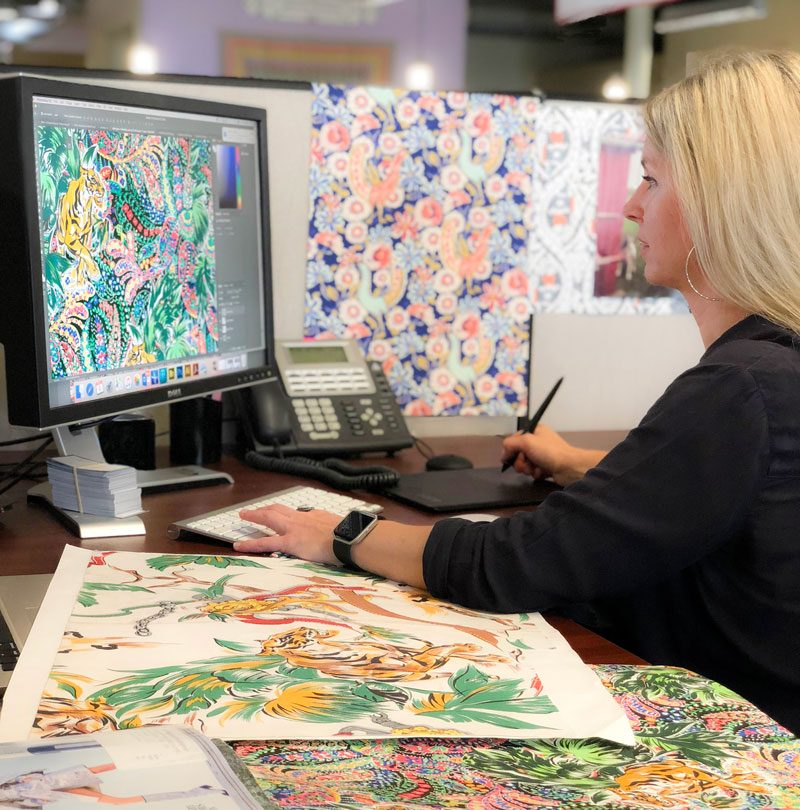
Rock Hill, S.C.-based Springs Creative had one license for a design program that was not integrated with the Adobe® suite. The company was looking to expand the number of textile design software licenses in an affordable manner to augment its Adobe Photoshop® and Illustrator® work. The goal was to enable designers to stay within the native Adobe suite and not have to go out to a separate program for textile-specific activities as well as to maintain access to tools, such as brushes in Photoshop, throughout the design process.

The company has had several licenses for EFI™ Fiery® DesignPro since 2014 and has found many ways to enable more creativity, improve productivity, and reduce costs.

In 1970, Springs Industries — formerly the 120-year-old Springs Mills and now Springs Global — bought the Finished Goods Division of Indian Head Mills of Massachusetts. From that acquisition, a new division, Springs Creative, was established — the Retail and Specialty Fabrics Division — to oversee the production of high-quality apparel and finished fabrics. Located in Rock Hill, South Carolina, Springs Creative is a leading supplier of fabric for the do-it-yourself market, offering a wide assortment of printed and solid cottons, cotton blends, and high-tech fabrications in man-made fibers, as well as digitally printed custom fabric. Springs Creative has 120 employees.

SpringsBeck
Springs Creative Senior Stylist Ashlyn Beck

Robust textile design solution unleashes creativity

Springs Creative Senior Stylist Ashlyn Beck had previously used another textile design program that was not integrated with the Adobe suite. “One of the advantages of switching to Fiery DesignPro,” she said, “is that we are able to stay in the native Adobe suite and do not have to go out to another product. I love all the brushes we have in Photoshop, and I can still use them in conjunction with Fiery DesignPro. That was really important to me as a designer.”

Beck notes that with Fiery DesignPro, she has been able to save hours on complex patterns with half drops. “It’s so easy now,” she says. “I can do a half drop or quarter drop, by row or by column. With a complex pattern, it used to take me as much as an hour. Now it’s five to 10 minutes. Depending on my workload, I was able to do three to four designs per day before. Now I can do nine to 12 — three times as many and without the headaches!” Another benefit for Beck is the ability to keep Illustrator designs in vector form for faster, easier scaling without risking rough edges.

In addition, she finds the weave tool in Fiery DesignPro to be both a creativity booster and a time saver. “Before, I would have to create weave patterns with layers and put on a texture or sun haze to create the pattern,” Beck said. “Now I just draw stripes and hit a button, and I have my weaves and plaids. What used to take one to two hours now takes five minutes. I can now do 20 of these per week; before I was doing one or two. It also allows me to experiment with lots of different designs in a fast and efficient way, choosing only the best ones to move forward with.” Beck describes one unique application she was able to make with this tool: a furniture substrate with a tweed printed on top of it. “It’s very realistic,” she said. “It looks woven!”

Beck uses Fiery DesignPro to create or update seasonal palettes as well. “We can have as many as five to 10 palettes each season,” she noted. “Now not only can we create them faster, giving us more flexibility in our collections, but it is also extremely easy to share them with the team.” She also loves the ability to print out color chips. “They are a great color communication tool,” she said. “I can choose my colors and then automatically create a set of chips using the Colorist module, which gives me a choice of a range of similar colors and tones. That lets us choose the exact right color during the development process. Then the final color chip set is sent to our factories for them to match, both physically and digitally. This process was completely manual before. We had to create each square individually. It took hours. Now it is automatic, with results delivered in minutes.” In addition, Beck creates trend palettes that she can easily share with her team.

For Beck and her team, the learning process was intuitive. “We had a full day of training, and experts are always available by phone if we need additional help,” she reports. “The Fiery DesignPro folks are proactive as well. They will often stop by to show us enhancements that have been added to the software.”

April 11, 2019

OnFarm Data Limited Acquires Assets Of Streat Instruments

CHRISTCHURCH, New Zealand — April11, 2019 — Christchurch based company OnFarm Data Ltd. has acquired the assets of Streat Instruments, a manufacturer of moisture measurement equipment, also based in Christchurch.

The sale, signed on February 1 in Christchurch between Alan Brydon, CEO of the Garnett Group of companies based in the United Kingdom and Andrew Neill, managing director of OnFarm Data, is the result of a long relationship.

Streat Instruments manufacture Aquaflex Soil Moisture Sensors and associated telemetry equipment with over 5000 installations in New Zealand alone, the Drycom Industrial Moisture Measurement system with installations in over 40 countries, and Equi-pF, a soil testing device which has also been sold extensively overseas.

Alan Brydon, who purchased Streat Instruments from founder Garth Streat in 2000, commented: “This is a very satisfying outcome for me as there are good synergies between OnFarm Data and Streats which should see significant growth for the combined operation.  We will continue to have a close relationship with my UK operation representing the Drycom products in the UK and OnFarm Data representing us in NZ”.

OnFarm data and Streats have worked closely over the last few years in the domestic agriculture market as OnFarm data have been a distributor of Aquaflex.

Andrew Neill commented: “This is an exciting development for us and will enable us to broaden the portfolio of top level products and services we can offer to our clients.  The Streat Instruments Drycom and Equi-pF brands will now come under the OnFarm Data Ltd. umbrella and will continue to be actively marketed both in New Zealand and Internationally”.

The Drycom products will be on display at ITMA 2019 in Barcelona.

“Our intention is to further support and grow the domestic market and continue expansion into key/high growth international markets.”

Posted April 11, 2019

Source: Streat Instruments

Toray To Establish New Water Treatment Membrane Company In China

CHUO-KU, Tokyo — April 8, 2019 — Toray Industries Inc. today announced that it has decided to establish a new company in Foshan, China, that will engage in production and sales of water treatment membrane products including reverse osmosis (RO), nanofiltration (NF), ultrafiltration (UF), microfiltration (MF) and membrane bioreactor (MBR) solutions. The new company will be named Toray Membrane (Foshan) Co. Ltd. (TMFC), and Toray is moving forward with land acquisition, construction and other activities to prepare for its establishment.

Foshan is also the site where construction of the premises of Toray Polytech (Foshan) Co. Ltd. (TPF) is already underway. This company that will engage in production and sales for the high-performance polypropylene spunbond (PP spunbond) business. TMFC will be located adjacent to the TPF premises, ensuring an efficient operating structure by sharing management and systems infrastructure.

Demand for water treatment membranes has been rapidly expanding in China in recent years. To date, in addition to promoting the use of household water purifiers, Toray has contributed to improving the water environment and solving water scarcity issues in China by providing various kinds of water treatment membranes for waterworks and industrial use, desalination plants, and wastewater treatment and recycling.

Guangdong Province is moving to strengthen industry-academia partnerships and is systematically promoting research and development in advanced technologies. Foshan City is located in the center of the Guangdong Province Pearl River Delta economic zone and has a long track record of attracting Japanese companies of all sizes to engage in business partnerships in the region.

Toray already has water treatment membrane production and sales companies in operation in Beijing and Yancheng. The establishment of a new base in Foshan will enable Toray to respond nimbly to the rapidly expanding water treatment membrane market in China, where environmental improvement efforts are being energetically promoted.

In relation to the establishment of TMFC, we held a signing ceremony on April 7 at Toray’s Nagoya Plant (location: Nagoya, Aichi Prefecture), on the occasion of the visit to Japan of Ma Xingrui, Governor of Guangdong Province.

Under the Green Innovation Business Expansion (GR) Project that is part of the Medium-Term Management Program, Project AP-G 2019, Toray aims to contribute to the resolution of environmental, resource, and energy issues. The water treatment business is a core part of these efforts and, by engaging in this sector at the global level as one of the world’s leading general water treatment membrane manufacturers, Toray will continue to work hard to deliver solutions to the world’s water resource-related issues.

Posted April 11, 2019

Source: Toray Industries Inc.

Toray To Sell Limited Quantity Of Toraysee™ Reversible Cloth

CHUO-KU, Tokyo — March 22, 2019 — Toray Industries,Inc. today announced that it would start a limited quantity sale of ultra-fine fiber Toraysee™ Reversible Cloth (six color variations, 24cmx24cm, ¥700 excluding tax) at opticians and Toray shops around Japan from early April 2019.

Toray printed the latest trending colors on the reverse side of the best-selling six colors of the Toraysee Color Cloth, currently on sale, to create the Toraysee Reversible Cloth. These are not just simple colors, but colors that give a three-dimensional feel to the cloth and the company also created the black (dark grey) cloth for the first time in the Color Cloth series. These are expected to cater to the tastes of old as well as young people, both men and women, who are particular about their accessories, and the color contrast between the surface and back side also makes it ideal as a pocket handkerchief. We will launch it as a limited quantity product in a new simple and stylish packaging.

The Toraysee series is marking the 32nd anniversary since its launch in 1987 as a high-tech cleaning cloth for glasses that used 2-micron diameter (cross-section comparison: 1/1600 of hair) microfibers (100% polyester). The series has been acclaimed for the wide-ranging cleaning goods based on unique concepts that it has been offering. The gaps in the fiber, which cannot be seen with the naked eye, wipe up the dirt and enable cleaning up sebum and other dirt, which could not be fully cleaned with regular cleaning cloth, without scratch the lens. The material also has superior durability and can be repeatedly used as it can be washed to recover its cleaning ability. The fabric can be used for cleaning in various daily life scenarios in addition to cleaning of glasses, such as sebum stain on smartphone touch panels, accessories, wristwatches, CDs and mirrors.

Toray will continue to offer high value-added products specializing in polishing and cleaning in the daily lives of consumers through the development of new products under the Toraysee series.

Posted April 11, 2019

Source: Toray Industries Inc.

Techtextil 2019 Exhibitor Preview: SHIMA SEIKI

WAKAYAMA, Japan — April 11, 2019 —Computerized knitting machine manufacturer SHIMA SEIKI Mfg. Ltd., Wakayama, Japan, will be participating in the Techtextil exhibition in Frankfurt, Germany this May. The company will show at two different booths displaying different product lines. Flat knitting applications in technical textiles are shown with its Italian subsidiary SHIMA SEIKI ITALIA S.p.A., while cutting solutions are shown with TAJIMA GmbH.

Knitted applications in the field of technical textiles take advantage of key knitting characteristics: stretch and compression. Flat knitting provides further potential as the only textile production method that can shape fabric on the machine. Shima Seiki’s new SVR123SP flat knitting machine goes a step beyond with its extra loop presser bed, capa­ ble of inlay technique used to produce hybrid knit­weave patterns suited to technical textile production. Even materials that could not be knit before such as metallic and monofilament yarns can now be now be knit. SVR123SP at Techtextil furthermore features the new iPlating® option for even greater diversity.

Shima Seiki’s SDS­ONE APEX3 3D design system is available for demonstrations as well. Of particular interest is its ultra­realistic simulation capability that realizes Virtual Sampling. When countless variations must be evaluated before arriving at a final design, virtual product samples can be used to streamline the decision making process by minimizing the enormous amount of time, cost and material normally associated with producing actual samples for each variation. When approved, the same data can be used to program machines for immediate knitting, significantly reduc­ing lead times.

On display at the Tajima GmbH booth is the P­CAM131 multi­ply computerized cutting machine (NC cutting machine), shown for the first time at Techtextil. Shima Seiki’s fast, efficient and reliable P­CAM series computerized cutting machines are known for their innovative functions and Made-in-Japan quality, and boast the largest market share in Japan. A knife sharpening system produces a sharp, strong blade every time. Strong, robust components permit quicker response times for knife movement and more accurate cutting composites and other industrial materials. P­CAM machines are ideally suited to global production in a wide range of industrial applications in addition to apparel and textiles. Shima Seiki’s SDS­ONE APEX3 CAD system will also be on display at the Tajima booth.

Posted April 11, 2019

Source: Shima Seiki

ITMA 2019 Exhibitor Preview: Gneuss Recycling Technology

BAD OEYNHAUSEN, Germany — April 11, 2019 — At this year’s ITMA, Gneuss will present its innovative PET recycling process with Gneuss’ reactor technology.

The Gneuss Recycling Technology enables the pro­cessing of high-volume, industrial PET waste from fiber, nonwoven or film production, and from contaminated post-consumer bottle flakes. The recycling technology is based on the Gneuss Processing Unit (GPU) with MRS extruder, rotary filtration system and online viscome­ter, combined with Gneuss’ JUMP reactor. This is a sophisticated processing step to accurately boost the IV of the PET polymer in the melt phase.

The first important processing stage, melt decontamination, takes place in the GPU. With its excellent devolatilization capacity, the MRS extruder can process PET waste with high residual moisture levels and/or contamination (such as spin finish oils) without the need for any pretreatment of the waste. In the Multi Rotation Drum, 8 satellite screws produce a large melt surface and surface exchange rate, so that an optimum devolatilization and decontamination result can be achieved with conventional water ring vacuum pumps. All volatile foreign substances, such as water and/or spinning oils, are removed.

Solid impurities are subsequently filtered out by the melt filter. Rotary Filtration Systems operate continuously, process constant and automatically, and guarantee a particle-free melt thanks to finest filter elements with filter fineness down to below 20 µm.

During the second important stage of the process, the purified and homogenised polymer is delivered into the JUMP reactor. Here, too, a large surface area of the polymer melt and optimum residence time of the polymer under vacuum are decisive factors. The polymer passes over several slow turning elements, which create a polymer film, the surface of which is constantly renewed. The reactor vessel is kept under vacuum and by regulating the residence time and speed of rotation of the agitating devices, the polycondensation reaction can be altered to achieve higher viscosities. The IV value of the PET melt can be specifically influenced over a wide range so that an increase of 0.02 to a maximum of 0.3 dl/g is possible. The design of the JUMP prevents the entry of oxygen, so discolouration (yellowing) of the polymer is minimized.

After passing through a stilling section in the reactor, the polymer melt is pumped either directly into the production process (e.g. direct extrusion melt spinning, strapping) or into a pelletising (chip cutting) system.

With this recycling technology, combining an MRS extruder with the JUMP reactor, industrial waste can be turned into a high-quality and directly usable melt in a very short time. Thanks to the enormous line flexibility, different PET qualities can be produced.

The JUMP process is an extremely efficient alternative to a Solid State Polymerisation (SSP) as there is no energy needed to cool the polymer down and then reheat it. Further, the reaction time in the melt phase is considerably faster than in the solid phase, which also contributes to the better economics of the JUMP system. Last but not least, the JUMP offers major advantages over an SSP in terms of space requirements and even maintenance.

This recycling concept, which received an award for innovative performance last year, has convinced one of China’s largest fiber producers. The recycling concept for processing fiber waste into pellets will be implemented by the Chinese manufacturer before the end of this year.

An MRS130 will process up to 900 kg/h of fiber waste (Staple fiber and POY) into melt. All the spin finish oil and water and other volatiles will be taken out in the high efficient degassing section. There is a possibility for injecting additives into the MRS as well, so there is an optional adding of color (TiO2, carbon black …) as well as of other reactive additives. After the devolatilization in the MRS all solid particles will be filtered out by a RSFgenius175 equipped with 20 micron screens. The purified melt will be fed via a startup valve into the reactor for the IV lift. Alternatively, in this line set-up, there is an option to feed the melt directly (before the reactor) to a pelletizer to produce pellets with a lower IV.

The high IV melt coming out of the reactor will be added into a POY or staple fiber spinning line, closing the recycling loop.

Posted April 11, 2019

Source: Gneuss Kunststofftechnik GmbH

Sponsors