Epson Introduces Next-Generation SureColor F6370 44-Inch Dye-Sublimation Inkjet Printer For Enhanced Workflow And Productivity

LONG BEACH, Calif. — August 20, 2019 — Epson America today announced the next-generation SureColor® F6370 44-inch dye-sublimation printer. Featuring speeds up to 680 square feet/hour,1  the new dye-sublimation printer quickly and efficiently produces high-quality images for promotional products, soft signage, cut-and-sew fabrics, and more. Designed with ease-of-use in mind, the intuitive SureColor F6370 comes equipped with new Epson Edge® Print workflow software, featuring an Adobe® PostScript® 3™ engine, as well as a built-in cutter for roll-to-sheet convenience and an optional take-up reel system for unattended printing. The SureColor F6370 replaces the SureColor F6200 to join Epson’s line of SureColor F-Series printers, including the SureColor F9370 and SureColor F7200.

“The award-winning SureColor F-Series product line is the number one selling large format dye-sublimation printer and we are thrilled to continue expanding the series and providing new features customers have requested,” said Tim Check, senior product manager, Professional Imaging, Epson America Inc. “The SureColor F6370 includes features that improve efficiency and productivity, including the new Epson Edge software designed to streamline workflow applications and provide customers with the information they need to produce high-quality output that meets the needs and turnaround times for customers.”

The SureColor F6370 comes equipped with Epson Edge dashboard, a remote printing management software featuring an easy-to-use, intuitive interface with detailed views on current activity, ink supply levels, and important warnings or errors. The dashboard allows users to manage the status of up to ten printers, including all SureColor F-Series, SureColor F-Series Direct-to-Garment, and SureColor S-Series wide-format printers. The Epson Edge Print workflow software features an Adobe Postscript 3 engine and includes job nesting, custom spot color, project libraries, pattern repeats and the ability to import new media settings, when available, and provides the option for print shop providers the ability to edit media settings and manage projects remotely.

Employing the renowned Epson PrecisionCore® TFP® printhead technology and Epson UltraChrome® DS ink packs with High Density Black,* the SureColor F6370 produces output with vibrant color saturation and contrast. Touting additional new hardware features to streamline workflow, the SureColor F6370 leverages new roll media adapters to provide support for 2-inch and 3-inch roll media cores and media up to 170 mm. The new roll media adapters lock into place to prevent unwanted roll movement and new built-in cutter for additional convenience. An optional take up reel aids in streamlining roll-to-roll printing and transferring to a rotary calendar heat press. In addition, the new user-accessible maintenance panel provides easy access to the printhead, wiper and wiper cleaner and features simple instructions to complete routine maintenance checks.

More About the SureColor F6370 
The new SureColor F6370 is built for enhanced workflow and productivity for the promotional product and cut-and-sew markets with a range of features, including:

  • Fast Print Speeds – Up to 680 square feet per hour1
  • High Quality Images – Efficient UltraChrome DS ink delivers vibrant color saturation and contrast;
  • Seamless Workflow – Equipped with powerful Epson Edge workflow software, featuring the Adobe PostScript 3 engine;
  • Versatile Media Support – Featured built-in cutter and optional take up reel system;
  • Optimized to Epson DS Transfer Papers – Multipurpose, Rigid Photo Optimized, Adhesive Textile, and Production papers;
  • Turnkey Solution, Fully Supported by Epson – Includes a one-year limited warranty; extended service plans available;
  • Reduced Cost of Ownership – High-capacity ink packs with 10 percent more ink than previous models2
  • Designed for Productivity – Compact design delivers more productivity per square foot1
  • Exclusive Epson Rewards Program Available – Accumulate points with every consumable purchase for trade-in options; and
  • Low User Maintenance – Easily accessible maintenance area ensures consistence, reliable performance.

Support and Availability 
The Epson SureColor F6370 Standard Edition is available now through authorized Epson Professional Imaging resellers for $8,495 MSRP. The optional take up reel will be available in Fall 2019. The SureColor F6370 offers a standard Epson PreferredSM Limited Warranty, a one-year program that includes toll-free advanced telephone access Monday through Friday and usually next business-day on-site service in the unlikely event of any hardware failure.

1 Print times are based upon print engine speeds only. Total throughput depends upon front-end driver/RIP, file size, printing resolution, ink coverage, network speed, etc.

2 F6370 ink packs contain 1.1 liters of ink, 10 percent more than previous generation 1.0-liter ink packs.

* This printer is designed for use with Epson genuine ink packs only, not third-party cartridges or ink.

Posted August 20, 2019

Source: Epson America Inc.

Durst Appoints Peter Jones To New Label Business Development Role

DurstJones
Jones

BRIXEN, Italy — August 19, 2019 — Durst, a manufacturer of advanced production technologies, has appointed Peter Jones to a newly-created role as labels business development manager for the UK and Ireland. Starting August 19, he will be working closely with the local sales, service, supply and logistics teams as well as Durst Group headquarters staff based in Brixen, Italy.

Peter’s new business role will cover the Durst RSC Tau UV inkjet portfolio and associated software offered by Durst Professional Services. They include Durst Workflow Label combined with the Durst SmartShop and integration packages.

Until joining Durst, Peter had spent 25 years in a variety of management roles for Esko, the last as global solutions manager for Danaher. “Having done a lot of research, I know that Durst’s product portfolio, customer service and support is second to none,” said Peter. “Durst is a family company and market leader with a first-class reputation in so many markets, which I hope to extend further in labels. I’m really excited. This was too good an opportunity to miss.”

Peter Bray, managing director of Durst UK and Ireland, which has more than 150 installations, said: “We welcome Peter to the Durst family. The creation of a new role within Durst UK & Ireland is part of a strategic push to grow business in the labels sector through our market-leading Tau systems, service and software. Peter’s considerable market knowledge will be a real asset to Durst, with labels continuing to be a really important target sector to further grow our business.”

Outside of work, Jones, who lives with his family at Stratford-upon-Avon, Warwickshire, will be continuing his masters degree in project management and his hobbies of flying and rugby. Peter holds a private pilot’s licence and, when time permits, coaches a ladies‘ rugby team near his home.

Posted August 20, 2019

Source: Durst

Inkcups Expands Portfolio With Three New Pad Printers

DANVERS, Mass. – August 19, 2019 — Inkcups has announced the release of three new pad printers: the ICN-120, ICN-200 and 2200-DLI, expanding the company’s current pad printer portfolio to produce larger images on longer goods with extended stroke capabilities.

The ICN-120 is a 1-color pad printer that provides increased flexibility with product decorating and labeling thanks to a larger-area image reproduction with an extended stroke of eight inches for greater printable area reach.

Ideal for the apparel, industrial and safety equipment industries, common applications for the ICN-120 include hooded sweatshirts (design location of left chest and neck); apparel sleeves; medical items including sharps disposal containers; denim jean pockets; and tall drinkware, such as protein shakers and tumblers. The machine’s 120 mm ink cup size can print an image up to 4.3 inches in diameter. The ICN-120 also offers an optional pad cleaning device as an add-on.

The new ICN-200 produces large 1-color prints on injection-molded plastics, industrial parts and appliances. This industrial pad printer is ideal for 1-color logos, graphics and labels on larger parts up to 11.7 inches tall.

In addition to printing large graphics, this machine’s plate accommodates multiple images for smaller parts. The ICN-200 utilizes a 200 mm ink cup, 11.8-inch pad stroke length and can print an image size of up to 7.48 inches in diameter. Typical applications include plastic containers (recycle bin); kitchenware (plastic and metal paper towel dispensers); food storage containers; satellite dishes and appliance panels.

In an entirely new capability, Inkcups’ 2200-DLI pad printer offers decorating long, hard goods or small 2-up items, allowing multiple image print locations on the same part.

The 2200-DLI prints 1-color, 2-up on footwear insoles, promotional products and electronics including Bluetooth speakers. This machine also enables printing of multiple images on a single part, such as lacrosse or hockey sticks. It has a 90 mm ink cup with a 6-inch pad stroke length and can print an image of 2.76 x 8.66 inches on parts up to 10.2 inches tall.

All three new pad printers are delivered as a turnkey package that includes the company’s world-class InkcupCare warranty and service coverage. Inkcups also offers multiple pad printing inks, solvents and other supplies, along with application testing and sample prints upon request.

“Our goal is to build pad printing machines that increase the capabilities of our current customers as well as expand Inkcups into other markets,” said Ben Adner, CEO of Inkcups.

The ICN-120, ICN-200 and 2200-DLI are engineered and manufactured in the U.S. and are available for order now.

Posted August 20, 2019

Source: Inkcups

Navigate Nonwovens Markets with Market Intelligence And Economic Forecasts Presented By INDA’s Brad Kalil At RISE® And Hygienix™

Brad Kalil Director of Market Intelligence and Economic Insights INDACARY, N.C. — August 20, 2019 — Nonwovens professionals will gain timely market forecasts and insights to better navigate dynamic markets by attending presentations by INDA’s newly titled Director of Market Intelligence & Economic Insights, Brad Kalil, at two must-attend industry conferences this fall: Research, Innovation & Science for Engineered Fabrics Conference (RISE®) and Hygienix™.

INDA today announced that Kalil will speak on trends driving nonwovens innovation at RISE, September 24-25 in Raleigh, N.C. He also will present on supply/demand developments in North American Nonwovens markets and absorbent hygiene sectors as well as population trends and the Echo Boom at Hygienix — the premier event for absorbent hygiene & personal care, November 11-14 in Houston.

“Brad has established himself as the ‘go-to resource’ in the nonwovens industry for the most accurate and informative reporting of capacity and production by the various sectors of the market. His strategic and creative thinking combined with a disciplined and organized approach to data supports better decision making and helps our industry avoid unneeded investments in oversupplied sectors while justifying investment in underserved areas,” said Dave Rousse, president of INDA. “Hearing the latest from Brad at these two key industry events will arm attendees with insights that will give them a competitive business advantage, making RISE and Hygienix not-to-be missed opportunities.”

Kalil produces INDA’s annual North American Nonwovens Supply Report in April of each year for INDA members, providing a review of North American capacity, production, and trade flows for the prior year. He continues to expand the annual report adding production by end-use and will add raw material consumption in the spring of 2020. He also produces the North American Nonwovens Industry Outlook Report that projects demand by more than 240 market sector and subsectors with a five-year forecast, which is available for sale on the INDA website.  In collaboration with EDANA, the prominent nonwovens association based in Europe, Kalil produced the Worldwide Outlook for the Nonwovens Industry Report, August 14, 2019, and available at the INDA.org. Another INDA member publication Kalil produces is a quarterly Market Pulse Report that provides statistics and commentary on the overall nonwovens economic situation with more detailed discussions of drivers and detractors by major sector.

These publications organize the disparate industry sectors into manageable sectors and analyze the trends to aid functional decision making, giving nonwovens professionals the most accurate and comprehensive data available.

A sought-after speaker at member internal meetings on strategy and planning, and at industry events within nonwovens and the greater engineered material fields, Kalil has a 27-year history in research and market analysis advising the world’s best-known consumer packaged goods companies. His previous experience includes Fastmarkets RISI and Weyerhaeuser Corporate Market and Economics Research Group as the Business Intelligence Manager for the Cellulose Fibers Business.

Posted August 20, 2019

Source: INDA

Accel Lifestyle Launches Ethical & Eco-Friendly Anti-Stink Activewear

HOUSTON, Texas — August 20, 2019 — Revolutionizing activewear for men and women, Accel Lifestyle is proud to announce the launch of anti-stink apparel for people who live actively, conscientiously and are always on the go.

Accel Lifestyle’s apparel is anti-stink and pro-environment. Even more revolutionary, this anti-stink apparel is also eco-friendly and encourages a wear more, wash less practice. The average American throws away 85 pounds of textiles a year, contributing to the landfill epidemic. Because their shirts are anti-stink, people will be less inclined to throw them away. Accel also uses sustainable fabric, minimizing the use of microplastics. Beyond sustainable fabric, they focus on sustainable packaging too — ditching plastic and providing 100-percent biodegradable packaging. Accel Lifestyle is more than just fitness apparel, they have created a movement for positive change.

The Accel tees and tanks are soft, lightweight, high-performance staples that will become your new favorite shirt. Available in six different styles, Accel’s tanks and tees are made with Supima®, the world’s finest cotton, and enhanced with a good dose of powerful anti-stink science woven into each thread of their proprietary Prema™ fabric. The tees and tanks are made to wear more and wash less, providing breathable stink-free comfort day in and day out.

AccelGroupPhotoAccel Lifestyle was created by a creative chemist who was tired of throwing away her athletic wear because it stunk, no matter how much it was washed. While searching for anti-stink clothing, she was underwhelmed by the choices — finding products were either covered in chemicals or made in sweatshops overseas. Concluding neither was an option, she decided to invent her own fabric. She hit the lab and after more than two years of rigorous antimicrobial testing, using the same lab the government uses, she developed Prema fabric – which is now patent pending in 120 countries, 100-percent sourced and made in the USA (NO sweatshops!).

“I founded Accel Lifestyle because, even though there are so many fitness apparel companies today, none of them hit all the boxes on my checklist. I wanted to support a fashionable fitness apparel company that has an ethical supply chain (no sweatshops), and a fabric that doesn’t smell. What did I find? Absolutely nothing. And, I wanted to change that,” said Founder and CEO Megan Eddings. “With my science background and experience working in science labs at University of Virginia and Brown University, it took 2.5 years to create the fabric from scratch, using the most luxurious threads available and a trade secret protected science.”

Posted August 20, 2019

Source: Accel Lifestyle

BST eltromat International Sales Team Now Serves Global Market Under Two Leaders

Sajid Malik (left) and Siegfried Steggemann are the two new sales directors at BST eltromat.

BIELEFELD, Germany — August 20, 2019 — As of June 1, 2019, BST eltromat International has subdivided its global sales into a western and an eastern region. With the dual leadership, the company is giving international sales a boost and putting a greater focus on its customers and subsidiaries all over the world. Siegfried Steggemann has assumed leadership of the western region as global sales director West. In addition to Western Europe, he is responsible for the markets of the American continent and North Africa. Sajid Malik is in charge of the eastern region, which encompasses the other parts of the world — Eastern Europe/Turkey, Middle East, Central and South Africa, Africa, and Asia.

“With Mr. Steggemann and Mr. Malik, we have filled the leading sales positions with two experts from our own ranks who have been familiar with individual requirements of the markets and customers for years,” said BST eltromat Managing Director Kristian Jünke. “As long-term employees, both are well acquainted with our company and our operations. This provides an excellent basis for further strengthening cooperation with our local sales partners and subsidiaries. Giving our customers the greatest attention possible is especially important to us. The dual leadership in our international sales with two very experienced professionals is a clear signal to our customers all over the world that we are consistently realizing this goal.”

“From entry-level solutions to high-end systems, the modular product portfolio of BST eltromat covers the requirements of the market as regards the efficiency and economy of quality assurance in web-processing production processes,” said Malik of his new position. “I see it as my main task to focus more closely than ever on meeting these requirements in my region — and in doing so to show our customers both the flexibility and the excellent price-performance ratio of our products and solutions. Currently, the eastern region is characterized by a large number of growth markets. There is enormous potential here to promote the BST eltromat brand name, which is already very well established in these markets.” Malik joined BST eltromat in 2005 and most recently served as vice president of sales for the Asia Pacific region.

After completing his degree in mechanical engineering, Steggemann started his career as an engineer at BST eltromat parent company EMG Automation GmbH, where he worked on web guiding systems in metal manufacturing. Most recently, he headed the BST eltromat business unit BST ProControl. Steggemann stresses the challenge for manufacturing companies in the western world to ensure maximum productivity and profitability in their processes: “The majority of our customers in my region are exposed to the constant pressure of growing international competition,” Steggemann said. “In order to survive in this environment, they must maximize the efficiency of their processes and produce at consistently high quality with minimal waste. The quality assurance systems of BST eltromat provide our customers with unique opportunities to strengthen their competitiveness in this respect. Automation and ‘Industry 4.0’ also play a key role in this, and these are topics that I take a special interest in.”

The reinforcement of global sales with a strong dual leadership is in line with the “perfecting your performance” strategy of the elexis Group, whose largest subsidiary is BST eltromat. It focuses more systematically than ever on delivering value for the company’s customers.

Posted August 20, 2019

Source: BST eltromat International

Gelest Joins The Global Effort To Intensify Fight Against Antimicrobial Resistance

MORRISVILLE, Pa. — Aug 20, 2019 — Gelest Inc., the manufacturer of BIOSAFE® Antimicrobials, announced today that it has joined The Antimicrobial Resistance (AMR) Challenge launched by the U.S. Government and Centers for Disease Control and Prevention (CDC) in September 2018. The AMR Challenge is an effort to accelerate the fight against antimicrobial resistance through committed action across governments and industries.

Antimicrobial resistance (AMR) occurs when bacteria, parasites, and fungi develop resistance against previously effective antimicrobials. AMR poses an increasingly serious threat to global public health that requires immediate action from government organizations, private companies, and society at large. In 2016, it was estimated that more than 700,000 people die each year due to drug-resistant infections. Without further action, infections caused by antimicrobial resistant “superbugs” could kill an additional 10 million people each year worldwide by 2050, overtaking cancer as one of the leading global causes of death.

“We are excited about joining this global effort and are committed to accelerating application development of our leading BIOSAFE® antimicrobial technology, which is highly effective and safe to use with minimal potential risk of creating adaptative resistant microorganisms,” said Ken Gayer, Chief Executive Officer of Gelest.

BIOSAFE antimicrobials inhibit microorganism growth by physically puncturing the cell microbe membrane, killing the microbes on contact by electrocuting them. This mode of action has been reported to have significantly less tendency for microbes to develop resistance through adaption and mutation.

“We plan to launch a series of new products including antimicrobial laundry additives, surface cleaning wipes, wound care dressings, and more through partnership with private industries, governments, and non-governmental organizations worldwide,” said Gayer.

Posted August 20, 2019

Source: Gelest

Natific Digital Color Solutions: Let’s Make Your Color Right!

NatificWeb
In the global textile supply chain, natific’s smart software solutions shorten the development cycles of colors by four to six weeks and improve color quality.

TW Special Report

Fast fashion means a new trend every week. But fashion can only be as fast as the supply chains that support it. In the fast-paced textile industry, businesses increasingly rely on digitalization to make their supply chains more efficient. Although fashion thrives on the thrill of color, color development often remains a tedious process. This makes the road from design to production very long and can lead to substandard results. This is precisely where Switzerland-based natific AG comes in. With smart software solutions and professional services, the company helps customers digitize their color results, shorten development cycles by four to six weeks, improve color quality — and make sure color stays thrilling.

“As part of Global Sourcing, our Color team manages the color approval process,” said Carol T. Revels, senior manager of Color & Fabric Operations at Dodgeville, Wis.-based Lands’ End. “In the past, the management consisted of a manual process of emails, spreadsheets, and data re-entry across disconnected systems. In partnering with natific, we have a centralized and integrated color management solution to communicate with our suppliers and internal cross-functional partners. The efficiency gains allowed the business to scale up product offerings to our customers, meaning increased color development, with no increase in headcount and no decrease in color quality.”

“Working with natific systems and certifications has improved our communication with suppliers, reduced time spent on tedious tasks, reduced our reliance on email communication, improved our historical record keeping, and standardized our submit and approval documentation,” reported Marielle Newman, color analytics manager at Baltimore-based Under Armour.

The fashion industry is increasingly digitalizing product development, thereby shortening lead times and reducing costs long-term. But it often neglects the color development process along the way, and that can be a critical mistake: “The traditional color approval process is quite laborious. Time gained from other digital efficiencies is quickly lost — and unforeseeable color differences between original samples and production are a common occurrence. Digitalization means more than just defining a digital Pantone® or CSI® standard for a supplier,” pointed out Christoph Bergmann, responsible for sales/marketing and senior partner at natific AG. “With our software and our years of dye house know-how, the textile industry gets precisely the colors it specifies, avoiding compromises caused by lack of time. This is also the message we’ve embodied in our slogan: Let’s make your color right!”

natific ColorWarehouse – Real-Time Color Management System

In order to provide customers with a platform for monitoring color production in real-time, natific developed its ColorWarehouse. This industry-first B2B software solution ensures high precision and reproducible color results for both brands and suppliers. All color data from the supply chain are transferred to a cloud-based system for central information management. Designers no longer need to send physical color samples or make visual assessments. In addition, there are fewer surprises when colors are off-shade or show metamerism. Dye houses actually self-approve colors when they are within tolerance. Key performance indicators (KPIs) can be benchmarked across different mills, services tracked and monitored, and quality issues minimized. Development cycles are shortened by an average of four to six weeks while color quality is elevated.

Beyond production monitoring functionalities, the system enables strategic supply chain management. Solid indicators help identify key performers and facilitate decision-making that supports supply chain optimization.

ASAP: The Analysis Tool For Generation 2.0 Color Managers

Another innovative product from natific AG is ASAP, a B2B platform for digital and physical color development that helps brands and affiliated suppliers efficiently achieve the greatest possible color accuracy. Based on a brand’s color standards, the system tracks key indicators for digital and physical color matching as well as for evaluating a supplier’s quality and delivery performance. This gives retailers and brands reliable information about whether and by when suppliers can execute a desired colorway, print or pattern. Suppliers, on the other hand, can optimize their dye formulas and reduce or completely eliminate lengthy lab dipping processes by using digital color approvals. In short, ASAP tells customers very clearly how accurately a supplier can produce a given color for a given material before going into production.

Fully Integrated For Precise Color Results

In contrast to traditional platforms that solely provide digital color data to suppliers, ASAP works by enabling a two-way interactive exchange between brands and their suppliers. The platform’s ability to seamlessly integrate into existing IT infrastructures, such as Product Lifecycle Management (PLM) or Enterprise Resource Planning (ERP), ensures smooth communication. Traditional data management based on the exhange of emails and Excel sheets can be eliminated. ASAP is the perfect way for textile and apparel companies to start digitizing their colors and create sustainable color processes for the future.

August 16, 2019

Succesful With ESSENTIAL: Rieter Makes Progress With The Digitization Of The Spinning Mill

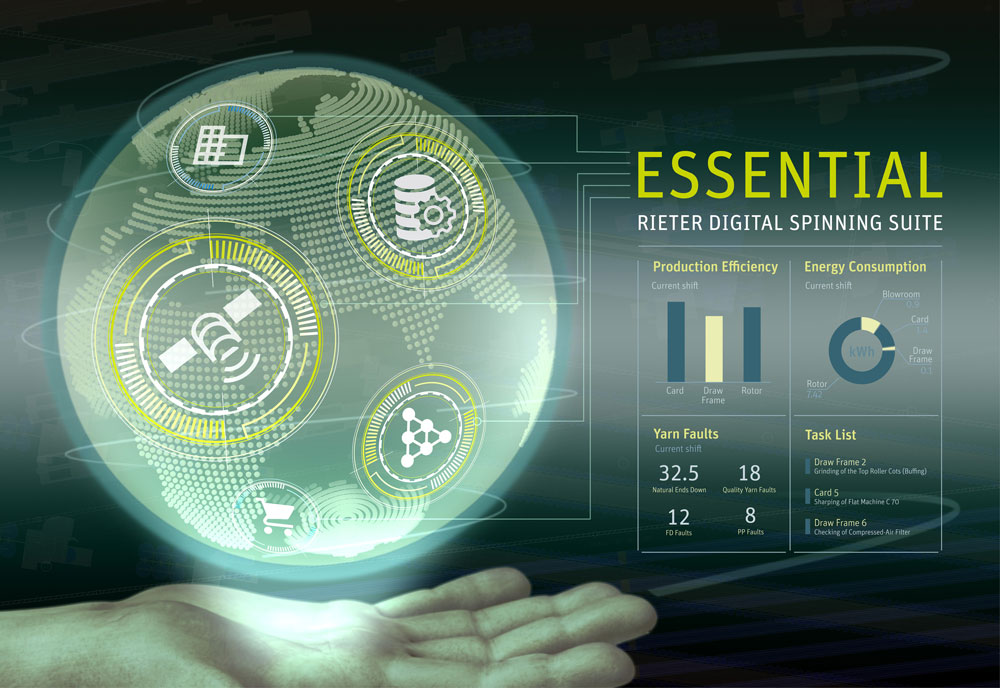
The all-in-one mill management system: ESSENTIAL – Rieter Digital Spinning Suite

TW Special Report

All customers who purchase new Rieter machines get access to ESSENTIALbasic, the entry-level model in the Rieter Digital Spinning Suite. ESSENTIALbasic makes it possible to use important functions and access additional modules in the Rieter Digital Spinning Suite, which is undergoing continuous enhancement. Rieter is also presenting new modules that can be used to further improve the competitiveness of the spinning mill.

The all-in-one spinning mill management system: ESSENTIAL – Rieter Digital Spinning Suite integrates all digital applications. The system connects all machines and auxiliaries that influence the production of yarn and provides user-defined interfaces for third-party systems such as enterprise resource planning (ERP). Users can select modules in the Rieter Digital Spinning Suite that best suit their requirements and add them individually.

ESSENTIALbasic With Every New Rieter Machine

The digitization package ESSENTIALbasic is delivered with every new Rieter machine. Every Rieter customer can have it enabled upon request. Among other things, it includes the use of digital machine documentation and the possibility to order spare parts via the Internet. This module is also available for machines that have already been installed.

Introduce The Right Measures

The Rieter monitoring system offers new features too. ESSENTIALmonitor provides clearly organized data from the entire spinning process centrally. This allows all relevant information to be collected, weaknesses to be identified and personnel to be utilized in the most economical way. The specific and continuous record of production, energy, and quality data enables short reaction times for the right measures to be initiated. This increases efficiency and reduces the cost of spinning mills. As a new feature, recommendations for how to improve productivity are provided. ESSENTIALmonitor can be operated either via a computer in the spinning mill, via a mobile app, or via ESSENTIALdashboard, i.e. a large display unit in the spinning mill.

Intelligent Maintenance

ESSENTIALmaintain enables intelligent spinning mill maintenance by analyzing sensor data from critical machine components and identifying abnormalities to avoid outages. The module offers a clear overview of all future, current and past maintenance tasks.

Avoid Outages

ESSENTIALpredict applies machine learning algorithms to sensor data and compares the running behavior of similar machine types. As soon as a machine starts behaving abnormally, the user receives a message containing instructions from Rieter on how to avoid a potential outage.

Ordering, Management

ESSENTIALorder offers the user the possibility to manage spare parts procurement. As well as the spare parts ordering service, the webshop also features additional state-of-the-art functionalities. The module also offers an online spare parts catalog tailored to the specific machine configuration. ESSENTIALorder can be accessed via ESSENTIALbasic.

Find Information Quicker

ESSENTIALconsult provides quick access to important information. The digital manual contains all operational and installation manuals, eliminating the need to spend time searching through traditional paper manuals. This module is also part of ESSENTIALbasic.

With these ESSENTIAL modules, Rieter offers an opportunity to capitalize on the potential for intelligent spinning. The ESSENTIAL portfolio will soon feature three additional modules: ESSENTIALlab, ESSENTIALoptimize and ESSENTIALautomate.

Quality Data At A Glance

A spinning mill management system would not be complete without the quality data collected from your laboratory equipment. With ESSENTIALlab, your quality data is integrated into the customer-oriented cockpit, allowing you to take action whenever this is required.

Optimized Process Recommendations

In the event that the lot, yarn count or end usage of the yarn changes in a spinning mill, the intelligent recipe management system ESSENTIALoptimize recommends the correct settings for the entire spinning process. The system first compares the current settings with the best practices from Rieter. ESSENTIALoptimize then suggests improved settings and/or optionally the optimal raw material to increase performance and reduce operational costs, while maintaining quality at a targeted level.

Transport Automation As An Integral Element

ESSENTIALautomate integrates automated transport and logistics systems into ESSENTIAL. This gives the user an insight into the efficiency of the transport automation and helps to improve efficiency through combination with the production data from ESSENTIALmonitor.

Access to the ESSENTIAL platform, including ESSENTIALorder and ESSENTIALconsult, is free to Rieter customers. Please contact your Rieter sales representative to find out how to access the Rieter Digital Spinning Suite.

August 16, 2019

Green In Every Color: Putting The Forest At The Heart Of Sustainable Fashion

sirpa_valimaa
Sirpa Välima

By Sirpa Välima

More than ever, people are looking for more sustainable ways to lead their lives. From the food they eat, to the transport they choose and even to the clothes they wear. Forward thinking retailers and designers such as IKEA1 and Marimekko2 have responded by experimenting with more sustainable, alternative materials, but overall our fast-fashion lifestyles and reliance on fossil materials keep us hooked on unsustainable textiles.

So where should we be looking for wardrobes that are green in every color? And what are the problems with our current array of common materials?

Fossil-Fueled Fashion

The world wears oil. As recently as 2016, 65 percent of global textile fiber volume was fossil-based fibers such as polyester and nylon3. They are cheap and easy to produce, with high performance on many measures: perfect for throwaway, fast fashion.

Except that we are becoming more conscious of what throwing away these materials means. These materials are plastics, and they do not biodegrade well in landfill, contributing to our pervasive plastic pollution problem.

However, the clothes don’t even need to be thrown away to cause problems. Every time we wash them, these clothes shed microplastics — as many as 700,000 fibers per 6 kg wash4. These microplastics make their way to our rivers and oceans and, from there, may make it into the food chain. What’s more, as products of fossil fuels, these materials have their share of the environmental blame for the broader oil and gas industry.

Keep It Organic?

What about natural alternatives then: wool, silk, linen, cotton?

Of these, only cotton is anything close to a serious contender, with 23 percent of the market. Wool accounts for 1 percent, and all other natural fibers only manage another 5 percent taken together5.

However, cotton is no environmental panacea. It takes as much as 12,000 liters of water to produce 1 kilogram (kg) of cotton. That’s almost three months worth of household water supplied directly to an individual European Union citizen — and cotton is often grown in areas suffering from drought. Pesticide and fertilizer use are also worryingly high6.

Retailers recognize this. H&M7 has set itself a goal of using 100 percent “preferred cotton” — meaning organic, recycled or “Better8” cotton.

fashionNatural Man-Made Materials

So, if synthetic materials are contributing to climate change and plastic pollution on the one hand, and natural contenders are too resource intensive, it seems we are stuck between a rock and a hard place.

But there is an alternative; materials that are both man-made in one sense and natural in another.

This may sound contradictory, but it is not. To explain: Viscose is a textile that is manufactured from pulp harvested from wood. So, it is man-made in that it is not directly grown like cotton, but natural in that it is made from a naturally occurring material.

Viscose can be a far more sustainable option for textiles. For a start, it is created from a renewable resource — trees — that can be regrown and even act as carbon sinks if responsibly managed. It also requires far less water than cotton — those 12,000 liters of water used to produce 1 kg of cotton would yield 26 kg of viscose.

Viscose also performs fantastically as a fabric. It is soft, smooth and breathable like cotton, but offers much better moisture management. It drapes well, has great luster and holds color and prints extremely well, even after many washes.

Not Your Grandmother’s Viscose

But viscose is not some new wonder material. It has been around for well over a century. At times, viscose has been a hugely popular fabric — as well as the basis for anything from cellophane to sponges to sausage casings — but has since suffered a decline.

This is largely down to concerns over the use of carbon disulphide in the manufacturing process. A dangerous and toxic chemical, carbon disulphide has resulted in worker safety incidents in developing countries, and its environmental impact has dented viscose’s eco-credentials. At the same time, beginning in the 1970’s, tighter emissions standards for European businesses raised costs and led to outsourcing production to China.

However, modern viscose is changing. Current production processes for both viscose and other man-made cellulosic fibers focus on a high recovery rate of chemicals and closed chemical loops, greatly reducing environmental harm. Widespread investment into worker health and safety and environmental controls also means that even viscose made using traditional processes is becoming safer and more environmentally friendly.

A future is in sight where viscose is the sustainable answer to sate the global textile industry’s demand for beautiful and high-performance materials. Our industries and societies are increasingly mindful of the impact they have on the planet and are realizing that the future must be built using renewable materials. As in so many things, we can look to the forest to inspire a renewable future.


References:

1 https://newsroom.inter.ikea.com/News/spinning-better-textiles-with-wood-pulp/s/c2d389ed-7567-4b6e-84bd-7b5963a33e6e

2 https://twitter.com/Marimekkoglobal/status/444190374622662657

3 Source: CIRFS, The Fiber Year

4 https://www.sciencedirect.com/science/article/pii/S0025326X16307639

5 Source: CIRFS, The Fiber Year

6 https://www.worldwildlife.org/industries/cotton

7 https://about.hm.com/news/general-news-2019/on-the-way-towards-using-100–sustainable-materials.html

8 https://bettercotton.org/


Editor’s Note: Sirpa Välima is product manager, dissolving pulp at Helsinki-based Stora Enso, a global provider of renewable solutions in packaging, biomaterials, wooden constructions and paper.


August 16, 2019

Sponsors