
Shaw’s Kellie Ballew Promoted To Vice President Of Global Sustainability

Ballew

DALTON, Ga. — September 30, 2020 — Shaw Industries Group Inc. has promoted Kellie Ballew to vice president of global sustainability.

A 25-year company veteran, Ballew has a long history of partnering with Shaw leaders to leverage market insights and technical expertise to inform, influence, and support business decisions. Most recently serving as director of sustainability, Ballew has been intensely focused on Shaw’s commercial business for the past two years ensuring that the company’s sustainability strategy and execution help create a competitive advantage for Shaw and its brands. Ballew will expand that role of internal consultant and subject matter expert to the enterprise — driving continued sustainability innovation and operational excellence.

“Kellie has an innate ability to navigate the complex, interdependent opportunities and challenges within sustainability. Her leadership will ensure we continue to enhance the value Shaw brings to its wide range of customers,” noted Susan Farris, vice president of corporate communications and sustainability.

Ballew looks to build upon Shaw’s sustainability leadership, which includes:

  • Almost 90 percent of the products the company manufactures being Cradle to Cradle Certified™;
  • Assessing more than 1.6 billion pounds of raw material used in its operations for material health last year (2019);
  • Reducing the enterprise’s carbon footprint by more than 50 percent since 2010 and achieving carbon neutrality in its commercial operations in 2018; and
  • Reclaiming and recycling almost 1 billion pounds of carpet since 2006 through the company’s re[TURN]™ Reclamation Program.

“People are at the heart of Shaw’s sustainability efforts. It’s what we call sustain[HUMAN]ability,” statds Ballew. “That’s why we are intently focused on the ingredients that go into our products and the impacts of sound, moisture, cleanability and other design elements on people in addition to global challenges like climate change and ocean plastics. It’s about people AND the planet.”

A recognized leader within Shaw, Kellie has also been recognized locally and nationally for her contributions, including being a 2015 Manufacturing Institute STEP Ahead award winner and a member of the 2020 class of the Institute for Georgia Environmental Leadership.

In addition to the more than six years that Ballew has been an integral member of Shaw’s sustainability team, she has played critical roles in Shaw’s industrial engineering, financial systems, and in commercial technical development teams. Her early involvement with EcoWorx carpet tile and Cradle to Cradle design philosophies provide her with deep knowledge and illustrate her ongoing commitment to innovation.

Posted October 1, 2020

Source: Shaw Industries Group, Inc.
Outcome Of Strategic Change Initiative Refocuses Organization On Core Differentiators To Build Member Value

ALEXANDRIA, Va. — September 30, 2020 — TRSA — the Association for Linen, Uniform and Facility Services — has embarked on a Strategic Change Initiative focused on core deliverables that maximize member value and best leverage TRSA’s resources for 2020 and 2021. Based on a series of internal and external qualitative and quantitative research and interactive sessions with stakeholders, TRSA activities for the balance of 2020 and those expected to be budgeted for 2021 will include:

  • Advocacy including proactively encouraging increased use of commercially laundered reusable linens, uniforms, and healthcare personal protective equipment (PPE) such as isolation gowns and scrubs for more a sustainable, hygienic supply chain;
  • Monitoring, responding, and educating federal, state, and local regulators and legislators to ensure a focus on continued recognition as a Critical/Essential Service;
  • Hygienically Clean and Clean Green certifications;
  • Dissemination of information and training focusing on best practices for improving employee and customer safety and supervisor training; and
  • Increased information-sharing through virtual networking communities, and print and digital communications.

“In recovery from the pandemic, TRSA needs stakeholder support and assistance in identifying how the industry has changed, and will continue to evolve, over the next few months and years,” said TRSA Chair Jim Buik, Roscoe Co., Chicago. “Member and subject matter expert input provides invaluable information for review and discussion by the TRSA Strategic Planning Committee and Board of Directors.”

TRSA began its Strategic Change Initiative in early April immediately following the stay-at-home orders that shut down the economies in North America and across the world.

“We knew the impact on the industry would be significant but varied based on geography, market and product mix,” said TRSA President and CEO Joseph Ricci, CAE. “We immediately began our Strategic Change Initiative that included 10 weeks of two-hour weekly facilitated discussions between TRSA senior management and association subject matter experts (SMEs) covering membership, events, certification, non-dues revenue, globalization and other issues. These association colleagues and consultants shared valuable insight and perspective, often without charging for their time.”

These internal discussions with SMEs feed directly into discussions with external stakeholders including leaders of related organizations including TRSA’s counterparts in Europe and Australia. TRSA hosted market-sector and regional Zoom discussions and facilitated a Strategic Industry Town Hall in June with more than 120 linen and uniform services professionals. These discussions led to the development of an Industry Looking Forward report indicating that survival and recovery are top of mind with both operators and supplier partner members suffering significant impacts to their bottom lines. Near-term challenges have made it more difficult for both to focus on longer-term planning post-COVID-19:

  • Increased costs and competition
  • Decreased sales and workforces
  • Consumer shifts in preferences and overall economic fears
  • Increased regulations and standards

Discussions concluded that promotion of linen, uniform and facility services to the variety of industries they serve can focus on three growth opportunities:

  • Reusables as a more cost-effective and sustainable supply chain
  • Cleanliness standards that ensure the products are hygienically clean
  • Commercial versus home or on-premises laundering (OPL)

Since mid-March, TRSA has hosted nearly 50 webinars, town halls, roundtables and other activities, as well as benchmarking surveys to facilitate the exchange of best practices for improving safety and operations during the COVID pandemic and access to resources to assist in recovering from its economic impact.

Thanks to members’ investment and support, TRSA continues to fulfill its charge as the lone advocate for the industry at the federal, state, and local levels, most recently:

  • Gaining nationwide recognition for the industry as a Critical/Essential Business
  • Defeating initiatives requiring disposable products at restaurants
  • Highlighting the supply chain sustainability of hygienically clean linens and uniforms

In addition to addressing COVID impacts, TRSA continues to proactively pursue every opportunity to fulfill its mission to expand, protect and professionalize the nearly $40-billion U.S. linen, uniform, and facility services industry.

“Throughout the COVD-19 Crisis, TRSA’s leadership, volunteers and staff have worked hard to consistently deliver timely, pertinent information and resources to help members survive and recover from the economic impact of business closures and promote the industry as a critical infrastructure business,” Ricci said.

Posted October 1, 2020

Source: TRSA

Oerlikon Barmag: Automation For Retrofitting – Wiping Robots Increase Production Efficiency

REMSCHEID, Germany — October 1, 2020 — Retrofitting a wiping robot to spinning systems is well worthwhile. This is confirmed by the experiences of those customers who have already installed the wiping robot. Oerlikon Barmag wiping robots have been cleaning spin packs at filament yarn manufacturing facilities in China and India for several months now, increasing efficiency considerably.

Regular wiping of the spin packs is important for process stability and yarn quality. These can be positively influenced using wiping robots, because — as confirmed by data acquisition and analysis at the respective manufacturing facilities — the yarn break rate can be reduced by up to 30 percent by automating the wiping process. And the yarn break rate has a direct impact on the key production figures; to this end, a considerable reduction translates into pure profit for yarn manufacturers.

Can also be retrofitted to existing systems

The Oerlikon Barmag wiping robot can be retrofitted to numerous spinning plants. Suspended from a track system mounted on the ceiling, the system automatically and autonomously targets the individual positions in accordance with the scheduled wiping cycles. In addition to the scheduled wiping processes, there are also events that cannot be planned or that are not immediately visible. Depending on the degree of integration into Oerlikon Manmade Fibers Smart Factory solutions, the wiping robot is able to identify issues such as yarn breaks or parallel wiping processes and to independently offer solutions.

The wiping robot operates in a crossline manner. Here, the wiping quality remains constant 24/7. The high wiping quality has a positive influence on both the stability of the overall process and on the yarn quality. The time saved between cleaning cycles is a further advantage: using the robots, the interval between two wiping processes can be extended by up to 25 percent. The considerable increase in the spinning process efficiency achieved by the wiping robot also has a positive impact on margins. For example, one customer deploying the wiping robot was able to reduce its production costs for the same yarn by more than 3 percent.

Posted October 1, 2020

Source: Oerlikon

Technology Webtalk On Automation And Digitization In Textile Dyeing And Finishing

FRANKFURT, Germany — October 1, 2020 — The next VDMA technology webtalk on October 6, 2020 (2-4 pm CEST) will focus on automation and digitization in textile dyeing and finishing.

The textile industry faces enormous challenges: Fashion trends, flexible production, rising costs, reduced prices, sustainability requirements, etc. To cope with these challenges and make reliable decisions, customers need automated processes, control systems and digitised data.

The presenters and their topics at a glance:

Axel Pieper, Brückner Textilmaschinen: “The topic of digitisation opens up completely new possibilites for increasing productivity, reducing the use of resources and improving quality.”

Using the example of a tenter frame, Thomas Höpfl, Mahlo, will show the possible savings and optimization potentials of data-controlled production.

Manfred Mentges: “Sedo Treepoint supplies highly integrated systems from ERP level, linking to our MES systems, to the machine floor. We offer solutions for process management, colour management, printing and energy management, establishing IoT / Industry40 systems.

After the presentations, the three experts will be available to answer the participants’ questions.

Registration is possible via this link (no participation fee):

https://register.gotowebinar.com/register/6406687539129219853

Posted October 1, 2020

Source: VDMA

Acquisition: Durst Acquires Majority Stake In U.S. Printer Manufacturer Vanguard Digital Printing

BRIXEN, Italy — October 1, 2020 — Durst, manufacturer of advanced digital printing and production technologies, is strengthening its position in the U.S. graphics industry with the acquisition of a majority stake in Vanguard Digital Printing Systems, headquartered in Lawrenceville, Ga.

Vanguard Digital is a manufacturer of printing systems for the signage, decoration, corporate, industrial and packaging sectors. With the acquisition, Durst adds new printer classes to its large format portfolio, while Vanguard now has a global distribution and service network and technical resources to continue developing robust solutions.

“Vanguard Digital Printing Systems is a rapidly growing and very successful company in a customer segment in which we are currently not active,” said Tim Saur, president of Durst North America. “Through the combination of high-quality products, a strong management team and absolute customer orientation, both companies are a perfect match.”

As part of the agreement, the new company will operate as Vanguard Durst Digital Printing Systems with effect from October 1, 2020. David Cich remains CEO while Jim Peterson continues to serve as Vice President of Sales.

“It is with great humbleness and excitement that Vanguard Digital will now be a part of the world class industry leading Durst Group,” said David Cich, CEO of Vanguard Digital Printing Systems. “Becoming part of the Durst Group Family, provides Vanguard Digital the opportunity to expand its portfolio of innovative market leading UV Printers to the entire world.”

“Vanguard’s printing systems have rightly achieved rapid growth and high customer acceptance in the North American market,” said Christoph Gamper, CEO and co-owner of the Durst Group. “Despite the global pandemic, we are positioning ourselves for the long term and are determined to invest in the large-format graphics market. In addition, with our technical expertise, Vanguard will continue to ensure that its products and services are industry-leading and a wider customer base will understand what it is like to be part of the Durst family.”

Posted October 1, 2020

Source: Durst Group

Chargeurs Partners With CLO Virtual Fashion To Innovate The 3D Digital Design Process

NEW YORK CITY — October 1, 2020 — Chargeurs*PCC Fashion Technologies today announced that it has launched an industry-first, exclusive global partnership with CLO Virtual Fashion, a producer of 3D garment simulation technology. Through the collaboration, Chargeurs’ interlining items will be made available as digitized assets on CLO’s platform, enabling fashion and apparel designers to add the interlinings directly into their 3D virtual designs. Chargeurs’ assets are the only interlinings that will be available on the platform and their addition by CLO will empower designers to digitally iterate complete designs in real time, ultimately creating more accurate virtual garments.

“Our partnership with CLO is a game-changing technology initiative, as we are the first company in the interlinings industry to make our products available as digitized assets that can instantly be added to 3D virtual fashion designs,” said Angela Chan, managing director and president of Chargeurs*PCC Fashion Technologies. “Designers will now be able to easily pull in our digitized interlinings to complete their visual creations and ensure true and proper fit on-screen in CLO’s 3D design program. In the past, designers had no ability to access digitized interlinings, so they could only make a best guess as to how a garment would truly fit, drape and look.”

Chargeurs’ exclusive partnership with CLO will enable designers to create more accurate 3D visual simulations of garments, driving faster speed to market for brands. The addition of the digital interlining assets to the CLO platform will also provide significant sustainability benefits, including reducing waste and resource usage by eliminating the need to create and ship physical samples back and forth among product development and manufacturing teams that are typically located in different regions across the globe.

“We’re extremely proud to be Chargeurs’ partner in innovation through this global initiative,” said Simon Kim, CEO of CLO Virtual Fashion. “By adding Chargeurs’ interlining products to our platform as digital assets, we will help apparel design companies shorten their lead times by making the design process more efficient and comprehensive, eliminating miscommunication and guesswork, and reducing waste and energy usage associated with physical sample making and shipping.”

Posted October 1, 2020

Source: Chargeurs*PCC Fashion Technologies

EURATEX – AAFA Joint Statement E.U./U.S. Trade Relations

BRUSSELS — October 1, 2020 — EURATEX and AAFA note the recent progress in eliminating and reducing customs duties on several American and European products. It is a very positive sign that we would like to highlight in a particularly difficult context for the textile and clothing industry at European, American and even global levels.

However, we regret the small scope of this recent tariff agreement and that it doesn’t include textile and apparel products. We call on the European and American authorities to make the necessary efforts to cover all industrial goods, including textiles and clothing, on both sides of the Atlantic.

We likewise call on the European and American authorities to keep the dialogue open with regard to regulatory cooperation. We are very pleased to see Smart Textiles as one of the areas in which standardization cooperation between Europe and the United States will be strengthened. These efforts must translate into concrete initiatives for the benefit of our European and American companies, their workers, and millions of consumers.

Last but not least, we strongly urge European and American authorities to end the long and unhealthy trade war related to the cases of Boeing and Airbus at WTO level. The European textile and clothing sector is already negatively impacted by this conflict, which is leading towards extraordinary customs tariffs for our and other industrial sectors. Just as we have opposed the imposition of duties by the U.S. Government on EU products, we strongly oppose additional duties being imposed by the EU on American products, as it is expected to be the case in the weeks to come. Current taxes should be eliminated, and solutions need to be arranged to rapidly end this trade war.

EURATEX and AAFA remain available to collaborate with European and American authorities to find the best solutions for the European and American textile and clothing industry.

Posted October 1, 2020

Source: EURATEX/AAFA

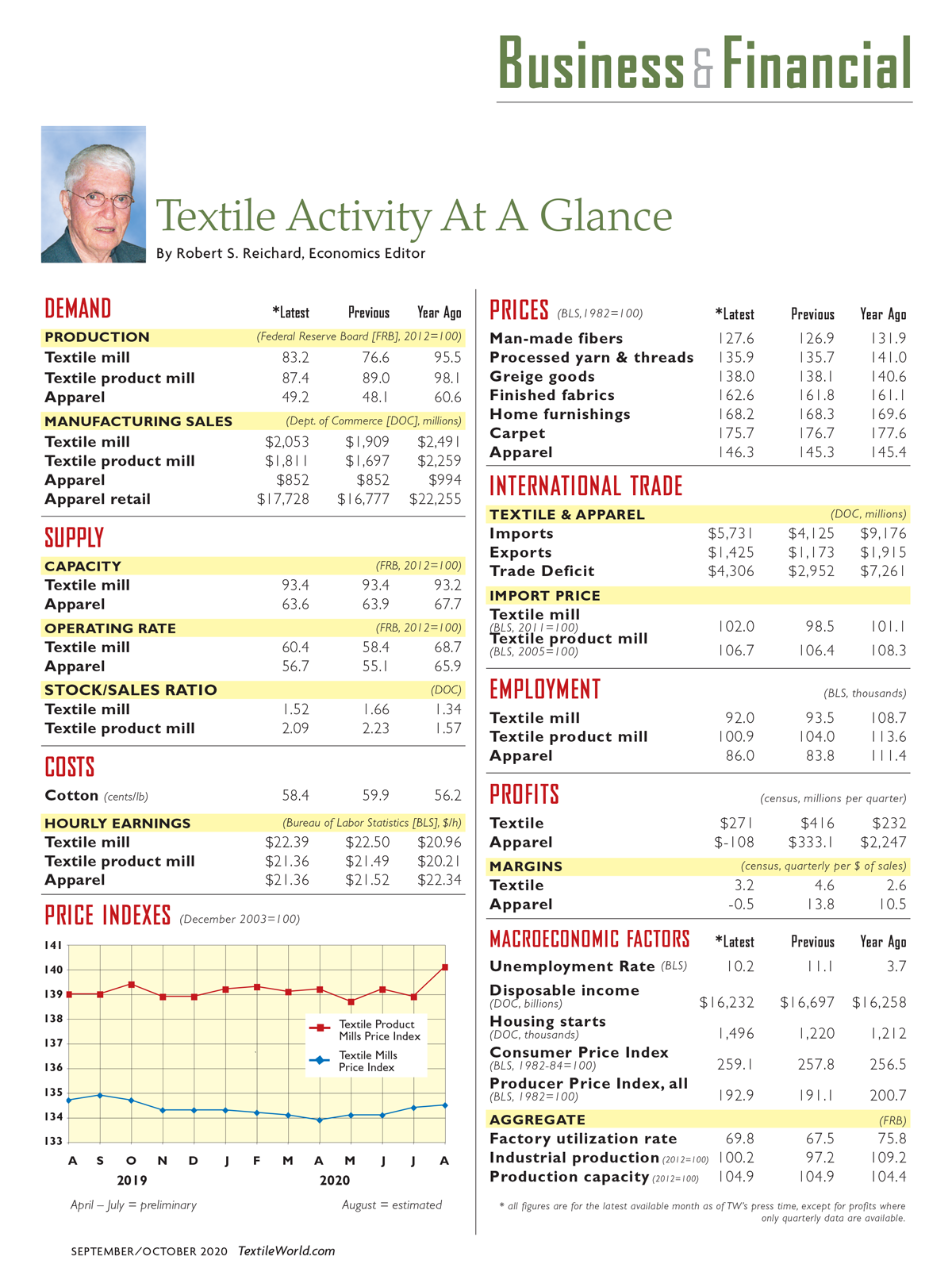
September/October 2020: Textile Activity At A Glance

September/October 2020

U.S. Textiles: COVID-19 Changes Everything

By Jim Borneman, Editor In Chief

It’s fair to say that more has changed with U.S. textiles than has stayed the same in the age of COVID-19. From an economic standpoint, the U.S. has been turned on its head — supply chains disrupted, demand curtailed and uncertainty has skyrocketed economic risks.

For companies with deep pockets, entering protection and preservation modes have been short-term, but necessary strategies.

Others have taken the opportunity to modify their business lines to align with changing demands.

Volatile shipping costs and changing attitudes towards imported Chinese goods have many rethinking their supply chains. According to Nikkei Asian Review: “Most of the world’s major shipping lines sharply reduced their operations in February when demand dropped steeply as the outbreak was peaking in China, later spreading to the rest of the world.
At the end of May, the amount of idle capacity reached a record high with 550 ships anchored in ports. Prices began to rise at that time, prompting companies to start gradually putting capacity back on stream in the third quarter.

“Data from the Shanghai Shipping Exchange show that fees to send a 40-foot container from China to the U.S. West Coast had more than doubled year-on-year to around $3,900 as of mid-September. Sending a container to the U.S. East Coast cost as much as $4,700.”

But shipping costs are only part of the story. How the industry engages in B2B sales also has been severely disrupted.

“Virtual” solutions abound — webinars, zoom meetings and virtual seminars have become standard fare.

Much work is being done to enhance these virtual experiences, and because this COVID environment — with all its uncertainty — was unleashed with little preparation or notice, marketers were left scrambling.

Textile World has observed more inquiries for traditional advertising in
addition to electronic media marketing solutions, but budgets still seem lean even with vendors not spending on travel, entertainment or the cost of exhibiting at traditional trade shows. Many companies are not receiving visitors and have travel bans in place inhibiting personal sales calls.

The suspension of traditional trade shows and association meetings is a major blow to how U.S. textile professionals network, explore new products and processes, and engage in the sales process. This is a larger void than one might expect with these environments key to exchanging information, knowledge and in an interesting way, fellowship — the key to identifying as a cohesive industry.

TW editors have observed increased use of press releases by the industry — a positive trend to fill the information void — with many releases sharing good news of innovation, personnel changes and investment.

In early March, many forecasters were predicting a return to “normal” by September with an economic bounce in the third quarter. But with the political season in full swing and the pandemic still full of surprises, it seems operations will continue under the fog of the COVID war.

Thankfully, the U.S. textile industry is full of warriors that are very capable of surviving in a wartime environment.

September/October 2020

Ecofibre Acquires TexInnovate

Ecofibre Ltd. — headquartered in the United States in Georgetown, Ky. — recently acquired the businesses and assets of TexInnovate, a key manufacturing partner in North Carolina comprised of five businesses. TexInnovate founder Jeff Bruner was named president of Ecofibre company Hemp Black, and has resigned as vice chairman of Quantum Materials — a company he founded more than 30 years ago — in order to focus his efforts on Hemp Black.

“This is an incredibly important strategic move for Ecofibre,” said Ecofibre CEO Eric Wang. “For the past two years we have worked to develop a platform of intellectual property that allows us to sustainably deliver the natural antimicrobial and conductive properties of hemp into existing manufacturing supply chains for textiles, composites, coatings, paints and other industries.

“Through this period Jeff Bruner and the team at TexInnovate has been a very close partner in co-developing IP, building processes to deliver Hemp Black capabilities at industrial scale, designing, engineering and acquiring specialized equipment and developing/manufacturing the recently launched Hemp Black face mask to market.”

“Two years ago when I was introduced to the concept, research and patents being developed by Hemp Black, I quickly became a significant shareholder,” Bruner said. “Since 2018, I continue to see the very strong commercial potential for this technology to not only solve problems that our customers find today, but more importantly advance the quality and technical aspects of a very wide array of products. I am very excited to lead Hemp Black with Eric and his team and help innovate the high-performance textile industry to another level,” Bruner continued. “During my career there have been several innovations that led to step function shifts in our industry. I believe Hemp Black has the technology to underpin another step function shift in how textiles can enable and perform across a wide range of industries.”

September/October 2020

Sponsors