METZINGEN, Germany — October 20, 2020 — BOSS is teaming up with iconic American brand Russell Athletic to create a capsule collection of bold casualwear for a new generation. Inspired by both brands’ archives, the designs will unite expert BOSS tailoring and Russell Athletic’s instantly recognizable sportswear aesthetic in a unique style.
HUGO BOSS Bhief Brand Officer Ingo Wilts said: “Casualization is an important element in our BOSS collections, so it’s the perfect time to partner with a pioneer in this field. Russell Athletic invented the sweatshirt almost 100 years ago, and it has been a great experience to work with a brand that has such a heritage and expertise in sportswear.”
Ricardo Aranda, vice president of Russell Athletic, added: “We are excited to partner with one of the biggest fashion brands in the world to create a collection that takes inspiration from fashion and sports to reinvent iconic pieces in a whole new way.”
On the partnership, Wilts continued: “When I first traveled to the US, a Russell Athletic sweatshirt was among my first purchases. I have always wanted to do something with the brand, so this collaboration is a very special project for me personally. Working with the team in Kentucky was absolutely enriching and inspiring.”
The Pre-Fall 2021 BOSS x Russell Athletic capsule, which includes several items designed to be worn by both men and women, will launch in March 2021 with a campaign produced by publisher and creative agency Highsnobiety.
TRSA, the association for linen, uniform, and facility services, hosted the swearing-in of new Officers and Directors Oct. 22 during the business meeting at its 107th Annual Conference in Alexandria, VA, as elected by a mail-in vote of a quorum of its members.
Noël Hammer Richardson, president, CEO and owner, Shasta Linen Supply Inc., Sacramento, CA, has been elected TRSA’s chair for 2020-2022. “It has been my pleasure serving on the TRSA board and I am honored to be elected the first female chair in TRSA’s 108-year history,” said Richardson. “My father, the late Tom Hammer, served as chair for TRSA in 1989. He always talked about the importance of supporting our industry and giving back to the community that supports our businesses. Those are lessons that he passed on to me, and I am very proud to follow in his footsteps and the footsteps of all the other chairs who have given their time and invaluable direction to our association.”
Richardson served as TRSA vice chair in 2018-2020. Shasta Linen Supply, a fourth-generation commercial laundry company founded in 1923, serves restaurants, healthcare and hotels in Sacramento and the San Joaquin Valley. Under Richardson’s leadership, Shasta Linen Supply has earned the Hygienically Clean Healthcare and Food Service certifications in addition to the Clean Green certification for environmental stewardship.
Richardson is active in the Sacramento community, serving as a Board member of the Center for Advancing Pain Relief at the University of California at Davis, School of Medicine. She recently joined the Board of Directors of El Dorado Savings Bank and is a past volunteer of Women’s Empowerment, a nonprofit organization helping homeless women in the Sacramento area.
Richardson has served on TRSA’s Board of Directors for the past seven years and has been active in a variety of TRSA task forces and committees, including TRSA’s Women in Textiles Committee (recently renamed and expanded as the TRSA Diversity, Equity and Inclusion Committee).
Additional officers and directors sworn in at Thursday’s meeting include:
Jim Kearns, Officer-Vice Chair, executive vice president, CFO and CAO, Alsco Inc., Salt Lake City, UT
Randy Bartsch, Officer-Treasurer, CEO, Ecotex Healthcare Linen Services Corp., Vancouver, British Columbia, Canada
Vicky Cayetano, Director, president, Hawaii region, United Laundry Services Inc., Honolulu, HI
Steve Sintros, Director, CEO, UniFirst Corp., Wilmington, MA
Officers are elected to one two-year term and Directors serve a three-year term with eligibility for a second three-year term. In addition, Dan Farnsworth, vice president, sales and marketing, Leonard Automatics Inc., Denver, NC, was elected to represent Supplier Partner companies for one three-year term.
Due to travel limitations by its members, the elections were held via mail-in and electronic balloting in September, with further discussion and confirmation on Oct. 22.
The TRSA Board represents the industry’s most diverse, inclusive membership with more than 160 linen, uniform and facility services companies in North America, as well as nearly 40 companies operating outside of North America. In addition, TRSA membership includes nearly 140 Supplier Partners, who offer the industry’s most innovative equipment, chemicals, linens, uniforms, and other products and services.
Additional members serving on the TRSA Board include:
Johanna Ames, president, Ames Linen Service, Cortland, NY
Brad Drummond, COO, Aramark Uniform and Career Apparel, Burbank, CA
P.J. Dempsey, president, Dempsey Uniform and Linen Supply Inc., Jessup, PA
Robert (Bob) G. Dudley, president, APPEARA, Norfolk, NE
Scott Finkelstein, co-president, Ace Uniform Services Inc. Baltimore, MD
Tyler Fowler, president, M+A Matting, LaGrange, GA
Roger Harris, president & CEO, Metro Linen, McKinney, TX
Jose Luis Jacques, CEO, LAVARTEX SAPI de CV, Miguel Hidalgo, México
Juha Laurio, president & CEO, Lindström Group, Helsinki, Finland
Dan Sanchez, vice president, corporate sales, Medline Textiles, Mundelein, IL
Chris Sander, industry relations ambassador, Johnson Service Group PLC, Preston Brook, UK
Joe Sullivan, Spotless Facility Services Pty Ltd., Melbourne, Australia
James (Jim) Vaudreuil, president & CEO, Huebsch Services, Eau Claire, WI
Bylaws Revision on Suppliers Also Affirmed
In other action taken earlier this year, the TRSA Board of Directors voted unanimously to amend the TRSA Bylaws to better reflect the importance and support of our vendor/suppliers by changing the membership category from “Associate” to “Supplier Partner” as an initial step, as well as recent addition to TRSA’s Mission, toward better integrating and representing their advocacy concerns. Pursuant to the TRSA Bylaws (Article XII, Section 2) this change was submitted for a vote and ratification by two thirds of the active operator members. TRSA members voted via mail in and electronic balloting in September with further discussion and confirmation on Oct. 22.
To further enhance the value of industry suppliers in the association, TRSA also has created a new “Supplier Council” to replace the former Associate Committee model. The Supplier Council will provide a boost for the association’s Supplier Partners, giving them an expanded role in advocacy and association governance.
The recent announcement by Cone Denim that it would work to adopt the highest levels of end-to-end traceability is a significant step forward in helping instill consumer confidence in the safety and authenticity of the cotton yarn and fabrics they buy.
Cone, part of Elevate Textiles, will partner with Oritain, a product and supply-chain specialist, that uses a unique method that “combines forensic science and statistics to detect naturally occurring elements in the cotton, eliminating the need for additional foreign tracers such as spray or particles. Soil composition and other environmental factors give the cotton an inherent “fingerprint” specific to each location.” Oritain calls this the “Origin Fingerprint.” Once such fingerprints have been created, they — unlike other traceability systems — cannot be tampered with, replicated, or destroyed. Oritain says product can be tested at any point in the supply chain to verify origin claims.
Product traceability is an integral part of the complete transparency that today’s consumers are increasingly demanding. “Until recently, packaging and a product’s intrinsic attributes, such as those things a consumer could see, touch or taste, were the primary drivers of purchasing behavior,” said one noted traceability expert. “Today, these things are still relevant, but other factors, such as traceability, transparency and sustainability, have taken on added importance.”
The need for product traceability became apparent more than a decade ago when a spate of food and consumer product contaminations caused death, illness and injury to a number people all over the world. Corrupted peanut butter, romaine lettuce and other food products caused multiple deaths and sickened hundreds. Children were poisoned by lead paint flakes from toy fire trucks made in China. Supposedly fire-retardant materials easily burst into flames. “All of these factors contributed to an increasing consumer demand for traceability and accountability,” a consumer products consultant said. Consumers want to be assured that the products they were buying with both safe and authentic. “People wanted to know more than just what is on the label. Where did the product originate? Who handled it and when? Were there any additives? Where was it and with whom at every point in the supply chain?”
The demand for traceability goes even beyond the basic attributes of a product, he said. “What are the policies of the companies that make the products and the farmers who grow the food? Do they treat their people well? Are they ethical in the ways they conduct business? Are their practices environmentally friendly?”
In addition to helping keep products safe for consumers, traceability also helps to decrease counterfeiting, which costs U.S. companies — including textile and apparel manufacturers — billions of dollars per year. “The number of counterfeit products sold in this country is staggering,” said the traceability expert. “From DVDs, to cell phones, to golf clubs, to designer clothes, fake products are permeating the marketplace. And there only a few ways to make sure you are getting what you are paying for. You need either transparent traceability programs or you need to restrict your purchases to well-established companies that will stand behind their products. Private e-commerce and auction sites, for example, are a haven for counterfeiters because there is little-to-no traceability. Complete traceability guarantees you know where the product is from, what it contains, and who has touched it every step along the way.”
Yarn, Fabric Manufacturers Embrace Traceability
And while food and consumer products were the pioneers in product traceability, other companies, such as Cone Denim, are beginning to realize how valuable such an endeavor can be. According to Cone, its latest partnership with Oritain reaffirms the company’s long history of innovation and commitment to sustainability and responsible sourcing.
Steve Maggard, president, Cone Denim said: “Traceability and sustainability are no longer just industry buzzwords but strong-held values fast becoming the gold standard for our customers and the consumer. Our partnership with Oritain enables Cone Denim to be the first denim mill globally with the ability to provide documentable transparency admissible in a court of law, underpinning sustainable and ethical sourcing claims. Through scientific verification of cotton origin, customers can be assured that Cone Denim products do not contain any cotton from prohibited regions, offering an elevated level of confidence and scientific peace of mind to our customers and our wider stakeholders.”
He continued: “Innovation and sustainability are as integral to our company as is the cotton in our denims. Through this partnership we are able to combine sustainable innovation with industry leading traceability. Oritain’s advanced science requires no changes to the manufacturing processes, giving us flexibility, scalability and ease of implementation, which are critical factors for us to provide our customers with the best product.”
Rupert Hodges, chief strategy officer for Oritain, said: “Traceability is a prerequisite for understanding your environmental, ethical and social impact. Manufacturers, brand owners and retailers are increasingly focused on ensuring there is transparency within their supply chains. A huge part of this is knowing and trusting where their product comes from, especially when claiming a certain provenance or ethical standard.”
While Cone is the latest textile company to embrace traceability, others have done so as well. For example, another Elevate Textiles brand, American & Efird (A&E), began a few years ago manufacturing “Integrity”-branded industrial sewing threads that incorporated anti-counterfeiting technology. “One of the big challenges brands face today centers around authenticity. Loss of revenue, reputation, and brand trust are some of the potential outcomes of counterfeit products,” said Chris Alt, senior vice president of Elevate Textiles. The threads were first previewed at the Texprocess trade show in Frankfurt in 2019.
GREENSBORO, N.C. — October 21, 2020 — Lee®, the iconic apparel brand known for its timeless denim style and innovative apparel, today announced a collaboration with AppHarvest to be the official and exclusive denim provider for employees at its new high-tech greenhouse in Appalachia. The announcement comes as the company opens its new 60-acre controlled environment agriculture facility in Morehead, Ky. One of the largest in the world, the facility will provide a fresh source of sustainable agriculture for the East Coast.
Since its founding in 1889 and the opening in 1912 of its first factory in Salina, Kansas producing overalls, dungarees and jackets, Lee has dressed America’s workforce. From the railroad workers and cowboys of the past to the blue-collar workforce and entrepreneurs of today, the company’s early slogan “The Jeans That Built America,” still resonates. Lee continues its iconic legacy by providing purposefully designed and crafted workwear for AppHarvest’s approximately 300 employees. Betty Madden, Lee’s Global Head of Design, will spearhead the development of the uniforms.
“For over 130 years, Lee has been a brand that embodies unrelenting optimism and a pioneering spirit. We are so pleased to join forces with AppHarvest, an organization that shares our commitment to sustainability and innovation,” said Madden.
“At AppHarvest, we’re reinventing American agriculture by growing up to 30 times more food in an indoor acre compared to traditional open-field farming and doing it while using 90 percent less water (and only recycled rainwater at that),” said AppHarvest Founder & CEO Jonathan Webb. “We admire Lee’s longtime commitment to sustainability and look forward to partnering with them to show how Middle America is leading in the field.”
Both brands align on their commitment to using innovation to further sustainable practices, particularly around water. AppHarvest’s farm applies hydroponic growing techniques and circular water distribution to eliminate agricultural runoff. Lee has worked to revamp the way indigo is dyed, increasing its use of Indigood™ foam dying technology to virtually eliminate water from the process.
“As we look ahead, we must continually challenge ourselves to redefine how we operate, so that we can help create a brighter future for our planet and our industry,” said Roian Atwood, senior director of Sustainable Business, Lee. “Partnering with innovators like the minds at AppHarvest broadens our perspectives, which open the way to new and unique ideas around sustainability.”
Man-made fibers are durable, versatile and cost-effective. That’s why they have become indispensable in yarn production over the past decade and now account for more than 40 percent of staple fiber consumption. Truetzschler has supported this trend by developing highly specialized machines for man-made fibers that meet constantly rising expectations for quality and efficiency – and the TC 19i is now winning over customers worldwide.
The intelligent card TC 19i for man-made fibers was launched in 2019 and is now the international benchmark for man-made fiber processing. The results from major textile markets across Asia, Europe and the Middle East speak for themselves: customers were able to increase productivity by between 20 and 100 percent, while also improving quality (IPI) by between 20 and 55 percent.
Acarsoy Tekstil General Manager Bülent Değirmencioğlu (center) with the new Trützschler TC 19i card.
Turning Skeptics Into Believers
Acarsoy Tekstil, a leading yarn manufacturer based in the Bursa province of Turkey, is a strong example of what can be achieved with the TC 19i for man-made fibers. The company has a daily production capacity of 65 tons of yarn across two production facilities, and manufactures a broad portfolio of cotton, linen, polyester, viscose, modal and lyocell yarns. Its processes include ring, compact, air jet, open end, core spun and siro spun technologies. Experts at Acarsoy Tekstil were initially skeptical when Truetzschler TC 19i cards were installed in the second air jet line for 100-percent viscose yarn (Ne 20 to 28). General manager Bülent Değirmencioğlu, as well as his team of operations and maintenance managers, were unsure whether the required level of quality could be maintained when the TC 19i operated at such high speed. However, they were able to produce 60 percent faster with the TC 19i, and clearer cut numbers were 50 percent lower than the first line. In light of these impressive results, Acarsoy is now considering modernizing its other machines too.
“Cards are the beating heart of the spinning mill,” says Bülent Değirmencioğlu. “We know we’ve made the right choice with the TC 19i for man-made fibers because it’s taking our superior quality to the next level – while also cutting waste, reducing energy consumption and saving labor costs.”
Major Improvements Across All Man-Made Fiber Applications
Every single one of the manufacturers that tested the TC 19i for man-made fibers has been able to increase productivity and reduce yarn imperfections compared to predecessor machines. Of course, individual results vary depending on the customer’s specific application, raw material and process – but the TC 19i achieved success every time. This success is largely made possible by the T-GO gap optimizer, which has been specifically adapted to meet the requirements of man-made fiber applications.
1. Stainless steel comb instead of screen fabric 2. Stainless steel cleaning flap 3. Stainless steel reserve trunk 4. Segmented feed tray 5. Special opening rollers for higher speeds 6. Stainless steel reserve trunk 7. More carding and less cleaning elements 8. WEBFEED with a large needle roller 9. T-CON 3 and T-GO Gap Optimizer for man-made fibers 10. Additional deflection roller 11. New doffer clothing TCC NovoDoff 3211
“For cotton processing, a very narrow carding gap is often advantageous for the carding result – but this doesn’t apply to man-made fibers” says Christoph Leinders, who was responsible for the design of the TC 19i. “Our T-GO gap optimizer uses advanced, intelligent sensor technology to make sure the machine always maintains the best possible carding gap for the man-made fiber material, blend or application that is being processed. This gives the TC 19i a big advantage over machines from our competitors. We always know the exact carding gap and can adjust it during production using algorithms that we specifically developed for man-made fibers. This means changing environmental conditions or differences in the skill level of the individual operator no longer affect the carding gap setting – so quality levels remain constant.” The T-GO gap optimizer for man-made fibers is as easy to operate as its counterpart for cotton. Only a few clicks on the display are required, and there’s no need for time-consuming flat setting work after each maintenance or re-clothing.
A Winning Combination Of New And Proven Features
The excellent performance of the TC 19i for man-made fibers is made possible by several new and proven features. The doffer clothing NovoDoff 32, for example, has been specifically developed for man-made fibers by Truetzschler Card Clothing, a subsidiary of Truetzschler that is located in the Black Forest region of Germany. Its engineers invented a new process technology that makes the clothing even more robust and durable, and further improves quality while reducing maintenance requirements. Of course, the new card retains the outstanding features that have proven their performance in man-made fiber applications over many years. All metal sheets in the tuft feeder and the transfer section to the card are made of stainless steel to ensure an optimal flow of man-made fibers. All covering elements for the cylinder and doffer are made of high-precision, eloxated aluminum. A stainless-steel sliver coil tube and coiler plate ensures gentle sliver guidance during sliver coiling. And the pre-opener system of the TC 19i features one large roll with a special needling and surface treatment. This makes it possible to reduce yarn imperfections (IPI) by up to 30 percent compared to rolls with conventional wires, while the average lifetime of the needle roll is twenty times longer than a conventional roll. As man-made fibers gain importance for yarn production, the TC 19i is a powerful new card that delivers valuable performance across a wide range of applications. Customers at spinning mills around the world are taking advantage of this new benchmark for man-made fiber processing – and moving ahead of their competitors by increasing productivity, efficiency and quality.
CARY, N.C. — October 22, 2020 — Industry leaders are touting the importance of participating in this year’s Virtual Hygienix™ conference November 17-19 to gain critical insights and connections offering valuable business opportunities in the “new normal” pandemic market.
With Virtual Hygienix approaching in less than a month, interest from professionals and companies around the world is building due to its compelling program, interactive virtual events, award presentations and high-level networking. Registration remains open at Virtual Hygienix for both the full conference and the networking-only option.
According to those registered to attend, among the many benefits of Virtual Hygienix are its breadth of content, strength in bringing together the global hygiene and personal care market in one online forum, real-time insights gained through crowdsourcing, powerful networking platform and more.
Themed “Navigating the New Normal in Hygiene,” topics that will be addressed by acclaimed industry experts include: The Absorbent Hygiene Industry under COVID-19; U.S. Economic Forecast and Industry Statistics; Packaging and Labeling Challenges; Innovative Developments and Intellectual Property; Smart Diapers; and Principles of Sustainability and Elderly Care. For the full speaker line up, see the Virtual Hygienix program.
Virtual Hygienix™ Highlights
The new online format allows participants to interact live in small groups based on their interests in a thought-provoking environment and also have some fun. These “hot happenings” include coffee connection talks, virtual happy hour, afternoon tea breaks, casual conversations in hosted meeting rooms, live audience polling, live moderated question and answer sessions with the experts, trivia breaks and virtual tabletop exhibits. Attendees also will have opportunities to view their presentations and ask confidential questions and get immediate answers to their most challenging issues through the Virtual Hygienix event app.
A much-anticipated highlight will be the presentation of the Hygienix Innovation Award™ on November 19. Leading up to the announcement of this year’s winner, attendees will have the opportunity to ask the finalists about how their advancement exemplifies innovation within the absorbent hygiene value chain and advances the use of nonwovens.
Presentations will be made by the following finalists: Male Drip Protection, Ian Heyman, CEO and Alex Gross, general manager, both of Dermasteel, Ltd.; High Gel Strength (HGS) SAF™ fabrics, Dr. Mark Paterson, product development director, Technical Absorbents Ltd.; and Full-Care® 6217, Daniel Everson, senior scientist II, H.B. Fuller.
Speaker Line Up
November 17:
Challenges for 2021 and Beyond: Post-Covid-19 Supply Chain Resiliency and Sustainability for Absorbent Hygiene Products – Presented by Colin Hanna, director of Research, Price Hanna Consultants LLC;
Global Market for Absorbent Hygiene: Disruption, Innovation, Path to Future Growth – Svetlana Uduslivaia, head of Home & Tech, Americas, Euromonitor International;
U.S. Economic Outlook – Dr. Lindsey Piegza, chief economist, Stifel Financial Corp.;
The Outlook for the North American Nonwovens Absorbent Hygiene Market and the Impact of COVID-19 – Brad Kalil, director of Market Intelligence and Economic Insights, INDA;
Third Party Certifications for Hygiene Products – Their Scope and Influence on Manufacturers and Consumers – Monica Becker, director of Beauty, Personal Care and Household, Cradle To Cradle Products Innovation Institute; and
Navigating Sustainability Label Claims to Set your Brand or Business Apart- Alan Perlman, business development director – Consumer Products & Retailer, NSF International and Jeff Wilson, senior business development manager, NSF International.
November 18:
Hygiene 2035, Product of the Year (A Thought Experiment) – Nick Carter, director – Market Business Intelligence and Intellectual Property, and Dr. DeeAnn Nelson, development program manager, both of Avgol Nonwovens;
Lessons from the Front Lines on Reducing Confusion & Building Trust – Adam Greenberg, president, NorthShore Care Supply;
Collection & Composting Program for Bamboo-based Baby Diapers – Michael Waas, vice president, Brand Partnership, TerraCycle Inc. and Sergio Radovcic, CEO, DYPER;
The Future of Sustainable Plastic Alternatives and the Impact of the SUPD on Innovation – Dr. Bryan Haynes, senior technical director, Global Nonwovens, Kimberly-Clark Corp.;
Innovative Stretch Engine Improves Heat Transfer & Dissipation – Michael Sandlin, product manager, SWM International; and
Consumer Feedback – Analyzing Amazon Reviews and other Market Research Tools – Natalia Richer, COO, Diaper Testing International.
November 19:
Technologies for Smart Sensors in Absorbent Hygiene Products – Dr. Olaf Isele, Nonwovens Consultant, Metaxi SimBioSys LLC;
Smart Diaper Technology – Everyday Wellness Monitoring in a Low Cost, Manufacturing Friendly Package – Peter Curran, chief technology officer, Simavita;
Diaper Wetness Detection Using Low-cost Hydrogel-Based RFID Tags – Pankhuri Sen, researcher, MIT AutoID Lab and Dr. Rahul Bhattacharyya, research scientist, MIT;
The Fallacies in Our Testing – Jim Robinson, principal, Absorbent Hygiene Insights LLC;
Bringing Scientific Certainty to Decisions About Product Feel – Peter Botticelli, director, Customer Solutions, SynTouch Inc.;
Less Ouch, More AHHH – Cotton Applies Hard Science to Sensitive Skin – Janet O’Regan, director, Nonwovens Marketing, Cotton Incorporated; and
Incontinence Products: Ensuring Safety and Quality to Aging Adults – Steven Gregg, executive director, National Association For Continence.
Registrants will receive a personal URL to access the event. All speaker presentations will be recorded and available near real-time and on-demand for 12 months.
Posted October 22, 2020
Source: INDA, the Association of the Nonwoven Fabrics Industry
Gurudas Aras, director of the Textile Engineering Group ATE.
MÖNCHENGLADBACH, Germany — October 23, 2020 — Over 250 textile specialists attended Coating Solutions and Further Profitable Alternatives, the first Monforts webinar held on October 21 specifically for companies in India.
And in a poll during the event, 69-percent of those taking part revealed that their companies were actively exploring the possibility of entering the field of the coating and finishing of technical textiles within the next 12 months.
Attraction
It is without doubt India’s response to the global shortages of face masks and other PPE items which has alerted many to what is just a part of the vast technical textiles market, but Gurudas Aras, director of the Textile Engineering Group ATE, the representative for Monforts in India, provided a few more reasons why it is now so attractive.
The global market for technical textiles was estimated to be worth $194 billion in 2019, and to grow to $250 billion by 2027. India’s share of this market in 2019 was just $19 billion, and the nation remains dependent on imported materials for medical implants, sanitary protection, protective materials and much more.
More than 41 percent of India’s technical textile production is still in the relatively low-profit area of materials for packaging, but much bigger opportunities are to be found in areas such as transportation (Mobiltech), sportswear (Sportech) and construction (Buildtech).
Meanwhile, India’s population currently consumes just 1.7 kilograms (kg) of technical textiles per capita, compared to 10-12 kg in the countries where the markets are the most developed. Under the National Technical Textiles Mission, the country’s government plans to build India’s market to a value of $40 billion as early as 2024, via a package of investment-friendly incentives for both domestic players and foreign investors.
Montex®Coat
Monforts Head of Technical Textiles Jürgen Hanel outlined the extraordinary flexibility of the Montex®Coat coating system which allows users to exploit no less than seven separate coating techniques. This provides opportunities to target a huge number of technical textile end-use markets.
Various successful high-speed line configurations of the MontexCoat, the Eco Applicator minimum add-on unit and the Monforts padder, operating with Montex stenters, were then explained by Head of Denim Hans Wroblowski. He also outlined the many opportunities that exist for the retrofitting of existing lines with these latest Monforts technologies.
ATC
Textile technologist Jonas Beisel stressed that despite any current travel restrictions, the Monforts Advanced Technology Centre (ATC) is fully operational for industrial-scale trials which go beyond lab or pilot plant testing, to be run by highly experienced staff on behalf of customers.
Since its opening in 2013, more than 3 million euros has been invested in equipment at the Monforts ATC, which over an area of 1,200 square meters, houses two full finishing lines, engineered to accommodate an extremely diverse range of processes and based around the industry-leading Montex stenter including high temperature and split temperature fabric treatment, in addition to a Thermex range for the continuous dyeing and the newly developed process of yarn dyeing.
FRANKFURT, Germany— October 23, 2020 — The next VDMA technology webtalk on October 29, 2020, from 2-4 p.m. CEST, will focus on production and packaging technologies for respiratory protection masks (FFP- and surgical masks).
The presenters and their topics at a glance:
Heiko Irlbacher, Schott& Meissner Maschinen- und Anlagenbau: “Our new mask production line for foldable masks — completely Made in Germany — is becoming your new key player to produce FFP1 and FFP2 face masks as well as N95 or KN95 standards.”
Title of the presentation: “Sophisticated production line for FFP folding masks – Made in Germany”
www.schott-meissner.de
Timo Kollmann, Hugo Beck Maschinenbau, shows different styles and possibilities for packaging masks in film, singlewise or in stacks. Timo will present best practices and delivered machines as well as future concepts.
Title of the presentation: “How to pack respiratory masks in film”
www.hugobeck.de
Fabrice Ferretti, ANDRITZ Nonwoven and Textile: “Disposable face masks are now important more than ever. ANDRITZ Diatec has developed a fully automatic, high-speed production line for surgical and FFP disposable face masks. Production speed can reach up to 600 pcs per minute.”
Title of the presentation: “Fully-automatic, high-speed-production lines for surgical and FFP masks”
www.andritz.com/converting-nonwovens
After the presentations, the three experts will be available to answer the participants’ questions.
Registration is possible via this link (no participation fee):
Pore volume, pore diameter, pore volume distribution and pore throat diameters of nanofiber mats were measured using mercury intrusion porosimetry, liquid extrusion porosimetry and capillary flow porometry.
By Sudhir Sharma
Nanofiber nonwovens are finding increasing applications in filtration industry particularly in processes involving biotechnology. For such applications, pore volume is very important. Through pore diameter, pore throat diameter and permeability are also important pore structure characteristics.
Nanofiber mats are normally sensitive to pressure and are often brittle. Therefore, the characterization technique should be such that the pore structure is not distorted. In this investigation, the applicability of the techniques, Mercury Intrusion Porosimetry, Liquid Extrusion Porosimetry and Liquid Extrusion Flow Porometry for pore structure characterization of nanofiber mats have been investigated. The results obtained by the three techniques have been critically examined.
Mercury is non-wetting to most materials. It does not enter the pores spontaneously. Intrusion of mercury into pores occurs due to pressure applied on mercury. Pressure is used to compute pore diameter1:
D = – 4γ cos θ/p
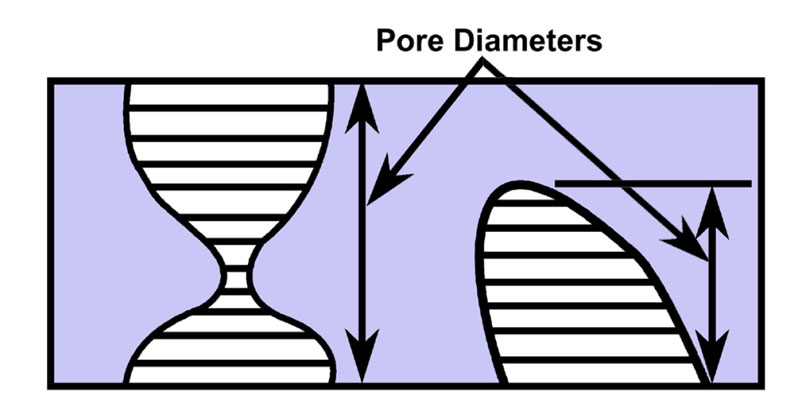
where D is pore diameter, γ is surface tension of mercury, θ is contact angle of mercury and p is pressure on mercury for intrusion into the pore. Intrusion volume gives pore volume. The technique measures pore volume and pore diameter of through and blind pores. As shown in Figure 1, all diameters and volumes of through and blind pores are measured.
Figure 1: All diameters and volumes of through and blind pores measurable by mercury intrusion porosimetry.
In liquid extrusion porosimetry, the pores are spontaneously filled with a wetting liquid and the liquid is extruded from pores by a non-reacting gas. It can be shown that the differential pressure is related to pore diameter2,3:
D = 4 γ cos θ/p (2)
where D is pore diameter, γ is surface tension of wetting liquid, θ is the contact angle of the wetting liquid and p is differential pressure.
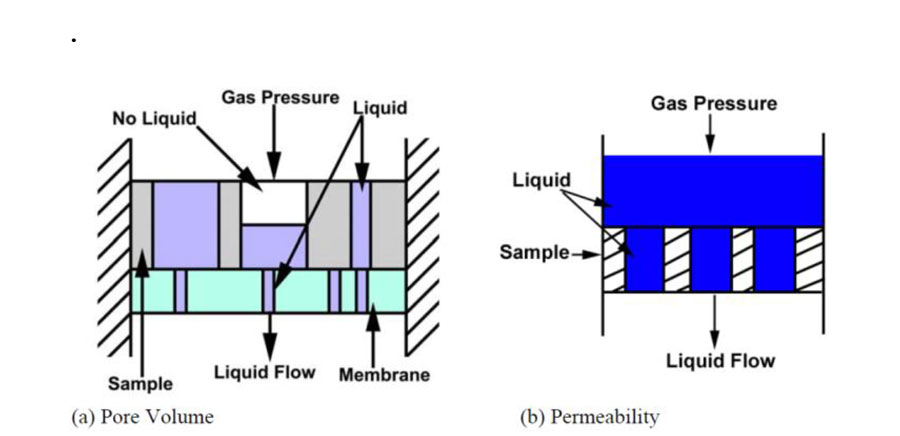
In this method, the volume of extruded liquid is measured in addition to the differential pressure. In order to allow the extruded liquid to flow out and prevent the gas to escape, a membrane is placed under the sample such that the largest pore of the membrane is smaller than the smallest pore of interest in the sample (see Figure 2a). The pores of the sample and the membrane are filled with a wetting liquid and pressure on gas is increased to displace the liquid from pores of the sample. The gas pressure is inadequate to empty the pores of the membrane. Therefore, the liquid-filled pores of the membrane allow the extruded liquid from the pores of the sample to flow out while preventing the gas to escape. The measured volume of the liquid flowing out of the membrane gives through pore volume. Differential pressure yields through pore diameter and variation of volume with pressure yields through pore surface area. Flow rate of excess liquid maintained on the sample yields liquid permeability (see Figure 2b).
Figures 2a and 2b: Principle of liquid extrusion porosimetry
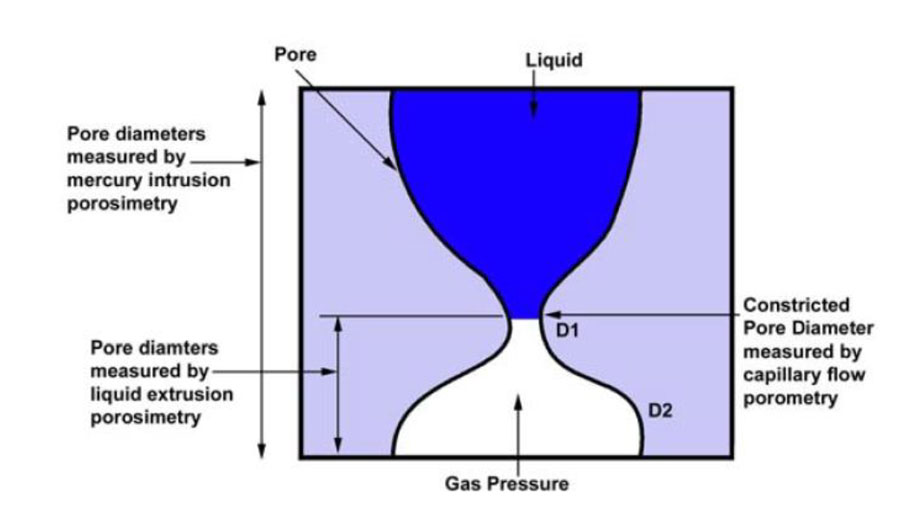
This technique measures only the volume and diameters of through pores (see Figure 3)3. Blind pores are not measured. As shown in Figure 3, only some of the diameters of the through pore are measured, whereas mercury intrusion measures all pore diameters.
Figure 3: Pore diameters of a through pore measurable by Liquid Extrusion Porosimetry
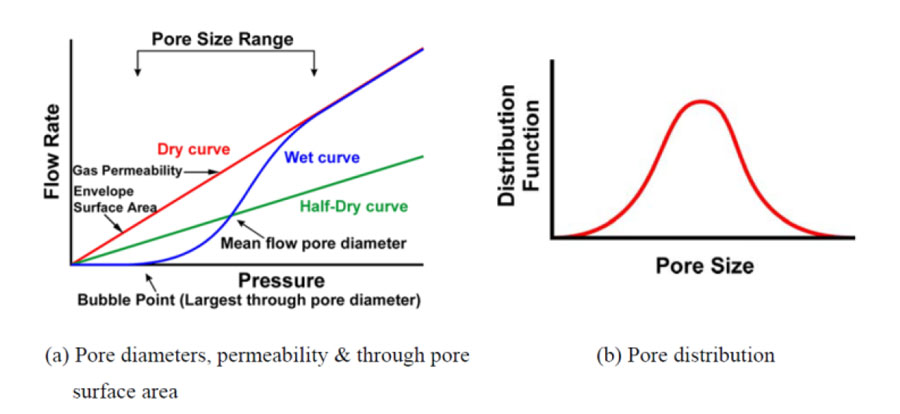
Figure 4: Through pore characteristics measurable by capillary flow porometry
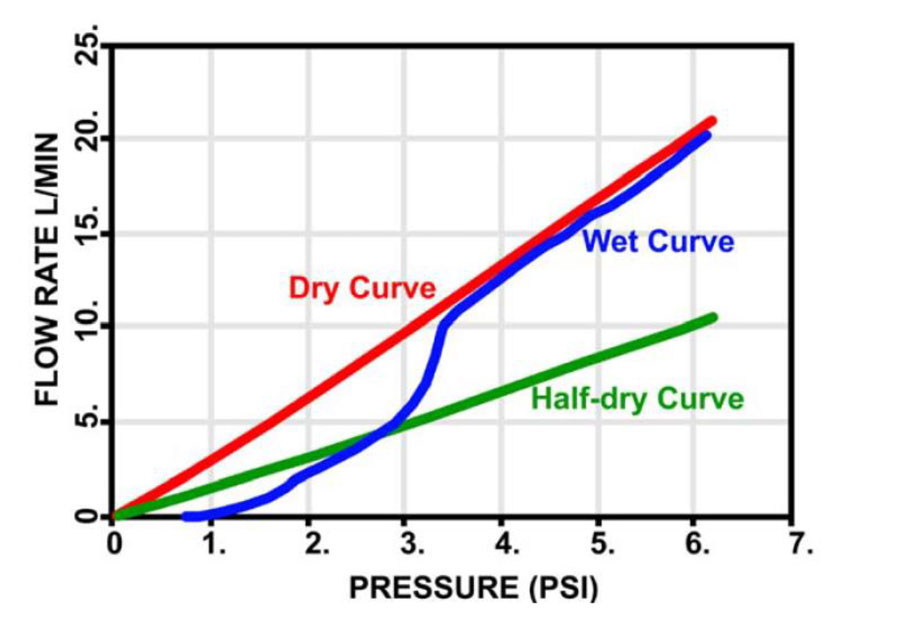
In this method, the pores of the sample are filled with a wetting liquid, the liquid is emptied by a pressurized gas permitting gas to flow through the empty pores. The differential pressure required to empty a pore of diameter D is given by Equation 21,4. It shows that the largest pore is emptied at the lowest pressure and initiates gas flow. With increasing pressure smaller pores are emptied and gas flow increases. The differential pressures and gas flow rates through dry and wet samples are measured. In the dry sample, the flow rate increases with increase in pressure. In case of the wet sample, initially there is no flow because all the pores are filled with the liquid. At a certain pressure the gas empties the largest pore and gas flow starts through the wet sample. With further increase in pressure smaller pores are emptied and the flow rate increases until all the pores are empty and the flow rate through the wet sample is the same as that through the dry sample. This is schematically illustrated in Figure 4. The half-dry curve in this figure is computed from the dry curve to yield 50 percent of flow through dry sample at the same pressure. The dry and wet curves yield the bubble point, the mean flow pore diameter, flow distribution and pore fraction distribution of through pores. The dry curve yields gas permeability and envelope (through pore) surface area. Liquid flow rate gives liquid permeability.
Capillary flow porometry measures only the throat diameter of each through pore. One diameter per through pore is measured. Blind pores are not measured.
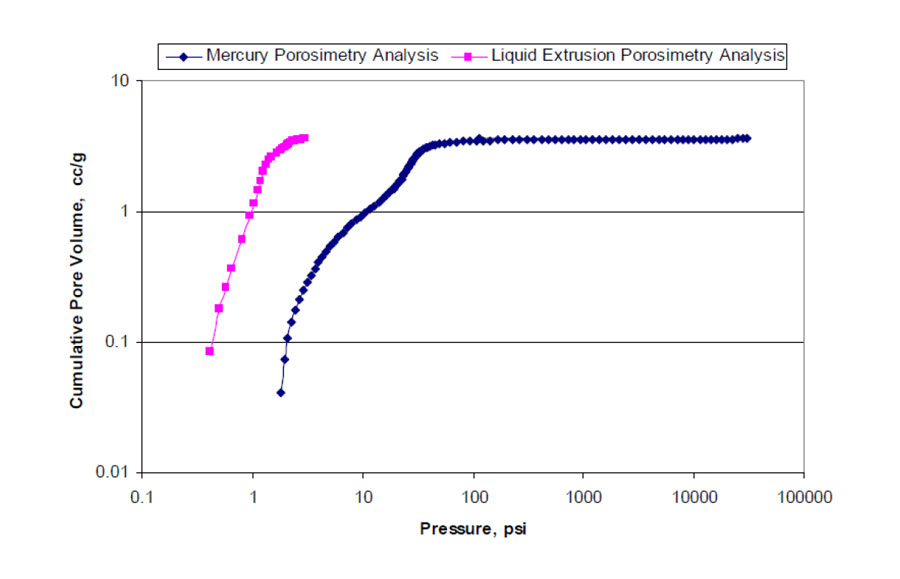
Figure 5: Through pore volume measured as functions of pressure in nanofiber mats using PMI Mercury Intrusion Porosimeter and Liquid Extrusion Porosimeter.
Results And Discussion: Through Pore Volume
Mercury Intrusion Porosimetry yields volume of through and blind pores as a function of intrusion pressure. However, nanofiber mats are not expected to contain appreciable amounts of blind pores. Therefore, the measured intrusion volume is due to the volumes of through pores. Extrusion porosimetry measures only the through pore volume as a function of extrusion pressure. The pore volumes measured in both techniques are shown as function of pressure in Figure 5.
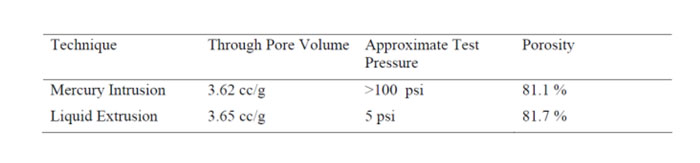
The total pore volumes measured by both techniques are the same (see Table 1). This observation confirms that the blind pores in the nanofiber mats are negligible. However, the measurement pressure for mercury intrusion is almost twenty times higher than the test pressure required for liquid extrusion. The high test-pressure for mercury intrusion is likely to distort the pore structure of nanofiber mats.
Porosity
Blind pores in the nanofiber mat are negligible. Therefore, porosity of the nanofiber mat is computed from the measured pore volume and bulk density of the material. As expected, porosity is high for the nanofiber material. Both techniques yield the same value (see Table 1).
Table 1: rough pore volume, test pressure and porosity measured by the mercury intrusion and liquid extrusion techniques.Figure 6: Pore volume plotted against pore diameter measured by liquid extrusion and mercury intrusion.
Pore Diameter
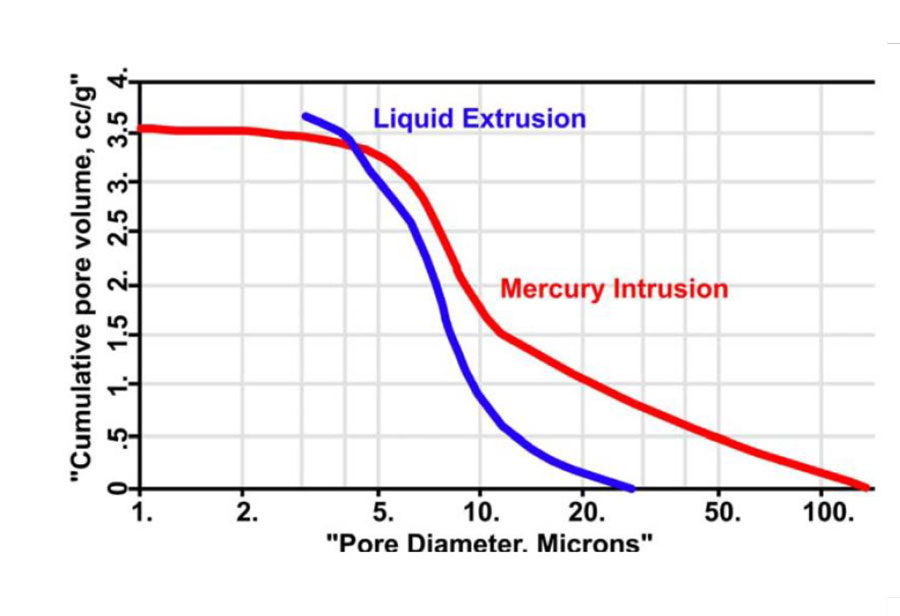
Figure 6 shows a plot of pore volume against pore diameter measured by mercury intrusion porosimetry and liquid extrusion porosimetry. Pore volume of wide pores measured by liquid extrusion is less than the pore volume of wide pores measured by mercury intrusion. But pore volumes of small pores measured by liquid extrusion are larger than those measured by mercury intrusion. Such behavior is expected. As explained above, the diameters and volumes of wider parts of a wide mouth pore beyond the throat are not measured by liquid extrusion porosimetry, but the volumes of these parts of the pore are measured as the volume of the small pore of constricted diameter. Therefore, volume of large pores measured by liquid extrusion is smaller and volume of small pores measured by liquid extrusion is larger than the volumes measured by mercury intrusion.
High intrusion pressure of mercury can also shift the mercury intrusion curve relative to the liquid extrusion curve by distorting the pore distribution. Before mercury intrusion could start, the pressure of mercury can compress the sample and measure intrusion volume due to volume reduction of the sample by compression. Thus, mercury intrusion will show higher intrusion volume when the pores are large. With increasing mercury pressure smaller pores will be reduced in diameter. Although, the volume reduction by compression of the sample is measured as the pressure goes up, the volume of smaller pores are not measured. Therefore, volume of small pores measured by mercury intrusion will be smaller than the volume measured by liquid extrusion.
Figure 7: Differential pressure and flow rate through wet and dry samples of nanofiber mat measured by the PMI Capillary Flow Porometer.
Liquid extrusion and mercury intrusion techniques do not give the pore throat diameter, the largest pore throat diameter and the mean flow throat diameter of the nanofiber mat. Capillary flow porometry is capable of such measurements. The results obtained with capillary flow porometry are shown in Figure 7.
The largest pore throat diameter (bubble point pore diameter) and the mean flow pore diameter computed from the data in Figure 8 are 12.50 and 3.36 μm respectively. Figure 7 shows that the test pressure for this technique is also very low so that the influence of pressure may be taken to be negligible.
Pore Volume Distribution
The pore volume distribution over pore diameter is expressed in terms of the distribution function Fv:
Fv = – (dV/d log D) (3)
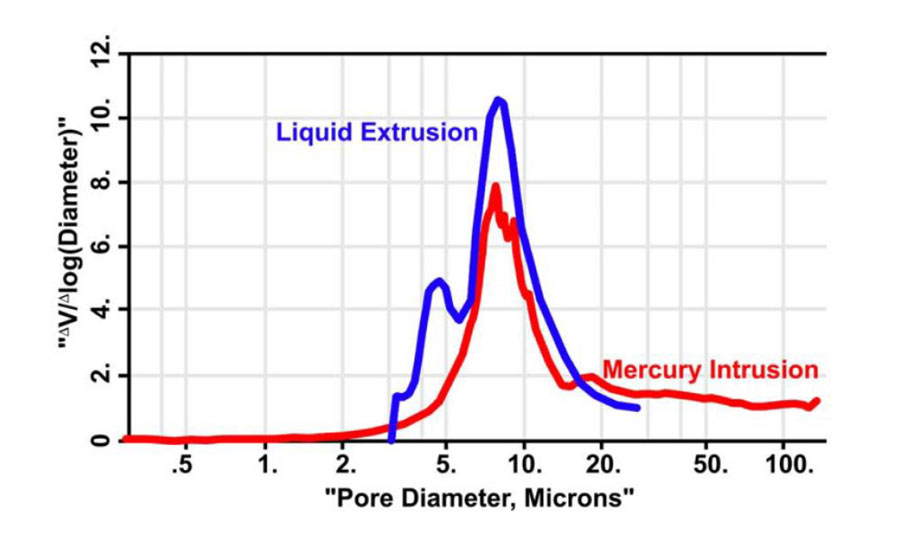
where V is pore volume. The function is such that area under the function in any pore diameter range yields volume of pores in that range. Figure 8 shows the pore volume distribution computed from data in Figure 6 based on mercury intrusion and liquid extrusion.
Figure 8: Through pore volume distribution over pore diameter by mercury intrusion and liquid extrusion.
Mercury intrusion yields only a single peak whereas liquid extrusion yields two peaks. The first peak represents about 75 percent of pore volume and the second peak represents about 25 percent of pore volume. Thus, the resolution is much higher in liquid extrusion. In this technique, smaller pores are more easily detectable because volume of pores beyond the pore constriction is associated with the constricted pore diameter.
As shown in Figure 8, the smaller pores are not seen by mercury intrusion because of the high pressure. With increase in pressure, mercury enters large pores and reduces the diameters of small pores by compressing them. Thus, the peak due to the small pores is suppressed. The flow distribution is expressed in terms of distribution function F:
F = – [(Fw/Fd)×100] /dD (4)
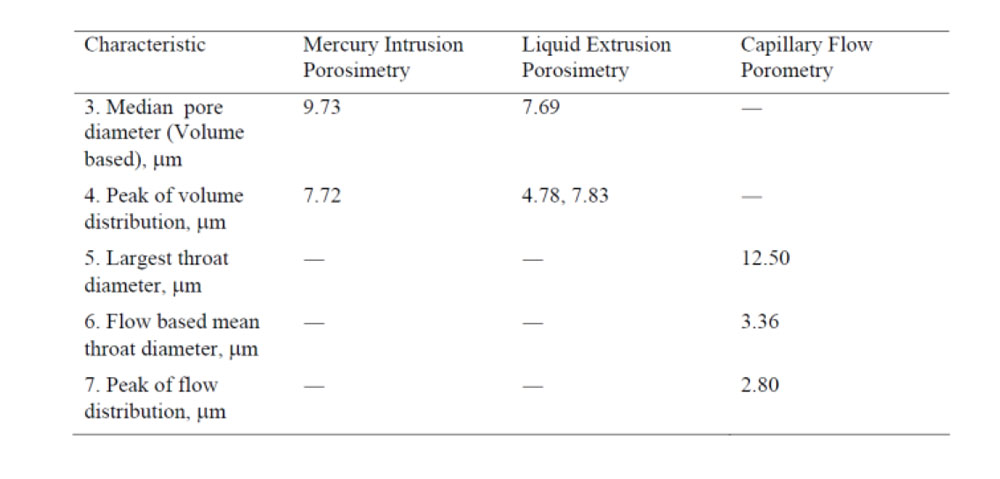
Where Fw and Fd are flow through wet and dry samples respectively. The function is such that area under the function in any pore diameter range is the percentage flow in that range. Figure 9 shows the flow distribution over pore diameter computed from data in Figure 7. The peak of the flow distribution curve is at 2 μm. Characteristics of distributions are listed in Table 2.
Figure 9: Flow distribution over pore throat diameters of through pores of nanofiber mats.Table 2: Characteristic diameters of through pores.
Mercury intrusion yields a larger median pore diameter because the pore volume of large pores measured by mercury intrusion is larger than that measured by liquid extrusion. The volume distribution peak at 4.78 μm is completely suppressed by mercury intrusion. The bubble point diameter is similar to the median pore diameter suggesting that the widest parts of pores are not much larger than the median value. The mean throat diameter and the throat diameter corresponding to the distribution peak are close to the volume distribution peak at 4.78 μm.
Appropriate Technique For Characterization Of Nanofiber Mats
Through pore volume of nanofiber mats can be measured by liquid extrusion porosimetry and mercury intrusion porosimetry. However, mercury intrusion requires high pressures. High pressures reduce pore diameter and further increase in pressure is required to measure the smaller pores. Thus, pore diameters relevant for application are not measured. Pore distribution is suppressed. Peak due to smaller pores is not observed. On the other hand, liquid extrusion requires very little pressure — about 5 percent of the pressure needed for mercury intrusion — produces excellent resolution of peaks and yields the same total pore volume as mercury porosimetry. In addition, liquid extrusion technique is capable of measuring liquid permeability and surface area of through pores, which are important for attachment. Mercury intrusion cannot measure these properties. Therefore, liquid extrusion technique is undoubtedly more appropriate for characterization of pore volumes of nanofiber mats.
For filtration and tissue growth applications, pore throat diameters of nanofiber mats are required in addition to pore volume. Mercury intrusion and liquid extrusion techniques cannot measure pore throat diameter. Capillary flow porometry measures pore throat diameters without distorting pore structure because this technique uses low pressures. Therefore, capillary flow porometry is a good technique to use along with liquid extrusion technique when nanofiber mats are used for filtration applications.
Summary And Conclusion
Mercury intrusion porosimetry, liquid extrusion porosimetry and capillary flow porometry were used to characterize nanofiber mats. Through pore volume, pore diameter, volume distribution and pore throat diameters were measured.
Analysis of results showed that both mercury intrusion and liquid extrusion yielded the same total pore volume and porosity, but pore diameter and distribution were distorted by high pressure applied during mercury intrusion. The pore diameters relevant for application were not measured. Liquid extrusion technique did not have these disadvantages and had much higher resolution. The peak due to small pores was clearly seen
Liquid extrusion technique is the appropriate technique for testing nanofiber mats.
Capillary flow porometry cannot measure pore volume, but uses low pressures and measures pore throat diameters, which are not measurable by liquid extrusion or mercury intrusion. This is the appropriate technique to support the liquid extrusion technique diameter is similar to the median pore diameter suggesting that the widest parts of pores are not much larger than the median value. The mean throat diameter and the throat diameter corresponding to the distribution peak are close to the volume distribution peak at 4.78 μm.
References
Akshaya Jena and Krishna Gupta, “Characterization of Pore Structure of Filtration Media,” Fluid particle Separation Journal, Vol. 14, No. 3, 2002, pp. 227-241.
A. Jena and K. Gupta, “A Novel Technique for Pore Structure Characterization without the Use of Any Toxic Material,” Nondestructive Characterization of Materials XI, Eds. R. E. Green Jr., B. B. Djordjevic and M. P. Hentschel, Springer, 2002, pp. 813-821.
Akshaya Jena and Krishna Gupta ‘Liquid Extrusion Techniques for Pore Structure Evaluation of Nonwovens,” International Nonwovens Journal, Fall 2003, pp. 45-53.
K. Jena and K. M. Gupta, “In-Plane Compression Porometry of battery separators,”Journal of Power Sources, Vol. 80, No. 1-2, 1999, pp. 46-52.
Jena, Akshaya and Gupta, Krishna, “Accuracy and Reproducibility of Pore Size Determined by Flow Porometry” presented at The 14th Annual Technical Conference, The American Filtration & Separation Society, May 1-4, 2001, Tampa, Florida .
Jena, Akshaya and Gupta, Krishna, “Measurement of Pore Volume and Flow Through Porous Materials,” Materials Testing: MP Materialprufung, Jahrg. 44, pp.243-245, 2002.
Editor’s Note: Sudhir Sharma works for Ithaca, N.Y.-based Porous Materials Inc. The company manufactures novel platforms for testing porous materials including nanofiber nonwovens.