TW Special Report
Frankfurt am Main will once again become the global hub of textile innovation when Techtextil and Texprocess 2026 open their doors April 21–24 at Messe Frankfurt Fairgrounds. Organized by Messe Frankfurt GmbH, the dual trade fairs will bring together every link in the textile and apparel value chain, from fiber manufacturers and technical researchers to machinery suppliers and apparel producers.
Held concurrently, Techtextil and Texprocess have become synonymous with progress in high-performance materials, manufacturing technology and sustainable production. The 2026 editions promise a comprehensive look at how digitalization, automation and advanced materials are reshaping the industry’s future.
Reflecting A Complete Textile Value Chain
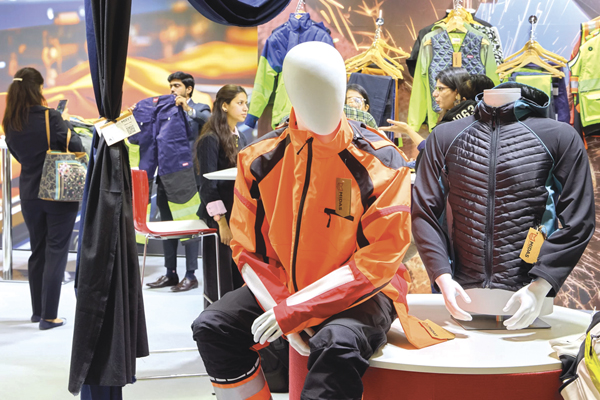
Techtextil will showcase the global scope of technical textiles and nonwovens across 12 application areas, covering the entire spectrum from research and fiber production, to coated fabrics, composites and apparel textiles. Exhibitors will span categories such as fibers and yarns, woven and knitted fabrics, nonwovens, composites, textile chemicals and performance apparel materials, complemented by industry associations, media and consulting organizations.
Texprocess will center on technologies and services for garment and textile processing, including automation, software solutions and digital value-chain optimization, ensuring visitors can navigate from raw materials to finished products within a few exhibition halls.
“The simultaneous staging of Techtextil and Texprocess creates a unique ecosystem,” said Olaf Schmidt, vice president of textiles and textile technologies for Messe Frankfurt. “Especially in times of restrained investment, it becomes clear just how crucial innovative strength is. These fairs are where ideas are not only presented but further developed into market-ready solutions.”
Innovation Under One Roof
Innovation will take center stage at the Techtextil and Texprocess Innovation Awards, which honor pioneering developments in materials, digital processes and sustainable manufacturing. The awards embody the organizers’ vision of connecting research, technology and application — this formula has made the fairs leading launch platforms for industry-shaping ideas.
“The Innovation Awards make this strength tangible, giving new technologies visibility, credibility and often the decisive impetus needed to turn research into industrial application,” Schmidt said.
This year’s themes mirror the industry’s broader transformation. Artificial intelligence and 3D design are increasingly shaping product development, supporting faster iterations, less waste and more agile production models.
Walter Wählt, chairman of the Texprocess Innovation Award and senior director of advanced creation at adidas, underscored the convergence of digital tools and human expertise.“3D design, virtual prototyping and AI drastically shorten development cycles and reduce material use,” he said. “Yet despite all the technological momentum, people remain decisive — creativity, experience and judgment cannot be automated.”
From Lab To Marketplace
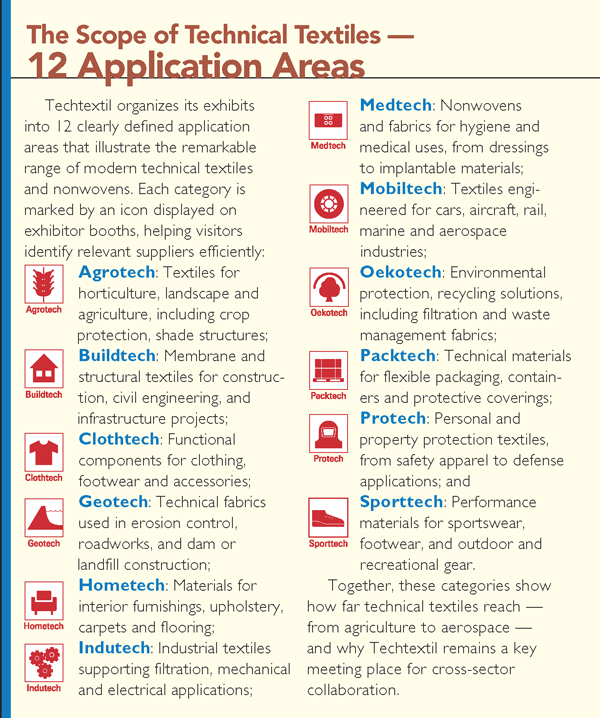
At Techtextil, exhibitors will demonstrate how technical textiles now permeate every sector, organized into 12 application areas — from Agrotech for agricultural fabrics to Mobiltech for automotive and aerospace textiles, Medtech for healthcare, and Sporttech for sportswear and outdoor equipment. This cross-disciplinary format is designed to encourage collaboration: where “car manufacturers meet fashion designers and medical engineers meet industry specialists,” as Messe Frankfurt describes.
The fair’s visual navigation system will again feature easily recognizable icons on exhibitor stands, helping visitors connect quickly with materials and solutions relevant to their production needs.
Among the key themes, sustainability remains a competitive necessity rather than a niche pursuit. António Braz Costa, chairman of the Techtextil Innovation Award and general manager for CITEVE, emphasized the link between scientific research and industrial scale-up. “Sustainability, particularly when applied to high- performance materials and products, only becomes economically viable through a virtuous tandem of research and innovation,” he said. “Recycling technologies, circular solutions or entirely new materials are meaningless if they remain confined to the lab. What matters is their translation into real industrial processes.”
That translation happens most visibly at events like Techtextil and Texprocess, where the interaction between R&D centers, brand engineers and equipment suppliers can accelerate pilot projects into scalable production.
Industry Dialogue In A Time Of Transition
While economic uncertainty and geopolitical tensions continue to challenge global supply chains, many experts view innovation as the sector’s most reliable growth engine. In a recent press discussion announcing the 2026 fairs, speakers from technology providers and brand manufacturers echoed this sentiment, pointing to innovation as a stabilizing force during market volatility.
“Today, innovation serves both as a lever for efficiency and a driver of growth,” noted Elgar Straub, managing director of VDMA Textile Care, Fabric and Leather Technologies. “Digitalization, automation and AI enable companies to conserve resources, produce flexibly and reposition themselves more effectively and competitively.”
Such perspectives resonate with an industry in transition. Beyond automation and AI, sustainability and circularity are bringing research-driven startups, fiber laboratories and system integrators into closer dialogue with multinational manufacturers. That convergence, Messe Frankfurt representatives say, is exactly what defines Techtextil and Texprocess: a live environment for the cross-pollination of ideas.
Innovation As A Strategic Imperative
The 2026 editions will again illustrate how innovation — from smart textiles and bio-based fibers to limit-pushing processing technologies — is not merely a marketing theme but a strategic imperative for survival in a rapidly evolving global economy.
 Each biennial event historically draws thousands of visitors from more than 100 countries. While exhibitor numbers will be confirmed later this spring, organizers expect strong international participation, reflecting the continuing demand for efficiency, sustainability and technical performance.
“Research, development and scalable implementation thrive best when the entire value chain is present,” Schmidt added. “That’s why Techtextil and Texprocess happen side-by-side — this is how ideas turn into results.”
As April approaches, the textile world will once again look to Frankfurt for insight into what’s next. Whether through automation breakthroughs, fiber innovation or sustainable design systems, Techtextil and Texprocess 2026 will provide a concentrated look at the future of global textile manufacturing — where technology, creativity and collaboration converge.
2026 Quarterly Issue I