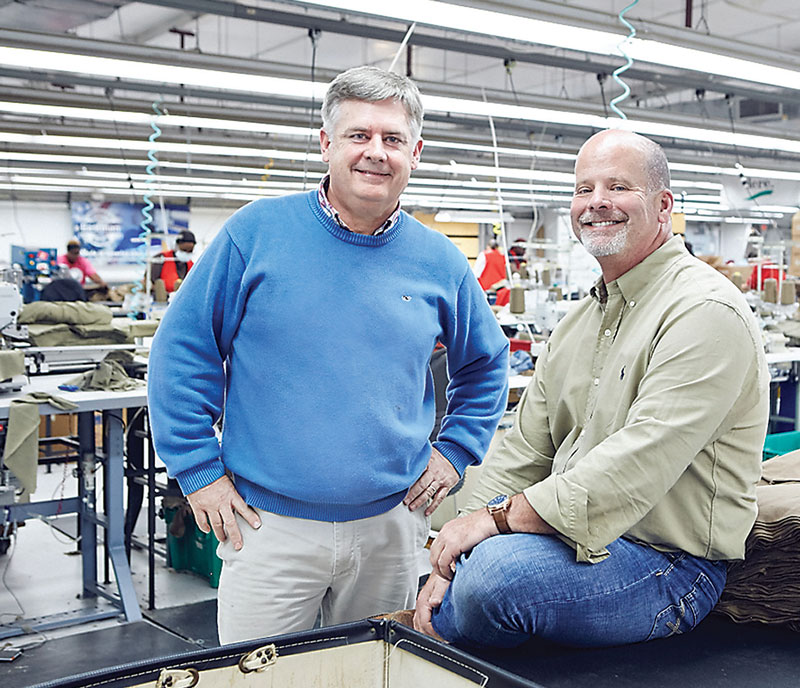
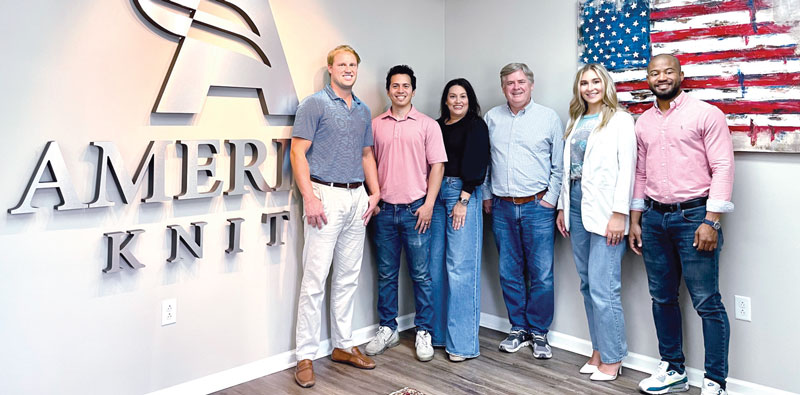
America Knits is a modern cut-and-sew operation in rural Georgia built with a mission to revive “Made in America” and create a new story.
By Rachael S. Davis, Executive Editor
Anyone who has spent time in the textile industry knows its greatest strength has always been the people. And it was these warm, welcoming people who made heart surgeon Dr. David Talton fall in love with the industry after tagging along with his lifelong best friend —apparel industry veteran Steve Hawkins — to a handful of trade shows and conferences.
In 2018, Talton, looking for a new challenge and enamored with the textile industry, and Hawkins, looking for a lifestyle change, decided to partner creating America Knits — a company dedicated to producing premium, high-quality Made in America apparel in Swainsboro, Ga.
Cut-And-Sew Experience
Hawkins has been on a remarkable journey in the cut-and-sew business from the time he graduated college with a degree in finance. From Reelsboro and Ayden, N.C., to Honduras — requiring his first passport at age 35 — and back to the United States in Swainsboro, Ga.
He didn’t expect to work in the apparel industry. “I thought maybe I’d work in a bank,” Hawkins said. But through his part time job, he met Skip Hudson who owned five cut-and-sew plants in and around New Bern, N.C., where Hawkins grew up. “Hudson asked me one day what I was going to do after graduation because he knew I was a senior,” Hawkins recalls. “I really didn’t know, and Hudson asked if I’d like to learn about the sewing business. He said his company was taking a different approach and was looking for some-one fresh out of college to teach the business. They wanted to find some-one that could think outside the box.”
This chance offer set Hawkins on a course that would dictate his career to date. After learning about the cut-and-sew business at Hudson’s Reelsboro facility, an investor helped Hawkins open his own cut-and-sew business in Ayden at the young age of 25. The business thrived staying busy from 1988 until 1994, when the North American Free Trade Agreement (NAFTA) came along. “NAFTA marked the first time since I had opened my plant that we saw a slowdown, and it was the first time I’d ever had to lay anybody off” Hawkins said.
He had never owned a passport, so when a colleague in the business asked if he’d ever considered going overseas, Hawkins did not immediately entertain the idea. But when he learned if he set up a plant in Honduras that he could keep it running 52 weeks a year, he was intrigued and decided after some more research, to take the leap. “That’s where I learned a lot of the full package part of the business,” he said. “I also made many connections with Parkdale, as well as other spinners.”
But in a now well-known twist of events, cut-and-sew work slowly began to move to Asia and work was harder to come by in-between seasons for Hawkins’ Honduras facility. He decided to return to the United States and went to work for a larger, global manufacturer in sales and production management. It was a job he enjoyed, and it allowed him to further his knowledge of the business with another layer of learning. But the extensive traveling required to visit customers and offshore facilities meant he was missing out on home-life with his wife and sons. “I wanted a lifestyle change,” Hawkins said. “I had two young boys that were in first and fifth grade and I was missing everything because I was traveling all the time.”
At that point in his life, industry friends were urging Hawkins to consider opening a plant in the United States again. “That’s where David comes in,” Hawkins relayed. “We had been best friends since kindergarten, and we’d always wanted to be in business together. You’d have to know David, but I guess saving lives wasn’t exciting enough for him,” Hawkins said with a chuckle. “And that’s what brought us to this little town with a population of 7,000 people in Georgia called Swainsboro.”
New Facility: Different By Design
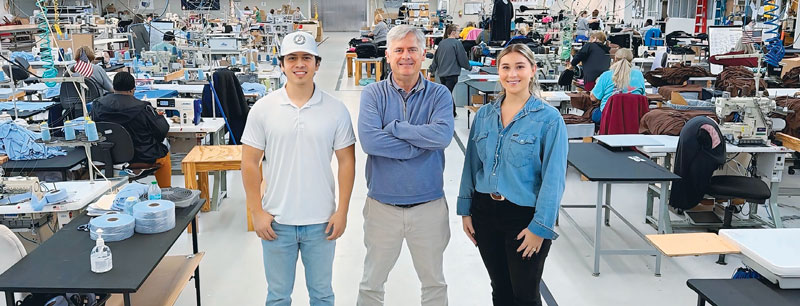
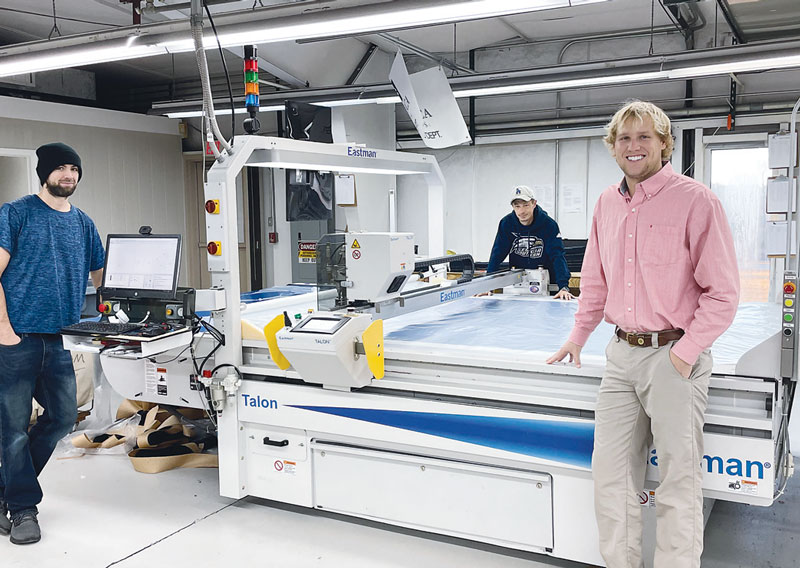
Attracted by the potential work-force in Swainsboro, the duo first identified a good building for the plant and then invested in state-of-the-art equipment from the very beginning. They hoped to differentiate America Knits from other plants in the United States. “We knew the facility had to be something different and spent a good bit of money to outfit it and make it like we wanted it to be,” Hawkins said. “We wanted to avoid the old school thinking of ‘let’s get it as cheap as we can and just get started with used equipment.’ My theory was that we need the plant to look different, it needed to be bright, attractive and a place people would want to come to work.”
Displayed prominently on the plant floor is the company’s slogan, “Together, we are building a new story.” Hawkins really believes in this idea. “The slogan really applies to the employees on the floor — we can only talk about it,” he said. “The story we are building has to be created by everyone involved in America Knits.
“We also hope that when visitors enter our facility that they see the quality of everything we do, not just the quality of the shirts we make,” he said. “If you have a clean, organized facility, I think that environment naturally promotes quality.”
Immediate Pivot
No sooner had Hawkins and Talton got America Knits up-and-running making basic T-shirts, the Covid pandemic hit. “Just like everybody did at that point in time, we pivoted and figured out how to make personal protective equipment [PPE] like masks and isolation gowns,” Hawkins said. “As a cut-and-sew company in the United States, we were quite fortunate because there weren’t many companies to turn to for help.”
In 2020, Parkdale Inc. led an effort to build a coalition of companies to respond to the nation’s need for PPE, and America Knits was honored to be included in the group. Hawkins said the collaborative effort generated a lot of free publicity for the fledgling company. “We were the smallest company in the group, but for a period of time, every night our name was mentioned on national television!” he said proudly.
That initial exposure attracted the attention of the State of Georgia and Governor Brian Kemp. In 2021, America Knits was invited to the governor’s State of the State speech where the company was highlighted for its efforts to make PPE during the height of the pandemic and the willingness of its employees to step up and work even though there were so many unknowns. That exposure led to more work for the company producing shirts for the Georgia prison system at a time when inmates couldn’t work in factories within prisons. “It was definitely hard times, but the exposure built us to where we became a recognized company within the state of Georgia and we have received really friendly treatment from everyone involved, as well as numerous state recognitions,” Hawkins said.
Current And Future Capabilities
As the supply chain shortages created by the pandemic eased, America Knits refocused on its original business plan. The company currently has the capacity to produce a total of 20,000 pieces a week in an assortment of premium T-shirts, polos and sweatshirts — all made using fabric sourced from U.S.-based manufacturers. A recent expansion investment added screen-printing, embroidery and laundry equipment.
Hawkins emphasized fit is something that is very important to consumers and that it is therefore important to him that the shirts sold by America Knits are true to size and remain so after home laundering. America Knits’ new washing and enzyme equipment allows the company to precisely control the size of the finished garments.
The company aims to add garment dyeing in the not-too-distant future, and possibly even some spinning capability one day.
America Knits also is working closely with a Germany-based automation company that is developing robotic technology for T-shirt assembly. “We are sending them cut parts as they need them so they can tweak and experiment making T-shirts using robots,” Hawkins shared. “When they are ready — and they are getting closer — we hope to get a machine in our plant as a beta site.”
Employees First
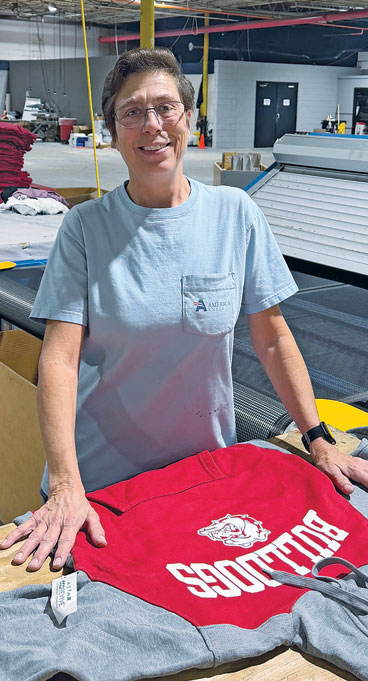
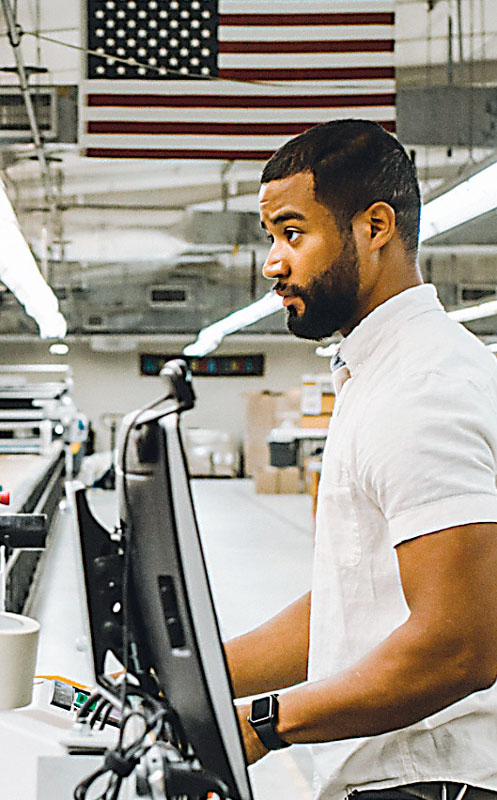
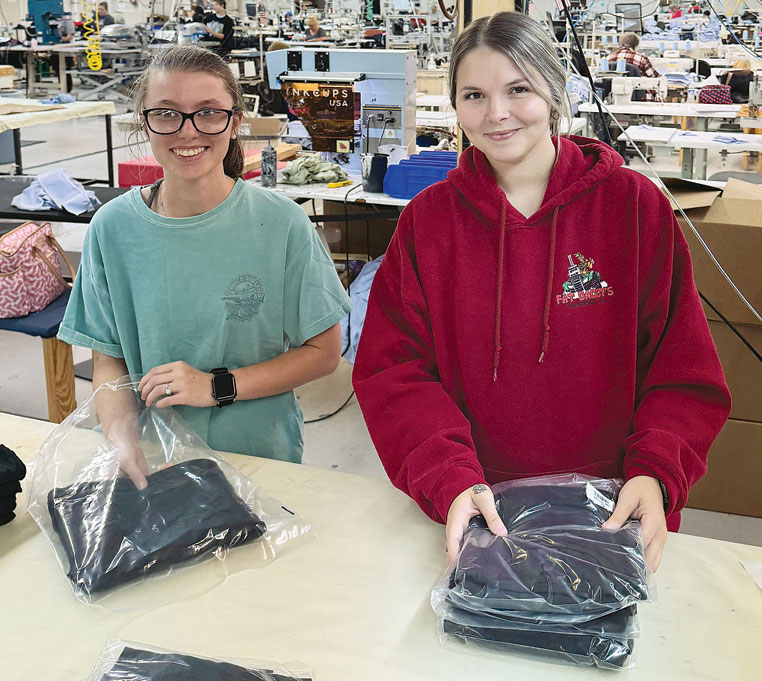
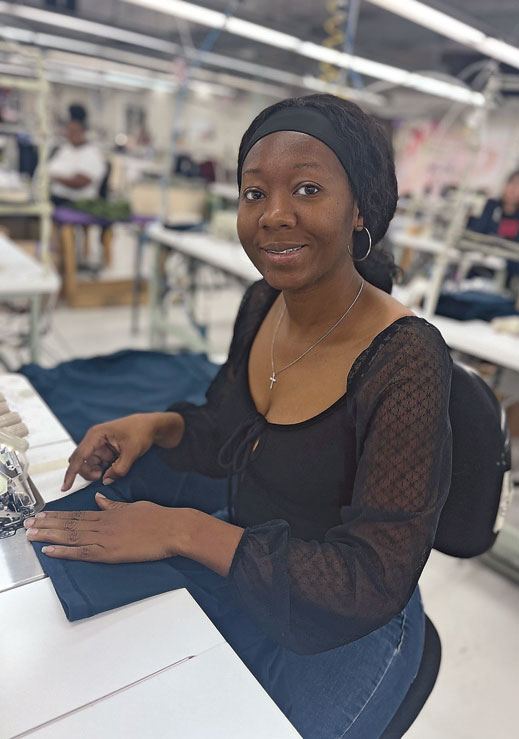
As of today, the company employs 53 local people. In many cases, those associates are quite familiar with the sewing business. “We are trying to rejuvenate a business where for many of our employees, their mothers, fathers and sometimes grandparents worked in sewing plants when they were young,” Hawkins said. “I think engaging employees is important,” he added. “We need to make sure they know what the goals are, and what the vision is for what we are trying to build. We also want them to feel proud of where they are from.”
“Made in Small Town America” is imprinted in every shirt America Knits makes. “That idea means something to me,” Hawkins said. “There isn’t a large enough workforce for us to grow in Swainsboro, but I would like to replicate the business model in other small towns. I think it’s possible because by automating some of the tasks, we’ve made it a nicer place to work.”
Hawkins credits his wife, Alejandra, with suggesting employees be known as VIPs. They also make a point to celebrate birthdays at the plant. They hope such efforts will attract younger people into the business.
Another change America Knits made to the traditional cut-and-sew business model was to eliminate tying wages to production quantities. It was confusing to employees and sometimes meant losing good people because they didn’t fully understand and connect the hourly wage with the incentivized pay. “We took everyone’s average wage from the prior year and made that their guaranteed salary,” Hawkins said. “We still set goals for the teams but find they are more diligent about reaching the goals now than when they made money for production. We still have set costs, but we know the team costs per hour and in the end, we still get what we need. It was a game changer.
“We also encourage employees that the more they crosstrain, the more jobs they can do and the more raises they can earn!”
Workforce Development
Hawkins understands the value of training and educating the work-force. He never forgot Hudson’s willingness to give him a chance to learn from the ground up when he was a new college graduate.
“We have a really young middle management team at America Knits that is learning this business, and we take on interns and new graduates to learn as well” he shared. “Our goal is to keep layering on new people —hopefully those that have the ambition to eventually start their own plant someday. I believe in character. I hire the people who may not have the knowledge, but they have the character. For someone with the right character, the sky is the limit!”
When it comes to nearshoring the apparel industry in the United States, Hawkins says the solution is obvious, but not easy to implement. “The problem with scaling and ramping up U.S. manufacturing is the lack of middle management,” Hawkins shared. “This industry is valued in small towns, but once an industry has been gone more than 20 years, middle managers are retired or have moved on to other work. Unfortunately, the middle management aspects of this business are not learned in one month, six months or even a year in most cases. It takes two-to-three years to become a good mechanic or maintenance guy or shift supervisor. Without those people, it’s hard to make good product.”
He noted that middle management positions pay more and it’s not feasible as a small business to double up on such positions while people are training. In order to expand, experienced people who can hit the ground running are needed so a new plant can generate revenue while also training new people. Hawkins said the ability to bring in trained people from other countries is one way to open facilities faster and with less risk, but as a major political issue, it’s not a popular idea.
While America Knits did not receive any government funding or assistance when it first opened because of its very small size, the company has since been able to take advantage of some incentive programs. “Georgia has a program where they will pay half of a trainee’s salary for up to 12 weeks,” Hawkins said. “We underwent an expansion and did participate in that program, and it went really well.”
Growing, Expanding, Collaborating
In 2020, America Knits joined the Field to Closet initiative — a program designed to increase demand for cotton fiber, reward growers and support communities — to help with a medical scrub project. The group put together a supply chain in the state of Georgia to make scrubs for rural hospitals that were struggling to get the PPE they needed. The cotton was grown and yarn spun in Georgia, fabric was made in the Carolinas, and the all-cotton scrubs were cut and sewn at America Knits.
This collaboration led to a second Field to Closet project with Lumberton, N.C.-based Contempora Fabrics Inc. for clothing brand J.Crew.
The J.Crew collaboration allowed America Knits and Contempora Fabrics to become better acquainted, and the companies have since partnered outside of Field to Closet, with Contempora acquiring a stake in America Knits. “Partnering with Contempora is one of the best things that happened to us since we started the company,” Hawkins said. “We now have the credibility of a partner that has more than 50 years in business, and one that shares a philosophy and has similar culture to our own. In addition, together we form a completely vertical factory, and we are not dependent on anyone.” The companies hope that together, they can build a stronger U.S.-based garment supply chain. A new beanie and cap product line was announced this year as part of this partnership.
Branching Out: Seeds II Seams
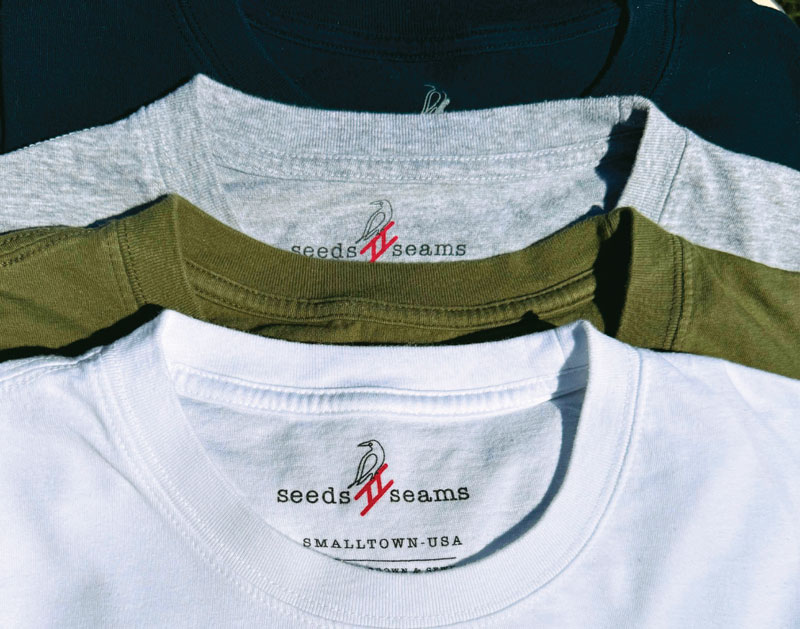
When brainstorming on future ideas with Field to Closet executives, Hawkins realized the next step for America Knits was to start its own brand. The discussions led to the Seeds II Seams brand, which was developed with focus on sustainability and is 100-percent American made. The brand logo incorporates a crow because as the crow flies, there is only 238 miles between the links in the complete supply chain for the brand’s garments. In comparison, based on a recent independent study, the average T-shirt sold in the United States travels 17,000 miles from fiber to finished product.

Challenging, But Exhilarating Career
While ruminating on his challenging career in the apparel cut-and-sew industry, Hawkins laughed and said: “I always thought it would be fun to be in sports in some way — maybe as a head football or baseball coach. But maybe this is almost the same in a weird way. You have professional people with God-given talents, and you put them together as teams. Then you have to motivate the teams and have to try to get them to pull together in the same direction to hit your numbers.” It’s an analogy that while unexpected, surprisingly works.
Hawkins also spoke of adrenaline and the extremely competitive nature of the business. “It’s competitive in that you are trying to accomplish goals on a daily and a weekly basis, which causes a lot of stress” he said. “But if you’ve been in this business for a long time, you get addicted to the stress and the excitement and ultimately surviving!”
Hawkins has not only survived but thrived in the cut-and-sew industry adapting, rebuilding and learning at every turn. And with its partner, Contempora Fabrics, and an eager workforce, America Knits is poised for whatever comes next — a future Hawkins approaches with the same curiosity, grit and affection for the industry that has carried him through more than 30 years.
2025 Quarterly Issue IV