A 55-piece collection showcases the climate-positive AeoniQ™ cellulosic yarn designed to rival polyester and nylon in performance.
By Rachael S. Davis, Executive Editor
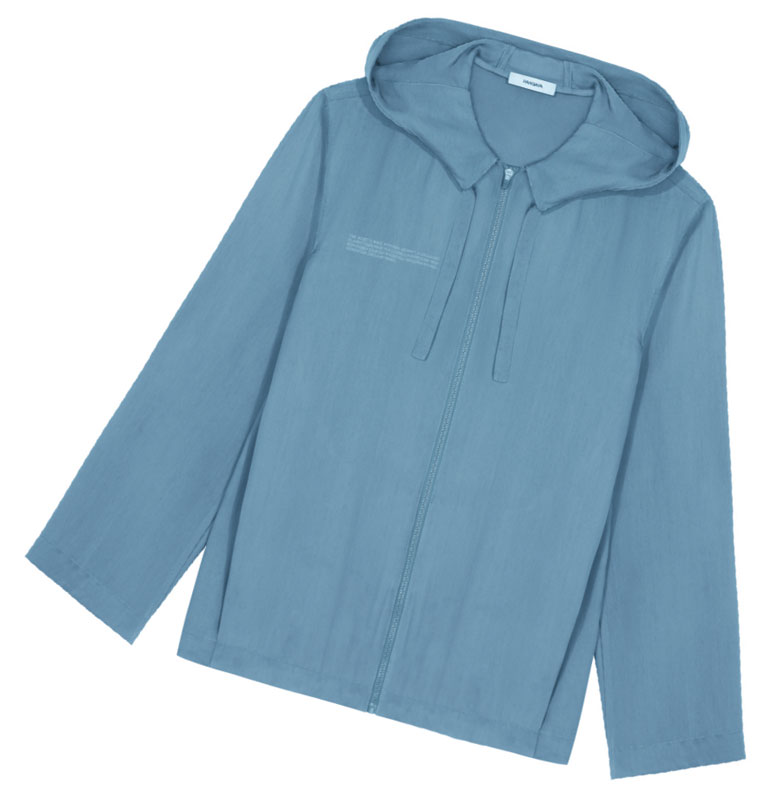
London-based PANGAIA — a company established to scale cutting-edge material solutions — recently introduced a limited-edition 55-piece capsule collection of hooded jackets, half-zip overtops and straight-leg trousers made using AeoniQ™ cellulosic filament yarn developed by HeiQ, Switzerland. An alternative to fossil-fuel derived fibers, AeoniQ was designed to imitate the performance of polyester and nylon while offering closed-loop circularity.
HeiQ and PANGAIA have previously collaborated, and “Over time, our partnership has evolved to explore more transformative technologies that can shift the textile industry toward regenerative, closed-loop systems,” said Chelsea Franklin, head of Advanced Concept Design, PANGAIA. “AeoniQ represents the next chapter of that collaboration, a truly circular, climate positive alternative to synthetics like polyester and nylon.”
Renewable cellulose feed-stocks, including wood and eucalyptus pulp, form the starting materials for AeoniQ, making the fiber fully recyclable and biodegradable. When used in place of polyester, the fiber may reduce emissions by up to 3.2 kilograms of carbon dioxide equivalent per kilogram of yarn, according to assessments by Amsterdam-based Fashion for Good and South Pole, Switzerland.
AeoniQ is a continuous filament with a smooth, lustrous surface; and innate tenacity, abrasion resistance and drape. “The performance properties are inherent in the AeoniQ filament itself,” Franklin shared. “HeiQ’s proprietary spinning technology allows precise control over filament formation, giving the yarn its strength, resilience and smooth hand feel.” Yarn twist and fabric density as well as final fabric weight also can impact durability in the finished garments. Applications include both apparel and technical textiles.
According to Franklin, AeoniQ does not fibrillate so it maintains a smooth and stable finish with no pilling, which makes it different to typical cellulosic fibers.
“Additionally, AeoniQ can be texturized, providing diverse hand feels and allowing designers and manufacturers greater flexibility in creating both soft and structured textiles, something not possible with traditional cellulosic fibers,” Franklin shared.
For the capsule collection, PANGAIA worked closely with both HeiQ and Italy-based mill Beste to develop the 100-percent AeoniQ fabric. “The capsule was intention-ally limited, only 55 pieces, to showcase the material’s potential and validate its performance through design,” Franklin said. “HeiQ is currently scaling AeoniQ production with plans to increase capacity over the next year. As availability increases, PANGAIA is exploring a broader application of AeoniQ across product categories where performance and circularity intersect.
“At PANGAIA Lab, we believe design plays a critical role in bridging scientific innovation and cultural desirability,” Franklin said. “By translating new materials like AeoniQ into timeless wearable pieces, we can help shift perception, showing that responsible innovation can be both advanced and accessible.”
For more information, visit pangaia.com.
2025 Quarterly Issue IV