With its robotic apparel manufacturing platform and microadhesive technology, startup company CreateMe is pioneering a new approach to apparel production that could help bring manufacturing back to U.S. shores.
TW Special Report
It’s a widely accepted fact at this juncture that reshoring cut-and-sew operations in the United States is going to require some use of automation and robotics in order to overcome a trained labor force shortage, among other issues.
Founded in 2019, Newark, Calif.-based CreateMe is on a mission to combine automation, robotics and advanced adhesive technologies to transform apparel manufacturing. Originally a small innovation lab, the company has grown into a multi-disciplinary technology organization that employs a team of engineers, chemists and designers — all operating with a start-up mindset — to bring sustainable garment production closer to the consumer.
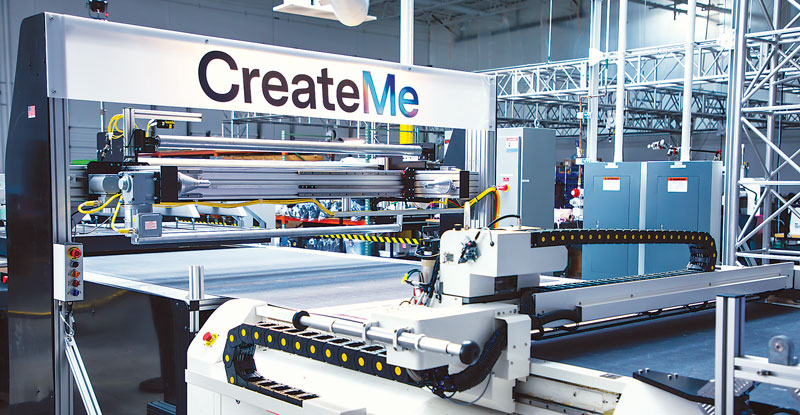
CreateMe recently announced the launch of its robotic apparel manufacturing platform as well as the first commercial grade products made using the technology — women’s intimates. The Modular-engineering Robotic Assembly (MeRA™) paired with a proprietary microadhesive technology named Pixel™ provides “a scalable, high-precision platform that replaces traditional sewing for longevity, shortens production timelines, and enables sustainable, on-demand manufacturing in the U.S.,” according to the company.
CreateMe notes that the apparel industry generates 92 million tons of textile waste and loses more than $180 billion to inefficiencies tied to speculative production.
“CreateMe enables a new business model for the industry — responsive, localized, on-demand manufacturing that replaces forecast-driven production with data-driven precision,” said Cam Myers, CreateMe’s founder and CEO. “Our value lies in transforming how apparel is made and how manufacturing works, making it faster, cleaner, and closer to demand.”
Textile World recently had the chance to speak with CreateMe’s Myers to learn more about this apparel manufacturing platform — with more than 200 prototypes, more than 1,000 process tests and almost 100 issued patents — and its potential to bring manufacturing closer to the consumer.
TW: What led to the development of MeRA and the Pixel microadhesive technology?
Myers: The development of MeRA and Pixel grew directly from CreateMe’s mission to redefine how apparel is made. Traditional sewing and offshore production had reached their limits — too slow, too labor-intensive, and too resource-heavy to support the future of on-demand, sustainable manufacturing. Rather than improving legacy processes, our team chose to rebuild them entirely.
By uniting robotics, computer vision, and adhesive science, our engineers and materials scientists developed MeRA, a modular robotic assembly platform, and Pixel, a precision microadhesive technology that bonds fabrics without thread. Designed in tandem, they form a single integrated system that enables faster, cleaner, and more flexible production, laying the foundation for truly scalable, on-demand apparel manufacturing.
TW: Automation in soft goods is notoriously difficult, especially when handling soft, drapey fabrics. How does the CreateMe technology handle those issues?
Myers: Soft-goods automation has long been constrained by the nature of fabric; it stretches, drapes, and shifts unpredictably, making precision control extremely difficult. CreateMe tackles this from the ground up through advanced material-handling and assembly algorithms. Our systems use specialized end-of-arm tools and vacuum fixtures to maintain fabric tension and alignment, effectively transforming a deformable textile into a stable, robot-readable surface.
The MeRA platform is designed to assemble as much of each garment as possible in 2D, where accuracy and throughput are highest, before transitioning into controlled 3D operations for forming or joining. Traditional sewing is especially hard to automate because it demands two-sided access, continuous feeding and dynamic thread control. Our Pixel microadhesive bonding process removes those constraints, enabling static, single-sided assembly with precise edge alignment and integration into 3D molds or shaping tools.
Building on this foundation, CreateMe’s Physical AI software extends our machine-learning and computer-vision algorithms into a unified control layer that adapts in real time to different fabrics and garment types. It’s what allows our systems to achieve fine-dexterity manipulation and industrial-grade repeatability across one of manufacturing’s most variable and complex materials.
TW: Can you talk about how the adhesives work and if there are any limitations compared to sewing?
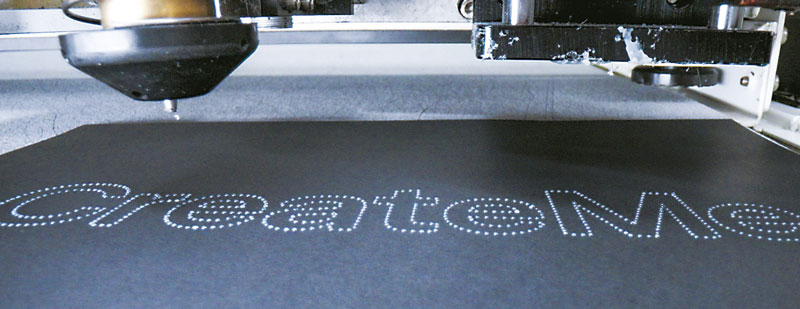
Myers: Unlike traditional sewing, which mechanically stitches fabric together with thread, CreateMe’s process uses precision robotics and Pixel microadhesive technology to bond materials at the fiber level. This approach eliminates puncture holes, reduces bulk, and creates seamless, flexible joins that enhance comfort, durability and design freedom. The adhesives are engineered to be lightweight, washable, and compatible with a broad range of fabrics, and in some cases thermoreversible, allowing garments to be reheated and separated for recycling.
Integrated within CreateMe’s MeRA robotic platform, the process is faster, more consistent, and easily automated, enabling scalable, on-demand production that minimizes waste and inventory risk. While certain niche applications or highly textured materials may still favor traditional stitching, CreateMe’s bonded construction meets or exceeds sewn performance across strength, comfort and sustainability metrics.
TW: How durable and sustainable are the bonded garments? What’s the potential for recycling?
Myers: CreateMe’s bonded garments are engineered for both durability and sustainability. The Pixel microadhesive forms strong, flexible bonds that often exceed sewn seams in tensile strength and wash performance, maintaining integrity through repeated wear and laundering.
On the sustainability side, the process eliminates thread, minimizes material damage from needle punctures, and supports on-demand, localized production — reducing excess inventory, transport and waste. A major advantage of CreateMe’s adhesive platform is its recyclability potential: certain formulations, known as Thermo(re)set™, are thermoreversible, allowing bonds to be safely released under controlled heat so fabrics can be separated and recycled by material type.
This capability creates a pathway toward circular manufacturing — where garments can be disassembled, reclaimed, and reintroduced into production rather than discarded.
TW: Is the technology proprietary and only to be used in CreateMe facilities, or is it something you foresee licensing to other producers?
Myers: Our technology is proprietary by design, forming the foundation for both our own manufacturing operations and select licensing partnerships. Within apparel, we’re already engaging with partners on a license-to-operate model while continuing to scale production within CreateMe-operated facilities. Longer term, the versatility of our underlying platform also opens opportunities in adjacent industries that rely on the assembly of technical textiles, such as automotive, aerospace, home goods and medical, where we expect to extend licensing as well.
TW: What’s the potential for reshoring and nearshoring in the United States?
Myers: The potential for reshoring and nearshoring in the United States is both significant and accelerating. Over the past decade, fragile global sourcing models have buckled under freight disruptions, tariffs, and geopolitical shocks, costing retailers tens of billions and exposing the limits of offshore dependency. What once promised cost efficiency now drives overproduction, poor demand matching and mounting risk.
Over the next five years, we expect a more balanced, matrixed supply chain to emerge. Today, more than 95 percent of apparel manufacturing remains offshore; that mix should evolve toward roughly 70 percent offshore, 15 to 20 percent nearshore, and 10 to 15 percent onshore. The goal isn’t full reshoring; it’s diversification and resilience. By producing closer to demand, brands can reduce lead times, cut waste, and respond dynamically to market shifts.
Technology is the unlock. Digital tools are reshaping design, planning, and product intake to align production with real-time demand, while robotics and Physical AI will enable automated, cost-competitive manufacturing closer to the point of sale. This convergence will give rise to a new generation of responsive supply networks that are faster, leaner
and more transparent.
TW: What are some of the biggest challenges facing wide-scale re/nearshoring especially in cut-and-sew operations?
Myers: In the United States, the challenge extends far beyond labor costs. Decades of offshoring have eroded the physical and technical infrastructure that once supported domestic manufacturing. Mills, dye houses, trim suppliers, and equipment manufacturers have largely disappeared, creating critical gaps in the upstream supply chain. Even with mounting pressure from tariffs, sustainability mandates, and consumer demand for transparency, most brands face a hard truth: there simply isn’t enough local capacity or expertise to bring production back at scale.
True reshoring requires more than intent; it requires rebuilding capability from the ground up. That means new tools, new infrastructure, and new forms of collaboration to reconnect the entire value chain. Without dependable access to raw materials, finishing, and components, even the best-equipped cut-and-sew operations struggle to scale. This is where automation and robotics become essential. By digitizing and linking every stage of production, from design to assembly, technologies like CreateMe’s MeRA and Pixel platforms make onshore manufacturing not just viable, but economically competitive.
The most forward-looking brands are proving the model first, then scaling it. Pilots and automated microfactory programs demonstrate that onshore production can compete on cost, quality, and speed; each success signals confidence that draws in capital and accelerates capacity investment. As those deployments grow, they directly expand domestic cut-and-sew, or bonded-assembly, capacity, rebuilding the foundation of a modern, technology-enabled manufacturing base. These compounding wins form the blueprint for a resilient, regionally balanced supply network that replaces fragile, far-flung chains with intelligent, localized production systems.
TW: Do you think there are things the government could do to further incentivize companies to reshore operations?
Myers: Absolutely. Reshoring depends on creating the right economic and innovation conditions for apparel manufacturing to thrive locally. That means aligning tax incentives, procurement policy, and workforce development to make domestic production both viable and competitive, and the current administration deserves real credit for bringing greater focus to this effort.
In recent years, we’ve seen a policy shift toward rebuilding American manufacturing through legislation such as the CHIPS and Science Act (2022) and, most recently, the One Big Beautiful Bill Act (2025), which provides immediate expensing for qualified manufacturing investments, including machinery, automation and other production equipment. For companies like CreateMe, these measures accelerate ROI on new manufacturing lines, bonded-assembly systems and AI-enabled production technologies, directly improving the economics of onshore production.
The proposed FABRIC Act could be even more transformative for apparel and textiles. It represents the first comprehensive, bipartisan effort to reestablish a competitive U.S. apparel base, pairing strong worker protections with meaningful incentives for domestic production, supply-chain rebuilding and facility investment. If enacted, it would directly support the kind of infrastructure renewal, workforce development and technological advancement required to make U.S. apparel production globally competitive and environmentally sustainable.
Government procurement is another powerful lever. The U.S. remains one of the world’s largest purchasers of apparel — uniforms, workwear and protective gear among them — but smaller, technology-driven manufacturers often face barriers to participation. Stream-lining qualification and contracting processes, or piloting procurement programs that prioritize innovative and automated facilities, would open this channel to next-generation domestic producers.
Finally, workforce development must advance in parallel. Programs modeled on those in semiconductor and advanced-manufacturing sectors, focused on digital design, robotics and systems integration, would ensure reshoring creates future-ready jobs.
TW: How do you position the company as both disruptive and compatible with the current apparel supply chain?
Myers: Our platform, anchored by a deep IP portfolio, operates on a made-for-demand model that transforms the speed and economics of apparel manufacturing. Instead of the 30- to 120-day offshore cycle, brands can design, sell, produce, and ship in 5 to 30 days. That 10-fold acceleration lets companies respond to real-time demand, reduce inventory exposure, and minimize waste. Automation stabilizes costs, reduces labor dependency, and breaks reliance on fragile offshore supply chains; brands gain faster speed to market, and consumers get better products.
The core disruption lies in efficiency and circularity. Traditional offshore models depend on long lead times and overproduction, creating both financial and environmental inefficiency. By eliminating those inefficiencies, CreateMe improves unit economics while setting new sustainability standards. Our fully automated bonded assembly, powered by proprietary thermoreversible adhesives, allows garments to be both assembled and disassembled at scale, making true circular fashion viable. Unlike stitching or permanent adhesives that block recycling, our process allows trims, zippers, and fabric layers to be separated easily for reuse.
At the same time, CreateMe is built for compatibility. The platform integrates directly with existing digital design and production workflows, connecting to standard CAD files and automated cutting systems, to extend today’s CAD/CAM automation into the assembly phase. Where traditional manufacturing hands off to manual sewing, CreateMe continues the digital thread, using bonding and robotics to maintain precision, consistency, and efficiency through final construction. This plug-in compatibility gives brands and manufacturers a practical on-ramp to automation while accelerating the shift toward scalable, onshore production.
And because any technology in apparel must scale to matter, we’ve engineered CreateMe for high-volume categories first, starting with T-shirts and underwear, where throughput, waste, and impact are greatest.
TW: What is your long-term vision for the CreateMe platform?
Myers: CreateMe’s mission is to redefine how all apparel is made. We’re building toward a future where digital bonding, robotics, and Physical AI form the foundation of how clothing is designed, produced, and experienced. Over the next decade, we see a systemic shift in apparel manufacturing that mirrors the transition from internal combustion to electric vehicles, driven by consumer demand for performance, sustainability, and speed. Digital bonding will replace sewing as the dominant method of garment construction, delivering products that are more comfortable, longer lasting, and cleaner to produce.
This transformation begins by uniting digital design and manufacturing, allowing brands to move from static, labor-dependent models to intelligent, data-driven systems that produce exactly what’s needed, when and where it’s needed. By connecting design software, material science, and automated production, CreateMe enables true mass customization at scale, closing the loop between creativity, commerce and circularity.
While apparel is our starting point, the same tools and software that power digital bonding and robotic assembly can extend to footwear, accessories, furniture, automotive interiors, and other consumer products. The convergence of digital design, advanced materials, and intelligent automation will redefine how products are made across industries — faster, cleaner, and closer to demand.
TW: What are the company’s greatest strengths and how do you differentiate from competitors?
Myers: While others are optimizing legacy systems, CreateMe is building the next industrial platform — one that enables cost-competitive, onshore manufacturing at scale and positions brands to thrive in a market defined by speed, sustainability and resilience.
We’ve reimagined how apparel is made from the ground up. CreateMe achieved a world-first with the commercial launch of two integrated technologies that replace sewing and manual handling with robotics, AI, and precision bonding: MeRA and Pixel microadhesive technology. Together, they form a unified platform that delivers a step change in precision, efficiency, and circularity. MeRA is an intelligent robotics and AI platform that automates garment assembly end-to-end, enabling fully digital production lines that remove the need for sewing entirely. At its core, Pixel forms precision-bonded seams less than one millimeter wide, stronger, lighter, and more consistent than traditional stitching. Its Thermo(re)set formulation allows garments to be disassembled cleanly at end of life, unlocking true circularity and large-scale textile recycling. Pixel™ also brings new functionality to apparel, from thermal regulation and moisture management to enhanced comfort and design flexibility.
With nearly 100 patents granted, CreateMe’s technology establishes the foundation for a new model of manufacturing, faster, cleaner, and more adaptable than anything before it. Our first commercial deployment in women’s intimates validated both technical and economic viability, and we’re now expanding into high-volume categories such as T-shirts and everyday apparel. Each MeRA line is designed to produce over one million units per year, delivering garments up to twenty times faster and with double the precision of manual methods.
TW: Why do you do what you do? What motivates you?
Myers: We’re motivated by the ingenuity and grit of the people determined to transform this industry— the engineers, scientists, designers and entrepreneurs who refuse to accept “business as usual.” Every day, we’re inspired by forward-thinking partners who are building new models and proving that apparel can be made better, smarter, and closer to home.
At the same time, we’re driven by the industry’s inertia. Despite years of conversation around sustainability and innovation, real change has been slow. The technology to make apparel more responsibly already exists; it takes conviction to move beyond entrenched, volume-driven systems.
At CreateMe, we’re turning that conviction into action. Our work is about proving that a different future for apparel isn’t theoretical — it’s within reach, and we’re building it.
2025 Quarterly Issue IV