By Alessandra Olisia Medeiros
C
onsidering “Print Design as a Driver of the Textile Industry,” the world of print design connects creativity, technology, and engineering, and it is one of the main drivers of innovation within the textile industry. More than an aesthetic element, print has become a force that propels the development of new materials, machinery, and industrial processes.
Over the past decades, surface design has encouraged manufacturers to create faster, more precise, and more sustainable equipment, reducing waste and opening space for new forms of visual expression.
As Audaces, a technology leader in fashion innovation, explains: “The art of producing prints is millenary and, like most textile processes, has evolved alongside the industry’s technological and industrial development — with more and more digital technologies being incorporated into processes that were once manual.”1
From Art To Industrial Process
Since the earliest civilizations, humans have expressed their ideas through images. On walls, fabrics, and paper, the first forms of painting and printing emerged, eventually giving rise to what we know today as textile printing. With the Industrial Revolution, this artistic practice transitioned into an industrial process, laying the foundation for a field that merged creativity and engineering.2
Modern screen printing owes much to the 1960s, when technological advances allowed production to meet industrial demand. One of the key figures was Michael Vasilantone, founder of Vastex in Philadelphia, who developed a dual rotary printing press in 1967. This innovation enabled fabric printing with greater speed and accuracy, transforming screen printing from an artisanal practice into a scalable, industrial process.3
Another significant milestone was the development of new inks. Early water-based inks were slow to dry and difficult to control. The introduction of plastisol, made from PVC particles, changed the game. It offered higher viscosity, greater durability, and stability, enabling consistent, long-lasting results. This evolution expanded creative possibilities, allowing designers to explore layered effects, 3D-textures, and more intense colors, merging artistic expression with industrial efficiency.
Balancing Technique And Art
Automation transformed screen printing without eliminating human touch. Operators remain essential for feeding garments and ensuring quality control, but the difference in productivity is remarkable: while a manual press can produce 40 to 100 T-shirts per hour, an automatic press can print more than 2,000 garments per hour.
According to FESPA, the world record reached 2,139 T-shirts per hour, demonstrating how automation redefined textile production speed and scale.4 Even so, manual printing maintains its artistic value. Many manufacturers today combine both methods, creating hybrid workflows, using automation for large runs and manual presses for smaller or specialized projects.
Contemporary screen printing also continues to evolve through tactile and sensory effects, such as puff, glitter, and glow-in-the-dark inks, which some of them have a little difficult to replicate digitally. This ability to create unique textures and visual depth keeps screen printing relevant in the digital era.
When Design Drives Technology
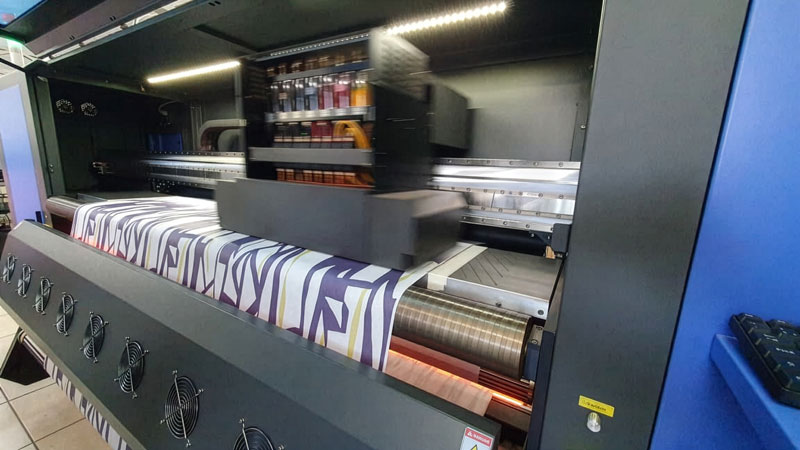
As screen printing advanced, digital textile printing began to reshape the industry. With the arrival of DTG (direct-to-garment) and, more recently, DTF (direct-to-film) technologies, it became possible to print directly onto fabric or transfer designs onto various materials, eliminating screens, reducing setup time, and enabling faster and more flexible production.
These methods expanded the creative freedom, allowing designers to produce highly detailed, colorful, and customized artwork that was previously impossible with traditional techniques. According to Kornit Digital, a leading manufacturer in the field, these processes combine “photographic quality with on-demand production,” serving both the fashion and promotional markets.5
This progression demonstrates how design continues to drive industrial innovation: as designers and brands pursue new forms of expression, manufacturers respond by developing smarter machines and more sustainable processes.
Designing The Future
Today, innovation in textile printing is closely tied to sustainability. The industry’s pursuit of more conscious practices has led to the use of low-impact inks, the adoption of 3D digital prototyping and sampling, which reduces water consumption and fabric waste, and the growth of on-demand production systems that minimize excess inventory. This integration of technology and sustainability shows that print design goes far beyond aesthetics, it plays a crucial role in the technical and ethical progress of the textile industry, bringing new solutions that combine agility, cost efficiency, and environmental responsibility.
Print design remains a vital bridge between creativity and textile engineering. Every industrial innovation begins with a creative vision that pushes technical boundaries and inspires new possibilities for fashion and design. As technology becomes smarter and production processes more sustainable, the designer’s role grows even more essential, positioned at the intersection of art, innovation, and efficiency. When creativity and technology work in harmony, fabric ceases to be just material; it becomes a true expression of innovation. That’s why collaboration between designers and industry is so important, together, they shape new technologies that combine the best of both worlds.
In addition, designers today are deeply engaged in monitoring trends in consumption behavior and market needs. Because they are close to brands and in tune with what the end consumer demands, they could be able to propose innovations to machinery and production systems. Working collaboratively, designers and manufacturers can co-create next-generation technologies that better reflect both aesthetic vision and industrial feasibility, shaping processes that elevate entire product ecosystems.
References
1 Audaces Blog. “Estamparia Digital: A arte de produzir estampas é milenar…” (2023). https://audaces.com/pt-br/blog/estamparia-digital
2 WNY Book Arts Center. “A Brief History of Screenprinting.” https://wnybookarts.org/a-brief-history-of-screenprinting/
3 Everpress “A Brief History of T-Shirt Screen Printing.” https://everpress.com/creator-toolkit/a-brief-history-of-t-shirt-screen-printing/
4 FESPA “Automation in Screen Printing.” https://www.fespa.com/en/news-media/analysing-the-benefits-of-automation-in-screen-printing-for-textiles/
5 Kornit Digital. “What Is Direct to Garment Printing – A Full Guide.” Published July 2024. https://www.kornit.com/magazine/what-is-dtg-printing-a-full-guide-kornit/
Editor’s Note: Alessandra Olisia Medeiros is founder and creative director of Brazil-based Olisia Design Studio
December 1, 2025