INDEX™20 Exhibitor Preview: Reifenhäuser Reicofil

TROISDORF, Germany — October 18, 2021 — Reifenhäuser Reicofil will exhibit at the nonwovens trade show INDEX in Geneva (booth 2531) October 19-22, 2021. Under the slogan “Living Nonwovens”, the nonwoven line specialist will showcase solutions for the production of sustainable nonwovens for a wide range of applications.

“Nonwovens often accompany us from the first to the last day of our lives. In diapers, face masks or air filters, the material contributes to our well-being, safety, and comfort. Nonwovens are close to our skin so they deserve only the highest quality. This is what we stand for, this is what we live for,” explains Markus Müller, sales director at Reifenhäuser Reicofil. “We also assist our customers to sustainably produce nonwovens from biobased raw materials or recycled material to leverage the global shift in sustainability as an opportunity.”

In fact, sustainable nonwoven production starts with the amount of material used – the less raw material needed, the better. The “Reicofil 5x” line series is specialized in this application and achieves fabric weights of 8 gsm (grams per square meter) or even less through efficient downgauging, even on 1000 m/min Composite lines containing 3 Spunbond beams.

In addition, Reicofil customers can reduce the use of fossil raw materials on request by processing biobased raw materials as an ecological alternative — for example for diapers. The topsheet material, made of bulky, soft, and industrially compostable high-loft nonwovens, meets maximum hygiene requirements at the same time.

For industrial applications, high-strength nonwovens can be processed even from up to 90-percent PET flakes from post-consumer waste. This is how Reicofil shows perfect ways to combine sustainability and high-performance nonwovens.

In the medical sector, the line manufacturer will also be exhibiting its leading solutions for high-barrier medical protective clothing. In addition, meltblown nonwovens for face masks — still in great demand in many regions due to Covid — provide reliable safety and are helping to combat the pandemic worldwide. Reicofil technology therefore guarantees maximum safety, with filtration efficiencies of up to 99% (N99 / FFP3 standard), minimum quality fluctuations, and extremely high line availability at the same time.

With the current RF5 machine generation, Reicofil also sets benchmarks in terms of quality, performance, availability, efficiency, and machine intelligence — for challenging applications in hygiene, medical, and industrial sectors.

Posted October 18, 2021

Source: Reifenhäuser GmbH & Co. KG Maschinenfabrik

STOLL Training Courses: Introduce A New Software For The Creation Of Knitwear Designs

OBERTSHAUSEN, Germany — October 18, 2021 — With k.innovation CREATE, a new design software from STOLL and KM.ON, the flat knitting industry is getting a powerful tool that combines knitwear design with 3D product development and knit production. The functions offered include shape creation and grading, digital stitch and yarn development and data export for the simulation in any 3D software.

STOLL explains how these can be used efficiently in practice-oriented training courses. The courses for 2021 last two days, are conducted online and are held in English. Target groups are mainly knitwear designers, but also pattern makers, knitwear producers and 3D artists. Prior knowledge of flatbed knitting structures, stitch formation principles, yarns and 3D product development is a plus.

The content of the courses accordingly focuses on the most important software functions required for the digital development of knitwear. Corresponding training exercises and a manual also provide support for daily work with the software. At the end of the course, each participant receives a certificate.

The first training was held in September 2021. Others will be held:

  • October 27 and 28;
  • November 17 and 18; and
  • December 8 and 9.

STOLL is looking forward to its course participants. Registration is possible under: training@stoll.com.

Posted October 18, 2021

Source: KARL MAYER Gruppe

HDry ® North America Launch Of HDry ‘b5’: A Technically Advanced Bio-Based Laminate Membrane

BETHEL, Conn. — October 18, 2021 — Altexa S.r.l. and GHS Holdings announces the launch of HDry® ‘b5’ a bio-based, waterproof laminate, for the Summer- Fall Market season 2021. HDry® will be attended the in-person the Functional Fabric Fair in Portland, Ore., November 17-18.

Top tier brands are on board and feedback is exceptional for HDry, the most advanced technology for waterproofing outdoor products through direct 3D lamination of a waterproof-breathable membrane. It’s another step forward in ecological technology for “direct lamination,” in waterproof outdoor performance products.

HDry is committed to its role in protecting the environment. Its innovative manufacturing processes and materials used throughout the lamination process are well above industry standards and aim to reduce the environmental footprint of the outdoor and apparel manufacturing industries. The new HDry ‘b5’ bio-based membrane offers the opportunity to reduce dependence from fossil fuels on a high-end active performance gear with a high bio-content rate (53%), resulting in the highest range of responsible technical performance.

“This new bio-based version of our membrane at HDry replaces the majority of the petroleum in our process with a non-edible bio-based corn derivative, we are working to maintain our premium performance characteristics where waterproof-breathable performance is concerned, while at the same time reducing the negative environmental impact our product has on the ecosystem,” said Gary Schloss with GHS Holdings, distributor to HDry NA. ”We are working hard to set our brand apart from market competition with an alternative that offers best in class protection from the elements while continuing to build on our sustainability story.”

The existing HDry compound is made by a polyurethane ester-based waterproof-breathable membrane combined with thin polyester knit. Material saving and lightness are its greatest advantages. HDry is PTFE-free, and no per fluorinated compounds (PFCs, PFOs, PFOAs, etc.) are used in its production. HDry does not contain any restricted substance of REACH–ECHA list and is OEKO-TEX certified.

The “HDry” brand name derives from the abbreviation of the chemical name for water (H2O), coupled with the word “Dry,” and it signifies the connection between this technology and water.

Posted October 18, 2021

Source: Altexa srl

INDEX™20 Exhibitor Preview: Indorama Ventures’ Hygiene Fibers Group

BANGKOK, Thailand — October 19, 2021 — The Hygiene Fibers Group of Indorama Ventures (IVL) comes together at the Index Show in Geneva, October 19-22, to present an all-inclusive range of recycled and biodegradable solutions for Hygiene Fiber and Nonwoven applications.

The combination of polymers, technologies, processes and global reach supported by the Hygiene Fibers Group — one of three business segments that make up Indorama Ventures — positions it uniquely within the Hygiene industry to meet increasingly challenging market demand for innovative sustainable solutions within the hygiene sector. Across the six brands and companies that make up Hygiene Fibers Group — Auriga, Avgol, FiberVisions, Indorama Asia, Trevira and Wellman International — sustainability and supporting customers to achieve circular objectives is integral to all efforts and fundamental to the ethos of the Hygiene business segment.

At the Index Show, the Hygiene Fibers Group will launch CiCLO®, a textile technology which allows polyester and other synthetic materials to biodegrade like natural materials do in wastewater treatment plant sludge, sea water and landfill conditions, reducing synthetic microfiber pollution generated during washing, and minimizing plastic accumulation in landfills caused by discarded textiles.

Involved in PET Recycling, IVL is fully committed to the delivery of a circular economy and also recognizes that alternative sustainable technologies, such as CiCLO® textile technology, provide valuable alternative solutions when recycling may not be possible. In line with the company’s commitment to support customers with high performance products, while also reducing the impact on the environment, several of the  Hygiene Fibers brands, including Wellman International, Trevira GMBH and Auriga, have been working closely over the last 12 months with the IAM team and the CiCLO® technology. Developments have focused on PET and rPET staple fiber and filament sustainable solutions for applications where recycling is particularly challenging, such as Hygiene, Home Textiles and Automotive applications.

Strengthening the profile of biodegradable offerings within the Hygiene Fibers Group’s sustainability portfolio, Trevira will introduce a new range of bicomponent fibres based on PLA and PBS (polybutylene succinate) at the Index show. Both biopolymers offer an exceptional technological opportunity in terms of environmental care and sustainability, while delivering optimum performance. Equally to PLA, PBS is recyclable and up to 100-percent biodegradable under industrial conditions.

Efforts towards supporting customers to achieve circular objectives are a priority within the Hygiene Fibers Group. This is reflected in the recycled fibers expertise deployed across the segment. Four Hygiene Fibers Group brands, IVL Asia, Auriga, Trevira and Wellman International offer an extensive range of 100-percent recycled, accredited PET fibers, across a multitude of fiber and nonwovens applications. Through investments and evolving technological advancements,  Wellman International, as pioneers in recycling technologies for over 50 years, has broadened the range of PET that can be processed into other PET applications towards achieving a circular economy. The segment’s rPET product portfolio is represented under the  Deja™ brand platform, differentiated in the market by a performance-led suite of sustainable solutions that helps customers to achieve their sustainability targets, while also responding to end-consumers’ demand for transparency and environmental responsibility. All brands look forward to productive discussions at Index on how IVL Hygiene rPET fibers can help support customer objectives and targets.

The development and evolution of sustainable technologies is central to activity across IVL’s Hygiene Fibers Group, with particular focus on sustainable polyolefin solutions. FiberVisions and ES-FIBERVISIONS, leading Polyolefin mono and bico fiber brands and sister company Avgol, have partnered with UK-based Polymateria to commercially harness the innovative ‘biotransformation’ technology pioneered by Polymateria. The patented technology alters the properties of polyolefins to make them biodegradable in a natural process.  Other polyolefin sustainable innovations within the Hygiene Fibers Group being featured at Index include biosurfactant and biocolourant developments being undertaken by the Avgol team with FiberVisons progressing sustainable design solutions, including lightweight, high performance, reduced carbon solutions. All developments are featured at Index and the team welcome the opportunity to explore how these developments can support customers sustainability goals.

Shachar Rachim CEO, Hygiene Fibers Group said: “Integrated within the IVL Hygiene Group is extensive knowledge, experience and a true commitment to Sustainability, which will be evident in the innovations and products being featured on our booth at the Index Show. This is reflective of the priority which we as a business attach to this fundamental issue. Within the IVL Hygiene Group, we take this responsibility very seriously and Sustainability is strategically embedded in all of our efforts’.

Posted October 18, 2021

Source: Indorama Ventures Public Company Limited (IVL)

Milliken & Company, A&E Honored With Visit From USTR Katherine Tai

United States Trade Representative (USTR) Ambassador Katherine Tai recently visited Milliken & Company and American & Efird (A&E) on a tour organized by the Washington-based National Council of Textile Organizations (NCTO). Ambassador Tai first toured Milliken’s Magnolia plant in Blacksburg, S.C., then participated in a round table discussing the role women play in the textile industry, the critical need for domestic supply chain policies in Washington, and the contributions of the textile industry to the overall U.S. economy. At A&E’s plant in Mount Holly, N.C., Ambassador Tai followed up a tour by participating in a round table with textile executives from the fiber, yarn, fabric and finished products sectors of the industry. Discussion topics included the competitiveness of the U.S. industry, priority issues in Washington, and ways to support the domestic industry with Berry Amendment and Buy American policies.

“Milliken is honored to host Ambassador Tai at our Magnolia plant to discuss not only the invaluable contributions we make every day to our community and our nation, but also the
importance of sound trade policies that bolster domestic production and the co-production chains we have built, in particular with our Western Hemisphere trading partners,” said Chad McAllister, executive vice president of Milliken & Company and president, Textile Business.

“It was an honor hosting Ambassador Tai at our manufacturing facility in Mount Holly, employing 380 valued associates and just 2 miles from where the company started 130 years ago,” said Sim Skinner, CEO of Elevate Textiles, A&E’s parent company. “We had an engaging discussion with the Ambassador on our company’s and industry’s innovation and competitiveness, and on the policy priorities that we believe will help ensure our competitiveness and long-term investment in the domestic textile industry.”

“As United States Trade Representative, I am committed to helping all of your companies build on the success by finding market opportunities and helping reach new customers,” said Ambassador Tai. “I want to ensure that our trade policy matches the innovation and changes happening in the textiles industry. With your help, we can continue addressing critical issues. In doing so, we will help the textiles industry maintain its competitive edge and ensure it remains a global standard-bearer in the years to come.”

September/October 2021

Glen Raven Invests $70 Million In Custom Fabrics Division

Glen Raven Inc., Glen Raven, N.C., has announced plans to expand its custom fabrics division in Anderson County, S.C. The $70 million investment will add a distribution facility to the company’s existing operation along with new equipment and processes to improve overall efficiency and capacity. In addition, the expansion includes enhancements to the location’s Sunbrella manufacturing assets with new finishing capacity, material flow technology, and inspection and sampling upgrades. All upgrades are expected to be operational by early 2023. All told, the investment will create 135 new jobs.

The cost of site preparation and building construction will be defrayed by a $400,000 Set-Aside grant to Anderson County from the Coordinating Council for Economic Development.

“We’ve been a proud part of the Anderson County community since 1986, and over the decades, dedicated and skilled South Carolinians have been critical to our growth,” said Leib Oehmig, Glen Raven CEO. “We are thrilled to expand on our great partnership and look forward to creating more growth for our company and the community, together.”

“New jobs and investments are important to a strong and healthy economy,” said South Carolina Governor Henry McMaster. “We appreciate Glen Raven Inc.’s commitment to Anderson County and the state of South Carolina, and we look forward to their continued growth.”

September/October 2021

Auria Announces $12.4 Million Expansion

Automotive flooring, acoustical and fiber-based solutions company Auria, Columbia, S.C., announced it will invest more than $12.4 million to grow its operation. The expansion, which will take place incrementally over the next two years, will create 103 jobs.

“We are proud to be able to grow our business and build on our future at the Spartanburg plant,” said Auria Vice President of Operations Mike Van Booven. “We know we can continue to count on Spartanburg’s talented, dedicated workforce to help us deliver best-in-class automotive products to our customers.”

“This announcement is a terrific win for the Upstate … we congratulate Auria on their expansion in Spartanburg County,” said South Carolina Secretary of Commerce Harry M. Lightsey III. “This announcement is further proof that South Carolina is an ideal location for businesses to grow and thrive.”

September/October 2021

Supply Chain Crush, Labor Shortages

By James M. Borneman

Markets in general are about people — and more importantly the emotions and fear they choose to act on.

Whether it is stocks, gasoline, the latest Xbox or toilet paper, consumers currently are moving markets by sharply increasing demand and, in some cases, well beyond the capacity of supply chains to replenish the surge.

The supply chain for textiles has suffered as well, not just imports of apparel but also goods and inputs throughout the supply chain.

A new surge appears to be happening today regarding Christmas shopping. More and more people — consumers and press — seem to be chatting-up fears of shortages
in a range of goods from appliances to apparel.

According to the monthly Global Port Tracker report recently released by the National Retail Federation and Hackett Associates, “Imports at the nation’s largest retail container ports should remain at near-record levels this month but could see a slight dip from last year’s unusually high numbers as congestion slows the movement of backed-up cargo.”

There may be shortages, but retailers want to maximize sales and have taken
steps to do so in this challenging market.

In a recent Barron’s article by Jack Hough titled, “Why Global Shortages Won’t Ruin the Holidays,” he reported: “’Many of our savvy retailers and importers advanced their orders,’ says Gene Seroka, executive director of the Port of Los Angeles. ‘We started seeing Christmas goods arrive on our shores back in June of this year. Normally, that arrival would take place at the end of August, beginning of September.’”

Hough goes on to explain: “Trans-Pacific shipments are up some 30% this year,
which has worsened a shortage of 40-foot shipping containers. The cost to send one
of them from Shanghai to Los Angeles has jumped to nearly $20,000 from $2,000 in a year and a half.”

Regarding port bottlenecks, Hough noted: “Under normal circumstances, the ideal number of ships to drop anchor outside of California’s San Pedro Bay Ports Complex, which consists of the busy ports of Los Angeles and Long Beach, is zero. Among the 88 vessels recently waiting to dock, 64 are carrying containers, with about half of these headed for each port. Port productivity is up, Seroka says, but truckers and warehouses haven’t added as much capacity as shippers, so unloaded containers are sitting at the port for six days rather than two, and at warehouse doors for seven or eight days versus three or four.

“The ship jam will not be cleared by Christmas, Seroka says.

“’There will be goods on the store shelves, in the fulfillment centers, for us to order,’ [Seroka] says. ‘My only advice is maybe for the American consumer, like I’m doing, to shop a little early.’”

And in textiles, unfortunately shipping is not the only bottleneck. COVID-19 has taken supply and manufacturing off-line. COVID-19 has also shifted consumer demand from
services to manufactured goods — again pressuring the supply chain.

But in textiles, as in most industries, labor is on everyone’s mind. As generous unemployment benefits expire, many wonder if the incentive to participate in the labor force will rise. The participation rate has been steady at 61.7 percent versus the pre-pandemic rate of 63.3 percent. Jobless claims are down after rising in September.

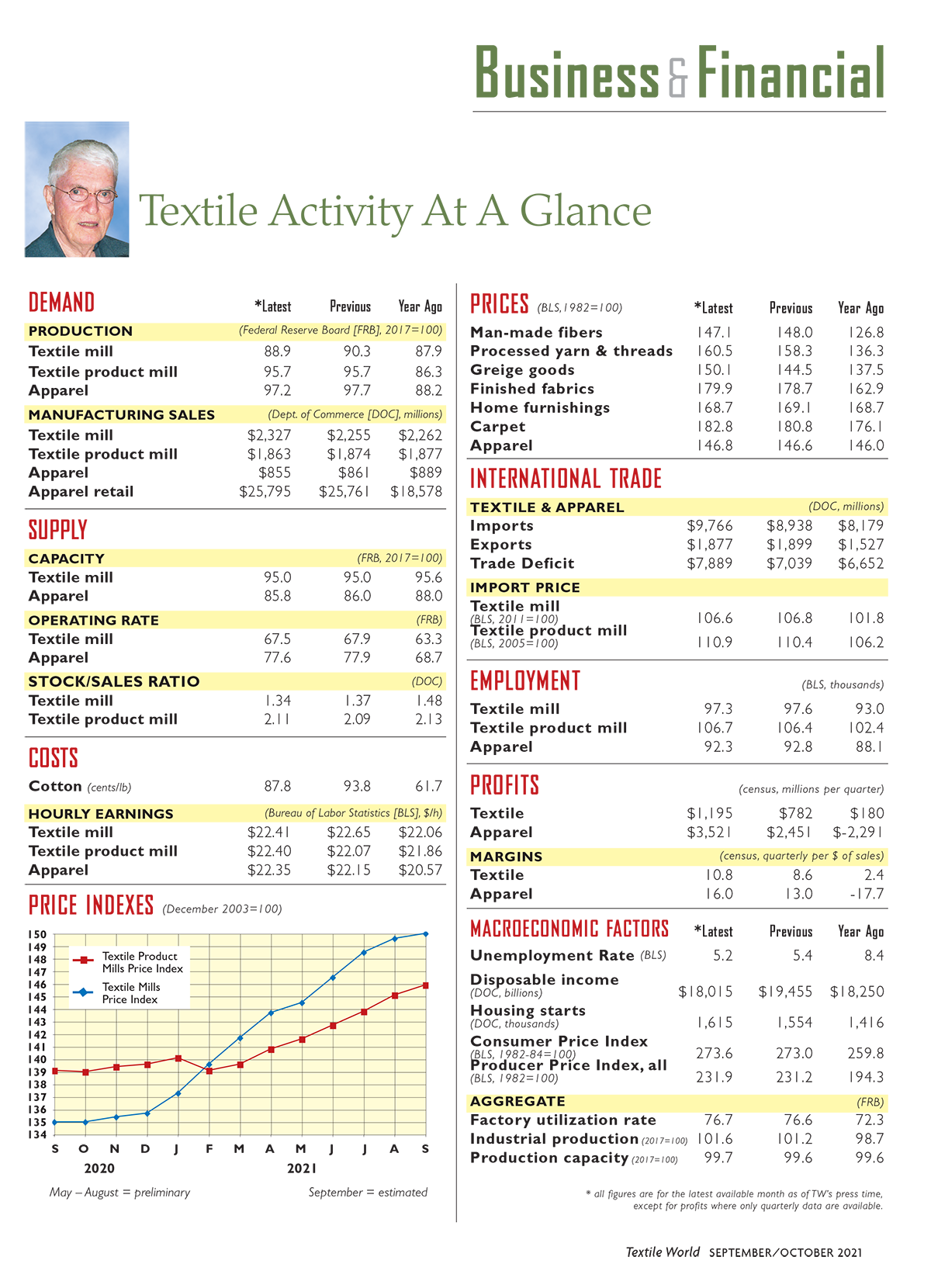
According to Robert Reichard’s “Textile Activity At A Glance,” in this issue, textile mill, textile product mill and apparel employment has improved year-over-year, but will U.S. textiles see labor improvements? Only time will tell.

September/October 2021

September/October 2021: Textile Activity At A Glance

September/October 2021

Product Traceability Gains Momentum

By Jim Phillips, Yarn Market Editor

The need for source-to-consumer product traceability has been featured multiple times in these pages, dating back more than a decade. Public focus on traceability began as a result of contaminated food. As the frequency and variety of contaminated or faulty products increased over time — ranging from toys laden with lead paint to cell phones that spontaneously burst into flames — consumers began to demand a more rigorous accounting of what their products were made of and from where each component originated. Further, consumers wanted to ensure product claims and labeling were correct. In textile products, for example, class action lawsuits have been filed over the past few years against major retailers for misrepresenting the sheets and bedroom accessories items they were selling. One lawsuit alleged the thread count of sheets was substantially below what was stated on the packaging. Another claimed that sheets sold as 100-percent Egyptian cotton contained only 16 percent of the fiber.

One company, Applied DNA Sciences, has developed a platform — CertainT® — that helps companies assure their customers of the veracity of all product claims. CertainT uses molecular taggant technology to create fully traceable textile supply chains. It was reported earlier this year, for example, that CertainT was the choice for American & Efird when it wanted to introduce a new recycled sewing thread and guarantee its authenticity to customers.

In late September, Applied DNA Sciences reported it received purchase orders from an unnamed textile customer totaling $1.6 million to supply molecular taggant to tag textile fibers.

CertainT’s molecular taggant serves as a unique identifier that can be tested for its presence as the tagged material travels throughout virtually any global supply chain.

Spun Yarn And Global Fibers Market Projected To Grow

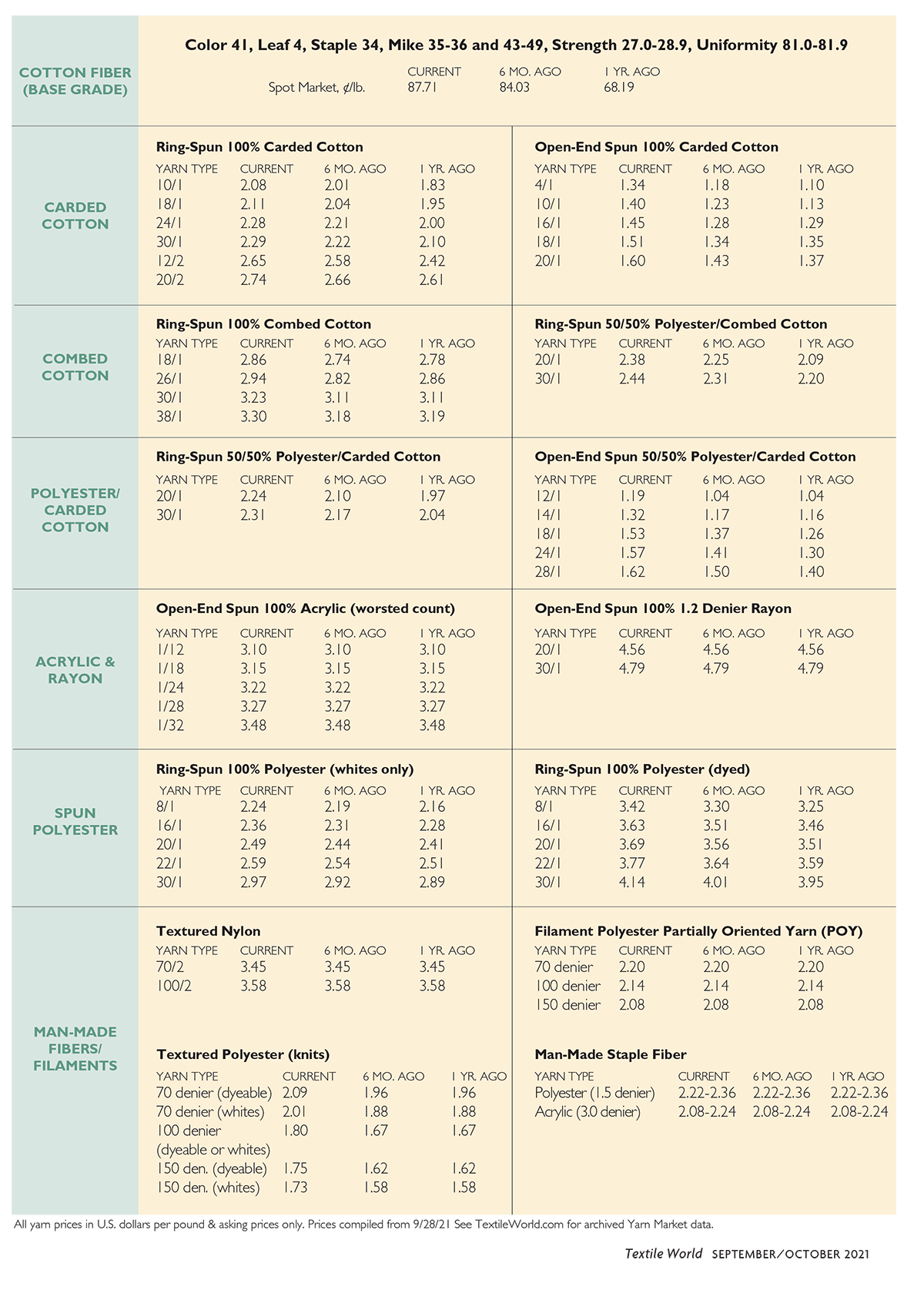
The global market for spun yarn, which was estimated at 52 million tons in 2020, is expected to grow to 59.3 million tons by 2026, according to a new report by research firm Global Industry Analysts, Inc. The overall CAGR is projected at 2 percent over the analysis period. CAGR for cotton is projected to be 1.9 percent and reach a total 34.8 million tons. The polyester segment is estimated to have a 2.5 percent CAGR for the period.

The research firm also projects the global market for all textile fibers, estimated at 109.5 million tons in the year 2020, is projected to reach 125.1 million tons by 2026, growing at a CAGR of 2.2 percent over the analysis period. The company also projects the textile fibers market in the United States to be 30.2 million tons for 2021.

New Microfiber Eliminates Recontamination Risk

Skokie,. Ill.-based UMF Corp. has developed a new hospital-grade microfiber that can be converted into a wide range of long-lasting, reusable products, including towels, cubicle curtains, socks, gloves, walk-off mats, reusable N95-rated face masks and color-coded microfiber cleaning products. Manufacturers are using these high-performance Micrillon® microfiber yarns to develop a new standard for materials targeting infection prevention in hospitals, hotels, cruise lines, long term care and many other industries.

“The introduction of Micrillon microfiber puts an end, once and for all, to any question about recontamination related to reusable products,” said UMF Corp. CEO George Clarke. “Some manufacturers and distributors of disposable products — including cubicle curtains, microfiber mops, and wipers — have generated controversy around the risk of reusable products, such as microfiber wipers, recontaminating a patient room, even after being laundered.” This ignores “the fact that after laundering, wipers used in hospitals are immersed in an EPA-registered disinfectant before use — effectively killing bacteria and inactivating viruses.”

Micrillon is a rechargeable polymer additive that can be incorporated into man-made fibers, films, and plastics and then charged with chlorine molecules. The Micrillon chemistry recharges for the life of the product and will not leach into the environment. When microbes come into contact with a Micrillon surface, they are eliminated, and viruses are inactivated.

September/October 2021

Sponsors