The board of directors of the American Floorcovering Alliance Inc. (AFA) recently voted to dissolve the floor covering advocacy organization. Pandemic-related revenue shortfalls and event cancellations were factored into the decision. The board agreed to donate a cash balance of $135,000 that remained to Georgia Northwestern Technical College (GNTC) to support flooring industry education programs. GNTC — which added a Flooring Production program in 2019 comprising of a Flooring Production Operator and Flooring Production Technician certificate program — was selected to receive the funds based on its essential role in workforce development for the floor covering industry.
“Upon the dissolution of AFA, we determined that the balance of cash after liquidation would be best used by local colleges to assist in training and recruiting students to help fill the employment gap and provide skilled talent to the industry,” said Stephanie Manis, owner of Capital Contract Services and former executive director of AFA.
EAST PROVIDENCE, R.I. — September 29, 2022 — Motion plastics specialist igus® is expanding through investments in its Low-Cost Automation and has now acquired the majority shares in Commonplace Robotics based in Bissendorf near Osnabrück. As an integrator, Commonplace Robotics specializes in intuitive control systems and software and power electronics for robotics, both in industry and in education. The two companies have been cooperating intensively for six years. They have, among other things, developed the igus Robot Control, which supplements igus’ low-cost kinematics made from high-performance plastics.
Dr. Christian Meyer, who worked at the Fraunhofer Institute for Production Engineering and Automation at that time, founded the company Commonplace Robotics 11 years ago. The name says it all. Make the integration and operation of robots so cost-effective and easy that they become “commonplace” — meaning they can be used anywhere. The first products with a control system and proprietary power electronics were robots for teaching.
Dr. Meyer approached igus in 2016 because he found that igus robotic kinematics matched his vision of “commonplace” — cost-effective, simple, and suitable for the industry. Since then, the two companies have jointly developed products such as the iRC igus Robot Control, an actuator, and the ReBeL cobot. New developments can be quickly implemented thanks to the high level of vertical integration of Commonplace Robotics – from firmware and software to switch cabinet construction and circuit board assembly.
Driving Low-Cost Automation forward with increased innovative power
“Many customers are surprised that they can implement simple robot tasks in just 30 minutes without any programming knowledge,” said Frank Blase, CEO of igus GmbH. “We are very pleased that, following intensive collaboration over the last six years, an even more focused approach to Low-Cost Automation is now possible.”
With this acquisition, Commonplace Robotics and igus are combining their innovative strengths.
“We are looking forward to exciting technological projects with igus. The RBTX platform for low-cost robotics, operated by igus, brings new requirements from customers from all areas of the industry to our laboratories every day,” stated Dr. Meyer. “Much of this can be implemented quickly, especially as we expand with this investment.”
The latest product of the collaboration is the ReBeL cobot for 4,970 euros, including the control system. The actuator, also available as an individual component, combines igus’ plastic know-how in the gearbox with the power electronics and software from Commonplace Robotics. With six axes, the ReBeL can handle a payload of up to two kilograms with a range of 664 millimeters with a net weight of just 8.2 kilograms.
Requests and orders come from traditional areas of applications such as quality control and pick and place applications in mechanical engineering. However, new areas of applications such as restaurant automation or urban farming are now becoming more frequent.
Milliken & Company recently announced it has expanded its domestic yarn spinning capacity with the acquisition of a plant — previously known as Frontier Spinning Plant #3 and located in Mayodan, N.C. — from Montreal-based Gildan Activewear Inc. The open-end spinning facility will make yarn for Milliken’s protective fabrics, workwear, government and defense, industrial, and napery businesses. Milliken will rename the plant Two Rivers Plant.
“Investing in this plant enhances the agility of Milliken’s Textile Business and shores up our supply chain in the U.S. to benefit our customers,” stated Halsey Cook, president and CEO. “Guided by integrity and excellence in all we do, this move bolsters our supply chains to enhance customer service.”
BIOPHIL Natural Fibers, a hemp stalk processor with a processing facility in Pennsylvania, has announced plans to invest more than $10.9 million in a new operation in Lumberton, N.C. The company produces fiber and hurd from the stalks, which can be used in a variety of applications from construction to paper and nonwovens and woven textiles. The new 90,829-square-foot facility will have decortication equipment as well as parallel processing lines to further clean, refine, and cut hurd and fiber to customer specifications. The operation also will house research and development for mycelium load-bearing structural composites by Okom Wrks Labs, as well as prototyping and eventually manufacturing for hurd-based construction materials and other hemp-based products.
Biophil will hire 41 associates for the new facility including production, administrative and managerial roles with an average starting salary of more than $40,000.
In this issue of Textile World, the cover story, “CiCLO®: Just One Arrow In The Microfiber Pollution Solution Quiver” highlights three impressive points.
It is refreshing to see the U.S. textile industry acknowledge, address and invest in solving serious environmental challenges.
Environmental issues facing the industry have always been taken seriously, but on some level the industry has had a contentious relationship with environmental regulators.
There is a strong history of progress on improving the relationship and impact of
textile manufacturing on the environment — who doesn’t want clean air, clean water and efficient use of clean power?
In truth, the relationship between textile manufacturing and the environment really has moved to the next level.
Now, in some cases, effluent leaving the plant is cleaner than the water entering the plant. Technological improvements in textile dyeing, printing and finishing have reduced both consumption and waste of water, dyes and chemicals. Digital printing, new indigo technology, waterless dyeing, and improved foam and spray application of finishes are perfect examples.
The next level of improvement is focused on embracing sustainability and the full life cycle of products the industry creates.
Recycling technologies have moved from a fringe group of manufacturers to the mainstream with recycled polyester in common use. Apparel brands have been supportive and demanded sustainable solutions for their products which has encouraged manufactures to invest and innovate with new technologies.
Acknowledging the man-made microfiber pollution challenge — the impact fiber and plastic five millimeters in length loose in the environment — goes a long way to developing serious solutions.
The CiCLO story is a prime example of developing a serious solution. As Co-founder and CEO of Intrinsic Advanced Materials and Co-inventor of CiCLO technology Andrea Ferris explained: “CiCLO technology gets blended with conventional or recycled polyester and nylon during melt extrusion at the very beginning of the fiber manufacturing process. It becomes permanently embedded in the fiber, so it never washes out.”
CiCLO provides nutrients that encourages microbes to biodegrade the polyester or
nylon within which the CiCLO is embedded. One can only imagine the breadth of
environmental impact this technology will have and the proof is in the partnership.
In 2018, Intrinsic Textiles Group LLC and Parkdale Advanced Materials — the fibers
and yarns innovation division of Parkdale Inc., Gastonia, N.C. — formed a joint venture named Intrinsic Advanced Materials.
Ferris stated: “As the largest spun yarn manufacturer in the Western Hemisphere, Parkdale’s production of polyester-containing yarns exceeds 500 million pounds per
year. It has taken a leadership position in delivering sustainable solutions for the
textile industry and CiCLO is the proven technology to mitigate microfiber pollution generated by man-made textiles.”
It is that kind of leadership — acknowledging, addressing and investing in solving serious environmental challenges that takes the textile industry’s relationship with the environment to the next level — and into the future.
A memorandum of understanding (MOU) recently was signed between North Carolina State University, Gaston College and Catawba Valley Community College, and Honduras-based Central American Technological University (UNITEC) in an effort to educate and train a next-generation textile workforce using training and certificate programs as well as undergraduate and graduate degree programs. An increase in nearshoring and onshoring in Honduras, Central America and the United States is leaving the industry with a shortage of trained workers.
With almost $1 billion of textile and apparel investment in the United States and Central America anticipated this year, employee growth projections over the next five years suggest more than 10,000 new skilled workers will be needed to meet the demands of the industry in Honduras alone.
The MOU, backed by the U.S. Department of State, also creates an educational pathway to economic opportunity in Honduras and the region.
A signing ceremony was held at Gaston College in Dallas, N.C. Both U.S. and Honduran government officials — including Jose W. Fernandez, under secretary of state for Economic Growth, Energy and the Environment; Jennifer Knight, deputy assistant secretary for
Textiles, Consumer Goods and Materials at the U.S. Department of Commerce; and Hector Zelaya, private secretary to Honduran President Xiomara Castro — participated in the signing, as well as a roundtable discussion that followed. In addition, the government officials toured two of Gildan Activewear’s yarn spinning facilities in Salisbury, N.C.
After a string of months in which demand for U.S-made yarns remained remarkably high, especially considering inflation rates and a slowing economy, the past few weeks have seen a slight-to-moderate drop in inquiries and orders for a number of spinners.
“I think we’re in a lull — a temporary one, I hope — because the market is currently saturated,” said one source. Added another, “The retail pipeline looks to be full at the moment. Store shelves are generally well stocked, and our customers are hesitant to place new orders until they see how the economy goes. Fingers are crossed at this point that we can avoid a recession, but the odds of that seem to be decreasing day by day. Consumers have already begun to tighten up their pocketbooks.”
In fact, The Expectations Index, part of the Consumer Confidence Index published by The Conference Board®, although recovered slightly in August from July’s nine-year low, still remains below a reading of 80, suggesting recession risks continue. Consumer concern about inflation remains elevated, but has retreated from the high of previous months.
Cotton Prices, Sustainability Practices
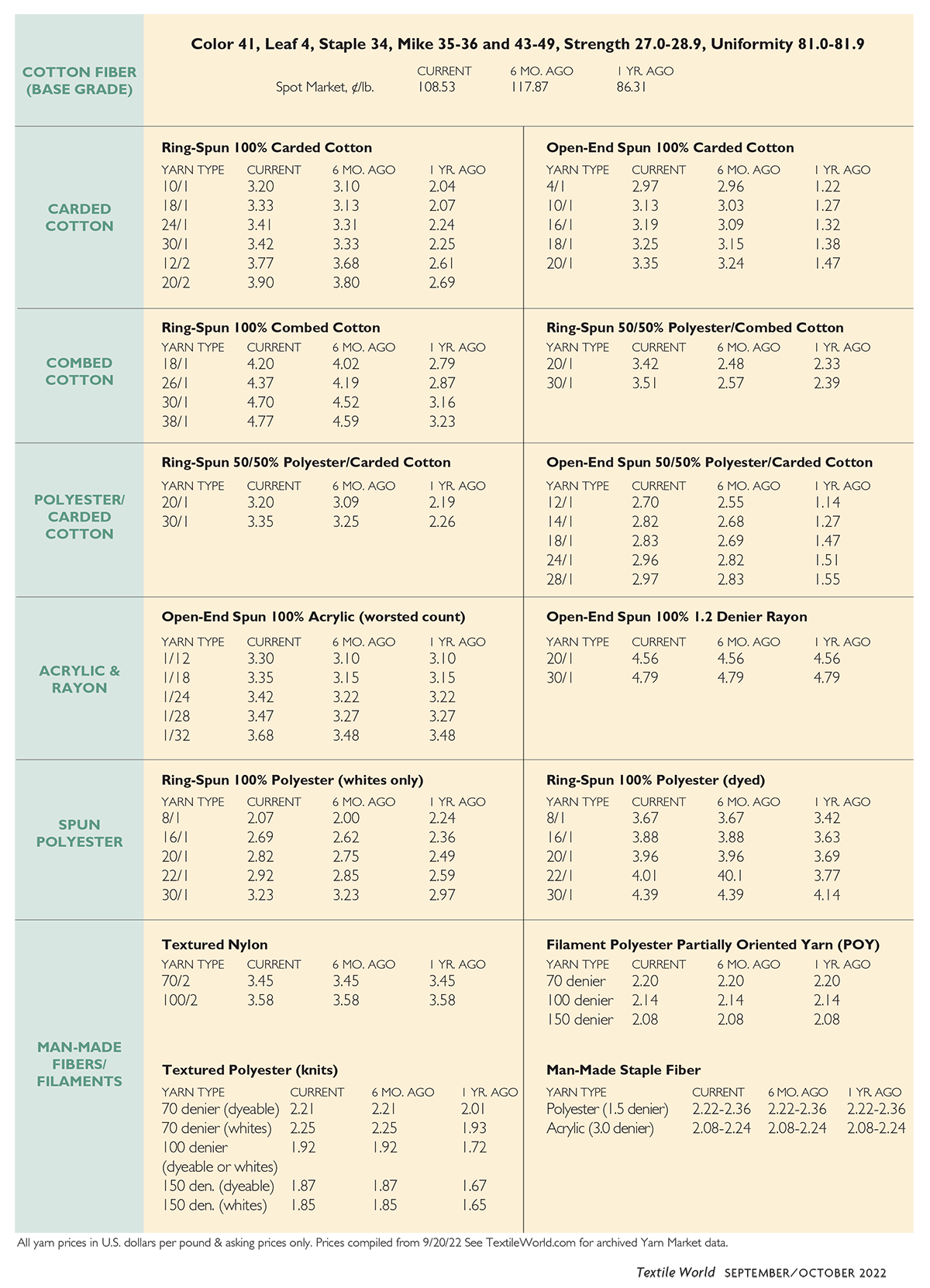
Spot quotations for the base quality of cotton (color 41, leaf 4, staple 34, mike 35-36 and 43-49, strength 27.0-28.9, and uniformity 81.0-81.9) in the seven designated markets measured by the USDA averaged 108.53 cents per pound for the week ending September 15, 2022. The weekly average was up from 90.71 cents reported for the corresponding period a year ago. Daily average quotations ranged from a high of 111.07 cents Monday, September 12 to a low of 106.10 cents Thursday, September 15. Spot transactions reported in the Daily Spot Cotton Quotations for the week ended September 15 totaled 7,467 bales. This compares to 7,613 spot transactions reported the corresponding week a year ago. Total spot transactions for the season were 20,447 bales compared to 24,772 bales during the same period a year ago.
The ICE October settlement price ended the week at 105.24 cents.
In other cotton news, Cotton Incorporated, as part of the USDA Partnership for Climate-Smart Commodities pilot project, is collaborating with industry leaders to focus on increasing the adoption of climate-smart agriculture practices. The project will build markets for climate-smart cotton and provide technical and financial assistance to more than 1,000 U.S. cotton farmers to advance adoption of climate-smart practices on more than one million acres. This will allow the production of more than four million bales of climate-smart cotton over five years.
“The climate-smart cotton program brings together USDA with private industry resources to increase the production and demand for climate-smart cotton that will help the U.S. cotton industry meet the ten-year sustainability goals,” noted Dr. Jesse Daystar, vice president and chief sustainability officer for Cotton Incorporated.
Eastman, Patagonia® Collaborate On T-shirts
Eastman, maker of Naia™ Renew sustainable fibers and yarns, is collaborating with Patagonia® to offer a limited run of T-shirts made with Naia Renew ES — Eastman’s latest fiber offering made with increased recycled content.
Named for its enhanced sustainability, Naia Renew ES is made with 60 percent recycled content. Unlike other cellulose-based yarns and fibers, this option requires fewer virgin materials to make an environmentally friendly product. Naia Renew ES is made from a combination of 40 percent molecularly recycled waste material, 20 percent recycled cellulose, and 40 percent renewable wood pulp.
The 20 percent recycled cellulose comes from waste materials, textiles waste and non-forest-derived cellulose waste. This innovation is made possible through Eastman’s continuous efforts to collaborate with eco-conscious partners throughout the value chain. For example, the Naia team has partnered with GP Cellulose, a pulp supplier with a focus on sustainability, to integrate renewable forest fibers and non-forest fiber solutions into its feedstock.
The remaining 40 percent recycled content comes from Eastman’s molecular recycling technology that breaks down hard-to-recycle waste materials like plastic packaging and old carpet into fundamental building blocks to produce the acetic acid used to make cellulose acetate yarn and fiber.
The Washington-based National Council of Textile Organizations (NCTO) recently hosted two roundtables — one with Representative Greg Murphy (R-N.C.) and a second with Congresswoman Kathy Manning (D-N.C.) — and both featuring textile executives from the fiber, yarn, fabric and finished textile product sectors. The meetings were designed to highlight the importance of the industry and urge the lawmakers to back policies that support the competitiveness of the U.S. textile industry.
The event with Representative Murphy was hosted by East Carolina University in Greenville, N.C.; while Unifi Inc. hosted the roundtable with Representative Manning at its headquarters in Greensboro, N.C.
Executives spoke about the innovative and sustainable production practices, as well as the industry’s contribution to the state of North Carolina. According to U.S. government data, textile jobs employ more than 36,000 people in the state and support a further 108,000 jobs. The state also leads the nation with its $2.7 billion in textile-related exports.
Executives also raised priority issues for the industry in Washington such as maintaining the yarn forward rules of origin in the Dominican Republic-Central America Free Trade Agreement (CAFTA-DR), advancing the Miscellaneous Tariff Bill, and upholding buy American and Berry Amendment procurement policies, among other issues,
“As the proud representative for North Carolina on the Ways and Means Committee, it’s an honor to work alongside NCTO to promote American jobs, grow our state economy, and protect domestic manufacturing,” Representative Manning stated.
“I am thrilled to engage with industry leaders in my district, as we discuss ways to grow the U.S. textile industry and the critical role that textile manufacturers play in our local, state, and national economy,” Congresswoman Manning said.
NCTO President and CEO Kim Glas expressed her sincere appreciation to both lawmakers for participating in the meetings. “It is imperative that we have sound trade and government procurement policies that help the U.S. industry continue to grow jobs and contribute to the overall U.S economy,” Glas noted.
Radians is expanding its Memphis, Tenn., campus with a new building. The manufacturer of a wide variety of personal protective equipment required additional space for its growing warehouse operation. The addition will allow the company to have more inventory in-house and grow its supply chain capabilities. Additionally, the new facility will process orders for some big box retailers and large industrial customers.
“The increase in space is significant because the expansion represents a 20 percent increase in Radians’ overall square footage, bringing our Memphis campus footprint to approximately eight acres under roof,” said Radians CEO Mike Tutor.
Calhoun, Ga.-based Mannington Commercial recently joined the Drawdown Georgia Business Compact, a consortium of Georgia businesses that are working together to address climate issues in the state with the shared goal of transitioning Georgia to net zero carbon emissions by 2050.
Pakistan-based Gadoon Textile Mills Ltd., a member of the Yunus Brothers Group, has
joined the Zurich-based International Textile Manufacturers Federation (ITMF) as a corporate member.
Atlanta-based sublimation paper manufacturer Beaver Paper has announced price increases of up to 12 percent across all its paper grades. The increase goes into effect for all deliveries after October 1, 2022.
Atlas Copco recently introduced a new generation of variable speed drive compressor named the GA VSDS.
Germany-based Freudenberg Performance Materials was recently awarded the EcoVadis Silver Medal for U.K.-based facilities in Ebbw Vale and Littleborough that manufacture advance wound care and ostomy products. The silver medal recognizes the company’s performance in environment, ethics, labor and human rights, and sustainable procurement categories; and ranks the company in the top 25 percent of companies rated by EcoVadis. The company also recently established the Apparel Technical Solution Center – Asia at its Nantong, China, factory, to expand innovation capabilities.
New York City-based Carnegie Fabrics has expanded its Xorel® biobased fabric with
four new patterns — Ashford, Windsor, Dover and Galway.
New York City-based Schumacher has opened its first concept showroom in Nashville, Tenn. Located at 609 Merritt Ave. in the Wedgewood-Houston neighborhood, the space features a to-the-trade showroom exclusively for interior designers and also a luxury boutique for consumers interested in smaller items.
Epson, Los Alamitos, Calif., has introduced its first Epson-built spectrophotometer, the SD-10.
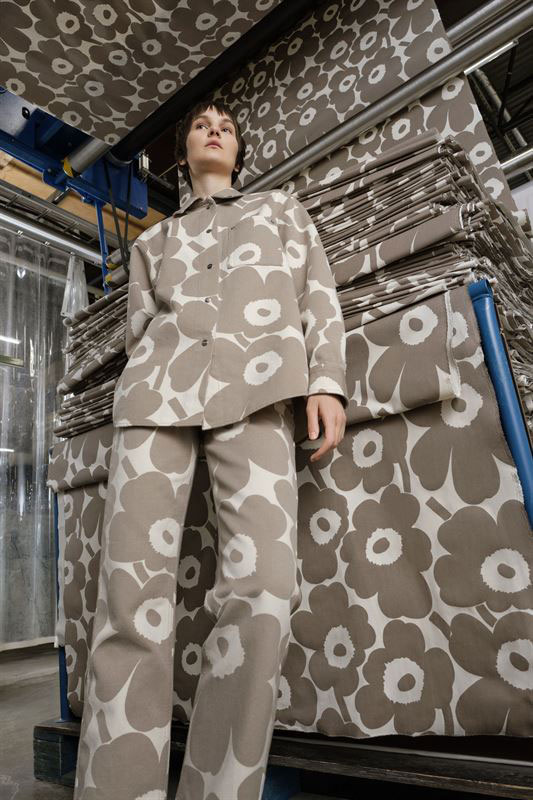
A garment from Marimekko and Spinnova’s recent collaboration
Finland-based companies Marimekko and Spinnova have collaborated on a capsule clothing collection that features Marimekko’s iconic Unikko poppy print on a blended SPINNOVA® fiber/organic cotton/cotton fabric.
Matouk reports it received STeP by OEKO-TEX® certification for sustainable and responsible textile production practices at the company’s Fall River, Mass., facilities. Pendleton Woolen Mills also recently announced both its century-old mills in Washougal, Wash., are now STeP by OEKO-TEX certified.
Suominen, Helsinki, has announced general surcharges on all its products in North America as a result of increases in raw materials, energy and freight costs.
Regel™ recycled acrylic fiber from Thai Acrylic Fibre Co., a member of the Aditya Birla Group, is now bluesign® Approved.
Boston Scientific Solutions Inc., Woburn, Mass., has launched the Natron-SilTexAS Series of screen printing silicone inks for socks and gloves.
Finotex, Miami, recently launched a new website located at finotex.com. The site was redesigned with the user experience in mind and includes all the information as well as a geolocation feature to help customers with their specific branding needs.
Gildan Activewear Inc., Montreal, recently published its 18th Environmental, Social and Governance (ESG) Report.
Santa Clara, Calif.-based Avery Dennison and the San Francisco 49ers recently announced an exclusive partnership naming Avery Dennison the official cutting-edge embellishment partner of the football team. Avery Dennison will provide smart embellishments and digital labels for select 49ers Fanatics merchandise to introduce digital connectivity into the products.
Alpharetta, Ga.-based Datatex TIS Inc. reports Parkdale Inc. selected NOW as its next
generation enterprise resource planning (ERP) solution replacing an older Datatex TIM ERP system. Parkdale also will implement the solution at its U.S. Cotton business.