Automotive, Upholstery Markets Boost Texturizers


T
alking with texturizers is a lot like talking with cotton spinners because they are both
experiencing much the same problems — increasing costs, cheap imported yarn and garments, customer
resistance to price increases and long-term contracts.

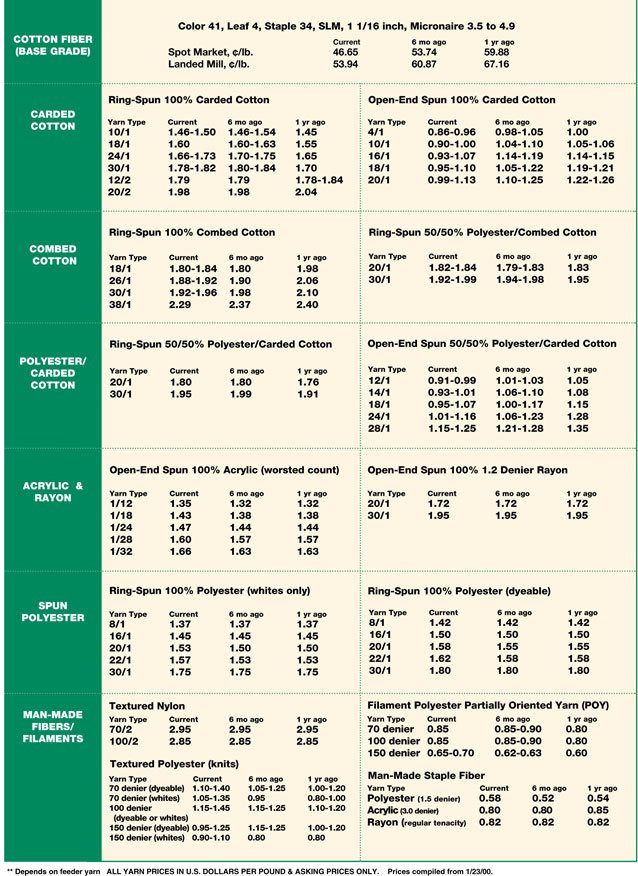
One texturizer responded to this month’s Yarn Market by saying: “Apparel markets are
especially soft but the upholstery markets are OK. Automotive markets are pretty good as well.
Basically, we are running full and we are sold up with some bookings as far as five months ahead.”

He added: “There will be a selective jump in the price we pay for certain polyester fibers in
April with an across-the-board increase in July. Volume-wise I feel this will be a pretty good year
— stronger than last year — but we will continue to have problems with our margins. Pricing is
terrible. Not as bad as for open-end yarns, but terrible.” The problem will be passing on the
increase in raw material costs to the customer.

Markets for POY yarns are reported as “pretty good,” but they are very flat. Here again it is
difficult for the texturizer to get prices up even enough to get back the recent increase in these
feed yarns. The customer resistance is due mainly to the influx of cheap imports, according to this
respondent.


Good For Business

Cotton spinners vary in their appraisal of market conditions, with comments ranging from “
business is improving” to “excellent.” Figure it out.

Ring-spun yarns continue to move well. Several spinners of both ring spun and air jet rated
their markets for these yarns as excellent.

One such spinner said: “All of the indicators point to a pretty good year. Prices are at
least competitive, our customer confidence is high and the Asian problems have subsided. This
should be good for business.”

This spinner reports that they are running a full seven-day schedule. He also predicts that
open-end yarns, the markets for which he reports as “steady — nothing to write home about but OK,”
will be stronger within the next 4 to 6 weeks.

Another spinner said: “All of our markets are excellent, very active, very strong. But we are
in a most competitive environment, an environment where we are making money but we are not really
profitable.

“All of our indirect expenses have gone up like wages, insurance, cardboard boxes, yarn cones
and on and on. The only thing that is somewhat lower in price is cotton and even that is on the way
up. We are quite fortunate in that we were recently able to increase prices. But that has been
tough.” So what do you do? As this spinner says: “You keep trying.”

One cotton respondent said: “We haven’t yet regained the momentum in sales volume we
experienced just before Christmas but we’re close to the start of the regular season. We expect a
turn-around soon. Our volume is good, but pricing is terrible.”

The spinners who report excellent sales positions have a worry that any manufacturing
operation would like to have. They worry about making enough yarn to fill orders.

At this particular time spinners in the South are being plagued by inclement weather. It is
difficult to make a product when your employees can’t get to work.


Fact Or Fable

One of the respondents this month, a cotton spinner making open-end yarns, was quite concerned
with a rumor circulating that a new open-end facility was planned for construction. According to
this spinner the operation is planned by a vertical manufacturer.

With respect to this rumor, he said: “I really cannot imagine building a new operation of
this type when everyone knows of the oversupply of open-end yarn existing today. Most mills realize
that OE yarn can be bought for less than it costs to make so why build a mill?”

He also discussed how additional production would affect sales and prices. The only possible
positive effect this could have would be to discourage imported yarn. As a spinner said last month:
“The reason prices are stabilizing is that they are so low that the industry can’t go any lower.”

These low prices discourage imports as well because it doesn’t allow any margin for them
either.
YarnMarket_920

March 2000


Lyndall Sees Restructuring As Improving Profits

Lyndall Inc., Manchester, Conn.,
recently announced a major restructuring plan in line with the company’s previously announced
strategic direction as a manufacturer of thermal and filtration products.

The company announced the impending sale of certain operations unrelated to its core focus;
the discontinuation and eventual sale of its Woven Products Segment; and the recognition of a
reduction in the values of certain assets, including two facilities of the Gerhardi operation
located in Germany.

“Lydall will emerge from this restructuring as a much more focused and profitable company
with strong growth prospects in its core businesses,” said Christopher R. Skomorowski, president
and CEO. “We are confident that these actions, which are largely non-cash write downs of asset
values will help us to meet our goals of gross margins of 30 percent and operating margins of at
least 10 percent in 2000.”


February 2000

People

WestPoint Stevens Inc., West Point,
Ga., has announced three promotions.

Joan Amberg has been promoted to senior vice president, merchandising. Amberg rejoined the
company in 1995.

Kathleen Cwirko Schorr has been promoted to vice president, creative services. Schorr has
been with the company since 1983.

Clyde Collier has been promoted to vice president, sales. Collier will be responsible for
Wal-Mart and J.C. Penney. He rejoined the company in 1996.

The Chemical Fabrics and Film Association (CFFA), Cleveland, has announced the election
three new officers: John K. Givens, as president; Thomas J. Carstens Jr., as first vice president;
and Alfredo Frohlich as second vice president.


February 2000

People

Guilford Mills Inc., Greensboro,
N.C., has announced the appointment of Herb Briggs as president of Guilford Home Fashions.

In his new role, Briggs will lead the expansion of the Guilford home Fashions businesses and
oversee product development, brand positioning, nationwide sales and the manufacturing facilities
in Herkimer, N.Y.

Briggs joins the company from Primex International Corp., Where he served as executive vice
president.

Wellman Inc., Shrewsbury N.J., has recently announced that the company has elected Thomas M.
Duff as chairman and CEO; Clifford J. Christenson as president and chief operating officer; and
Richard F. Heitmiller as chairman of the committee of independent directors of the Wellman board of
directors.

Springs Industries Inc., Middleton Wis., has announced that Ronald W. Zabel has joined the
company as president of Springs Window Fashions Division Inc.

Zabel joins the comapny from Worldwide Sports and Recreation where he served as president
and CEO.

Woolrich Inc., Woolrich, Pa., has recently named Charles E. Aides senior vice president,
apparel manufacturing and sourcing.

Aides has been with the company since 1989, and was named vice president of apparel
manufacturing and sourcing in 1994.

The International Design Guild, Atlanta, has named Christopher P. Ramey as president.

The Dixie Group, Chattanooga , Tenn., has appointed Gary A. Harmon as vice president and
chief financial officer.


February 2000

CITDA Focuses On Emerging Technologies


N
ow that Y2K is A-OK, the Computer Integrated Textile Design Association (CITDA) has
turned its attention to emerging technology at the turn of this century. CITDA’s first event of
2000 will be held March 2-3 in Charlotte, N.C., and the day-and-a-half event promises to deliver
exciting new facets of technology for design and manufacturing to meet the needs of a rapidly
evolving business environment.

The symposium line-up includes many presentations and activities aimed at addressing today’s
design and production processes, including: mass customization; the color process at United Kingdom
retail giant Marks and Spencer; future trends for design technologies; Web/multimedia tools for the
sales presentations; a lively discussion on off-the-shelf software; and much more.


Keynoters Talk Technology

CITDA is featuring two keynote
speakers in this year’s line-up.


gracej1_758Grace
Jeffers, a decorative arts historian, who was recently featured in New York Times magazine, will
deliver a dinner presentation on March 2 about the role technology will play in new materials, our
environment, and trends for the future of design. Jeffers’ presentation will come alive with
inspiring ideas for the 21st century. She will share her view of how technology is shaping new
material design beyond traditional textiles, and how it is causing a revolution in trend and design
direction for all materials.

In the past two years Jeffers has been linked with plastics, particularly high-pressure
laminates, in the pages of Metropolitan Home, Wallpaper Magazine, The New York Times, and many
other publications.

Jeffers was the curator of “Going Digital: Digital Manufacturing and the Emancipation of
Design,” an exhibition about computer-aided design of decorative materials, held in New York City.
Her presentation is the highlight of an evening that includes cocktails, dinner, dancing and a
surprise performance from the Computer Aided Players. The event is sponsored by Kimberly Clark
Printing Technology Inc.


ATI Sponsors Luncheon


nancyw1_759Nancy
Webster, vice president of creative development at Springs Industries Inc, Fort Mill, S.C., will
deliver her keynote presentation titled “The Power of CAD” during the luncheon on March 3. As one
of the top textile leaders in the country, Webster will share her insight on how design
technologies are benefiting organizations from design to production, from merchandising to
selling.

Webster has successfully spearheaded
major installations of CAD/CAM technology for both Fieldcrest Cannon and Springs Industries. As we
turn the corner on a new century, Webster will share with us the Power of CAD for the future of
product development and manu-facturing. She will draw from her experience at Springs, a verti-cally
integrated enterprise and one of the leading textile companies in the nation.

The luncheon event also includes a special ceremony recognizing the winners of the CITDA
Professional Achievement Awards. The luncheon is sponsored by ATI.


New Format

This year CITDA introduces a new
exhibit format to the symposium with tabletop displays, rather than the traditional 8’X10’ booth.
The exhibit area is called “The Mobile Designer” and will feature displays from today’s leading
providers of design technology hardware/software. Displays will illustrate how truly mobile CAD/CAM
can be with laptops, portable devices, and Internet capabilities. Attendees can browse this area of
the symposium to pick up valuable information or ask questions about the latest and greatest
technology offerings.

For more information on the symposium, call (336) 226-1550, or visit www.citda.org.


February 2000

DuPont- Sabanci Venture Creates Unique Strengths

DuPont, Wilmington, Del., and Haci
Omer Sabanci Holding A.S., Turkey, announced that their joint venture in greater Europe for
polyester fiber, resins and intermediates started as planned on January 1, 2000.

The new company, known as DuPontSA, develops, makes and sells polyester filament, staple
resins, intermediates and related products for markets throughout the Europe, the Middle East and
Africa.

According to DuPontSA, the company will generate $1 billion in revenues and employ 4,500
people.

“We are commencing operations at an opportune time, when the industry is beginning a
turnaround from the very difficult circumstances it has experienced over the past two years,” said
P.W. Kery Kehoe, CEO, DuPontSA.

“The joint venture combines the strengths of its two partners — the operations and know-how
of Sabanci and the technology prowess and branding of DuPont.

“We are also uniquely situated geographically in the region to offer customers not only the
broadest product line in polyester, but superior service. Our challenge is to establish margins
that allow the reinvestment necessary to keep the industry healthy.”

The joint venture includes DuPont’s PTA (pure terephtalic acid) and resins businesses at
Wilton, United Kingdom. It also includes DuPont’s Dacron® filament and staple businesses at
Pontypool, United Kingdom.

Sabanci’s polyester subsidiary SASA, with its businesses in polyester filament, staple,
resins, bottles and DMT (dimethyl terephthalate), other sites in Turkey and the Sabanci texturizing
plant in Garforth, United Kingdom, are also included in the venture.

DuPontSA will have full access to DuPont polyester technology development and brand
management resources, including Dacron, Coolmax® and Melinar®.


February 2000

Jay Yang Signed To Design For Spectrum Fabrics

Spectrum Fabrics, a division of
Covington Industries Inc., New York City, has announced that Jay Yang has signed an exclusive
agreement to design printed and woven collections for the company.

Yang’s first collection was introduced in January in High Point, N.C. Two collections were
introduced: The Great Voyage Collection, comprised of six prints; and The United Kingdom
Collection, consisting of six jacquards.

Marjorie Hoyne, president of Spectrum Fabrics said of Yang: “He’s a true Amercian Success
story. He has a natural instinct for color, texture and design — and an extraordinary
merchandising sense of what the market wants.”


February 2000

Website Launched For Floor Covering Industry

SurfaceExchange.com Inc.,
Forestville, Md., has established a business-to-business exchange exclusively dedicated to the
international floor covering industry.

According to the company, SurfaceExchange.com will provide industry buyers and sellers a
service to auction, purchase and procure the entire range of floor covering products including
carpet, tie, resilients, stone, hardwood and laminates as well as related machinery, supplies and
other accessories.

“The SurfaceExchange.com represents the shift in electronic commerce that is already
occurring in many other industries,” said Manish Gupta, a founder and managing director of
SurfaceExchange.com.

“Aside from traditional e-mail or ordering office supplies, businesses now have specific
need for using the internet to enhance their mission critical activites.”


February 2000

ATMI Report Emphasizes Optomistic Future

Optimistic hopes for the future even
with weakened textile activity and reduced textile shipments caused by imports of low-cost Asian
textiles were the major topics covered by Doug Ellis, president of the American Textile
Manufacurers Institute (ATMI), in the recent textile industry year-end trade and economic report
from ATMI.

According to the report, overall prices of Asian fabrics and yarns continued to fall,
dropping by 6.5 percent for fabric and 7. percent for yarn, according to the U.S. Commerce
Department.

“This hurt our domestic market shipments as well as our exports to the Caribbean Basin
Initiative (CBI) region.” Ellis said.

“On a positive note, import growth from Asia moderated. Asian fabric imports increased only
2 percent, while imports rose only 3 percent.

“Also, our exports to Mexico continued their strong growth, with textile and apparel
shipments rising by 19 percent during the first 10 months of the year and reaching a record high of
$4.4 billion.

“Looking to the future,” Ellis continued, “it is interesting to note that even during these
very competitive times, our two largest textile export markets — Mexico and the CBI — have
continued to take market share from the Far East.

“Their combined share of apparel imports during 1999 rose from 39.1 percent to 40.1 percent,
while the Far East’s share fell from 36.6 percent to 35.8 percent. This trend reinforces the need
for swift enactment of the CBI bill approved overwhelmingly in November by the Senate.

“The Senate bill will help all segments of the U.S. textile industry, while harming no one.
It will be a win-win for the United States as well as the nations of the Caribbean,” Ellis
said.


February 2000

Mohawk Launches Modular Carpet Brand

Mohawk Industries, Atlanta, has
announced the launch of Mohawk Modular, a new carpet brand for the modular carpet market.

According to the company, the Mohawk Modular product will be made with the company’s ECOFLEX
multi-layer backing system.

The initial product line for Mohawk Modular is currently in development. The company plans
to introduce at least 20 styles to support the new brand over the next year.


February 2000

Sponsors