Avondale Mills Announces Modernization Plan

G. Stephen Felker, chairman,
president and CEO of Avondale Mills Inc., Monroe, Ga., has announced a company-wide $115-million
modernization plan to be executed over the next 18 months. An additional $30 million in
expenditures is being considered for the same time frame.

The projects include expenditures totalling $74 million in Alabama and $41 million in South
Carolina to upgrade equipment and provide the newest technology to increase production and enhance
quality and cost effectiveness. Improvements at the Bevelle Plant in Alexander City, Ala., will
also increase employment by adding 51 new positions.

According to Felker, Avondale’s willingness to invest the expenditures in Alabama are due to
the passage of the Alabama Tort Reform Act of 1999 and the cooperation of governmental entities in
providing tax incentives, which contribute to the feasibility of planned projects.


July 2000

Textile Activity On The Upswing In Europe

Fueled by a 16.9-percent rise in
Europe, worldwide yarn production increased during the fourth quarter 1999 by 4.2 percent compared
to the previous quarter. Asia experienced a 3.4-percent increase, while U.S. production slipped 1.8
percent.

Global fabric output was 3.5 percent higher due to a 12.8-percent upswing in Europe, while
weaving activity in Asia and the United States declined by -0.7 percent and -0.4 percent,
respectively.

On a quarterly basis, yarn inventories grew by 2.8 percent worldwide. During the preceding
12 months, a 6.2- percent reduction in European stocks was more than offset by a 7.5-percent
buildup in Asia, resulting in a 1.7-percent increase overall.

Fabric inventories continued to decline for the fourth consecutive quarter, with a drop in
Europe of 2.0 percent and in Asia of 0.8 percent, for an overall decline of 0.9 percent. Compared
to the corresponding period in 1998, global fabric inventories fell by 14.3 percent, with U.S.
production falling by 29.4 percent and European by 14.6 percent. Asian inventories increased by 1.0
percent.

The European index for outstanding yarn orders improved 8.5 percent during 1999.

On a quarterly basis, outstanding fabric orders fell by 1.0 percent in Europe and 3.4
percent in the United States. Compared to the corresponding period in 1998, order levels were up
4.9 percent in Europe, but declined in the United States 14.8 percent.


July 2000

VF Corp. Installs SAP Apparel Footwear Solution

VF Corp., Greensboro, N.C., announced
that it has successfully implemented the first phase of the SAP Apparel Footwear Solution (AFS) in
its domestic jeanswear operation.

AFS is a comprehensive industry-specific enterprise resource planning (ERP) solution that
simplifies the way companies plan, process, track and ship products.

SAP AFS controls the systems that comprise the informational backbone of the supply chain.
The procurement, materials management, production planning and finance components of SAP went
“live” in February in VF’s Jeanswear coalition, marking the first successful large-scale
implementation of an apparel-specific SAP solution.

“Three years ago, we identified SAP as a partner who could help us design a real time
interactive supply chain solution specific to our needs as an apparel manufacturer,” said Mackey
McDonald, VF chairman and CEO. “Now, with their help, we have been able to create a world-class ERP
platform that will streamline our internal ordering, tracking, shipment and goods fulfillment, and
achieve operational efficiencies throughout our system.”


July 2000

Lectra Tecmath To Offer Body Measurement Solutions

Lectra Systèmes, Paris, and
Germany-based Tecmath have signed a letter of intent to enter into an exclusive partnership to
develop and market integrated body measurement solutions for mass customization under the
Lectra-Tecmath Body Measurement Technology brand.

The combination of body measurement solutions with CAD/CAM virtual reality and Internet
technologies opens doors to the new economy. For apparel retailers, pre-order risk and inventory
costs are eliminated, and they can provide custom-made garments and establish close relationships
with their customers. Manufacturers reduce investment and inventory risk by producing on-demand.

Designers can offer a larger variety of styles and combinations. And information on customer
preferences becomes vertically available in the entire textile chain.

Lectra will market, sell and service the integrated solutions on an exclusive basis
worldwide, while Lectra and Tecmath will both market, sell and service the Tecmath body measurement
solutions in Germany and the Benelux.


July 2000

WestPoint Stevens Terminates Recapitalization Plan

The Board of Directors of WestPoint
Stevens Inc., West Point, Ga., has terminated its plan of recapitalization approved by the company
in March 2000. Due to a significantly higher cost of debt financing, the principal new equity
investor withdrew its investment commitment.

“I and the rest of our management team are optimistic about the company’s prospects for
substantial sales and earnings growth over the next few years,” said Holcombe T. Green Jr.,
chairman and CEO, WestPoint Stevens. The Board also voted to cease the company’s exploration of
strategic alternatives, which included a sale, merger or recapitalization, that the company
announced in November 1999.

The Board declared the company’s regular dividend of $0.02 per share, as well as a special
dividend of $2.00 per share, both payable on June 1, 2000, to stockholders of record on May 29,
2000. The Board also approved the resumption of WestPoint Stevens’ open market share repurchase
program, with authorization to purchase up to 3.9 million company shares.


July 2000

Increased Consumer Spending, Surge In Business Investment Fuel Continued Expansion


T
he U.S. economy is still running strong as it enters the tenth year of expansion. Real
GDP grew in the first quarter at an annual rate of 5.4 percent on top of the blistering 7.3-percent
gain in the fourth quarter.

Consumer expenditures shot up 8.3 percent at an annual rate, after rising 5.9 percent in the
fourth quarter. Business fixed investment shot up 21.2 percent, following a modest 2.9-percent
increase the previous quarter. Investment in business equipment and software surged 23.7 percent,
while spending on residential structures rose 13.4 percent. Only inventory investment was sharply
down in the first quarter, which subtracted 1.4 percentage points from GDP growth.

The latest reports indicate that the U.S. economy, with part of the first-quarter strength
arising from a mild winter coupled with the latest increase in interest rates by one-half of a
percentage point in the second quarter, can be expected to slow down. This would come as a welcome
development in light of the Federal Reserve’s concern about inflationary pressures. Nevertheless,
another rate hike is likely to occur in early July.

The producer price index for finished goods declined 0.3 percent in April, after rising by
1.0 percent in March and February. The decline was due to a sharp 4.1-percent drop in energy
prices, which rose 5.8 percent in March and 5.2 percent in February.

Consumer prices were flat in April after surging 0.7 percent in March and 0.5 percent in
February. The core inflation was up 0.2 percent.


Industrial Production Picks Up The Pace; Business Sales Surge


Industrial production has picked up speed in the last two months after slowing down in
February. Output grew 0.9 percent in April and gained 0.7 percent in March. This was the strongest
gain since August 1998.

Factory output also rose 0.8 percent with most industries registering gains. Utility output
rebounded 2.8 percent.

Housing starts bounced up 2.8 percent in April to an annual rate of 1.663 million, partially
offsetting the 11.2-percent drop in March.

Construction of single-family homes edged up 0.3 percent to 1.329 million. Multifamily units
rebounded 14.0 percent to 0.334 million after taking a 41.2-percent dive in March.

Housing construction was 6.5 percent stronger than last year, but the rise in interest rates
will bring new construction down.

The U.S. trade deficit widened in March to a record $30.18 billion, up from $28.71 billion
in February. Exports rose 2.9 percent led by capital goods and industrial supplies, while imports
rose 3.4 percent as oil prices surged.

Business sales surged 1.2 percent in March after rising 0.4 percent in February. Meanwhile,
inventories grew 0.3 percent. As a result, the inventories-to-sales ratio slipped to 1.31 from 1.32
before.


Greige Fabric Prices Rebound;  Finished Fabrics, Synthetic
Fibers Prices Advance


Results for textiles and apparel were mixed. Textile output edged up 0.1 percent in April
following a strong 1.2 percent gain in March. The operating rate for textiles mirrored the output
pattern, staying flat at 84.3 percent.

Sales by textile manufacturers took a 1.2-percent dive in March, while inventories rose 0.6
percent. Thus, the inventory-to-sales ratio climbed to 1.57 from 1.54 in February.

The industry’s payrolls slipped 0.1 percent in April. The volatile jobless rate for textile
mill workers came down to 5.4 percent from 6.0 percent in March.

Retail sales fell 0.2 percent in April after rising 0.5 percent in March. Furniture stores
took in 0.3 percent more than the month before. Apparel and accessory store sales turned down 0.9
percent in April after surging 1.6 percent in March.

Producer prices of textiles and apparel rebounded 0.2 percent in April to erase a
0.2-percent decline in March. Prices rebounded 1.6 percent for greige fabrics, advanced 0.8 percent
for finished fabrics and moved up 0.7 percent for synthetic fibers.

Prices were unchanged for processed yarns and threads, and for home furnishings.


June 2000

More Than Just A Name

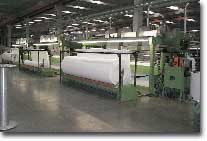
The Superior Companies, consisting of Superior Fabrics Inc. and Superior Shade and Blind Co.
Inc., Pompano Beach, Fla., have seen tremendous growth since moving their operations from New York
to Florida in the 1980s. While the company made its name with interior blinds, the last decade saw
the fabric side of the company expand dramatically. Superior is a completely vertically integrated
facility with warping, carding, knitting, dyeing, finishing and foam coating all done on-site. The
company produces products that are exported globally to Canada, Mexico, the Caribbean, Central and
South America, Europe, Singapore, Korea and China.Superior was founded in 1895. Today it is run by
the Fryburg family, with Robert Fryburg serving as president of Superior Fabrics and David Fryburg
as president of Superior Shade and Blind. While the two divisions are run separately, corporate
decisions are made jointly by the Fryburgs.Window DressingIn 1972, Superior manufactured only
window shades in an 8,000-square-foot facility in Harlem, N.Y. The company then moved to a
36,000-square-foot facility in Manhattan. While in Manhattan, Superior brought colors and styles to
the window shade industry that had not previously been available. In the late 1970s, the company
began manufacturing vertical blinds and rode its wave of success into the 1980s.The company moved
to its current location in 1984. An increased demand for stitch-bonded fabric started in 1985, due
to its ability to be easily dyed. Superiors first line of stitch-bonded fabric was available in 86
colors. Today, the company produces more than 600 different colors and styles.New MarketsSuperior
Fabrics began as an in-house operation to supply 100-percent polyester greige fabric to its
Superior Shade and Blind division. By 1987, the company began looking outside its operation to sell
its greige fabric, first supplying the mattress ticking market by selling directly to
converters.The next few years saw Superior enter new markets, which meant producing new products as
well. The company now supplies stitch-bonded print-cloth and ticking fabric to the shoe industry as
well as roofing, outdoor furniture, industrial fabrics and window treatments markets.The Superior
Shade and Blind division sells to fabricators along with manufacturing horizontal and vertical
blinds for its own shipment directly to its customers.The increase in its product line caused
Superior to begin a 120,000-square-foot expansion in 1999. The new expansion provides additional
space for nonwoven, knitting and warp tricot-knitting equipment.Superior also has a dyeing and
finishing division. The new facility gives the company four buildings on the premises three of
which are Superior Fabrics related.The company now has more than 400,000 square feet in
manufacturing and warehousing space. The most recent addition allows for a more ergonomic layout
and increased inventory space a key element to keeping its customers satisfied.”We are very loyal
to our customers,” said Robert Fryburg. “And our customers are in turn very loyal to us.”To
Superior, relationships are the key to good business. The companys production and shipping plans
are built around that principle. The company has an EDI with its trading partners, and all of its
shipping and billing are on-line. This includes linked on-line shipping information with UPS, of
which Superior is one of the largest customers in Florida.On The Production Floor

Located in the new manufacturing facility is a mix of both new and older machines. One step
the company took in ensuring maximum life from its older machinery was performing preventative
maintenance and rebuilding components, such as the bearings on all machines, before reinstalling
them in the new facility. This maintenance allows Superior to maximize efficiency and create a
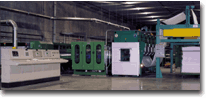
better product for its customers.The company purchased a new HDB card with a built-in metal
detection device. The company also retrofitted other cards with metal detection devices. According
to the company, the HBD card is running almost twice as fast as other cards.A recently purchased
OCTIR line is also in place. The line has carding and crosslapping. One of its biggest advantages
is its on-line com-munication capability with the manufacturer, Octir Deutschland GmbH, Germany, so
technicians can evaluate and diagnose any problems that might occur with the line. This expedites
any repairs that might be needed, thus reducing downtime.Also running in the plant is a
Hollingsworth double doffer and crosslapper and a line by Tomaja. All needlepunching is done on
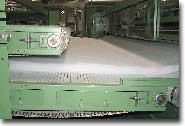
Dilo needle looms.The next step in manufacturing stitch-bonded greige fabric is knitting. Superior
uses 80 high-speed Liba knitting machines to stitch-bond the fabric. The stitch-bonding not only
gives strength to the fabric, but also a style and design. All take-up is done on Alexco
equipment.Superior has the capability to add many different finishes to its products. These range
from foam or vinyl backing in order to add strength and insulative properties to window treatments,
fire-retardants and water-resistant coatings. For these processes, Superior uses Menzel frames.
Masrob frames, which can be by-passed when not in use, are used for foam-coating applications.The
Superior Shade division can slit more than 150,000 yards of fabric for its blinds a day on a
Midland slitter. Superior Shade cuts and sews its blinds, taking them from fabric to die-stamped
metal to assembly to packaging. This allows Superior to ship its products to retail stores,
distribution centers or directly to customers.According to Robert Fryburg, the company is also
manufacturing roll-good fabrics for diverse markets.Concern For Customers

Superior Fabrics success is based largely on its customer service. The Fryburgs feel that
building and maintaining relationships with customers over the years has directly attributed to the
companys success.”We try to set ourselves apart by our service,” Robert Fryburg said. “We take
great pride in the quality and service we provide. We dont try to have the lowest price we deliver
price and service with quality work.”One of the areas that Superior excels in is its on-time
delivery. The company maintains records of the products it has shipped to customers in the past in
order to anticipate future deliveries. If a shipment is delayed, Superior calls the customer ahead
of time to inform them of the delay. However, a delay is the exception.”When something goes out of
here, it goes out of here on time,” Robert Fryburg said.After the sale, service also sets Superior
apart. The company ships some of its products directly to the consumer, so its customer service
department handles any customer questions. “Our customer service department handles our ready-made
blind questions if there is a problem,” Robert Fryburg said. “We put a high priority on the quality
of all our work. Our rate of refusal throughout the company is not even 0.5 percent of
sales.”Customers that buy the companys stitch-bonded greige fabric also get the same support. If a
customer calls with a question, the call will be returned.”I make it a priority that all calls are
returned,” Robert Fryburg said. “If someone calls me and I cant get back to them, then I will have
someone here call them.”The numerous awards won by the company over the past few years for its
customer service further attest to Superiors commitment to its customers. The company knows that
going out of the way to help its clients gives the customer that extra trust that jobs are done
right at Superior.

June 2000

Unifi Forms Alliance With DuPont Adds To Worldwide Production Base

Unifi Inc., Greensboro, N.C., and DuPont, Wilmington, Del., have announced their intention to form
a manufacturing alliance in the United States to produce polyester filament yarn. The alliance will
optimize the companies partially oriented yarn (POY) manufacturing facilities, increase
productivity and improve product quality. The alliance will only involve production.Under the terms
of the agreement, DuPont and Unifi will cooperatively run their polyester filament manufacturing
facilities, with a combined capacity of 800 million pounds, as a single unit, with DuPont managing
the production planning and scheduling. According to the companies, production will be realigned
among DuPonts Dacron® polyester filament plants in Kinston and Wilmington, N.C., and Unifis plant
in Yadkinville, N.C., to take advantage of the unique capabilities of each site.DuPonts Dacron POY
business and Unifis textured yarn business will remain separate entities.Unifi also recently
announced its acquisition of Intex Yarns Ltd., Manchester, England, giving Unifi high-quality
package dyeing capabilities in Europe. Intex will be renamed Unifi Dyed Yarns Ltd.According to
Unifi, the new company enhances its flexibility to adjust to evolving market needs and represents
an ongoing commitment to provide customers worldwide with a broader range of specialized products.
The acquisition gives Unifi 4,000 tons of dye capacity annually.”Our goal is to establish Unifi as
a high-quality supplier of dyed yarns throughout Europe,” said Brian Parke, Unifi CEO. “The
acquisition is a logical addition to our yarn production facility in Letterkenny, Ireland, and
allows us to offer our European customers a unique advantage in the marketplace.”Unifi plans to
upgrade the plant over the next 18 to 24 months. All employees will remain with the new company.

June 2000

People

PeopleRodney J. Merriweather, global brand manager for DuPont Dacron®, Micromattique and Supriva®
brands has been promoted and takes over the global brand management responsibilities for the
CoolMax®, CoolMax® Alta and Thermolite® brands from Dana B. McCauley, who has been promoted to
e-commerce venture manager for the DuPont Polyester Enterprise.Both will be based in the companys
Wilmington, Del., headquarters.

June 2000

JERZEES To Invest 21 Million In Alabama Plants

JERZEES Activewear, Alexander City, Ala., a division of Russell Corp., has announced plans to spend
approximately $21 million on expansions and renovations of its textile operations in Wetumpka,
Sylacauga and Alexander City, Ala.The two-year plan to expand our Coosa River textile operations in
Wetumpka calls for us to spend $11 million in that facility alone, said Dean Riggs, vice president
of operations.By expanding our capacity to produce material at Coosa River, we are making the
operation more cost-effective and efficient. That is a crucial factor in JERZEES efforts to become
more aggressive in the marketplace and to grow our business. We have to ensure that our
manufacturing costs are in line with the prices we can charge for our products. The only way to
create any stability for our business and for our employees is to be the low-cost producer so we
can be competitive in our pricing and still make a profit as a business.Beginning last year, with
the conversion of our cutting and sewing operation in Sylacauga to a world-class textile facility,
we have invested $7 million in that plant with plans to spend approximately $1 million more, Riggs
said.We are now producing all of the white T-shirt material we use at Sylacauga and doing it in a
very cost-effective manner.In addition to the Coosa River and Sylacauga plants, JERZEES will spend
an additional $2.5 million to modernize knitting, dyeing, finishing and cutting equipment at its
Alexander City operations.

June 2000

Sponsors