Herwig Strolz Textiles39 Global Statistician

Leader Of The YearBy John W. McCurry, Managing Editor Herwig Strolz: Textiles’ Global StatisticianLongtime ITMF Director General is Textile World’s Leader of the Year. 
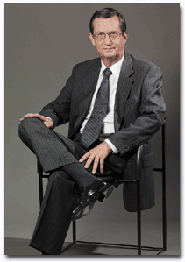
Ask Herwig Strolz a question about worldwide textile machinery shipments and be prepared for an education on the state of the industry. Strolz, director general of the Zurich-based International Textile Mfrs. Federation (ITMF), can offer seemingly unlimited insightful analysis.For example, Strolz believes the U.S. industry is in the midst of a restructuring similar to what its European counterpart experienced in the 1970s. However, what took about 20 years in Europe is on an accelerated pace in the U.S., he believes.”I have thought for a long time that the U.S. will go the way Europe has gone,” Strolz says. “Europe was affected much earlier by globalization. Restructuring of industry started much earlier in the 70s and is still continuing. Companies have learned over a period of time to adapt.” Strolz believes the evolution of the textile industry may take just five years in the U.S. He says to survive, companies must increase flexibility, pay more attention to quality and seek strategic alliances with manufacturers in other countries.”What it will come to is America will have a different textile industry in five years, perhaps even earlier,” Strolz predicts. “Developments are already pointing in that direction. It will be a more versatile, a more quality conscious industry that caters to the upper market segments and pulls out of commodity textiles.”Dan Frierson, chairman of The Dixie Group and a former ITMF president, is a Herwig Strolz fan. He says Strolz has few peers as an industry analyst. “I really think Herwig has done the best analytical work on this industry,” Frierson says. “He is extremely knowledgeable and talented and is a great student of industry trends. If people in the industry listen to him, they will come out ahead.”Frierson says Strolz has been “beating the drum” of overcapacity since the early 1990s, updating his statistical model on installed capacity each year. “He has been very accurate, and candidly, his analysis is one thing that led us to exit the traditional textile business and enter carpet business,” Frierson says.When the worlds textile associations need an expert speaker to dispense a dose of honest industry assessment at an annual conference, they often turn to Strolz, who arguably is a premier tracker of textile trends. One of his recent talks was to the American Yarn Spinners Assn. where he admitted that todays textile market leaves even the most informed observer perplexed. In his speech, which he titled, “Spinning in the Real World,” Strolz told spinning executives their segment has “a giant overcapacity around its neck.” His advice: “excess capacity must be the central point of departure in each spinning companys strategy.”ITMF President Herbert Schmid, president of Brazils huge Santista Textil, a global manufacturer of denim and other fabrics, says Strolz has been involved in every sector of the global textile production process through personal visits, conferences, speeches, committees and publications. “His personal commitment to the industry has been to serve as a bridge between cultures and styles of doing business,through his command of several languages, his unflagging goodwill and his practicality and persistence,” Schmid says.Strolz, one of the worlds premier purveyors of textile industry information, is Textile Worlds 2001 Leader of the Year. He is the first non-industrialist to receive the award. A Global OrganizationITMFs member nations account for about 65% of the worlds textile production. China, which accounts for 20%, is the largest non-member. Strolz expects China may join in the future. “There is a relationship between ITMF and the Chinese industry, but it has not reached the quality of a membership relationship,” he says.An association of associations, ITMF does not have a large staff. Besides Strolz, an assistant director, an economist and a part-time secretary comprise the staff.Strolz, 64, has spent nearly half of his life as head of ITMF. He will observe 32 years with the organization next Jan. 1. During that time, he has enjoyed many professional relationships, which have contributed to his successful tenure. He recalls three men, all former ITMF presidents who are now deceased, who helped him immensely during his early ITMF years.”To be successful, you need a lot of good will on the part of leading people at the helm of any organization,” Strolz says. He cites Craig Smith, former chairman and CEO of Avondale Mills, Tami Guchi, head of Toyoba, the largest textile company in Japan and Mateo Legler, former chief of the huge Legler Group in Italy.Guchi hired Strolz and Smith was the incoming president. Legler also later served as ITMF president. “They all gave me enormous support from the beginning,” Strolz says. “Then there are all my colleagues from associations around the world who have been supportive in our efforts.” ITMF Becomes Authority On Machinery ShipmentsOne of ITMFs greatest accomplishments since Strolz took the reins is the accurate compilation of global textile machinery shipment statistics. In the early 1970s, information of this sort was scarce and consisted mainly of installed capacities in various textile sectors such as spinning and weaving. Today, ITMFs annual “International Textile Machinery Shipment Statistics” is a highly regarded industry publication. The current edition is the product of many years of research and convincing of machinery manufacturers to share information.”In the early 1970s, all we knew were the installed machinery capacities around the world,” Strolz remembers. “It was a good time for the industry in the years leading up to the first oil crisis with machinery manufacturers selling out two or three years in advance, sometimes even more. So, even they had lost sight of investments.”We wanted to go a step further than the information that was available and track investments year to year. At that time, this kind of data was considered absolutely confidential.”What Strolz and ITMF needed was the cooperation of machinery manufacturers. Gradually, Strolz persuaded companies that ITMF could compile the data and then divulge it in a way that would not reveal the number of machines shipped by an individual company. German and Swiss manufacturers were the first to participate and then others joined.
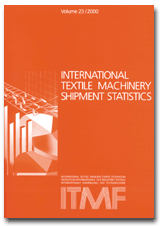
“We started a new thing,” Strolz says. “Today, this is our Number 1 publication, no doubt about it. Nowadays, companies are working with us directly. We dont take any existing trade statistics. We take our questionnaires as they come back from the companies and they provide a picture of investments by the industry today.”The publication continues to grow. Texturing and circular knitting machinery manufacturers joined in recent years and the current issue includes flat knitting machinery figures for the first time.”We can say we are covering somewhere between 95% and 100% of the worlds investment in textile machinery,” Strolz says with a sense of pride. 
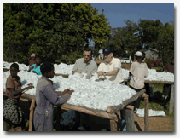
Other ITMF milestones include establishment of various committees for industry segments. Strolz cites the Spinners Committee, in particular. ITMF created the Spinners Committee in 1985 to give the spinning sector a greater voice in matters of interest to the industry. A major objective is to support the development of quality cotton fiber based on modern spinning requirements.”We decided that if we really wanted to bring this industry forward, we needed to seek a dialog between the spinner and the grower of natural fibers,” Strolz said. “In its 16 years, it has grown to 12 members.” Strolz says the committee is representative of the worlds spinning industry. A new member is Andy Warlick, president of Parkdale Mills.The Spinners Committee travels to the worlds cotton growing regions and this summer toured areas of southern Africa. “We try to bring the message from the modern spinning industry to those in the field that produce cotton who have little idea of the constraints of spinning machinery,” Strolz says. Consolidation Of Machinery ManufacturersMirroring trends in textile manufacturing over the last several years, makers of textile machinery are merging and acquiring competitors at a quick clip. Major conglomerates include Saurer, Rieter and Radici. Strolz thinks the trend will continue.”Its in full swing,” he says. “Consolidation is going on in all areas. The essential thrust is toward higher concentration because companies are finding it more difficult to constantly innovate with the volume of business they are doing now.”Still, there remain many major machinery companies in the world, about 150 by Strolzs count with about one-third in China.  Expanding ITMF MembershipStrolz enjoys his work with ITMF membership and states a goal of expanding its base, an effort he says is never ending. ITMF represents about 50 nations, although there are some notable exceptions such as China and Mexico.”I cherish my relations with my membership and I want to bring in more members,” Strolz says. “Some have been in and out like the Mexicans. China should have a place in the Federation. I would also like to see the Japanese textile machinery industry join. There is a good chance of this.”
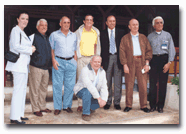
Strolz (center, in yellow shirt) stands with members of the Turkish Textile Employees Association during its meeting in April.ITMF should become more of an “umbrella” organization, expanding both ways in the textile pipeline with increased membership from the fiber and apparel sectors.Interestingly, the U.S. does not have a full member of ITMF since the American Textile Mfrs. Institute left the fold early this year. However, several U.S. associations are associate members, including the American Yarn Spinners Assn., a recent addition. MillikenandCo. and huge Korean fiber manufacturer Huvis Corp. are ITMFs two corporate members.With expanded membership come expanded services. A new initiative is the Young Entrepreneurs Group, which had its first meeting in September at ITMFs annual meeting in Budapest. The group gives young industry leaders (maximum age is 40) a forum to discuss opportunities. Says Strolz, “It brings new blood into the Federation.”The Herwig Strolz BiographyHerwig Strolz was born in Bregenz, Austria, in 1937. He studied law and political science at the University of Vienna where he graduated in 1961 as a doctor in law.Strolz joined the foreign trade department of the Austrian Federal Chamber of Commerce in 1962 and was appointed Assistant Austrian Trade Commissioner in Caracas, Venezuela, the following year. He was transferred to the Austrian Foreign Trade Office in Montreal, in 1966. In 1968 he was appointed director of the Austrian Federation of Industries and assumed managerial responsibilities for the textiles and clothing department of the Chamber of Commerce of Vorarlberg, the province where most of Austria’s textile manufacturing activity is located. Strolz became director of the International Federation of Cotton and Allied Textile Industries (IFCATI) on Jan. 1, 1970, by appointment of the Federation’s Committee of Management at its meeting in Oporto, Portugal, in October 1969. The Federation changed its name to International Textile Mfrs. Federation (ITMF) in 1978. During his term of office ITMF has become the leading global trade association of the primary textile industry with close to 50 of the world’s most important textile producing countries in membership. In 1991 Strolz received the “Golden Jenny Award” of the Schlafhorst Foundation. ITMF Evolves With Industry For 97 YearsThe International Textile Manufacturers Federation (ITMF), founded in 1904 by the British cotton spinning industry, is one of the worlds oldest textile trade associations. Its original name was International Federation of Master Cotton SpinnersandManufacturers Assn. and first headquartered in Manchester, England.In 1954, the organization adjusted to the changing industry and changed its name to International Federation of CottonandAllied Textile Industries. The Federations headquarters moved to Zurich, Switzerland, in 1963 to broaden its international scope. In 1978, the name was changed to International Textile Mfrs. Federation.ITMF membership includes:Full Members are associations and other constituted organizations of manufacturers of textiles. There can be only one member association from each country. Associate Members are associations and other constituted organizations of manufacturers of textiles in countries where there is already a member association; and associations allied to the textile industry. Corporate Members are manufacturers of textiles or of products allied to the textile industry in countries where their respective central trade association is not affiliated with the Federation. Today, ITMF says its main objectives are toprovide a forum for discussion of matters appropriately within the common interest and concern of textile companies. provide a neutral meeting ground for textile trade associations for the exchange of information on matters affecting their textile industries, consistent with the trade regulation laws of the nations represented. act as a central agency of the textile industries for the collection of information, statistical and otherwise, on textile manufacturing developments in all countries of the world. act as spokesman for the world textile industry in matters relating to raw materials (cotton and manmade fibers). perform the functions of a liaison agent between the textile industries and governments and intergovernmental organizations interested in the textile industry. October 2001
SSM And Fadis Reach Patent Agreement

SSM AND FADIS REACH PATENT AGREEMENTSSM Schr Schweiter Mettler AG and Fadis SpA signed a license agreement which includes the use of patents for electronic yarn-guiding system. The deal resolves a patent infringement dispute that originated during ITMA 1999.The license agreement authorizes Fadis to use SSM patents for the production and the incorporation of electronic yarn-guide systems in its entire Syncro winder line. SSM has been delivering this technology since 1995 and has sold about 40,000 units.November 2001

Martin Color-Fi Granted Exclusive Rights To ColorGuard TM

Martin Color-Fi Granted Exclusive Rights by Clariant Corporation; ColorGuard(TM) Fiber to Enhance
Manufacturers Automotive Segment EDGEFIELD, S.C., Jan. 24 /PRNewswire/ — Martin Color-Fi Inc.
(“MCF”)announced today that it has been granted exclusive rights by the Clariant Corporation to
utilize Clariant’s new Nylostab S-EED(R) additive in the manufacture and sale of polyester fiber
for automotive applications. MCF isone of the leading producers of polyester for use in the
automotive industry and the agreement specifically covers this market segment in the United States,
Mexico and Canada. This unique fiber, introduced today by MCF as ColorGuard(TM), is stabilized
against the long-term effects of ultravioletlight and heat and provides an improved color
appearance. ColorGuard(TM) fiber is a preferred solution available in all of MCF’s demanding
applications as well as the automotive segment. Stephen A. Zagorski, President and CEO of MCF,
commented, “We view this new additive as enabling MCF to provide the next generation of solution
dyed polyester fiber.” Robert A. Post, Vice President of Clariant’s Additives Business Unit added:
“We are excited about the impact our product will have in the automotive segment and are pleased to
have the opportunity to partner with a significant player in Martin Color-Fi.” Martin Color-Fi,
Inc. is a leading producer of specialty staple fiber,both solution dyed and natural, for a wide
range of markets, including automotive, industrial, home furnishings, floor coverings, apparel, and
construction. The company also produces polypropylene and nylon staple fiber,in addition to yarn,
pigments and additives.SOURCE Martin Color-Fi, Inc.Copyright 2001 PR Newswire

AYSA Elects Little President

AYSA ELECTS LITTLE PRESIDENTThe American Yarn Spinners Assn. (AYSA) elected Charles L. Little president during its 34th annual meeting held in September at Sea Island, Ga. Little, president of Mount Vernon Mills Yarn Div., succeeds D. Harding Stowe, president and CEO of Stowe Mills.Members also elected James W. Chesnutt, (president and CEO of National Spinning Co.) as first vice president and Stephen G. Dobbins (president, treasurer and COO of Carolina Mills) was elected second vice president.Fred A. Jackson, president of AmericanandEfird, was re-elected treasurer and Micheal Hubbard was elected executive vice president and secretary.Hubbard replaces long-time AYSA head man Jim Connor, who is retiring. Connor, 64, will serve as an advisor to AYSA for another year.Hubbard, 33, is a native of South Carolina and graduated from Auburn University in 1990 after majoring in German and political science. He attended Heidelberg University in Heidelberg, Germany, and is fluent in German. He received a Masters degree from Baylor University in 1933 with a focus on diplomatic relations and international trade.Hubbard served in Washington on the staffs of Indiana Sen. Dan Coats and Rep. Barbara Cubin of Wyoming. Before joining AYSA in September 2000, he worked in the South Carolina Senate as director of research for the Senate General Committee.October 2001

Planit 2000 Knitted Goods Finishing Machine Introduced

Germany-based Novakust GmbH is offering a finishing machine, Planit 2000, that meets all the
requirements of product-specific finishing of fully fashioned knitwear parts before the parts are
sewn into a garment. The machine can be used for finishing all yarn combinations as well as
continuous finishing of fabric webs.All parameters for finishing quality including top and bottom
heat, steam dosage and temperature, decatizing roller contact pressure, production speed and
uncurling spindle speed can be set. Once determined, the process data can be saved and reused,
permitting exact reproduction of finishing results.

January 2001

West Point Stevens Finds Totes Final Piece Of Automation Puzzle

Materials HandlingBy Cosby W. Woodruff, Assistant Editor WestPoint Stevens Finds Totes Final Piece Of Automation PuzzleContainers allow Clemson plant to improve quality, cut costs. 

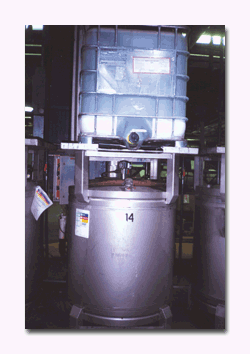
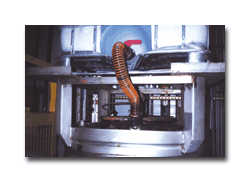
WestPoint Stevens sprawling Clemson (S.C.) complex is one of the largest and most diverse operations in the companys portfolio. Inside the walls of the four plants that make up the Complex, some 2,000 associates perform functions from opening bales of raw fibers to shipping finished bedding products that are complete with bar codes for the appropriate retail outlet.Like other major textile operations, WestPoint Stevens automated the Clemson Complex in recent years, and this presented specific problems for various departments.At Clemson Finishing Plant, one of the big automation needs was the ability to dispense dye ingredients from standard containers via an automated system. Clemson Finishing Plant Manager Billy Harris says the company spent a year working out a system of totes that allows the Bespoke automated dyehouse equipment to dispense just what a dye batch needs.The WestPoint Stevens team came up with a series of 64 fixed totescalled bottom toteseach with necessary plumbing, sensors and pumps. These stainless-steel fixtures hold the key ingredients for dyes and printing inks that go into WestPoint Stevens sheeting.Each bottom tote has a frame to support a top tote. The top tote is a standard off-the-shelf container that a chemical supplier ships full of a dye, pigment or other chemical. When the Bespoke system alerts the operator that one chemical is low in the bottom tote, the operator moves that tote, hooks up a tube to the top tote and lets gravity refill the bottom tote. When the top tote is empty, the operator simply replaces it with another one and the empty tote ships back to the chemical supplier.WestPoint Stevens rejected using the suppliers totes as the main container for several reasons. Installing the pumps, plumbing and monitoring equipment was not feasible on the supplier totes, which sometimes are little more than a plastic container on a wooden pallet with an aluminum frame.WestPoint Stevens was looking for something more permanent. So a company team drew a sketch of what would work and passed it on to Hoover Materials Handling Group, which developed what the company now uses.Requirements included a sloped bottom and no sharp corners where dyes may settle, then break loose, causing specks or uneven dyeing. The bottom tanks also needed to be a standard size, and market totes vary slightly from company to company.”There is no such thing as a standard tote,” Harris says. “We had to have a tote that was standardized.”Clemson Finishing Plants storage system allows its automated dye facility to do its job of anticipating what color will be required for the next run, locating chemicals needed to make it, gathering those chemicals from the totes, mixing the color and sending it to the dye pad.This saves the company money in several ways. WestPoint Stevens enjoys labor savings as associates no longer mix dyes by hand, and there is a quality gain. And because the machine only mixes what is needed, there is less waste. Clemson Finishing also gets productivity gains by being able to deliver the dye when it is needed.The plant no longer runs patches – the old way of ascertaining that a dye was the correct color. Now, the machine mixes the dye, it is checked against a prior sample, and the batch of material is dyed. Color changes can be achieved within 20 minutes.Clemsons fabric ranges 120- to 310-count sheeting, and it goes to Clemson Finishing Plant, along with fabric from WestPoint Stevens five other sheeting plants. Clemson Finishing Plant dyes in up to 400 colors, with more than 300 active at any time.

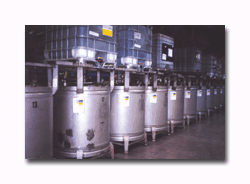
Chemicals shipped in manufacturers’ totes drain into WestPoint Stevens’ totes through a connecting tube.

Totes line the floor at WestPoint Stevens Clemson (S.C.) plant. The containers store chemicals used in dyeing and finishing.November 2001

Salant Corp Acquires Tricots St Raphael

NEW YORK, Jan. 17 /PRNewswire/ — Salant Holding Corporation, a wholly owned subsidiary of Salant
Corporation (OTC Bullentin Board: SLNT), has announced the acquisition of Tricots St. Raphael
(Tricots), the designer knitwear collection. Salant acquired Tricots through an Asset Purchase
Agreement dated January 10, 2001, which was effective January 2, 2001. Salant is primarily known as
the manufacturer and distributor of Perry Ellis Menswear, which includes sportswear, dress shirts,
slacks and accessories, to retailers such as Federated Department Stores, The May Company and
Dillard’s. Tricots is one of the most prestigious labels in designer men’s sweaters and knitwear;
the collection is sold at Nordstrom, Saks Fifth Avenue and other better specialty stores. The
alliance with Tricots affords Salant the opportunity of adding an upscale tier to its distribution.
“Salant intends to maintain the design, merchandising and marketing integrity of the Tricots brand,
while enhancing its back office efficiencies through operational alignment,” stated Michael J.
Setola, Salant’s Chairman and Chief Executive Officer. “I am delighted with the dimension that our
new association will bring to the Salant organization.” The acquisition of Tricots, together with
the recent licensing arrangement with Tallia Uomo, an upscale contemporary men’s sportswear
collection, will strengthen Salant’s position in better channels of distribution. Setola continued,
“Through our continued efforts in forging new businesses and the appropriate alliances, Salant is
strongly positioning itself for the future. We are focused on marketing through multiple channels
of distribution, and on increasing our share of the total menswear market.”SOURCE Salant
CorporationCopyright 2001 PR Newswire

Letters Concerning Sept 11

LETTERS CONCERNING SEPT. 11(The following letter was sent by the National Textile Alliance to President Bush.)The PresidentThe White House1600 Pennsylvania Avenue NWWashington D.C. 20500Dear Mr. President:As our government and people respond to the barbaric events of September 11th, the members of the American Textile Alliance want to pledge our support for your efforts to fight back against those who have attacked our great nation.We represent various sectors of the United States textile industry, including suppliers in the cotton, wool, man-made fiber and textile machinery industries. The entire textile industry complex provides the U.S. military with approximately 13,000 different items made either partially or entirely from textiles.As we are key suppliers to the Armed Forces, we want you to know that we stand ready to do our part in the war on terrorism. We have already contacted procurement officials at the Defense Supply Center Philadelphia to make them aware of our readiness to help, as we did when they were confronted with the unique supply challenges of the Persian Gulf War.Mr. President, as you know, for the past several years, our members have been experincing tough economic times. They have had to deal with the pain of massive layoffs, plant closings and bankruptcies. But these economic hardships will not deter uswe will help shoulder the burden of meeting and defeating the threat terrorism poses to our American way of life.Sincerely.Alabama Textile Mfrs. Assn.American Cotton Shippers Assn.American Fiber Mfrs. Assn.American Sheep Industry Assn.American Textile Machinery Assn.American Textile Mfrs. InstituteGTMAAssociation of Georgias Textile, Carpet and Consumer Products Mfrs.Knitted Textile Assn.National Cotton CouncilNorth Carolina Mfrs. Assn.Norther Textile Assn.South Carolina Mfrs. AllianceTextile Distributors Assn., Inc.(Textile World also received the following letters regarding the Sept. 11 attacks)DEAR FRIENDSIN AMERICAThe information about the disastrous attacks on the United States shocked everybody here at Dornier immensely.We join you in your mourning for all the lives lost and deplore the horrible damages these brutal acts of terrorism have done to your country and the whole civilized world.May we assure you of our steadfast partnership with you, our dear friends and customers on the other side of the Atlantic Ocean.One of the most important cornerstones in the history of our company was the good and reliable business conducted with our friends in America. We have every intention to carry on this close relationship into the years to come, despite of the adverse conditions that exist at present.If you can think of any way we could be of assistance to you, please do not hesitate to call on us.Peter D. DornierHans GeigerLindauer DORNIER GmbH(The following letter is from Mexicos apparelmanufacturers association.)Dear AmericanPartner:Receive our greatest condolences for the unspeakable acts that have occurred in the last days. This association and its members are truly worried for your situation and the safety to your families. Please remember that you will have as always, all the support you need from Mexico. Think of us not only as a business partner, but as your friends, we will stand at your side in these and other situations.We send you our best wishes and thoughts, knowing the strong character and great determination of the American people.Sincerely,The Board and Membersof Camara Nacional de la Industria del VestidoOctober 2001

Partners In Success

After 23 years at one of the worlds largest producers of textile auxiliary products, long-time
friends and co-workers Ramon Navarro and Lorenzo Liste left the safety and security of the
corporate world to start their own company in Barcelona, Spain. The two friends, whose families
spend holidays and vacations together, worked 16-hour days, making sales calls during the day and
filling orders at night.Today, 14 years after Aplicaci Suministros Textiles, S.A. (Asutex) opened
its doors, the textile chemical formulator boasts $20 million in revenues; annual growth close to
30 percent; three production facilities on two continents; and market share across Europe, South
America and Asia. Along the way, Navarro and Liste sought key partnerships to offer the
highest-quality products and services to their customers. Genencor International, one of the worlds
largest biotechnology companies, became an integral part of Asutexs success. A Baby Is
BornWhen Navarro and Liste decided to leave the multinational company, friends and family were
astonished. Despite feeling really at home at the company, our desire to form our own firm was much
greater, said Navarro. We both felt we had the knowledge and experience to go out on our own, and
we didnt see it as a big risk.The company opened its doors in 1986 to produce and sell products for
preparation, dyeing, finishing, continuous printing and serigraphy. Asutex began with five
employees and 20 customers in a small warehouse near Barcelona. Navarro focused on sales and
marketing, while Liste concentrated on technical service and research and development. Daniel
Carreras and Arturo Ferrando, also from the multinational company, joined Navarro and Liste to
handle the dyes and warehouse responsibilities. Two years later, the companys rapid growth
necessitated its relocation to a larger facility in Barcelona the heart of Spains industrial region
in the province of Catalonia. The 11,000- square-meter facility, located 140 kilometers south of
the French border, houses the companys sales and marketing, customer service, research and
development laboratory, and warehouse. Today, the companys 65 employees produce 14,000 metric tons
of auxiliary products per year, plus 4,000 metric tons of liquid sulfur black at production
facilities in Barcelona and Portugal. Last September, Asutex opened a plant in Morocco.Never did we
expect the success that we have realized in such a short time, said Liste. We knew we had the
knowledge and experience, and we are so excited to see our baby has grown up. Long-Time
PartnersSeeking alpha-amylase enzymes for use in desizing preparations, Asutex discovered Genencor
International in 1990. In the last decade, the relationship between the two companies has grown and
flourished. Asutex has been instrumental in helping Genencor commercialize new products by
conducting trials on several new enzymes including IndiAge® Neutra, launched in 1999. Neutral
cellulases are key products for our stonewash customers in Europe and South America, and we were so
happy when Genencor developed this product, said Navarro. We are very pleased with IndiAge Neutra
enzyme; its the only neutral cellulase that we formulate for our end-users. 

Genencor claims the IndiAge Neutra enzyme offers textile chemical formulators the most
flexible neutral cellulase available in the market today. The enzyme operates over a wide range of
temperature and pH, 40°C to 60°C and 5 to 9, respectively. Unlike conventional neutral cellulases,
the IndiAge Neutra product responds to variations in temperature and pH with only moderate changes
in abrasion activity. This flexibility allows processors to operate at lower temperatures than with
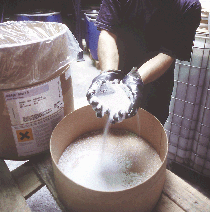
conventional products.IndiAge Neutra comes in both liquid and granule forms. IndiAge® Neutra G
enzyme features Genencors proprietary granule, which includes a patented Enzoguard® coating. These
granules are safer to handle than dusty powders and have improved features for easy blending and
storage stability. The IndiAge® Neutra L product is very beneficial for automated liquid feed
systems. We compared IndiAge Neutra G against other products, and we prefer to use it over anything
else because it is very easy to formulate and has the encapsulated enzyme technology, said
Liste. About GenencorGenencor International is a diversified biotechnology company that
develops and delivers innovative products to the health care, agriculture and industrial chemicals
markets. Using an integrated set of technology platforms, Genencors products deliver innovative and
sustainable solutions to many of the problems of everyday life.Genencor was established in 1982 as
a joint venture between Genentech Inc. and Corning Incorporated. Since its founding, Genencor has
grown to become a leading biotechnology company, with over $300 million in 1999 revenues, more than
250 biotechnology products in commerce, and more than 3,000 owned and licensed patents and
applications. Genencor, with more than 1,500 employees worldwide, has principal offices in Palo
Alto, Calif.; Rochester, N.Y.; and Leiden, the Netherlands. Long Hours, Hard Work Pay OffFor
the last 14 years, Navarro and Liste have logged long workdays and many kilometers traveling around
the globe selling their products. Their families continue to spend holidays and vacations together,
and they hope that one day their children might run the business. Through the ups and downs of
running a business, one constant has remained: their friendship. There are lots of people who say
our situation is unbelievable, especially after being friends for 30 years and continuing to work
successfully together, Liste said.Both owners also say they attribute much of their success to
forming partnerships with key companies like Genencor. We have always been interested in new ideas,
new products or new processes, and we appreciate it when Genencor calls us seeking our opinions,
said Navarro. From the first trial we ran of IndiAge Neutra G to participating in the University of
Genencor three-day textiles training seminar, we feel that by working together, we are a part of
Genencor, even though we are only a customer. 

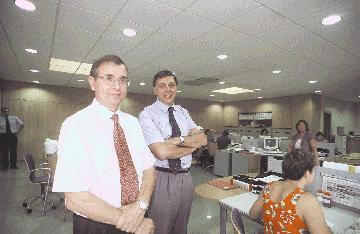
Long-time friends and co-founders of Asutex, Lorenzo Liste (left) and Ramon Navarro, turned a
start-up textile auxiliary company into a thriving business with 65 employees; three production
facilities; 30-percent annual growth; and market share in Europe, Asia and South America.

January 2001

Product Resource Guide

Product Resource GuidePumps, heavy duty, are for totes, tank and barrel washing. Units are designed for caustic, high-temperature and recycled fluids. Pumps have no cups, packings or seals and can run dry without damage. Hydra-Cell. www.hydra-cell.com 

Motors, explosion proof, are for applications in hazardous environments containing explosive gases or dusts. Motors are available in single-phase power through 2 hp and in 3-phrase through 250 hp. Motors available in steel frames through 5 hp and in cast iron through 250 hp. Leeson. (262) 387-5239. 

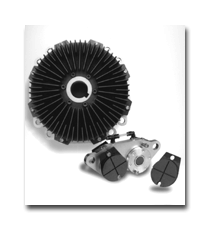
Brake actuator, UA, is a replacement for in-place brake systems for web converting machine. Actuator uses a dual-disk brake upgrade with anti-squeal friction pads. Each assembly has two pneumatic cylinders and four friction pads. Other features include quick-change release locks that allow pads to be changed in seconds, zero-maintenance piston and a 5-yr warranty. Dover Flexo Electronics. www.dfe.com 

Operator interface, Model 2300, is a combination of a PLC and a motion control interface, offering a programmable touchscreen HMI, two connection ports, a programming port and a PS2 keyboard port. SoftPLC provides software and hardware products. Connection is by Winbuild 2000 HMI software and serial connection. Eason Technology. www.eason.com 

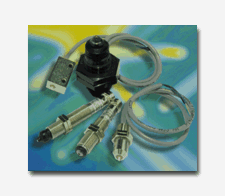
Switches, My-Con, offer repeatability to within 0.000040 in. and switch-point accuracy of +/-0.001 mm. Activitaging forces are defined by user between 30 and 250 grams. Units offer barrel-type housings, rectangular enclosures and M8 screw-on connectors. Standard activitating pin materials are offered, and devices are either a-c or d-c. Baumer Electric.www.baumerelectric.com 

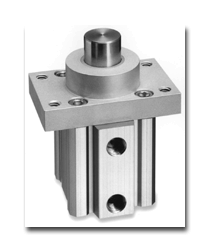
Actuator, conveyor-stop, bases on an EF1 cylinder, self-lubricating nylon-shaft bearing and compact size. Rod end of stopper cyclinder is modified with a flange and anchored with four bolts. Flange has a pilot with an energy-absorbing polymer bearing, and cylinders oversized piston rod maximizes effecting bearing area. These features give stopper a load resistance up to 65 lb at 10 in./sec. Bimba Mfr. Co. www.bimba.com 

Dust collectors, PleatJet II, uses a horizontal cartridge filter design for easy maintenance and filter changes. A Venturi-Pulse cleaning system is included as a standard feature. An Opti-Pulse cleaning design optimizes energy from the pulse pipe, providing uniform dust release. Device offers all-welded construction without cantilevered supports. Models available to 50,000 cfm. Sly. www.slyinc.comNovember 2001

Sponsors