NEW YORK, Dec. 27 /PRNewswire/ — Bank of America Securities today announced the launch of $1.5
billion Senior Secured Credit Facilities on behalf of Levi Strauss and Co., one of the world’s
leading branded apparel companies. The facilities have been underwritten by Bank of America,
NA,Citicorp USA, Inc. and The Bank of Nova Scotia. Syndication of the facilities will commence in
early January. The commitment is subject to customary conditions, including the negotiation and
execution of a definitive creditagreement. Completion of the agreement is expected to occur in late
January. The new senior secured credit facilities consist of a $750 million Revolving Credit
Facility and $750 million in Term Loan Facilities. Banc of America Securities LLC and Salomon Smith
Barney Inc. are acting as Co-Lead Arrangers and Joint Book Managers on the facilities. The
facilities are allpari passu in ranking and scheduled to mature in August 2003. The purpose of the
new financing will be to refinance existing bank debt.SOURCE Bank of America Corporation Web Site:
http://www.bankofamerica.com Copyright 2001 PR Newswire
Bank Of America Arranges 1 5 Billion Financing For Levi Strauss
Challenging Tradition
There have been several comments in the textile press that there is perhaps an excess of textile
machinery shows and that machinery makers are limiting their efforts by electing to make a
significant presence at selected exhibitions. This was clearly apparent at the American Textile
Machinery Exhibition International (ATME-I) 2000, because the booths contained little equipment,
and several manufacturers had only a token presence. While this report primarily focuses on staple
spinning, it was clearly evident from the number of exhibitors, and from the activities at the
various booths, that the nonwovens sector had become a major feature of this ATME-I (See the
upcoming nonwovens report in the February issue of ATI). Exhibitors included companies that market
cutting and recycling of waste fibers, opening and feed systems, web-forming systems, and different
bonding techniques.A further surprising feature was the re-emergence and significant presence of
Greenville, S.C.-based Saco Lowell Inc. at the textile machinery show. Indeed, Saco Lowell (and
Fiber Controls) occupied the greatest amount of booth space of any single manufacturer at the show
and, furthermore, actually showed the greatest range of spinning machinery. The focal point of the
Saco Lowell display was the companys 766 Rovematic roving frame, which claimed to doff an entire
128-spindle frame in less than three minutes. Also on display were opening and cleaning machinery,
the M-2000 card, the Model 995 draw frame, the Model 804 tdS spinning frame and Model 849 heavy
ring twister. The brief review that follows looks primarily at general trends in yarn production
and particular new developments viewed in the light of the last ITMA and OTEMAS. There have
been several developments in carding machines, which, when taken together, could represent a major
breakthrough. These include automatic measurement of sliver uniformity (all cards with
autolevelers) and nep content (Truetzschler), automatic measurement of card settings (Truetzschler
and Hollingsworth), centralized and possibly motorized flat setting (Truetzschler), automatic
grinding of cylinder and flats (Rieter). If these technologies were combined, it should thus be
possible to grind and set the card based on measurements of nep content and sliver uniformity.
There have been few changes in drawing machines, but the possibility of integrating a drawing unit
with the card is being promoted by Truetzschler. While this possibility has been previously
proposed by other manufacturers, it is claimed that by using a higher draft, the present system
gives improvements in fiber straightening and, hence, yarn properties. Truetzschler also exhibited
its Sliver Focus System, which records the incidences of thick places (longer than 20 millimeters
and 15 percent over-weight), and emphasized that sliver thick places can be correlated with yarn
defects. One further drawing unit worthy of note was the Schlumberger chain gill with electronic
autoleveling, which has a maximum speed of 500 meters per minute (m/min). SpinningRing
Spinning In conventional ring spinning, a cotton spinning frame (with Murata link winding) was
shown by Shanghai Erfangji Co., while Schlumberger showed a double-sided carpet-yarn machine with
autodoffing and sliver stop motions operating with a draft of 73.Compact Spinning The buzz word in
staple spinning at ITMA 99 was compact. While this term was originally used by Rieter to describe
its technology adopted from Fehrers DrefRing development, Rieter replaced the terminology with
comfort spinning and, ultimately, Com4. The technology is also termed condensed spinning by other
manufacturers. The concept behind this spinning technology is that the strand of fibers issuing
from the drafting system is condensed (usually pneumatically) and this gives the yarn a more
compact structure (See Photograph 1-all photos and figures are at the bottom of the page).In
compact spinning, the fibers are integrated more tightly into the yarn structure, resulting in
yarns that are less hairy, stronger, more extensible and lustrous. Fabrics produced from the yarns
are softer, stronger, have better abrasion resistance, and give better print and pattern
definition. In terms of processing advantages it is claimed that fewer end breaks occur during
spinning and, for certain end-uses, it is possible to reduce the spinning twist and thus increase
production on the ring frame. In downstream processing, it is claimed that the reduced hairiness
and increased strength give better performance in knitting and weaving. Indeed, because of the
improved surface characteristics of the yarns, it is claimed that singeing, sizing and waxing can
be eliminated. While four different systems of compact spinning namely, Suessen, MAL, Zinser and
Rieter were shown at ITMA 99, three different systems were exhibited at ATME-I 2000: Rieter showed
a new version of the Com4 system. The drafting system used is a double-apron system with two top
front rollers. The bottom front roll of the drafting system is perforated, and as the drafted
strand passes between the two top front rollers, the strand is condensed. The new system utilizes
one suction roller for each roving (and each spindle), unlike the system shown at ITMA, which used
shared drafting and suction roller for two rovings (See Photograph 2). The new system, which is
designated ComforSpin K44, is not yet available, but it is intended for combed cotton yarns.
Suessen exhibited the EliTe spinning system. Suessens implementation of compact spinning follows a
different approach than Rieter, in that the EliTe system is an addition to an existing drafting
unit. A perforated apron, through which suction is applied, is positioned after the bottom front
roller of the drafting system (See Figure 1). An additional top roller, which is gear- driven from
the top front drafting roller, forms a nip with the apron and drives it through friction. Because
the additional top roll is slightly larger than the front roll, a small tension (draft) is applied
in the condensing zone. The suction through the perforated apron is applied through a narrow angled
slot in the tubular profile (the tube that supports the apron). This condenses the fiber strand and
is claimed to cause the fiber assembly to rotate around its own axis so that the fiber ends are
closely embedded into the fiber assembly (See Photograph 3). Suessen announced it can now retrofit
the EliTe Spinning System to existing ring frames. A possible advantage of this system is that it
is relatively easy to revert back to normal spinning with the removal of the perforated apron and
the extra top roll. A further claimed advantage is that almost all short-staple fibers can be
processed on the EliTe system (both carded and combed). Marzoli had a static demonstration of its
Olfil system, which resembles the Suessen system in that it also uses a bottom perforated apron and
an extra top front roller. The Olfil system is still under development and not yet commercially
available. The major difference between these two systems is that, whereas Suessen utilizes a
bottom perforated apron that extends back into the nip of the normal front roller, the Marzoli
system uses a bottom roller around which the perforated apron passes. This implies that the Suessen
system has greater control of the issuing strand. Indeed, a video of the Olfil system showed a lot
of freedom for the fibers as they passed to the suction roller. An additional difference between
Suessen and Marzoli is that, while they both use slightly different roller sizes to promote the
tension in the condensing zone, Marzoli use a timing-belt drive, whereas Suessen uses a gear
drive.One observation on compact spinning is that the improvement in yarn processing due to the
higher strength and lower hairiness does carry a small penalty. The reduction in hairiness reduces
the amount of air carried with the yarn, which can result in hotter running of the traveler, which
shortens traveler life. It may thus be necessary to use slightly slower spindle speeds when
operating compact spinning frames. A further interest is that Rieter has attempted to quantify a
COM4 value, which is defined as: COM4-value = 100,000/(yarn twist * yarn hairiness) where twist is
turns per meter (T/m) and hairiness is measured with UT3 or 4. Higher values represent compact
yarns of better quality.Rotor Spinning There was little new in rotor spinning and indeed the only
machine shown was a Schlafhorst Autocoro SE 8 machine, which had been modernized using Suessen
upgrade components. The main feature of the conversion is the use of the SC 1-M spin box, which is
claimed to offer improved fiber control during combing of the fiber beard, coupled with improved
aerodynamics. The machine was also shown spinning Ne 20 yarn (50/50-percent polyester/cotton) at
116,000 revolutions per minute (revs/min) and 204 m/min. An additional feature of the conversion is
the use of a new piecer carriage that no longer required the use of a starter yarn. It is evident
that the modernization of rotor machines is currently an attractive alternative to purchasing new
machines.Vortex Spinning Murata Vortex Spinning (MVS) (See Photograph 4) was initially unveiled at
the OTEMAS exhibition. It has aroused a lot of interest because of the claimed possibility of
spinning 100-percent cotton at high production speeds (maximum 400 m/min). The system is best
viewed as a development of jet spinning, as available information indicates that the yarn produced
is fasciated. It was interesting to note that while three machines were exhibited at OTEMAS, only
one machine was shown at ITMA and ATME-I. The reasoning given was that, when shown earlier, the
machinery was under development and different configurations were being used, whereas the
configuration is now finalized. The MVS 851 machine shown at the exhibition was very impressive
spinning 100-percent carded cotton into Ne30 yarn at 350 m/min. It is clear that this system offers
major production advantages over other spinning systems (See Figure 2). Yarns and fabrics produced
are regarded as ring-like (See Photograph 5), and there have been claims that, in some respects,
they resemble combed cotton products. There are, however, significant fiber losses associated with
this system, and while it has been claimed that most of the loss is short fiber, figures of fiber
waste of 5 to 8 percent have been quoted. The system has undergone development in U.S. mills for
several years, and significant quantities of yarn are being commercially produced. It was claimed
that 200 machines are presently installed. Historically, successful spinning systems have doubled
in production speed within eight years of their introduction. Based on this maxim, it would appear
that the future looks exciting for MVS, but to realize the full potential of the system,
significant developments in drafting and winding technology may be necessary. Areas Of
Significant InterestConversations with exhibitors and representatives of the spinning industry
indicated that there is significant interest in two areas of quality control the monitoring (and
control) of moisture content and the detection and elimination of foreign materials. While these
areas have for many years been regarded as very important to worsted and woolen spinners, their
significance for cotton spinning is just being recognized. Moisture measurement and control is
important with respect to both the ease of fiber processing (and hence, yarn quality) and the
management of materials within the mill. Different sensors and approaches are offered by different
manufacturers, but the main areas of measurement are the input and the final product. Systems for
monitoring bales are available from, for example, Streat, Forte and Malcam. These units can monitor
the moisture content of unopened bales. Fortes system uses harmless electromagnetic waves. Monitors
placed on either side of the conveyor register the regain of the bale. Malcam utilizes microwaves
and claims they not only measure average moisture content, but can also detect wet spots, hot spots
and large foreign matter in the bale. These systems could also potentially be used for moving fiber
webs. In this area, Mahlo offers a multifunctional web-scanning device, which can use either
infrared or microwave moisture sensors (depending on the web characteristics). Additional sensors
can be used for measurement of the thickness and weight of the webs. Single yarn packages can be
assessed for moisture content using non-contact systems from Forte and Malcam. While the Forte
system claims to be able to assess the moisture content of palletized yarn packages, Malcam prefers
to sample individual packages. Foreign material detection and removal, including other unwanted
debris, can be achieved at many stages of processing. Intuitively, the earlier in the processing
stage the defect is removed, the better, because the impurity is coherent, and thus early removal
prevents its spreading to a larger volume. Unfortunately, in order to remove the impurity, it has
to be identified, which, in turn, requires that the fibers be at least partially opened. In
general, the systems use a camera system to scan the fiber tufts (See Figure 3) and then eject
unwanted material, usually with the assistance of jets of air (See Photograph 6). Systems working
at the early stages of the opening line are available from Uster, Barco and Jossi. The Vision
Shield Compact system offered by Jossi (marketed through Rieter), of which there are presently 350
installations, was shown to be capable of removing small tufts of colored fibers and small sections
of film (about 2 inches by 2 inches). Truetzschlers new Securomat SCFO system works at the deduster
stage, during which the fibers are well opened, and thus enables easier identification and removal
of foreign materials. Optical sensing devices offer the potential of foreign material
identification but not removal at the draw frame. The final stage of foreign material removal is at
the clearing stage, which can be during winding of ring yarn and spinning of rotor, jet or vortex
yarns. Uster and Loepfe (Barco) are well-known in this area, but other manufacturers of optical
sensing devices could also enter this market. It was interesting to note that Loepfe has created a
Foreign Fiber Standard, which is a table showing the classification for foreign fiber defects in
yarns.The limitation of the current systems is that they rely on distinct color differences between
the raw material and the foreign materials. Unfortunately, some of the foreign materials may be
very similar to the normal fibers, and thus defects will not show until after coloration.
ConclusionThere is no doubt that staple spinning is at the forefront of technology in terms
of automation and productivity. In addition, there are greater possibilities for improving yarn
quality by utilizing online and offline monitoring and control devices. However, it was evident at
ATME-I that alternatives to staple spinning are also making significant strides that may ultimately
lead to products that directly compete with those traditionally made from staple-spun yarns.
Visitors to ATME-I must have noticed the considerable amount of activity associated with the use of
air to twist, texture, intermingle, and cover filament yarns. There are also major breakthroughs
taking place in nonwovens technology, with respect to both productivity and fabric
properties.
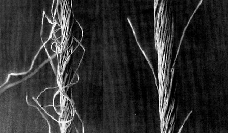
Photograph 1: Compact (right) versus “normal” ring-spun yarn
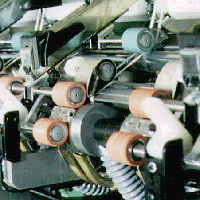
Photograph 2: Rieter Com4 (as shown at ITMA 99)
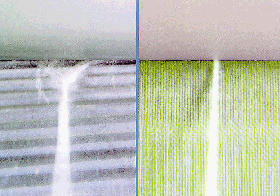
Photograph 3: Fibers issuing from normal (left) and EliTe (right) drafting systems
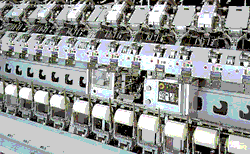
Photograph 4: Murata Vortex Spinning (MVS)
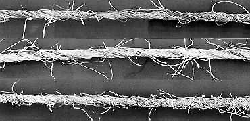
Photograph 5 (top to bottom): MVS, ring-, and rotor-spun yarn
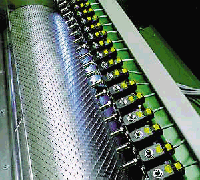
Photograph 6: Jets for ejecting foreign fibers
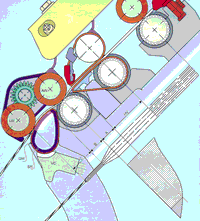
Figure 1: Suessen EliTe System
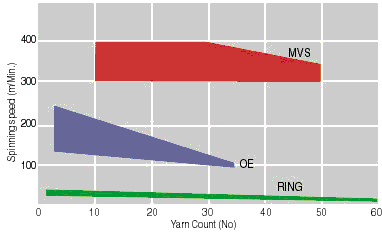
Figure 2: Production comparisons for MVS
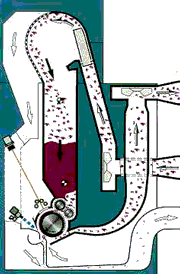
Figure 3: Truetzschler Securomat
Editor’s Note: This is the second of a three-installment report by ATI about the ATME-I 2000
show held this past October in Greenville, S.C. Next month, ATI concludes its coverage with a
report on nonwovens technology by Technical Editor Richard Mansfield.
January 2001
AMTEC Reorganizes
AMTEC REORGANIZESThe American Textile Export Co. (AMTEC), which once handled export sales for 39 U.S. companies, reorganized effective Oct. 1 with four shareholders remaining. The new company AMTEC, LLC, is owned by Tuscarora Yarns, Jones Companies, Pharr Yarns and Washington Manufacturing.Peter Hegarty will continue as AMTEC president. Hegarty also assumes global marketing and sales responsibilities for Tuscarora Yarns. He will report to Bud W. Willis, Tuscaroras president and COO. Hegarty will maintain offices in Ranlo, N.C., and at Tuscaroras corporate headquarters in Mt. Pleasant, N.C.October 2001
Worldtex To Close Plant In Lexington S.C.
Worldtex Inc., Hickory, N.C., announced that its wholly owned subsidiary, Elastic Corp. of America
Inc., will permanently close a narrow elastic manufacturing facility located in Lexington, S.C. The
company will continue to operate narrow elastic manufacturing plants in Columbia, Ala.; Woolwine,
Va.; Asheboro, N.C.; and Hemingway, S.C.We are rationalizing our manufacturing for improved
flexibility to meet the changing market demand by consolidating our narrow elastic fabric
operations. Production from Lexington will be shifted to other facilities, said Barry D. Setzer,
CEO. We will continue to operate our most efficient facilities, where a significant amount of
capital expenditures for 1998 and 1999 have been invested. We expect to reduce our manufacturing
cost by this operational restructuring, he added.The closing of the Lexington facility will affect
approximately 150 wage and salaried employees.
January 2001
Thermoadhesives For Wrinkle-Free Seams
France-based Protechnic introduces a thermoadhesive polyethylene film and a copolyester web that
make it easier for manufacturers of wash-and-wear shirts to achieve wrinkle-free seams.The 1/4-,
3/8- and 1/2-inch-wide tapes are inserted into seams of collars, pockets, armholes, cuffs,
buttonholes, side seams and yokes while the shirt is being sewn. Once in place, the thermoadhesive
is activated by heat when the shirt is pressed. Because the polyethylene films and copolyester webs
are totally unaffected by the laundering process, the seams remain flat and undisturbed every time
the consumer washes the garment.
January 2001
Teijin To Acquire Monofilament Business
Japan-based Teijin Ltd. has entered into a basic agreement to acquire the monofilament business of
Johns Manville Corp., Denver. Teijin will obtain all property relating to Johns Manvilles
monofilament business including its monofilament operations in Germany and Spartanburg, S.C. The
agreement remains subject to regulatory approvals in Germany and the United States. Financial
details were not disclosed.The facilities in Germany and Spartanburg, S.C., will be renamed Teijin
Monofilament Germany GmbH and Teijin Monofilament U.S. Inc., respectively.To date, Teijin
Monofilament has been marketing mainly to customers in Japan. The polyester monofilament business
of Teijin and Johns Manville together account for 25 percent of the present worldwide market for
these materials, said Shosaku Yasui, president, Teijin. This agreement with Johns Manville is part
of our strategy to better position Teijin to meet increasingly diverse customer needs throughout
the world.
January 2001
System Cuts Boiler NOx Emissions By Up To 90
BoilersBy Cosby Woodruff, Assistant Editor System Cuts Boiler NOx Emissions By Up To 90%Plants can add boiler capacity without increasing pollution. Environmental awareness has taken its place alongside globalization, specialization and consolidation as trends affecting the way textile companies do business. Along those lines, many companies look for wayshowever smallto reduce operating costs and pollution.Cutting the nitrous oxide emissions (NOx) from a boiler may only make a dent in a plants overall environmental impact, but Nationwide Boiler Inc. recently introduced a catalytic reduction system – CataStak – that reduces NOx emissions by up to 90% over traditional natural-gas fired boiler burners. Nationwides system also reduces carbon monoxide (CO) and volatile organic compounds (VOC). NOx is a key component to smog, and CO and VOC both contribute to air pollution.Nationwide developed CataStak to meet Californias tough, anti-smog laws, company president Jeff Shallcross says, but he expects to receive orders from textile operations through his firms Charlotte office.He predicts it is only a matter of time before national regulations become tougher, and the demand for emission-reducing products grows nationally. “They are getting tighter and tighter on pollution,” Shallcross says. “This is the next step in lower emissions. If plants need to get down below a certain level (of emissions), this is a way they can do it.”He also says CataStak can increase a plants boiler capacity without increasing its total pollution emissions.
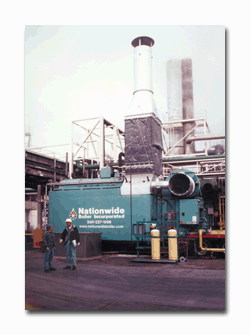
Nationwide’s CataStak reduces boiler emissions of several pollutants, including NOx, CO and VOCs.Installing CataStak does not mean installing a new boiler, or even a new burner. It installs on in-place boiler burners. It is for boilers producing 50,000-150,000 lb/hr, but Shallcross says it can be fitted onto smaller boilers and that it does not reduce boiler efficiency.CataStak operates with three, standard 150-lb ammonia containers instead of a conventional ammonia storage tank. Containers are replaced when empty. The ammonia mixes with the exhaust gases, and the mixture moves through a catalyst in the CataStak, which removes the ammonia and pollutants.CataStak took a year to develop and originally was for Nationwides fleet of rental boilersboilers mounted on 18-wheelers, which are rented to plants undergoing boiler maintenance. Then the company began selling them on new installations in California, then added the product to its retrofitting line. “We were applying it to package boilers,” he says. “Now this is available for direct sales and users.”Nationwide guarantees CataStak to reduce boiler emissions from 30 ppm NOx to 9 ppm. When used with a low NOx burner, it can reduce that to fewer than 3 ppm. Since CataStak is a self-contained box with no large ammonia tanks or vaporizers. Inside the box are a single-reactor with the catalysts and an ammonia-injection skid.Field installation requires a relatively small space, and the device requires little operation intervention. The device is portable and operates at low temperatues. It does not require a special burner or any special exhaust fans. The company began research into NOx reduction more than 15 years ago.November 2001
Clariant Integrates CEP Division
Switzerland-based Clariant Corp. has integrated its cellulose ethers and polymerisates (CEP)
division into the North American organization. The CEP division has 26 production sites in North
America and around the world. The company says the integration will allow Clariant to better serve
its CEP customers, while also providing all customers with complementary products and services from
all six of Clariants global divisions.
CRI Changes Guard
CRI Changes Guard
The Carpet and Rug Institute installs new leadership and initiatives for the coming
year. At its recent annual meeting, the Carpet and Rug Institute (CRI), Dalton, Ga., said
farewell to Ronald E. VanGelderen, its previous president; welcomed Werner Heinz Braun, who has
taken over the helm; and introduced the Executive Committee and Directors. In addition, issues,
barriers, strategies and budget were discussed in detail.The Board of Directors voted to update the
by-laws and appointed an Executive Committee to govern CRI. The Executive Committee for the coming
year includes: Bob Axtell, CEO, DuPont Commercial Flooring Systems; Carl Bouckaert, chairman,
Beaulieu Group LLC; Daniel K. Frierson, chairman, The Dixie Group Inc.; Jeff Lorberbaum, president,
Mohawk Industries Inc.; Robert E. Shaw, chairman, Shaw Industries Inc.; and E.P. (Rusty) Willimon,
general manager, MillikenandCompany. John Swift, treasurer, Mohawk Industries Inc., will serve as
CRIs treasurer.Directors serving a two-year term expiring in 2001 include: Mike Derderian,
president, Royalty Carpet Mills; Walt Hubbard, group president, Fiber Products, BASF; and Julian
Saul, president, Shaw Industries Inc. Directors serving a one-year term expiring in 2001 include:
Jim McCallum, president, Lees Carpets; and Jeffrey Wolff, vice president and general manager,
Solutia Inc. Directors serving a two-year term expiring in 2002 include: Richard Bierie, president,
Mannington Commercial Carpets; Jim Jolly, chairman, J and J Industries Inc.; Richard Prinstein,
vice president, Carpet Fibers, and general manager, Evergreen Nylon Recycling, Honeywell; and
Stuart Thorn, president, Beaulieu Group LLC.Association members include: Certified Floorcoverings
Institute; Association of Georgias Textile, Carpet and Consumer Products Manufacturers; Canadian
Carpet Institute; SB Latex Council; World Floor Covering Association; Floor Covering Adhesives
Manufacturers Committees; National Association of Floor Covering Distributors; Association of
Specialists in Cleaning and Restoration International; Institute of Inspection, Cleaning and
Restoration Certification; American Textile Manufacturers Institute; American Fiber Manufacturers
Association; Floor Covering Installation Contractors; Carpet Cushion Council; International
Certified Floorcovering Installers Association Inc.; and Dalton-Whitfield Chamber of
Commerce. A Fond FarewellVanGelderen served as president and COO of CRI for 20 years. Known in
the industry for a distinctive and proactive leadership style, he was a steward, enhancing
relationships and implementing board policy to resolve industry issues.As international ambassador
for carpet, VanGelderen spearheaded a raising of industry standards in anticipation of consumer
expectations. He vigorously pursued cooperation and encouraged communication among all
floorcovering industry segments.He gained respect throughout the industry for his leadership style,
not only in his efforts toward market expansion, but also because of his compassion, empathy and
integrity. He had a reputation for giving credit to others and making friends of adversaries both
inside and outside the industry. VanGelderen, in his farewell, said, The floorcovering industry is
an industry of people who need each other. Leadership is a humbling experience, and I would like to
thank all of you as my good friends, and I love you dearly.VanGelderen led the carpet industry
through many issues, including installation guidelines, transportation and shipping method
improvement, water effluence and conservation, exporting, hazardous waste compliance and proactive
consumer projects. He served as the lead liaison and spokesperson for the carpet industry during
the Carpet Policy Dialogue, organized and conducted under the aegis of the U.S. Environmental
Protection Agency (EPA), and he perceptively addressed consumer indoor air quality questions
through education and an industry testing program to reduce indoor air pollution and ensure that
carpet, cushion and floorcovering adhesives are environmentally responsible. Changing Of The
GuardBraun, VanGelderens successor as president of CRI, previously was senior director,
international affairs, of the Chlorine Chemistry Council of the Chemical Manufacturers Association.
Prior to that service, he was manager of environmental strategic issues for chemicals and
performance products with Dow Chemical Co., Midland, Mich. His duties during his 30 years with Dow
involved public policy advocacy, issues management, regulatory and governmental affairs management,
and health and environmental affairs management.His awards include the Forest Chemicals Leadership
Award from the National Forest Products Association and the Speakers Award from the American
Chemical Society.Braun earned a B.S. degree in chemistry from St. Edwards University and has taken
graduate courses at Purdue University. He is a member of the Society of Toxicology, and a charter
member of the International Society for Study of Zenobiotics.
January 2001
Sag Harbor To License Name For Hosiery And Seamless
Kellwood Company, New York City, announces a partnership with Glendale Group Ltd., Siler City,
N.C., to produce Sag Harbor hosiery and seamless intimates. Under a licensing agreement with
Kellwood, Glendale Group will design, produce and market the new Sag Harbor product line. The line
includes moderately priced sheer hosiery, trouser socks and seamless intimate apparel. Barbara
McGraw, Sag Harbor brand manager, will serve as the liaison between Kellwood and Glendale, managing
product development and brand identity for the newly licensed products.
January 2001