Cargill Dow Awarded Grant For Bio-based Chemicals R And D

The U.S. Department of Energy (DOE) has awarded more than $2 million to Cargill Dow, Minnetonka,
Minn., for continued research and development of the companys fermentation process for utilizing
annually renewable resources.The DOE administers two financial assistance programs in support of
President Bill Clintons executive order to triple U.S. use of biobased products and bioenergy by
2010. Cargill Dow will share equally with the DOE the $4.6 million budget for the projects.The
projects center on developing process technology for the fermentation of corn fiber and corn stover
to lactic acid and a number of other products. The results will help support the continued
advancement of Cargill Dows NatureWorks PLA, which is derived entirely from annually renewable
resources, as well as help develop other biobased products. Ultimately, Cargill Dows
fermentation-based manufacturing technology will be able to be used anywhere in the world, using
native agricultural by-products.NatureWorks PLA has applications in both fibers and packaging
markets (See K/A News, ATI, this issue). In packaging, potential end-uses include high-value films,
rigid thermoformed food and beverage containers, and coated papers and boards. New, emerging
applications such as injection-, stretch- and blow-molded bottles are also being explored.

November 2000

Thickness Tester Provides Quick Easy Measuring

Philadelphia-based Thwing-Albert Instrument Co. has developed the ProGage, a new micrometer
that measures thickness to most testing standards. The anvil and dual-speed pressure foot with
high-speed return increases the samples measured per minute while maintaining a high degree of
accuracy. An optional auto-feed provides continuous sample profiling and minimizes operator
interface. Enhanced graphics and database capabilities are also available.
2000

Rubbex System From Maag Pump Systems Textron

Switzerland-based Maag Pump Systems Textron Inc., has introduced rubbex®, a complete system
for processing almost all natural and synthetic elastomers. The rubbex unit is a combination of a
gear pump, feed unit, filter and universal die. A screen changer is also available as an option.
The design of the system makes it possible to combine straining and forming processes into a single
step, allowing for the production of semi-finished products. This unit allows for gentle processing
of the elastomers at the lowest processing temperatures.The system is offered in five sizes for
throughputs ranging from 50 to 3,600 kilograms per hour and is almost entirely self-cleaning.
2000

Wayn-Tex Colbond Develop Stabilok Primary Backing

Stabilok, a combination of woven and nonwoven primary carpet backing, has been created through a
partnership between Wayn-Tex Inc., Dalton, Ga., and Colbond Nonwovens, Enka, N.C. The backing was
designed to eliminate the potential bowing and skewing that occasionally develops during the
tufting, dyeing and finishing process.The requirement for a stable, almost bow- and skew-proof
primary backing was evident when standard backings werent able to consistently meet the challenges
of patterned tufted carpets, said Durwood Knight, vice president, sales and marketing, Wayn-Tex
Inc. The two companies hope the alignment of resources and combination of products is solving an
expensive problem for the industry.

November 2000

Computerized Traverse Winder Two-Position Unwind

Independent Machinery Co., Fairfield, N.J., developed a computerized system for traverse winding
exceptionally long lengths of tension-sensitive materials into large spools. The system features
two-position unwind that can accommodate maximum 36-inch-diameter supply rolls slit to width. The
IMC smartwinders software provides an unlimited range of spool shape, size and winding patterns
easily programmed through a touchscreen. The winding position is cantilevered and has a doffing
feature for easy removal of the large spools.
2000

Idler Master Catalog Features New Expanded Lines

The Idler Master Catalog from Webex, Neenah, Wis., has been expanded. The catalog now includes
FeatherLight Carbon Composite idlers, a new line of rubber-covered de-wrinkling idlers and the
industrys first standard line of heat-transfer rolls.
2000

M-Tec Introduces Finish-Tec

Germany-based M-Tec Maschinen-baugesellschaft Mbh has introduced the finish-tec range for finishing
elastic and synthetic fabrics. The finish-tec range integrates pressing, decatising, setting and
shrinking.Intensive steaming under high surface pressure is the first step, followed by a
steaming/shrinking treatment and, finally, a shock-cooling. This procedure allows a multiplicity of
variants of the fabrics final appearance regarding touch, luster, volume and degree of fixation.
Steam and heat treatments release latent tensions, guaranteeing minimum residual shrinkage values
in the warp and weft.

November 2000

Yarn Market Open-End Yarn Production Decreasing

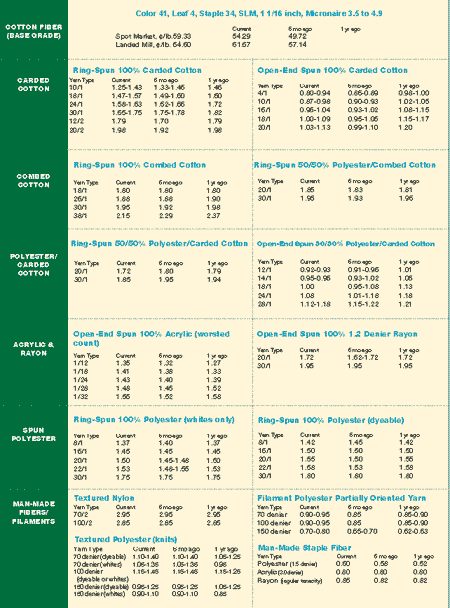
Yarn MarketBy J. Karl Rudy, Technical Editor 

Yarn_Author_2

Open-End Yarn Production DecreasingInitial reports from respondents in the cotton field
indicate that, while the crop this year will be large, the quality of the crop has deteriorated.
Drought conditions have ad-versely affected staple length, causing the fiber to be shorter.
Micronaire has also been hit. Rain late in the season will cause a spotted condition that will also
affect unharvested crop quality. Classing for the season has started, with about 10 percent of the
crop checked. Of course, when the irrigated crop starts coming in, crop quality will
improve.Spinners report additional movement in open-end (OE) spinning to reduce overall weekly
production of over a million pounds through closings, mergers and buyouts. They also say that
weavers in vertical operations have begun buying their OE cotton needs or replacing them with
ring-spun yarns, accounting for another million pounds or so weekly. As a result, spinners are
expecting early relief in the pricing situation that has plagued them for so long. Cotton prices
continue to move up, though, which puts a further strain on an already depressed bottom
line.Several respondents to the Yarn Market commented on this situation by saying, Pricing will
improve in 2001. It has to or retailers will not be able to purchase domestic yarn spinners will be
out of business. The follow-up comment to this is something to the effect that retailers care only
about their own bottom line, especially the large-scale merchandisers. Another spinner said, With
cotton up about 13 cents, pricing will have to go up!Volume for most OE spinners continues to be
good but they expect further improvement during the first quarter of 2001. Now, how about that
improvements in both pricing AND volume in 2001!One spinner, reminiscing about the good old days,
said, When I first started , a 10/1 cotton yarn sold for 56 cents a pound. Cotton was a constant 25
or 26 cents. And this was all ring-spun yarn. Some of us can remember when cotton sold for less
than 20 cents a pound and, if you go back far enough, you could buy a cord of wood for $1. But who
wants to go back to outdoor privies and no running waterRing-spun yarn markets are reported to be
very, very, very strong. Others confirm this market is very tight, as it has been for months. Mills
are running wide open and shipping all they make. On occasion they ship more than they make. That
should tell you something!Weaving has slowed in recent weeks, as confirmed by a weaver respondent.
Optimism still prevails, however, and weavers expect the slow-down to be of short duration.
Apparently, the problem is predominately with the apparel side of the market. Could this be due to
retail inventory, mentioned a few months ago by a spinner Last month, Yarn Mar-ket reported a
texturizers comment about a rumor to this effect concerning bottom-weight goods. For your
information this weaver is in bottom-weight apparel production.Synthetic markets are awful, as one
spinner put it. He also said, No area we sell would I consider robust all are weak! We hear it
might be due to inventory at retail but I dont really know. Even home furnishings, which is
normally pretty strong, suddenly became weak. We have curtailed from six- to five-day operations to
control inventory. Im surprised at the markets being so quiet it usually doesnt happen during an
election year. This will be a weak quarter, but I expect it will pick up by mid-January. He also
commented that he was optimistic about the Caribbean Basin Initiative but was discouraged with the
small number of attendees from that area at a recent conference.Trade Versus Fair TradeThe trade
agreement with China is on everyones mind not from the sense of whether we should have one, because
most consider it a done deal, but, rather, whether it will be a fair trade agreement, one that will
have enough safeguards to prevent abuses, with penalties severe enough to discourage unfair
practices. Farmers are, of course, most supportive of the agreement, but we need to remind our
politicians that agriculture is not the only industry concerned here. Even so fair is fair
regardless of the industry involved.To leave you with a thought for the day With the price of gas
running $25 for a tank, will consumers buy a $25 shirt they dont need just because they like the
color
Yarn_Table_174

November 2000

Milliken Headquarters Receives OSHA Recognition

The Roger Milliken Center, Spartanburg, S.C.-based MillikenandCompanys corporate headquarters, has
become the companys 46th VPP STAR Site. The designation is awarded by the U.S. Department of Labor
Occupational Safety and Health Administration (OSHA) Voluntary Protection Program (VPP) through the
S.C. Department of Labor, Licensing and Regulation, Palmetto VPP. The VPP program recognizes
companies that surpass normal safety requirements to meet and exceed OSHA standards. Since Milliken
began participating in the program in 1992, 45 of its manufacturing locations have been given the
VPP STAR Site designation.This is tremendous recognition, said Roger Milliken, chairman and CEO. It
is a tribute to every associate in our company, because every associate knows that they have
ownership of the safety process. [VPP] is not a management program.The VPP program has been
tremendously successful in helping our company establish an uncompromising safety and health
process, said Richard Dillard, director, public affairs, Milliken and Co. What better gift can you
give your associates and the community, than a safe working environmentMilliken has the most VPP
STAR sites of any company in South Carolina (28 of a total of 35) and also tops the list in every
other state where it operates, according to Wayne Punch, director, safety and health. It is second
nationwide only to International Paper.Janet Nixon, Palmetto STAR VPP coordinator, points to
Milliken when other companies complain that the VPP standards are set too high. [Millikens] record
speaks for itself, she said. They are one of our strongest advocates for the program.Remarking on
the attainment of VPP STAR Site status for the companys headquarters, Punch said, It has been quite
a challenge. This is our largest facility, and that just makes success that much sweeter.

November 2000

GE Plastics Buys NetProfiler From GretagMacbeth

GE Plastics, Pittsfield, Mass., has purchased 70 NetProfiler B2B, Web-enabled instrument management
software systems from GretagMacbeth LLC, New Windsor, N.Y.The purchase was driven to meet GE
Plastics ColorxpressSM corporate objective to maintain and monitor its spectrophotometers and
manage its electronic color standards on a global basis via the Internet. With 70 GE plastics color
resin facilities around the globe (in countries such as the United Kingdom, France and Brazil),
this purchase will enable GE plastics to significantly reduce inter-instrument biases and improve
instrument agreement between all spectrophotometers.

November 2000

Sponsors