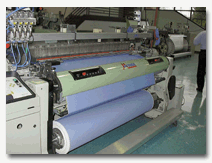
Frankl and Thomas Inc., Greenville, S.C., has introduced a new air-jet relay nozzle for modern
weaving machines. The air-saver nozzle produces an air velocity of more than 100 meters per second,
which will allow for more inserts per minute or will reduce the air consumption to achieve the same
amount of production compared to other nozzles.The nozzle has undergone extensive testing in
American mills and is now being used for production.Nozzles are currently available for Picanol,
Sulzer-Ruti, Dornier and Tsudakoma looms. Custom products can be manufactured per the customers
exact requirements.
2000
New Air-Saver Relay Nozzles
Zellweger Uster Unveils New Yarn-Testing Equipment
The Uster® Tensorapid 4 is now available from Zellweger Uster, Germany. The new tensile-strength
testing equipment uses Uster Statistics to permit direct classification of tested material and
automatically controls yarn quality. New test procedures, especially for testing the strength of
filament yarns, have been facilitated.
2000
ATMI Comments On Indian Tariff Reduction China NTR
The U.S. government announced India has agreed to reduce specific tariff levels recently levied
against selected textile and apparel imports. The duties, assessed on a per unit charge, rather
than on a value basis, caused tariff increases as high as 100 percent or more on certain products.
They had been imposed by the Indian government in retaliation for defeats it suffered in the World
Trade Organization (WTO) over its practice of banning imports of apparel, textiles and other
consumer products. The Office of the U.S. Trade Representative (UStr) received an analysis from the
American Textile Manufacturers Institute (ATMI) that showed the duties exceeded UStrs guidelines
for determining whether a country is allowing effective market access.These duty reductions are one
important step in the fight to open Indias market to U.S. textile imports, said Carlos Moore,
executive vice president, ATMI. We appreciate the hard work of the UStr, and especially Ambassador
Esserman, in attaining this result. Despite the reduction of tariffs, barriers remain for the
exportation of U.S. textile products to India, including high ad valorem rates, add-on taxes, and
various rules and procedures.We urge our government to move quickly to remove Indias remaining
trade barriers, Moore concluded.In other news, by a vote of 83-15, the U.S. Senate voted to grant
permanent normal trade relations (Ntr) status to China. The vote, according to Roger W. Chastain,
president, ATMI, Washington, D.C., is a vote against the values of the United States, the U.S.
textile industry, and its 550,000 employees.
(See China: Opportunity or Threat, ATI, this issue).
November 2000
Natureworks Provides Superior Performance In Sporting Applications
Tests carried out by Hohenstein Research Institute, Germany, have shown that fabric made using
Minnetonka, Minn.-based Cargill Dows Natureworks is a superior alternative to polyester blends when
used in sporting applications. Plaited Natureworks/cotton fabric outperformed plaited
polyester/cotton fabric in tests that demonstrated the fibers inherent benefits including increased
breathability, water vapor absorbency and overall comfort.Cargill Dow developed Nature-Works fiber
by processing natural plant sugars to create a proprietary polylactide polymer (PLA).Cargill Dow
has developed a natural fabric alternative that competes with traditional fibers in feel, comfort,
cost and performance, said Jim Lunt, director, fibers product development. The testing reaffirms
NatureWorks fiber is a valuable addition to the evolving fibers market, notably in
activewear.NatureWorks fiber also has applications in a number of fiber and nonwoven products, but
the Hohenstein testing concentrated on its performance in sporting and activewear applications.
Tests included measurements of water vapor resistance and absorbency, buffering capacity, thermal
insulation and sensorial wear comfort. NatureWorks/cotton was found to be superior to
polyester/cotton in the majority of the tests and to perform equally well in the remainder.Cargill
Dow is working with industry leaders to develop and introduce products containing NatureWorks
fibers, including apparel fabrics made using 100-percent NatureWorks fiber, as well as blends with
silk, wool and cotton. Non-apparel applications include carpet tiles, fiberfill, industrial fabrics
and home furnishings.
November 2000
Picanol Introduces OMNIplus With Sumo Drive Motor
Picanol, Belgium, has introduced the OMNIplus the next generation in its line of Omni air-jet
weaving machines. While continuing to offer flexibility with regard to frequent style or warp
changes, the OMNIplus improves on this feature, while providing higher quality at lower cost as
well as more manageable, user-friendly operation.At the heart of the OMNIplus is its Sumo (SUper
MOtor) drive motor. Based on switched reluctance technology, the Sumo drives the machine directly,
without clutch-and-brake units, varying the speed by electronic control to suit the filling
material and the weave structure.The flexible insertion system and Picanols Quick Style Change
system, which enables a style change to be achieved in less than 30 minutes, also contribute to the
versatility and manageability of the OMNIplus. Many parameters can be set by the weaver, and the
machine parts are easily accessible.Higher quality of finished product is achieved thanks to the
motor, the rigidity of the machine, the pneumatic pick finder and the microprocessor-controlled
start and stop algorithms. Yarn-friendly insertion as well as electronic control of the
harness-crossing position, crossing position of the rotary leno and the selvage further ensure
quality.The OMNIplus also reduces weaving costs. The reduced drive train and the Sumo main motor
help to reduce energy consumption by 15 to 20 percent. With fewer parts to repair or replace, there
is less maintenance and downtime. Air consumption is lowered considerably due to a reduced pressure
drop in the air distribution system and to the design and control of the main and relay nozzles.
2000
Clemson Alumnus Initiates Scholarship Fund
Computer science and computer engineering students at Clemson University, Clemson, S.C., will be
the beneficiaries of a campaign to raise up to $1.4 million in scholarships.Marvin Pinson, a 1946
textile engineering graduate, and his wife, Jerry Lee, now deceased, established the Marvin J.
Pinson Jr. Scholarship Endowment with an initial donation of $277,000 to fund scholarships for
students in computer science or computer engineering. An additional bequest by Pinson of up to
$600,000 has also been committed to the fund.Pinson is leading a campaign to raise a matching
$500,000 for the fund by June 2001. The former textile executive has observed firsthand the
importance of computer technology to the textile industry.Computer technology is one of the most
important disciplines for the growth of the South and especially for South Carolina, said Pinson,
who spent most of his career with Burlington Industries, retiring from his position as group vice
president in 1988. If we are to attract industries in the computer-related fields, there must be
highly qualified men and women available to support these high-tech needs.
November 2000
Two New Developments In Controlling Yarn Tension
Otto Zollinger Inc., Spartanburg, S.C., offers the Oz® Quickset yarn tension control and the
Oz-2000Q yarn tension control for tufting creels.The Quickset features quick and easy tension
adjustments if necessary for running differently sized yarn. There are no spare parts, and no
cleaning is required.The Oz-2000Q may be threaded from top or bottom and has only one opening per
side. It is easily mounted to the existing creel.
2000
High-Performance Tricot Machine Offers Flexibility
Germany-based Karl Mayer offers the high-performance tricot machine HKS 3 M. The three-bar
unit operates with medium-stroke needles and is equipped with the new EBA 2-Step System. The
machine is ideal for the production of garments, house and home textiles, and various
semi-technical articles including special constructions and elastic fabrics with elastane portion.
2000
System Solutions By ESI
Report on a systems integrator for textile finishing, nonwovens and the carpet
industry.Electrical Systems Inc. (ESI) established its roots 30 years ago. Back then, it was
conventional armature motors that the companys fathers rebuilt or replaced with better technology.
Today, ESI is a high-tech systems provider for applications in the textile industry and other
industries. For textile applications, the company concentrates on finishing, nonwovens and carpet
manufacturing. The company headquarters is located in Chattanooga, Tenn., and the company has a
service facility in Greenville, S.C.At the beginning of this year, ESI was acquired by the NSC
Group (N. Schlumberger Inc., France), which, according to company executives, will give the company
financial strength for growth and expansion into new areas, particularly the plastics, film and
paper converting industries.Mike Mauney, ESIs director of sales, emphasized the acquisition will
not affect the companys confidential cooperation with NSC competitors machinery manufacturers with
which large projects were already underway at the time of the merger. We would be a dead duck if we
abused the confidentiality agreements, Mauney said. ESI gets a wide range of customer orders
because of its reputation for understanding the manufacturing processes, and the companys worldwide
service commitment.Project Management PhilosophyESIs philosophy is to implement standardized
project management procedures for every project, regardless of its size, to ensure 100-percent
customer satisfaction. The following outlines some of ESIs key project-management procedures:
- assignment of a project engineer to supervise the project from design to start-up;
- charted project organization to determine bottlenecks and to minimize timing problems for
delivery; - regular project status updates and meetings;
- witness testing of systems prior to shipment;
- professional field staff start-up;
- complete engineering drawings for the system as installed;
- operator training; and
- spare parts recommendations.
ESI has grown and diversified over the years into different fields and kept up with the
advancements of the latest drive and systems control technology. The company has made it its task
not just to provide a system, but rather to evaluate the actual situation in a plant and to provide
the best possible and most economical solution for its customers. A team of highly specialized
engineers identifies and evaluates all control strategy options by analyzing the application and by
consulting with customer personnel. ESI calls this a one-on-one service for clients. Personal
contact is maintained with every client throughout the entire project. Because of this, ESI says it
has improved the overall performance of many customer mill, machine efficiency and product
quality.Modern Drive Technology: Latest Systems AppliedNo matter what drive technology is used on
older or new machinery, ESI offers system solutions to better control the manufacturing process.
With older drives, it is often much more economical to replace the conventional motors with AC or
DC drive technology. A cost calculation with return on investment (ROI) can clearly show what
modern drive technology can save on maintenance and service cost when compared to earlier
technology. At the same time, product quality improvements, better supervision and feedback from
the process are possible. Therefore, ESI has been a leader for many years in the integration of
drives and drive-oriented systems that include AC and DC drive systems, as well as stand-alone PLC
and automation systems. Lately the PC-based control systems have been in great demand because,
compared to PLC systems, they are low cost, flexible and offer quick serviceability. PC systems are
also much easier to expand than PLC based systems. ESI pointed out that the PC-based systems are
still not the solution for every application, but since the introduction of the Windows NT
operating software, the reliability of PC-based systems has improved significantly. In case of a
fatal hardware failure, it may be as easy as replacing the failed hardware and reloading the
software to get the system up and running again.Mauney emphasized that ESI is not strictly aligned
with only one electrical component manufacturer. The company enjoys an excellent relationship with
the worlds leading manufacturers of high-tech system solutions such as ABB, Magnetek, Reliance,
Rockwell Automation, Siemens, Toshiba, and many others. This gives ESIs engineers the freedom to
use the best from the best in the design phase for specific customer applications.Nonwovens, Carpet
And Finishing ApplicationsESI named a number of applications for which the company has installed
drive and control systems.The nonwovens field is an ever- growing market segment for ESI. Even
though ESI is owned by Schlumberger, which is also one of its largest clients, the company has
executed many projects that incorporate the Dilo Group, Fehrer and other suppliers that are
competitors to Schlumberger. At the end, what counts is that ESIs customer, the actual nonwovens
plant, needs to be satisfied with the specific control setup. And so far, the company has received
a lot of praise and repeat business.Besides nonwovens, which has typically been a dynamic industry,
the carpet manufacturing industry has seen many changes over the past few years. ESI has helped
these companies to stay productive through custom integration of sophisticated drive and control
systems. The company provides motor/reducer combinations selected for optimum efficiency and
durability. Further, ESI provides web-sensing devices and load cells to interface with process
lines. For every application, the options range from simple armature, voltage-controlled DC drives
to fully integrated systems with multiple PC-based MMI systems and state-of-the-art AV vector
drives incorporated in custom enclosures.Also important to ESI are finishing applications for
warpers, slashers, preparation ranges, mercerizers, tenter ranges, conventional dye ranges, indigo
dye ranges, and sanforizers.Other growing fields of activities for ESI include the plastics and
film industries and the paper converting industry. Especially in the plastics and film, the capital
investment is very high and, therefore, requires efficient, smooth-running processing machinery.The
Electrical Systems Inc. AdvantageIn summary, ESI emphasizes that for a customer they are the single
source of responsibility that tailors equipment and services specifically to each customers needs.
Usually, this permits a more efficient system layout with lower investment cost. All equipment and
services come from domestic suppliers, which reflects in lower maintenance cost. As well, the
company offers seven-day, 24-hour service for its customers.
November 2000
DSM Shell Develop Novel Caprolactam Route
DSM Research and Shell Chemi-cals, both based in The Netherlands, are jointly working on a
DSM-sponsored project aimed at the development of a novel caprolactam route based on butadiene.
Caprolactam is the basic starting material for nylon 6.Current technology for the manufacture of
caprolactam is based on either cyclohexane or phenol. Novel investments based on these routes are
uneconomical because large quantities of am-monium sulphate are produced.DSM is committed to
caprolactam, said Dick J. Venderbos, business group director, DSM Fiber Inter-mediates. This
process, called DSM ALTAM, is based on butadiene and carbon monoxide and would further increase the
competitive position of caprolactam and nylon 6 versus other materials.
November 2000