Disposable Safety Earplugs From Dalloz

Dalloz Safety, Reading, Pa., has introduced the new Bilson® 202 NST disposable earplug, which
combines comfortable hearing protection for all types of noise environments with enhanced
communication, allowing speech and other sounds to be heard in an unmuffled environment.The
earplugs, available in two sizes, are made of a foam material, which gives uniform and moderate
attenuation so the wearer can hear co-workers voices, warning signals, machinery and other sounds.
In addition, blue and green color coding of the earplugs allows for enhanced indentification and
color selection.

March 2001

Salant Corporation Enhances Its Channels Of Distribution Acquires Tricots St Raphael

NEW YORK, Jan. 17 /PRNewswire/ — Salant Holding Corporation, a wholly owned subsidiary of Salant
Corporation (OTC Bullent in Board: SLNT), has announced the acquisition of Tricots St. Raphael
(Tricots), the designer knitwear collection. Salant acquired Tricots through an Asset Purchase
Agreement dated January 10, 2001, which was effective January 2, 2001. Salant is primarily known as
the manufacturer and distributor of Perry Ellis Menswear, which includes sportswear, dress shirts,
slacks and accessories, to retailers such as Federated Department Stores, The May Company and
Dillard’s. Tricots is one of the most prestigious labels in designer men’s sweaters and knitwear;
the collection is sold at Nordstrom, Saks Fifth Avenue and other better specialty stores.The
alliance with Tricots affords Salant the opportunity of adding an upscale tier to its distribution.
“Salant intends to maintain the design, merchandising and marketingintegrity of the Tricots brand,
while enhancing its back office efficiencies through operational alignment,” stated Michael J.
Setola, Salant’s Chairman and Chief Executive Officer. “I am delighted with the dimension that our
new association will bring to the Salant organization.” The acquisition of Tricots, together with
the recent licensing arrangement with Tallia Uomo, an upscale contemporary men’s sportswear
collection, will strengthen Salant’s position in better channels of distribution. Setola continued,
“Through our continued efforts in forging new businesses and the appropriate alliances, Salant is
strongly positioning itself for the future. We are focused on marketing through multiple channels
of distribution, and on increasing our share of the total menswear market.”SOURCE Salant
Corporation Copyright 2001 PR Newswire

Inman Mills Streamlines Production

Inman Mills Streamlines Production Inman Mills, Inman, S.C., announced plans to close its Inman
plant, which has housed carding and spinning operations in only half of the building since it was
updated in 1984.Inman also announced plans to streamline production and make the company more
cost-effective, resulting in an additional 120 job losses at the Saybrook plant in Inman. Saybrook
will continue to be a spinning and weaving operation.The announcement was made by Robert H.
Chapman, president, who said the swift advancement of technology and increasingly competitive
markets has prompted the most recent decision to restructure manufacturing operations.
March 2001

ATMI Evolution

 
Incoming President Chuck Hayes vows to make ATMI a free-trade advocate. Chuck Hayes
is a man leading transition within both his company and the trade association he is poised to head.
Greensboro, N.C.-based Guilford Mills, the billion-dollar company he built from a one-plant
operation to rank among the worlds great knitters, is in the midst of repositioning itself
according to the demands of a global marketplace that values responsiveness more than quantity. Two
plants that were for years the backbone of Guilford Mills are in the process of shutting down. More
than 1,000 people in Greensboro, many of whom have dedicated their entire adult lives to the
profitability of Guilford Mills, have been told they will no longer have jobs. Hayes feels the
weight of each one of these people on his massive shoulders as he hobbles around his office, his
foot still bandaged from recent surgery. Its the hardest thing Ive ever done, he said about the
ordeal of announcing the plant closings to the employees. These people are like family to me, and
Greensboro is my home. Its just terrible. 

As terrible and painful as it is, Hayes is a realist. The two plants in Greensboro were
tooled for mass production of commodity fabrics. Guilford spent millions of dollars trying to save
the plants, but the company eventually realized that the short, customer-responsive production runs
necessary for profitability were just counter to the 40-year-old culture that had been established
at the older facilities. So, before too long, they will join a growing list of various textile
plants throughout the United States that, ultimately, just couldnt keep up with the times.Hayes,
however, is adamant fist-pounding adamant that the remainder of Guilford Mills and the rest of the
U.S. textile/apparel complex will not suffer the same fate. Later this month, at the organizations
annual meeting in Washington, he will become president of the American Textile Manufacturers
Institute (ATMI), the first knitter in history to be elevated to such a position. Telling It
Like It IsHayes is a flamboyant figure large, boisterous and physically imposing. He is Sinatra in
the textile industrys version of the Brat Pack. If he has something to say, he is going to say it
clearly and with no punches pulled. He is a man who has clearly defined the challenges that
confront his industry, and he is positioning himself to lead the industry through the beginnings of
what promises to be a dynamic transformation. The only real question is whether the industry is
prepared to follow where Hayes leads.Hayes sees himself as the catalyst who will transform ATMI
from an organization steeped in protectionism to one that espouses and embraces free trade. He
seeks to bring all elements of the textile/apparel complex together with a strong, unified voice.
And he is determined to return the destiny of ATMI to the hands of its membership.ATMI is evolving,
and it is going through tremendous changes, he said. These changes are needed and they are called
for. We have to adjust ourselves to the 21st century and to identify who we really are and what
role we play in representing our industry as its number-one advocate.Hayes, who is bringing a term
as first vice president of ATMI to a close, is perhaps in a better position than many to
objectively judge what that role should be. Guilford Mills is not a long-time member of ATMI. It
wasnt until the North American Free Trade Agreement (NAFTA) negotiations were underway that Hayes
felt compelled to cast his lot with the trade organization. It wasnt until then that I realized the
impact ATMI could have on the industry. I realized that ATMI was one of the best-kept secrets of
the decade. Thats going to change. People are going to know of the impact of this organization, of
what it can do when it represents a united industry.ATMI has been a force in the industry since its
inception shortly after World War II, he said, but the focus has always surrounded the major
corporations. Its never evolved downward to the smaller corporations, to the heart and soul of the
textile industry the medium and small-sized companies. Working For The Greater GoodIts time
that members of all sizes begin looking upon ATMI for the impact it can have for the total industry
not just the giants. I believe whats good for the industry is good for each of our individual
companies. We must not put what is good for individual companies above what is good for the
industry as a whole. Thats the creed with which I take on the presidency of ATMI.As you well know,
from the mid-1980s on, ATMI worked diligently to protect the textile industry and the loss of jobs.
We got through Congress three major bills (protecting the U.S. industry from inexpensive foreign
imports) and the respective Presidents vetoed all three. We had a lot of clout on The Hill, but we
never had the clout where it really counted, with the President who had the veto power. At that
time, I dont know that anybody in ATMI realized that the whole world was starting to move towards
free trade. The effort of protecting the textile industry, while looking great in the congressional
voting districts, was not really what the elected officials wanted to have for the future of our
country. They wanted free trade. They saw the benefits of free trade. Through all those
protectionist deals, where we had busloads of people going to Washington and every other doggone
function imaginable, we had the great feeling of winning, of turning out en masse to battle for the
survival of the textile industry. But underneath it all, we were beaten every damned time we made a
move.The constant defeats left a bitter taste in ATMIs collective mouth and engendered the first
major division among the ranks, Hayes said. People like Mr. (Roger) Milliken, who is both a great
protectionist and a great leader, stayed the course, while others of us felt the best direction was
to join the free-trade philosophies that had been proposed by the executive branch of government.
We were obviously unable to deter the respective administrations from their course of free trade,
so we felt we would be in a better position to serve the interests of the industry by joining that
movement rather than continuing to fight it. The Tide TurnsThe advent of NAFTA in the early
1990s was the beginning of the turning point for ATMI, he said. NAFTA was truly the first
free-trade agreement that benefited us in the textile industry. It was clear and simple. It was
cheap labor in Asia versus cheap labor in Mexico and not for the production of yarn or fabrics.
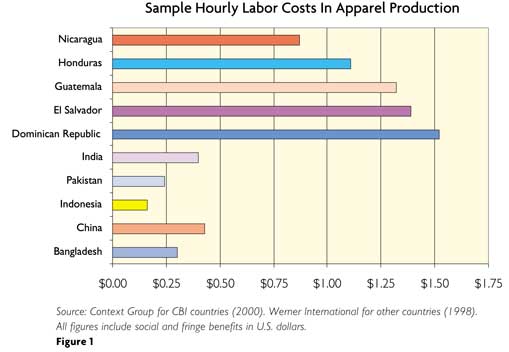
Everyone seems to make such a big deal out of labor costs in yarn and fabric production, but, in
reality, labor only accounts for 10 percent or less of the total cost. Whether youre paying $2 per
hour or $20 per hour, it is insignificant in the grand scheme of things. Where we were really
losing our base was in the manufacturing of the garments, where 30 percent or more is in labor. So
there it became extremely significant what you were paying. Therefore, we were losing all the
cut-and-sew business to the Far East as fast as it could get out of here. It became as obvious as
the day is long that, if we in the fabric and yarn business were ever going to exist here, we had
to save the cut-and-sew business.So, at the behest of ATMI, representatives from those countries
interested in participating in NAFTA began meeting in private, away from the prying eyes of the
media and the controlling hand of government. People from Canada, the United States, and Mexico
came together, he said, in a spirit of cooperation heretofore unseen. 

The Secretary of Commerce told me the textile part of NAFTA was anticipated to be the
toughest to negotiate, but it turned out the be the easiest and served as the model from which the
rest of NAFTA the automotive industry, the steel industry, the telecom industry was built.The ease
with which the textile segment of NAFTA was negotiated convinced Hayes that ATMI could, indeed, be
a forceful and effective advocate for the industry if its energies were properly channeled. That
was really the beginning, the very beginning, of ATMIs role as an advocate for free trade in the
Americas.Hayes continued: Out of this has come the development of what, essentially, will become
the three trade blocs of the world: the Asian bloc, the European bloc and the bloc that comprises
the Western Hemisphere. I am totally in favor of free trade among these blocs. This will become an
increasingly important political issue over the next five years. The unions and the remnants of
protectionism will make up one faction in this issue and those of us who believe in free trade for
the world will make up the other.There are those, however, who would point out that the benefits of
NAFTA and other trade agreements supported by ATMI are not as real as figures released by ATMI and
the U.S. Department of Commerce would indicate. The textile elements of NAFTA were intended, in
part, to provide a North American outlet for U.S.-made fabric. In 1995, for example, 90 percent of
apparel produced in Mexico was made from U.S. fabric. By 2000, that figure had dropped to
approximately 60 percent. In Caribbean nations, use of U.S. fabric peaked in 1997 and has been
spiraling downward since. NAFTA and Caribbean Basin Initiative (CBI) critics claim that these trade
agreements have resulted in increased foreign fabric production capacity to the detriment of the
U.S. industry. The final result, said one observer who requested anonymity, is that less and less
American fabric is being used in Mexico each day and even less in the Caribbean. Domestic fabric
production has remained stagnant. The only reason it looked as if there was an increase is because
a substantial amount of fabric has been attributed to U.S. production merely because it was cut
here. A Focus EvolvesThe real issue, regardless of which side is right, is how the industrys
premier trade association will play the role of aggressive advocate in a new climate of change and
compromise. Among the challenges the organization faces is one with which almost every CEO in
America has been confronted: how to become more effective with less money, especially after the
departure of Milliken and several other marquee names. Milliken left ATMI several months ago under
conditions that are not completely clear. ATMIs position is that the organization and Milliken had
divergent views about the agenda ATMI should pursue. Others have stated that the company believed
the ATMI staff did not aggressively and efficiently pursue the agenda and policy decisions
established by the ATMI Board of Directors. The bottom line for ATMI, however, is a decrease in
financial resources.ATMI has, historically, had a very large budget. Mr. Milliken was a prime
player in that budget. He decided that his philosophies and those of ATMI were not the same. In
life we have choice. Thats what makes us a great democracy. The choice of ATMI differed from that
of Mr. Milliken. We chose to take a middle-of-the-road path that would advocate free trade on a
level playing field with our competition in other countries. Knowing that the WTO is going to take
all quotas off in 2005, we chose to concentrate our efforts on maintaining what we have left and
that is tariffs. There has to be preservation of tariffs in 2005 in order to be fair and to prevent
the ruination of the textile industry as we see it today. Over a period of time, they, too, may
diminish, but not today. We have to fight for this. So ATMI now takes on a whole new theme, a whole
new mission statement. We no longer fight against free trade; free trade is here. But what do we do
to preserve the industry that we so well cherish here in the United StatesIts not a case,
necessarily, of enacting new laws or agreements, said Hayes, but of enforcing the ones already in
place. The laws are written. We have to make sure they are enforced. Were not going to get the WTO
repealed. Were not going to have protectionism. We dont have a single thing like that anymore. So
we must make the best use of those tools we do have to ensure a level playing field for all
competitors.To make this field as level as possible, all aspects of the textile/apparel complex
must work together. To facilitate this, the direction and stance of the major trade organizations
have to be determined by the Board of Directors and the memberships of the respective
organizations. There have been too many instances in the past where the staffs of the trade
organizations have been empowered to make too many autonomous decisions actions that have, in fact,
been detrimental to the industry as a whole. Those of us who run companies must determine the
conditions under which we run our businesses, not the execs of the trade organizations. They are
there to follow the directions and the mandates provided by the Boards of Directors of their
respective organizations. Period. Different TangentsAs an example, Hayes pointed in particular
to the position of the yarn spinners with respect to CBI, in which the organization proposes moving
knitting, dyeing and finishing operations offshore. He said much of the disagreement between ATMI
and the American Yarn Spinners Association (AYSA) was created by trade organization staff members
acting without sufficient input from their respective leaderships.The knitters, the dyers, the
finishers in the United States were their customers, Hayes said, pounding his fist on his desk for
emphasis. What in heavens name were they thinking CBI is much needed. Every organization in the
United States related to textiles needed to pass a good CBI bill, one that would be fair to all
parties involved and would allow garment manufacturing to come back into the Western Hemisphere.
But, at the same time, we needed an avenue through which we could, to some extent, preserve the
knitting, dyeing and finishing of cotton fabrics here in the United States. That was the
mission. 

But heres what took place, and it was a horrible thing. And to this day, I really havent been
able to get to the bottom of where it happened. But all of a sudden, this great unity for which we
had strived so hard began to fall apart. AYSA decided that they needed to protect the spinning
industry. They embarked upon a lobbying effort to convince legislators that knitting, dyeing and
finishing should all be done in the Caribbean. There were a lot of internal debates between
factions within ATMI and AYSA. There were numerous discussions. Some took place between the staff
executives of the two organizations and did not always include, I believe, the input of the
managements of those respective organizations. As a result, we both went off on different tangents.
Why not have a phase-in, of having this happen over a period of five years or so This became a
tremendous argument. During these discussions and I was very much a part of those discussions we
came upon a compromise. Certain goods should be knitted in the Caribbean and should be finished in
the Caribbean. That was all right with me. It would still allow us to dye and finish here in the
United States, ship to the Caribbean and still enjoy duty-free treatment.As well, he said, it would
give the Caribbean nations the opportunity to create the infrastructure to do the knitting, dyeing
and finishing of all the products that were going to be produced in the Caribbean. We fought hard
for the compromise. This compromise was printed in the bill and we all shook hands. Unbeknownst to
me, it was not but a few days before AYSA went back to the Hill and demanded that all knitting,
dyeing and finishing be done in the Caribbean and, in essence, negated an agreement that we thought
we could take before Congress and get passed into legislation. Suddenly, where we had once had
unity, we had divergence. Where we had compromise, we had disagreement. The only thing accomplished
was that it took away the effectiveness of ATMI and AYSA. Instead of projecting unity, we looked
like a couple of squabbling kids. We cant even get to first base because people in our industry
forgot the basic tenet that what is good for the industry is good for the individual segments and
companies. Give And TakePeople have to realize that nothing is going to be just one way any
longer. You have to give and take. Compromise. Compromise. Compromise. We are totally into a world
market and not the individualistic marketplace we had for 50 years. If we cant compromise and work
together, we wont survive.Somehow, some way, we must have unity. We are working hard to build a new
textile alliance, which is made up of 14 different organizations, including KTA (Knitted Textile
Association), AYSA, ATMI, state associations, distributors and others. The purpose is to prevent
any further deviation from what we all agree on. Right now is a crucial point in which the whole
textile industry must develop as one. When youve got China and WTO coming on board like a
steamroller, we must act in a unified way. We must stay together and act in what is the collective
best interests of the entire industry in our hemisphere.It is my dream that this alliance will
somehow come together and form a new organization it doesnt have to be called ATMI so that we could
have a much better, more cohesive and united voice for all of the textile industry.In other issues,
Hayes decried the attempts by the Clinton administration to further open U.S. markets to goods from
developing Asian countries. In some ways, it seems the textile industry is just a pawn for the
government. The United States was built on the textile industry, and now it seems were trying to
build other third-world countries in the same way often to the detriment of our own industry.As far
as the status of the textile industry in the United States, Hayes cautions the naysayers who
predict its impending demise to take heed. The U.S. textile industry is the most productive, most
innovative and most responsive in the world. No doubt we need to change the way we do business. In
fact, were already doing that. With our partners in Canada, Mexico, Central America, the Caribbean
and South America, we will continue to be a vital and dynamic part of the worlds production of
fabrics and garments.Charles A. Hayes was born December 19, 1934, in Gloversville, N.Y. His various
achievements include being named the 1984 Textile Man of the Year, Psi Psi Fraternity, North
Carolina State University. In addition, he has won numerous distinguished service awards from the
University of North Carolina at Greensboro, the Greensboro Chamber of Commerce and the United
States-Mexico Chamber of Commerce. He is a past president of the North Carolina Textile
Manufacturers Association.
Editors Note: Charles A. Hayes, chairman of Guilford Mills in Greensboro, N.C., ascends to the
presidency of the American Textile Manufacturers Institute (ATMI) at that organizations annual
meeting in Washington later this month. In January, Hayes, recovering from foot surgery, sat down
with ATI Executive Editor Jim Phillips to discuss his agenda for the coming year, his viewpoints
about the overall effectiveness of ATMI and other trade organizations, and the direction of the
textile industry as a whole.

March 2001

SPI Offers New Side Channel Convection Oven

Strategic Products Inc., Indian Harbour Beach, Fla., manufacturer of the ACCU-HEAT II line of
bench-top, convection, conveyor ovens for SMT solder reflow, drying and curing operations, has
introduced its newest model, the Sidewinder.The Sidewinders design allows items with localized
heat-process requirements to be addressed without the need to heat the entire product. The oven
operates on 100-volt power, has a temperature range to 275°C and includes automatic shutdown.
Machine options include input and output extensions and a high temperature belt cover.

 
March 2001

Swift Spinning Mills Reorganizes Resources

Swift Spinning Mills Reorganizes Resources Swift Spinning-Tifton Inc., the Tifton, Ga., operation
of Columbus, Ga.-based Swift Spinning Mills Inc. will close its doors on March 29, 2001. Officials
noted that they will make every effort to sell the operation as an ongoing concern. The decision
was made to close the plant after it was decided that the best way to utilize the companys existing
resources to meet customer needs was to consolidate operating units back into Swift Spinnings
Columbus operations.Shiro Kobayashi, chairman and CEO, said, Our intentions are to find a buyer for
the operation, and hopefully the new owner will maintain the current workforce. In the event we are
unable to sell the plant, we will make every effort to help these people as they transition into
other jobs in the Tifton area. We find it necessary to make this move in an effort to improve our
competitive position in the textile industry.Approximately 110 people will be impacted by the
plants closure.
March 2001

2001 Beltwide Cotton Conference Brighter Future

2001 Beltwide Cotton Conference: Brighter Future Memphis cotton merchant William B. Dunavant Jr.
told 2001 Beltwide Cotton Production Conference attendees in Anaheim, Calif., that cotton
production for the year 2000 will be about 17.2 million bales, compared with 16.6 million in 1999.
He added, however, that both years were disasterous with respect to quality and yield.For
2001-2002, Dunavant projected U.S. domestic consumption of 9.9 million bales and exports of at
least 8.3 million bales, as the Caribbean Basin Initiative (CBI) kicks in. The cotton industry has
struggled the last three years, but I truly believe that our future today is brighter than it has
been in a number of years, he said.He said the U.S. textile industry will be fortunate to consume
9.7 million bales in 2000, compared with the U.S. Department of Agricultures (USDA) projected 9.8
million. He projected exports between 7 million and 7.3 million bales, with a substantial increase
in exports from February forward.Dunavant said major buyers of world cotton have changed
dramatically because of the shift in the textile industry from developed to developing
countries.What we see is Mexico, Brazil, China, Bangladesh, Vietnam, Russia and Turkey expanding
their cotton consumption, and the major traditional consumers like Japan, Korea, Taiwan and Hong
Kong losing their textile industries, Dunavant said. He added that he doesnt see China as a major
exporter this season because there is inadequate supply for export of high-quality cotton and
because its domestic industry requires this cotton.Robert McLendon, National Cotton Council (NCC)
president, told conference attendees that the NCC is devoting considerable resources to technology
advances, including efforts to improve cotton yield and quality. Efforts are necessary because a
combination of yield and quality losses has wrung most of the profits out of cotton production in
recent years, and world prices continue to languish below production costs, he said.McLendons
report described NCC-supported yield and quality objectives that he said are fundamental to
improving the U.S. cotton industrys profitability and maintaining its competitive edge.
March 2001

Como Textile Printers Installs Arioli Steamer

Como Textile Printers, Paterson, N.J., recently installed a New Generation Steamer from Italy-based
Arioli. The new steamer replaces an older mini-steamer and is the fourth Arioli steamer to be
purchased by Como.Como selected the steamer because, using the same manpower, the new steamer can
accomplish four times the production of the old mini-steamer.The New Generation Steamer uses a
differential steam-distribution method. The steam distributed in the chamber does not have to be
uniform, but must be concentrated at the front of the machine. The exothermic reaction from the
dyestuff fixation and urea dissociation takes only a dozen seconds, and it is logical to
concentrate the fresh steam flow where these two vital phenomena take place. A special
steam-injection duct at the front of the machine concentrates 70 percent of the total steam flow,
which is pretreated and conditioned prior to entry.The steamer is equipped with programmable
controls that operate and monitor the speed of the recalculating and exhaust fans, the selvage
expanders, the fabric loop length, dwell time, production, temperature and steam flow, as well as
the working modes, which include saturated, superheated, hot-air and cooling.The steamer
supervisory system has images for the machine settings, temperature graphics, steam flow, trouble
shooting and recording of print recipes. All parameters and graphics can be stored and recalled at
any time.

March 2001

Great American Knitting Mills Completes Ridgeview Inc Transaction

BURLINGTON, N.C., Feb 23 /PRNewswire/ — On Wednesday, February 21, 2001Great American Knitting
Mills successfully completed the previously announced asset purchase of Ridgeview, Inc. For GAKM,
the components of the deal include the purchase of certain inventory, intangible assets and
intellectual properties. To guarantee uninterrupted service to Ridgeview’s customers, GAKM will
continue to operate certain Ridgeview facilities for a period of time. During this time, a
transition team established by GAKM will manage the consolidation of manufacturing, administrative,
customer service, and distribution operations into GAKM’s systems. Hugh Gaither will resign his
current position as CEO of Ridgeview but will be a member of the transition team to insure
Ridgeview’s customers continue to be fully serviced. Both Gaither and Jim Williams, CEO of GAKM,
said they “are pleased that the deal has been successfully completed and their immediate focus is
on a seamless transition of the business.” Additionally, Williams said, “this asset purchase
complements GAKM’s already strong portfolio of brands,including GOLD TOE(R), Silver Toe(R), GOLD
TOE Gear(TM), and will accelerate the company’s planned expansion into the sporting goods market.”
Great American Knitting Mills, founded in 1919, is based in Burlington,North Carolina, with
manufacturing facilities in Newton, North Carolina and Bally, Pennsylvania. GOLD TOE(R), GOLD TOE
Gear(TM), and Silver Toe(R) are trademarks of Great American Knitting Mills.SOURCE Great American
Knitting MillsWeb Site: http://www.thefashion.orgCopyright 2001 PR Newswire

Gretchen Bellinger Introduces New Fabrics

Gretchen Bellinger Inc., Cohoes, N.Y., has introduced three new interiors fabrics. Cashmere is a
100-percent cashmere brushed-twill fabric available in black. The fabric can be used as wall
covering.Woven of 54-percent wool and 34-percent cotton, In a Twinkling is a plush wool/pile blend
fabric with a hint of sparkle. The fabric is custom-dyed in The Netherlands and is available in a
range of colors.The third introduction is called Velvet Underground. This fabric is a dual-tone
mohair velvet of contrasting base and pile colors. Bellinger states that the fabric is sturdy and
well-suited for residential, contract and hospitality applications.

March 2001

Sponsors