T
he process of moving textile products, whether raw components or finished product, has
undergone an evolution that reflects the pressures of globalization, the search for competitive
advantages and compliance with customer demands to tightly control inventories throughout the
supply chain. A short survey of providers reveals a range of firms, of different shapes and sizes,
that not only are interested in textiles, but also are focused on assisting textile firms to
capture the advantages offered by up-to-date shipping and logistics practices.
Eagle Global Logistics
Houston-based Eagle Global Logistics
(EGL) is working to ensure “flexibility, visibility and IT solutions from cut to finish,” according
to Fred Annunziata, vice president, sales, Latin America.
The company has approximately 11,000 employees and had total revenues of $3.2 billion in
2005, nearly $500 million of which was associated with the textile sector.
What are EGL’s strengths? “Global coverage with a strong expertise in fashion logistics and
providing visibility throughout the whole supply chain,” Annunziata said. “We are now dealing with
logistics folks who have a direct report to the CEO,” he said, pointing to the growing realization
that shipping and logistics are an increasingly critical part of a company’s success. On the
horizon, EGL sees purchase order management with a direct-to-store concept that bypasses the
distribution centers.
When asked what stands out about EGL, Annunziata replied with a four-point answer:
• A single-source, industry-specific multimodal service package streamlines logistics
management, reduces administrative burden.
• Reliable, time-definite service worldwide supports quality, product-deliverability goals.
• Cost-effective rates and flexible routing maximize service needs at the lowest cost.
• The total supply chain is visible.
Delivering on factors like these enables service providers to assist textile clients with
the type of service demanded throughout the supply chain.
“EGL teams help customers realize the potential of today’s global marketplace,” Annunziata
said, “by improving and customizing the processes of their supply chain and maximizing its
efficiency with cost-effective services.”
Customs And Trade Services
Shipping and logistics involve much
more than moving freight. Take a look at Miami-based Customs and Trade Services Inc. (CTS), which
has 100 employees focused on textiles and approximately 90 percent of its annual revenues coming
from textile and apparel activities.
Norman Gelber, president, sees CTS’ people making the difference. “Our people know our
customers, and our customers know our people. Most of our staff has been with us for 10 or more
years,” Gelber said. “We handle the biggest and the best of the apparel producers. We have always
kept our customers informed of all changes before they happen. We have the most knowledgeable,
experienced people providing the highest level of service available in our industry. We know
textiles and apparel. We know where it is made and how it needs to be moved.”
How can a company like CTS make a difference? “One company bought a factory in a Caribbean
country and quickly realized that it did not know how to proceed. We educated the staff, advised on
equipment purchases, and made sure they knew how to ship their goods,” Gelber said. “Today, they
tell all who will listen, that they would not be in business were it not for CTS.”
When it comes to the industry’s effectiveness in leveraging logistics, Gelber said: “Too
many companies still do not understand the need to have a trained staff and to work with a customs
broker and freight forwarder who knows how to help train that staff and to partner with them to
achieve the best logistics results. Some companies still think they pay their people to produce
apparel and they do not need anyone on their staff who knows anything about shipping.”
What is next for CTS? “We will continue to provide our level of service to the apparel
industry, but we will also continue to diversify,” Gelber explained. “We will grow our business
with the Far East and with nonapparel companies. We continue to hope the apparel industry will
survive and grow.”
Pre-Positioning With Crowley
With $200 million of its $1.1 billion
total annual revenues associated with textiles, Oakland, Calif., and Jacksonville, Fla.-based
Crowley Maritime Corp., Crowley Logistics Inc. and Crowley Liner Services are dedicated to the
textile industry.
“Logistics and speed to market are where the action is today,” said Don Hire, director,
business development, Crowley Logistics. “We have a strong presence in the Latin American market —
more than 45 years of continuous service in Central America — and we really understand the
competitive factor speed-to-market logistics brings to textiles and apparel.”
Crowley Logistics operates four free zone warehousesand three bonded warehouses in Latin
America.
Regarding addressing changing needs
in the marketplace, Hire said: “We operate four free zone warehouse/DC [distribution center]
facilities and three bonded warehouse facilities in Latin America. This allows vendors to
pre-position inventory of raw materials and supplies close to the needle for manufacturing.
Additionally, these facilities provide the opportunity for consolidation, direct shipments and DC
bypass programs.“
With more than 3,000 employees and 114 years in business, Crowley is focused on the future. “
We look toward continued growth in regional transportation within Latin America,“ Hire added. “We
expect increased movements of raw material from Asia to Latin America, greater need for warehouse
and DC service within the region and continued growth in the direct shipment, DC bypass
programs
Meeting Textiles Challenges With Seaboard Marine
There certainly has been a strong
initiative among major shipping and logistics companies to capture the growing market of
international textile shipping. United Parcel Service, DHL and FedEx all have made overtures to the
industry to be primary suppliers of much more than delivery services. Firms like Crowley Logistics,
Maersk Inc. and Seaboard Marine Ltd. all have made efforts to participate in the textile industry
by offering value-added services that make a difference.
Seaboard Marine, a division of Shawnee Mission, Kan.-based Seaboard Corp., is an ocean
transportation company that provides direct, regular service between the United States and Central
and South America and the Caribbean Basin.
Wanda Velez-Fernandez, account executive, Seaboard Marine, sees it this way: “We are
entering a new era in cargo management. We were very familiar in the past with a market
characterized by the absence of regulation, a gradual improvement of services rendered, lower rates
and overall availability of services provided. Nevertheless, in the past year, we have experienced
the opposite: capacity constraints; increases in fuel costs and vessel chartering agreements; a
rise in drivers’ costs; a decrease in availability of truckers due to shortages affecting the
intermodal capacity to perform; and a dramatic increase of equipment demand.
“By 2020, US freight volume is estimated to increase by 70 percent, according to US
Department of Transportation statistics,” Velez-Fernandez said. “Additionally, a rise in the demand
for rail, air and ocean transport also is anticipated to outgrow the supply for at least the next
two years. Due to these changes in the nation’s transportation infrastructure, the textile industry
has been forced to quickly adapt to meet the supply/demand changes encountered.”
How does the industry cope? Velez-Fernandez offered this assessment: “Transportation leaders
must now be completely well-rounded on numerous matters such as regulation of the railroads, motor
carriers, airlines and ocean; intermediaries to include brokers, forwarders and 3PLs [third-party
logistics providers]; multimodal shipping; principles of contract law for transportation; liability
for loss and damage; cargo insurance; importing and exporting; international laws and treaties; and
hazardous materials laws and regulations, in order to efficiently comply to the elaborate web that
has been knitted around our industry.
Unfortunately, many transportation executives do not have all the tools to respond to the
pressures of the market. However, partnering with companies such as Seaboard Marine will alleviate
many of these unnecessary stresses of our current market environment.”
Seaboard has more than 5,000 domestic employees and more than 4,000 additional employees
within its Latin American and African operations.
“At Seaboard, we have an entire division dedicated to oversee the apparel/textiles cargoes,”
Velez-Fernandez said. “With an innovative system that centers around an extensive network of
offices and facilities throughout the United States, Central America, South America and the
Caribbean, we are ideally suited to expedite your shipments everywhere.
“The apparel/textile division within Seaboard Marine, known as the 807 Division, was created
with the vision and the needs of the apparel industry in mind,” Velez-Fernandez said. “It’s a
one-stop shop of boutique services, time sensitivity, proactive expertise, personalized service and
seamless link in the supply chain. We believe in developing coalitions and strong cohesion between
all parties involved in the supply chain.”
Serving clients such as Gildan Activewear Inc., Oxford Industries Inc., Jockey International
and Gear for Sports Inc., Seaboard’s commitment is more than apparent. “Above all,” Velez-Fernandez
added, “we are committed to the apparel industry as well as the countries we service, as it is our
main interest to build trust and reliability among your supply chain partners.”
Maersk: Truly Global
With US headquarters in Madison,
N.J., and global headquarters in Copenhagen, Denmark, Maersk is a leading firm in ocean
transportation as well as a broad range of logistics services.
“We are truly global — as are our customers” said Brian Moore, sales. “Maersk has its own
proprietary offices in virtually every apparel-producing nation in the world. We prefer to control
our own operations as much as possible and, thereby, the merchandise our customers entrust us with.
Apparel sourcing can shift dramatically, and our customers appreciate the fact that they do not
have to get involved with a new service provider every time they source from a new country.”
When asked about the type of client Maersk serves, Moore said: ”In the apparel and textile
arena, we provide services to a wide array of clients from the largest retailers to the smallest
family-owned apparel wholesalers. Because there is no one-size-fits-all in the logistics business,
we work closely with our clients to provide the level of service that they require, from the simple
to the very sophisticated.”
With US headquarters in Madison,
N.J., and global headquarters in Copenhagen, Denmark, Maersk is a leading firm in ocean
transportation as well as a broad range of logistics services.
“We are truly global — as are our customers” said Brian Moore, sales. “Maersk has its own
proprietary offices in virtually every apparel-producing nation in the world. We prefer to control
our own operations as much as possible and, thereby, the merchandise our customers entrust us with.
Apparel sourcing can shift dramatically, and our customers appreciate the fact that they do not
have to get involved with a new service provider every time they source from a new country.”
When asked about the type of client Maersk serves, Moore said: ”In the apparel and textile
arena, we provide services to a wide array of clients from the largest retailers to the smallest
family-owned apparel wholesalers. Because there is no one-size-fits-all in the logistics business,
we work closely with our clients to provide the level of service that they require, from the simple
to the very sophisticated.”
The smart companies that will be the eventual winners in the apparel industry are those who
look beyond the transactional and into the strategic,” Moore said. “They link themselves together
with their vendors and logistics suppliers to avoid costly duplication, and take costs out of the
system while accelerating their merchandise through the chain. The winners have realized they
needed to put emphasis on the logistics portion of their business.
“The full-package nature of the apparel business today may take some time out of the actual
production cycle, but the trade-off is that production is further away from the end-user. In order
to ensure there is a reduction in the time required from design to delivery, each portion of the
chain must be analyzed carefully; and to prevent a silo mentality, there needs to be an officer who
holds responsibility for all facets of the process,” he continued.
In terms of the future, Moore said: “We see opportunities to grow in all facets of our
business. The core business of moving containers will grow according to the market, as will the
amount of new vessel capacity and services that we start. Growth within the value-added services of
logistics, warehousing, brokerage, air freight and trucking will expand at a greater rate, as those
are areas where the customers have expressed strong interest in development, and they see the
possibility to spend a few dollars to save a lot.”
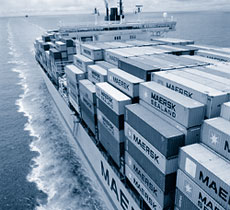
Maersk, a leading company in the field of ocean transportation, provides tailored services
to all its customers from large retailers to small, family-owned businesses.
FedEx Does More Than Deliver
The textiles and apparel industries face complexity like never before,” said John Wilkins,
apparel, footwear and textiles consultant, Memphis, Tenn.-based FedEx. With more than 250,000
employees and contractors worldwide, and revenues of $29.4 billion in fiscal year 2005, FedEx
offers a textile solution.
“FedEx has invested heavily in technologies that provide our customers access to the
information they need with services like FedEx InSight and Global Trade Manager. The ongoing
movement of goods around the globe creates challenges such as lab dips and sample rolls being held
in customs, total landed costs that constantly change as companies modify their sourcing base and
the risk of discovering that a new contractor might be on a denied parties list,” Wilkins said.
“FedEx also works with shippers to implement powerful enterprise-wide shipping management
systems on dedicated servers. These systems can provide electronic data interchange capabilities,
centralized shipping account management and control, electronic billing and accounting control; and
can apply business rules to different kinds of shipments for different scenarios so that shippers
within a company do not use services they do not need,” Wilkins said. “These systems can often be
integrated with a company’s own product-data-management systems and other warehouse-management
systems,” he continued.
“The apparel business is much more complex than ever before, but FedEx has the expertise and
resources to help our customers navigate global commerce,” Wilkins added. “FedEx is the largest
customs broker in North America and works with our customers to help them understand US customs and
regulatory agencies.
“For example, through FedEx Trade Networks Trade & Customs Advisory Services, we help our
customers take actions to avoid customs delays and improve their supply chains with programs that
guide them through the C-TPAT [Customs Trade Partnership Against Terrorism] audit and certification
process. Throughout the entire process, our visibility tools provide easy-to-access information for
our customers to see where their inventory is at all times.”
In terms of creative solutions, Wilkins said: “We developed a system for a large vertical
retailer that allows the retailer the ability to replenish goods direct-to-store from overseas
without having to pass through a domestic distribution center. Goods that are shelf-ready are
tendered to FedEx overseas, are electronically consolidated, and are then electronically entered
into the United States as a single entry — prior to the goods actually arriving. When the goods
have entered, they are then moved into the domestic Express network and delivered to stores all
around the country.
“This system was developed to allow the retailer to postpone allocations until the last
possible minute in order to distribute goods to the stores where color sell-throughs or weather are
having an impact on specific SKUs,” Wilkins said. “The retailer can keep inventories in check —
consider four days from factory to store in this scenario versus three to four weeks on the water,
maximize margins through better allocations and decrease stock-outs.”
When asked if the textile industry is leveraging the logistics successfully to be faster,
better, cheaper, Wilkins replied: “‘Faster, better, cheaper’ are crucial concepts to the textile
industry, but it is equally crucial to think about those concepts in a very comprehensive way. ‘
Cheaper’ can mean smaller checks to the transportation provider, reduced inventory-carrying costs
or reduced markdowns based on a faster replenishment system.
“At FedEx, we would like to see more companies in the industry approach transportation from
the standpoint of how it can help grow a business and how it can help impact other lines on the
profit and loss [P&L] statement like markdowns, interest charges and the top sales line. For
example, an appropriate transportation strategy can help a company enter a new geographic market
without having to invest in additional DCs. A number of best-in-class companies have taken this
approach, but more should follow. A key to this approach lies in spending time understanding how
transportation and speed fit into a company’s unique supply chain, P&L and balance sheet.”
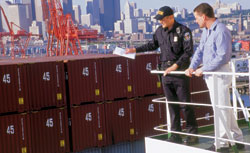
FedEx Trade Networks helps customers of all sizes solve the intricacies of shipping goods
globally through customs brokerage, international freight forwarding and trade facilitation
solutions.
Future Challenges
Listening to the responses from some of the key players in textiles-related
shipping and logistics clarifies the need for partnering and collaboration. The scope of services,
ability to coordinate movement and visibility provided by today’s solutions are making a difference
for textile firms, both large and small. With increased efficiencies, there are increased
expectations throughout the textile supply chain to know, understand and utilize the services
available.
As Wilkins at FedEx said: “The industry still has a lot of upside potential in leveraging
transportation. Too often, some companies still appear to approach transportation tactically or as
a commodity purchase.”
The consensus is that if shipping and logistics solutions have not been leveraged, the
affected company is inadvertently falling behind, for no other reason than not understanding and
prioritizing shipping solutions. “Creative strategies,” said Seaboard Marine’s Velez-Fernandez, “
are now becoming a day-to-day experience when it comes to making transportation decisions affecting
the supply chain management and logistics.”
That is another area where the textile industry must innovate and collaborate in order to
stay relevant in a global marketplace.
March/April 2006