Birdair Completes Work On Indianapolis Airport

Birdair, Inc., the leading specialty contractor of lightweight long-span roofing systems and
tensile structures throughout the world, recently engineered and constructed a fabric membrane for
a new parking terminal at Indianapolis International Airport, Indianapolis, IN.

In an effort to update and expand the current facility, renovations to Indianapolis
International Airport include the replacement of the previous terminal building with a new,
state-of-the-art, 40-gate terminal facility.  An adjacent parking garage, ground
transportation center and airfield will flank the new terminal, slated for completion in October
2008.

The new five-story, 2.5-million-square-foot parking garage, located immediately west of the
new terminal structure, was designed to accommodate 5,900 cars and 1,200 rental cars.  As an
integral part of the structure’s contemporary design, the new parkade features a Birdair PTFE
fabric membrane installed as helical canopies designed to emulate the spirals of the ramps
themselves.  Approximately 75,000 square-feet of PTFE material forms the two 100-foot diameter
helical ramp canopies and the 500-foot center atrium spine canopy.

ARCHonsortium LLC, Indianapolis, IN, selected the fabric membrane for its modern visual
appeal and versatility, as well as its optimum performance record for structures located in varying
climate zones. Birdair’s ability to overcome design and engineering challenges that other specialty
contractors would not have been able to meet was vital to the project’s success.

“One of the primary challenges we faced with this project was maintaining an acceptable
adherence to the design concept for the helical canopies, given the desire that the structures
follow the

spirals of the ramps themselves, and that they essentially cantilever from the inner core
ramp structure without additional visible structure at their peripheries,” explains David R.
Franklin, AIA, of Domain Architecture Inc., Indianapolis, IN, a member firm of ARCHonsortium.
“Birdair devised a single unobtrusive strut that ultimately served both our aesthetic preferences
and their own structural needs.”

“Birdair’s innovative engineering solutions continue to meet building challenges that
maintain initial design intent,” says Kevin Mayer, Birdair vice president of business development.
“Our coordinated construction and engineering efforts allow for unparalleled custom design and
fabrication of tensile structures throughout the world.”

“I am extremely pleased with the installation of the product, as well as Birdair engineers’
execution of our design intent, particularly for the helical ramp canopies,” adds Franklin.

Birdair has fabricated a number of tensile structures in the Indianapolis area, including
Methodist Hospital and the RCA Dome (formerly the Hoosier Dome), a project in which Franklin was
involved with prior to establishing Domain Architecture.

“Our familiarity with Birdair projects in the Indianapolis and North Carolina areas led to
our decision to select Birdair,” continues Franklin.  “They were able to successfully meet the
challenges associated with the project.”

Planning for the new $1.1 billion Indianapolis Airport terminal began in 1975, with
construction beginning in 2001.  Construction on the $92- million parking structure and
attached ground transportation center began in July 2005 and will be completed in July 2008. 
The 1,200,000- square-foot terminal will officially open to the public on October 28, 2008.

The new structure will meet modern security, parking, baggage handling, communications and
other systems requirements.  Its location between the airport’s two major runways will reduce
noise and pollution while saving taxiing time and fuel.

The parking structure project team consists of a group of firms called ARCHonsortium, LLC,
Indianapolis, IN. (www.archonsortium.net).   As part of the
group, Franklin served as chief designer for all Birdair components of the parking garage as well
as for the attached ground transportation center.  F.A. Wilhelm Construction Co., Inc.,
Indianapolis, IN, served as general contractor.  The Indianapolis

Airport Authority, Indianapolis IN, is the facility owner.

“With some admitted bias, I think the spiraling canopies for the helical ramps at the
Indianapolis airport parking structure are the most elegant and unique I have seen, and I must
compliment Birdair on their execution and engineering,” notes Franklin.

PTFE, or Polytetrafluoroethylene, is a Teflon®-coated woven fiberglass membrane that is
extremely durable and weather resistant; it is capable of withstanding temperatures from -100°F to
+450°F, immune to UV rays, and waterproof.

About Birdair: Birdair, Inc. is the leading specialty contractor of lightweight long-span
roofing systems and tensile structures throughout the world, providing design-build solutions for
architects and clients in all aspects of project design, engineering, installation and
maintenance.  Lightweight long-span roofing systems and cable structures can be attached to
any building envelope and

offer aesthetic and functional options to complement any exterior design.  Birdair,
based in Buffalo, NY, is a member of the Taiyo Kogyo Group, with operations serving North and South
America and other international locations.  For more information about Birdair, call
1-800-622-2246 or visit
www.birdair.com.


October 28, 2008

Press Release Courtesy of Birdair Inc.
US Suspends Trade Preferences For Bolivia

The Bush administration has decided to suspend duty-free treatment for Bolivian importers under the
Andean Trade Preference Act because of Bolivia’s failure to cooperate with the United States in its
effort to combat drug trafficking from Latin American countries. Bolivia currently exports $385
million worth of goods to the United States, including some $18 million worth of textiles and
apparel.

Under terms of the Andean trade agreement, the United States has given duty-free treatment to
goods from Bolivia, Colombia, Ecuador and Peru, but that trade preference has been tied to
cooperation in the anti-drug effort. On October 16, President George W. Bush signed legislation
extending the Andean agreement for one year, but subsequently announced that Bolivia would be
excluded. The US trade representative said the suspension could be lifted if the Bolivian
government improves its performance in the war on drugs.

October 21, 2008

USA-ITA Sponsors International Apparel Trade Conference

The United States Association of Importers of Textiles and Apparel (USA-ITA) is sponsoring a major
textile and apparel trade conference in New York City November 5-6, focusing on a wide range of
issues facing textile and apparel manufacturers and importers as a new administration and congress
take over in Washington in January. The program, which is open to all interested parties, will
feature speeches and panel discussions by leading government and industry trade experts including
W. Ralph Basham, commissioner, US Customs and Border Protection; Janet Labuda, director, Textile
and Apparel Policy and Program Division, US Customs; Sen. Charles  Schumer, D-N.Y.;
Christopher Padilla, under secretary of commerce, International Trade Administration; and
consultants and manufacturers’ and importers’ company officials. For further information or to
register, contact USA-ITA (212) 463-0089.

October 21, 2008

Zoltek Reports Successful Start-up For Mexico Plant, Record Sales

St. Louis-based carbon fiber manufacturer Zoltek Companies Inc. has commenced manufacturing
operations at its Zoltek de Mexico facility in Guadalajara. Zoltek acquired the textile acrylic
plant in October 2007, modified it to produce acrylic precursor — the principal raw material used
in carbon fiber production — and installed four continuous carbonization lines.

“The Mexico plant now enables us to meet anticipated major increases in demand in the wind
energy and other large emerging commercial applications,” said Zsolt Rumy, chairman and CEO,
Zoltek. “We have substantially increased our capacity to produce low-cost carbon fibers on a timely
and extremely cost-effective basis, and further extended our leadership in the growing commercial
advanced composite market.”

Zoltek announced it realized record sales for not only the fourth quarter 2008 but also the
full year, reflecting significant growth. According to company estimates, the Guadalajara facility
eventually could produce 60,000 tons of precursor material annually, supporting the production of
more than 27,000 metric tons of carbon fibers.

As part of its strategy to commercialize carbon fibers as a widely used building material,
Zoltek has expanded its management team, recentered its research and development programs, and
heightened its efforts to improve operations.

October 21, 2008

Gneuss Celebrates 25 Years

Germany-based Gneuss Kunststofftechnik GmbH — a manufacturer of filtration, measurement and
processing technologies for plastic melts — is celebrating its 25th anniversary.

Gneuss began operating in 1983 with the idea of inventing a new type of screen changer, using
rotary melt filtration technology. To date, there are more than 4,000 melt filtration systems in
operation, for raw materials, film and sheet production; compounding; and other polymer processing
applications; as well as recycling of contaminated polymers.

The latest technological development from Gneuss is the MRS extruder, a special multiple
screw extruder, which can be used to process polyethylene terephthalate (PET) without predrying.
The MRS system features a rotating single-screw drum with eight to 10 integrated satellite screws,
providing a large devolatilising capacity; a large melt surface area in the degassing zone; and a
20-millibar vacuum. The MRS35 extruder can be used in the production of chalk-filled low-density
polyethylene micropellets.

October 21, 2008

Quality Fabric Of The Month: In The Warm Seat

Canada-based nonwovens manufacturer Soleno Textiles, in partnership with CTT Group — a Canada-based non-profit organization supporting business development and innovation by providing
technical, commercial and information services to Canadian textile enterprises — is developing an electrically conductive nonwoven textile that will provide heating properties for applications such as automobile seats and apparel. Soleno and CTT debuted the patented technology earlier this month at CTT’s Expo Hightex 2008, a Montreal-based exhibition featuring new technological developments in the Canadian textile industry.CTT Group, currently counting more than 250 textile companies as members, has been serving the Canadian textile industry for 25 years. The organization has a staff of 50 textile professionals and houses state-of-the-art textile equipment in 2,000 square meters of laboratory
space.

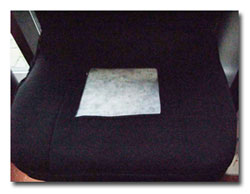
seat
For automobile seating applications, TX Conductor is placed between the seat’s padding,
shown, and the upholstery. Heat is delivered via a connection to the automobile’s 12-volt power
supply.

Soleno Textiles, part of the Canada-based Soleno Group, was established in 1998 as a manufacturer of needlepunched technical textiles for applications such as civil engineering, horticulture, filtration and industrial felts. The company offers several products through its TX
line, including TX Conductor, the electrically conductive product. A non-heating version of the new textile is already being used in a geotextile application. The heating function has been developed to the point that it can be offered for automobile seats, while that functionality for apparel is still being developed.

According to François Pepin, Soleno Textiles’ managing director, TX Conductor originally was developed as an electrically conductive geotextile to be used under a landfill liner to detect leaks. Moisture that may leak through the liner will trigger a response in the fabric, pinpointing the location of the leak so that it can be repaired. But during the research and development (R&D) activities, Soleno and CTT found that the fabric also could provide other functions.

“During R&D, we found that we were able to heat also, and we have continued to develop this branch of the technology,” Pepin said.

Textile engineer Aldjia Begriche, project leader at CTT, said TX Conductor will offer a cost-effective, reliable and durable alternative to carbon-fiber-based textiles and other heating technologies currently available for the targeted applications, in addition to saving energy in the automobile seat application. In TX Conductor, conductive fibers and man-made nonconductive fibers are homogenously intermeshed in a three-dimensional, lightweight network, and the textile may be
attached to electrically conductive bands functioning as terminals that are connected to a 12-volt power supply or a rechargeable battery. Begriche also is exploring the possibility of sewing into the textile a conductive thread to serve as the terminal that would connect to the power source.

The proportion of nonconductive to conductive fiber in the textile determines the heating function. “In laboratory testing, we could reach a temperature close to 50°C, but this is too high for some applications,” Begriche said, noting the details of controlling the temperature for
apparel applications are still in development.

Denier size also plays a part in the functionality of TX Conductor. The textile is flexible and easily cut with scissors, and the use of man-made fibers eliminates concerns of possible skin or eye irritation and other issues associated with carbon fibers.

When used to heat seats in automobiles, TX Conductor could help reduce a vehicle’s energy consumption vis-å-vis keeping the occupants warm, and in addition could have an antistatic function. The apparel application would encompass uniforms for outdoor workers as well as apparel for cold-weather sports and hunting.

Pepin said TX Conductor was very well received at Expo Hightex, with two automotive companies — one in the United States and one in Germany — expressing interest in developing a relationship with Soleno Textiles.


For more information about TX Conductor, contact François Pepin (450) 668-2545, fpepin@soleno.com.

Dornier Delivers 50,000th Rapier Weaving Machine

Germany-based air-jet and rapier weaving machine manufacturer Lindauer Dornier GmbH recently
delivered its 50,000th rapier weaving machine. The machine was produced at Dornier’s main factory
in Lindau, and reportedly was delivered to a leading global technical weaving company that will use
it to manufacture woven reinforcement fabrics.

Dornier delivered its first rapier weaving machine in 1967. The company reports its machines,
which are utilized in numerous technical woven-fabric fields, are able to gently process brittle,
fine individual-count continuous filament yarns in a variety of patterns. The machines’ features
include low weft pick-up speed of the rapier; soft clamps and precise center transfer for safe weft
insertion through the shed; the ability to process yarns without shed guide components; and digital
warp control to minimize tension throughout the weaving process.

Over the years, Dornier has made continuous updates and improvements to the machines. One
significant development is the Dornier DuoColor waste-saving device, which reduces selvage waste of
weft yarns used in technical applications by up to 70 percent.

October 21, 2008

ATC Expands Product Line, Increases Workforce

Citing “significant growth,” the Duquesne, Pa.-based American Textile Co. (ATC) — a manufacturer of
mattress and pillow protectors, bed pillows and mattress pads — has increased its product offerings
and expanded its workforce. The company has projected a 30-percent increase in total gross sales
for 2008 over 2007, noting that its pillow business alone has nearly doubled just in the past year.

“The significant growth we are experiencing at American Textile Company is being driven by
our ability to anticipate market needs and provide value-based solution offerings to our customers
and consumers,” said Jennifer Katz, vice president of marketing communications, ATC. “This past
year we challenged ourselves to not only identify needs through a deep understanding of the
marketplace, but to answer those needs with innovative solutions rooted in science.”

ATC has expanded its flagship Aller-Ease® product line, designed for allergy and asthma
sufferers; added 315 jobs across all three of its operating facilities in Duquesne, Dallas and Salt
Lake City, the latter of which has grown by more than 50 percent; and has promoted several
employees in its operations, sales and marketing, and finance departments. Katz stated the company
anticipates nearly 20 percent additional growth in 2009.

October 21, 2008

INDA Names Five Finalists For 2009 Visionary Award

The Association of the Nonwoven Fabrics Industry (INDA), Cary, N.C., has named five finalists for
the 2009 Visionary Award. The annual award recognizes innovative consumer end-products that
incoporate nonwoven fabrics or use nonwoven technology during the manufacturing process.

The finalists include: Finland-based Ahlstrom Corp.’s Disruptor nanoalumina fiber and
nonwoven water filter media; Menifee, Calif.-based Back Enterprises LLC’s Germy Wormy sanitary
sleeve; Dallas-based Kimberly-Clark Corp.’s GoodNites sleep boxer for boys and sleep shorts for
girls; Chula Vista, Calif.-based Rotano International LLC’s Nooby’s disposable dog booties; and
Richmond, Va.-based WearOnce.com and Tredegar Consumer Designs Inc.’s Once Single-Use Panty.

The five finalists will make presentations at INDA’s VISION 2009 Consumer Products
Conference, to be held Jan. 26-29, 2009, in New Orleans. Conference attendees will vote to select
the 2009 Visionary Award winner.

October 21, 2008

Naturally Advanced Technologies Conducting Trials To Commercialize Crailar® Technology

Canada-based Naturally Advanced Technologies Inc. (NAT) — a developer of proprietary technology to
process bast fibers including industrial hemp for use in casual apparel, performance yarns,
advanced composites, biopolymers, industrial filters and absorbent pulp and paper products — is
conducting bulk commercialization trials with a leading US apparel manufacturer and a North
American pulp and paper producer. Trial results will help the company plan its next course of
action to bring its Crailar® Organic Fiber and Advanced Materials technology — developed by its
wholly owned subsidiary, Crailar Fiber Technologies Inc. — to the market. The company expects to
announce the results by the end of November.

“These trials are a significant milestone in our long-term strategy to commercialize the
patented Crailar Technology Platform, which we developed in partnership with the National Research
Council of Canada and the Alberta Research Council,” said Ken Barker, CEO, NAT. “We are very
excited to reach the final stages of the trials and look forward to discussing the results and our
preliminary plans to apply this technology on a large commercial scale.”

Crailar technology makes use of industrial hemp’s natural properties, including tensile
strength, thermoregulation, antimicrobial and abrasion resistance. Industrial hemp cultivation does
not require the use of pesticides or herbicides; it flourishes in cool climates; is
drought-tolerant; benefits the soil; and supports the elimination of greenhouse gases.

October 21, 2008

Sponsors