Naturally Advanced Technologies Conducting Trials To Commercialize Crailar® Technology

Canada-based Naturally Advanced Technologies Inc. (NAT) — a developer of proprietary technology to
process bast fibers including industrial hemp for use in casual apparel, performance yarns,
advanced composites, biopolymers, industrial filters and absorbent pulp and paper products — is
conducting bulk commercialization trials with a leading US apparel manufacturer and a North
American pulp and paper producer. Trial results will help the company plan its next course of
action to bring its Crailar® Organic Fiber and Advanced Materials technology — developed by its
wholly owned subsidiary, Crailar Fiber Technologies Inc. — to the market. The company expects to
announce the results by the end of November.

“These trials are a significant milestone in our long-term strategy to commercialize the
patented Crailar Technology Platform, which we developed in partnership with the National Research
Council of Canada and the Alberta Research Council,” said Ken Barker, CEO, NAT. “We are very
excited to reach the final stages of the trials and look forward to discussing the results and our
preliminary plans to apply this technology on a large commercial scale.”

Crailar technology makes use of industrial hemp’s natural properties, including tensile
strength, thermoregulation, antimicrobial and abrasion resistance. Industrial hemp cultivation does
not require the use of pesticides or herbicides; it flourishes in cool climates; is
drought-tolerant; benefits the soil; and supports the elimination of greenhouse gases.

October 21, 2008

Invista, Klopman Unveil Klopman Vantage Fabric With Cordura® Technology

Wichita, Kan.-based Invista — a global integrated fibers and polymers manufacturer — has partnered
with England-based polyester/cotton blended fabric manufacturer Klopman International to create
Klopman Vantage workwear fabric featuring Cordura® brand technology.

Klopman Vantage twill fabric with Cordura — developed to meet a demand in the European
workwear market for increased comfort in a durable, abrasion-resistant fabric that can be used for
a complete garment — is made with an intimate blend comprising 50-percent Invista™ T420 Nylon 6,6
fiber and 50-percent combed cotton, and weighs 250 grams per square meter. According to the
companies, the fabric has been tested by independent laboratories and has met the highest color
retention and performance standards, withstanding 250,000 Martindale rubs without failure. The
fabric, which will be used to make trousers, coveralls and other apparel, will be available in
khaki and black, with additional colors to be later added to the range.

October 21, 2008

RadiciSpandex Rebrands Fibers As RadElast®

Gastonia, N.C.-based spandex fiber manufacturer RadiciSpandex Corp., the North American business of
the Italy-based RadiciGroup, has launched the RadElast® brand to identify its group of performance
stretch fibers.

The new brand — which combines the Radici name with elastane — is part of RadiciGroup’s
comprehensive corporate initiative for its fiber and textile divisions throughout the world, and is
expected to help end-users boost their sales. The branding program will be available free of charge
to fabric mills, manufacturers, designers and retailers in all end-use markets. The company will
provide hangtags featuring the RadElast logo, and will incorporate the new name into all
communications tools.

“In line will all new initiatives at RadiciSpandex Corporation, the introduction of the
RadElast brand is intended to support and help build our customers’ businesses,” said Marty Moran,
CEO, RadiciSpandex Corp. “We have created this brand icon as a means to add excitement to our
customers’ sales communications, thereby supporting efforts at retail. The RadElast hangtag program
will educate the end user about the benefits our fibers bring to fabrics in a variety of
categories.”

Effective November 2008, all RadiciSpandex stretch fibers will be identified by their
established code names in combination with new RadElast brand. End-uses include swimwear, lingerie,
activewear, hosiery, denim, sportswear, nonwovens, narrow fabrics, personal care, medical and
industrial applications. 

The RadElast fiber range includes S17B chlorine- and ultraviolet-resistant spandex; S17PC,
used in baby diapers and adult incontinence products; SRB premium black spandex; S45
polyether-based spandex with high-temperature resistance; and S85 clear spandex.

October 21, 2008

Financial Crisis Affects Spinners


T
he dwindling number of US spinners has had to learn on-the-fly about competition in a
global market and the provision of superior customer service and delivery to offset basic pricing
inequities with manufacturers in developing and subsisted economies.

Those either unwilling or unable to attempt a transformation have fallen by the wayside –
and that accounts for the majority of US spinning operations over the last quarter century.

But those that diligently sought new markets, new points of differentiation, and new
products – and who steadfastly sought to deliver enhanced value to their customers – found a niche.
They reduced spindles, increased automation and productivity, and developed specialized and
environmentally friendly products. They discovered the meaning of the word “service,” and applied
the definition attentively in their day-to-day interactions with customers. In short, they
survived, albeit in a different fashion than was the traditional industry standard.

After weathering one storm after another, overcoming improbable odds and constantly
reinventing themselves to meet the expectations of a constantly changing customer base, US yarn
spinners – especially the smaller ones – are at a crisis point again, this time as a result of a
faltering global financial industry.

Consider the case of a small North Carolina spinner that had done everything “by the book.”
The company specialized in environmentally friendly products, catered to a diverse array of
customers, ranging from apparel to automotive to high-tech industry, and generally enjoyed a solid
service reputation among its customers. 

Yet, in late September, employees came to work for what they thought was another routine day
only to find the company was shutting down immediately.

“The company just ran out of money,” said one former employee. “We came to work and were
told it was over, that there was no money and no opportunity to get any.”


Lack Of Sources For Capital

Textile manufacturers have long been among the high-risk industries that often have had to
look beyond traditional banking for sources of capital to either expand or get through lean times.
But the global banking crisis has suddenly put a stop to the trickle of credit available to all but
the largest yarn spinners.

“It’s going to get worse for a lot of traditional industry before it gets better,” a
financial analyst told

Textile World
. “Regardless of how or whether the $700-billion bailout bill works, the flow of credit to
mid-to-high-risk companies is likely to significantly diminish. This doesn’t just apply to
manufacturers, but to their customers as well. Smaller retailers, for example, that depend upon
short-term credit to increase merchandise stocks for the holidays may have a difficult time
financing those purchases. That affects their ability to place orders and precipitates a decline in
business at a time when most companies were anticipating an increase. That, in turn, increases the
likelihood of job losses, which, along with tightening credit standards, serves to decrease
consumer spending. It is a vicious circle, and one that has the potential to have a lasting effect
on small and marginal businesses.”

“Many textile companies that have tried to meet their capital requirements through
traditional banking circles have had difficulty for quite some time,” said one well-placed industry
executive. Asset-based lenders have been the answer for many smaller companies that have performed
well, make good on their promises and generate cash flow. But these sources are likely to dry up
for a while now, as well. Asset-based lenders tend to look for security – and the value of the
equipment we have in place is steadily decreasing. If you are in this industry and need money,
there are no easy answers right now.”

Said one industry observer: “The next 60 to 90 days are going to be critical. The only thing
we can do for now is to wait and see how this all shakes out. It’s certainly possible that a
meltdown can be averted at the 11th hour. But it is also possible things will get worse – much
worse.”

Stay tuned to Yarn Market and

Textile World
for continuing updates on the impact of the global financial crisis on yarn spinners and the
textile industry as a whole.


October 2008

The Numbers Remain Glum


T
he latest round of mill statistics continues to disappoint. Zero in on the basic mill
sector, and output has fallen another 3 percent over the latest available three-month period. And
even more disturbing: Compared to a year earlier, this key barometer of textile health is off by
double-digit amounts. This pretty much checks out with a similar hefty falloff in mill shipment
numbers. Moreover, the picture is not that much better when it comes to more highly fabricated mill
products such as carpets, household furnishings and industrial textiles. Here, the production
numbers are down about 2 percent vis à vis three months earlier and down some 8 percent over the
past year. And again, this yearly decline is confirmed by a comparable drop-off in mill shipments.
To be sure, incoming orders have tended to improve a bit in recent weeks. But these won’t be nearly
enough to prevent 2008 from being the worst textile year since 2001, when overall mill production
dropped some 10 percent as the first big onslaught of Chinese imports began to hit the US market.

To sum up: All the evidence now points to another significant drop for 2008 – with mill
slippage expected to be somewhere in the 7- to 9-percent range. All this, in turn, is contributing
to more excess domestic capacity, even with continuing mill closings and some slowdown in new plant
and equipment investment. At last report, for example, mills were producing at only around 65
percent of their potential – some 5 percent points under the last year and about 9 percent below
levels prevailing as recently as 2006.
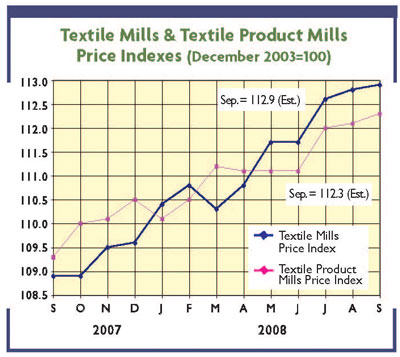
B&Fchart_Oct


The Bottom Line Impact


Given all these reductions in overall mill activity, it should come as no surprise that
industry profits are also shrinking. Analysis at Global Insight, for example, sees dollar earnings
this year dropping in all three major textile/apparel sectors. Using their rough measure of profits
– dollar shipments less raw material and labor costs, this prestigious economic forecasting firm
now sees earnings of basic textile mills falling to near $5.3 billion this year – well under the
$5.9 billion reported last year. And it’s pretty much the same story for more highly fabricated
textile product mills, where last year’s $9.5 billion profit total is projected to slip to near
$8.6 billion. Finally, a somewhat smaller decline, from $6.1 billion to $5.9 billion, is
anticipated for apparel manufacturers. Compare these latest estimates to the profit levels
prevailing only four years earlier – and the new numbers look even more dismal – with profits in
these sectors down 30 percent, 15 percent and 11 percent, respectively.

On the other hand, Global Insight analysts project a somewhat better performance for the
next two years, when earnings are seen bottoming out in all three sectors. Equally significant, the
firm remains modestly upbeat about the really long term – with profits expected to remain on a
relatively even keel in all three textile/apparel areas well into the second decade of the new
century.


Behind The Slowdown


Why all these industry woes? This time, it’s not so much a new drop in textile and apparel
imports, but rather the negative impact of the Wall Street meltdown and a sluggish economy, which
together have made consumers a lot more cautious. Again, the numbers tell the story. Backing up the
feeling that imports aren’t the problem is the fact that incoming shipments so far this year have
actually declined a bit. Obviously, then, the import share of the US textile/apparel market hasn’t
really increased. The blame, instead, can only be attributed to a shaky economy. And this is a
situation that isn’t likely to get any better as we enter the last quarter of the year. One reason,
aside from Wall Street concerns, is the still-high price of gasoline. True, pump quotes have
slipped a bit of late. But it would take an additional 10- to 15-percent drop to get them back to
where they were earlier this year. Another problem is slowing income growth. So far this year,
gains have tapered off to less than 3 percent at an annual rate – well under the increases of
recent years.

To a large extent, it’s this slowdown – when combined with rising unemployment and declining
home values – that is continuing to undermine consumer confidence. Not surprising, one recent
survey of economists suggests little more than a flat consumer spending pattern for the immediate
future. True, new government business-propping moves – along with the end of uncertainties
engendered by the upcoming election – will eventually make for some turnaround. But it will take
time, with even a modest recovery not expected before next spring.


October 2008

October 2008

Rock Hill, S.C.-based
Springs Creative Products Group LLC has announced a licensing agreement with
Nickelodeon and Viacom Consumer Products, allowing Springs Creative to offer Nickelodeon and Nick
Jr. properties as part of its retail fabric and craft kit product lines.

South Boston, Va.-based luxury linen supplier
Hilden America Inc. has updated its website, located at
www.hildenamerica.com. The site includes features such
as detailed product images and accurate color representations to help clients browse and select
products.

Germany-based
BASF SE has released an eight-page, English-language brochure providing
information on the glyoxal properties in various applications and the services BASF offers for it.
The brochure, titled “Glyoxal: The Sustainable Solution For Your Business,” may be downloaded or
ordered in print at
www.glyoxal-solutions.com.

Research and Markets Ltd., Ireland, has released the 2008 World Textile and
Apparel Trade and Production Trends report, Edition 1. Information about the report, as well as
instructions for ordering, can be found at
www.researchandmarkets.com/product/2b257e/world_textile_and_apparel_trade_and
production
.

Richmond, Va.-based
Carpenter Co. has launched an interactive, educational website, located at
www.sleepbetter.org, to provide users with tools, tips and
information on how to improve their sleep.

Belgium-based
Balta Group has launched its new website,
www.baltagroup.com. The new site can be displayed in four
languages, and features an updated design and information about Balta Group and its products.

The Toronto-based
Textile Museum of Canada is creating a section of its website, located at
www.textilemuseum.ca, to showcase the role of textiles in
culture. “In Touch: Connecting Cloth, Culture + Arts” will offer audio and video recordings of the
museum’s educational programs in addition to existing online collections and exhibitions.

Germany-based
Engelbert Strauss GmbH & Co. KG’s working trousers, part of the company’s
active workwear line, are the first products globally to receive Germany-based
Hohenstein Institutes’ Hohenstein Quality Label for fit.

Solvay Chemicals Inc., Houston, has launched its new SOLVAir products website,
located at
www.solvair.us. The site is targeted to the air pollution
control industry.

Bloomington, Indiana-based
Textillery Weavers has updated its website,
www.textillery.com. The site features user-friendly search
tools and showcases Textillery’s handwoven throw collection, as well as the company’s custom color
and design capabilities for the hospitality and contract design markets.

Pasadena, Calif.-based
Avery Dennison Corp.’s Information and Brand Management Division (IBMD) has
launched a new solutions-center website for apparel producers, retailers and brand owners. The
site, located at
www.ibmd.averydennison.com, offers retail
identification solutions for displaying, tracking, tracing and protecting brands, products and
information.

Leominster, Mass.-based
Spectro Coating Corp. now offers custom-manufactured flocked materials ranging
from blankets to optical and metallurgical pads, commercial carpet, specialty fabrics and tapes.
The products can incorporate combinations of various fiber sizes, materials and selective
adhesives, and can be cut and finished to match specifications.

Congressional Committee Seeks Information On China Trade

The House Ways and Means Committee has made a formal request for the International Trade Commission
(ITC) to investigate and provide information on Chinese textile and apparel imports, a move that
could lead to new import quotas when the current quotas expire.

In a letter to ITC Chairman Shara (sic) L. Aranoff, Ways and Means Committee Chairman Rep.
Charles B. Rangel, D-N.Y., expressed his concern over the possibility of a market-disrupting surge
of Chinese imports when quotas are removed, and he called on the commission to conduct an
investigation and provide the committee with statistical reports on the volume, overall value, unit
value and market share of certain textile and apparel products from China. He asked for the first
report by December 1. In addition, he said, to the extent practicable, the commission should
provide the committee with preliminary Customs data once every two weeks and publish that data on
its website.

Rangel’s letter noted that textile and apparel imports from China increased dramatically
beginning on Jan. 1, 2005, following the termination of import restrictions under the World Trade
Organization’s Agreement on Textiles and Clothing. “That import surge,” he said, “injured
businesses’ workers and communities in the United States and in other countries, particularly the
poorer developing nations.” As a result of that surge, the United States and China agreed on
safeguard quotas covering 34 sensitive product categories of textiles and apparel. Those safeguard
quotas expire December 31.

“Like many textile and apparel producers and workers in the United States and in other
countries, and like many other members of Congress, I am concerned that a market disrupting surge
in textile and apparel imports from China could occur when the textile and apparel quotas expire —
just as occurred on the expiration of the clothing and textile agreement just four years ago,”
Rangel said.

He said his committee is acting now because the Bush administration “does not appear to be
taking these concerns seriously.”

In a statement released along with the letter, Rangel said, “Monitoring Chinese textile and
apparel imports will help provide the committee with timely, accurate information to assess whether
Chinese imports are causing or threatening to cause market disruption in the United States and
other countries.” If market disruption is found, the committee has the authority to initiate an
investigation that could result in restrictions on Chinese trade, including quotas or tariffs, or
both.

The committee’s action received a strong and enthusiastic endorsement from nine major
business and labor organizations representing the textile industry, which have launched a major
effort to get a monitoring program.


Seventeen international textile and apparel associations have sent letters to  the US
Secretary of Commerce and US Trade Representative and the chairmen and ranking members of the
Senate Finance and House Ways and Means committees. Although quotas or other actions would be
confined to US imports, they feel a surge of Chinese trade would displace their products in the US
market and undercut preferential trade agreements such as the North America Free Trade Agreement,
the Central America-Dominican Republic Free Trade Agreement and the African Growth and Opportunity
Act.

Not everyone is excited about the committee’s action. Kevin M. Burke,  president and CEO
of the American Apparel and Footwear Association, issued a statement saying that while the
monitoring program may not necessarily lead to any “protectionist actions,” its existence does
create apprehensions that action may be taken in the near future. He expressed his concern that not
knowing what will happen next creates uncertainty in the market “at a time when predictability is
more important than ever.”


October 14, 2008

US Army Selects Milliken’s Abrams™ FR Fabric For ICVC Uniform

Spartanburg-based textile and chemical manufacturer Milliken & Company’s Abrams™
flame-resistant (FR) fabric has been selected as the only approved fabric for the US Army’s
improved Combat Vehicle Coverall (iCVC).

The iCVC uniform, featuring the universal camouflage pattern, replaces the current one-piece
flame-retardant CVC uniform. Abrams contains a combination of proprietary-blended fiber
technologies, including DuPont™ Nomex®, to provide protection against flames and other heat-related
hazards, as well as abrasion and tear resistance and moisture-wicking capabilities. According to
Milliken, the new uniform’s design offers improved fit, function, and comfort.

Milliken’s Abrams fabric also is approved for use in other combat uniforms. Milliken is a
materials subcontractor for all US Military branches, as well as the US Coast Guard, US Post Office
and the Department of Homeland Security.

October 14, 2008

Shuford Mills Adds To Outdura® Awning Line

Hudson, N.C.-based Shuford Mills LLC, a vertically integrated specialty textile manufacturer, is
expanding its Outdura® line of performance fabrics. Shuford produces its 100-percent solution-dyed
Outdura fabrics in various weights for awning, marine and furniture applications. In addition to
the existing solids and tweeds, the fabric line now will feature dozens of striped patterns
designed by Brenda Sewell-Bost and Karen Williams of Burlington, NC-based D2 LLC.

Outdura fabrics are stain-resistant, water-repellent and breathable, and when correctly used
and maintained, will not fade, mildew or weaken. According to the company, Shuford Mills is the
first weaver of solution-dyed acrylic fabric to offer its awning fabric in a 60-inch width. The
company reports Outdura fabrics have an ultraviolet protection factor of 50-plus and the highest
abrasion resistance in the industry, with the ability to endure more than 60,000 double rubs.

October 14, 2008

Recasens USA Introduces Four New Products

Bala Cynwyd, Pa.-based Recasens USA — a manufacturer of solution-dyed acrylic and vinyl textiles
for the marine and awning and other technical textile applications, and the US division of
Spain-based S.A. Recasens — has added to its line of high-performance textiles with the launch of
four new products.

Recasens’ newest marine textiles include an 86-inch-width version of its Nautimar® marine
fabric, which is polyvinyl chloride (PVC)-coated on one side; and the new Nauti Plus®, a woven
polyester that is PVC-coated on both sides and also is available in an 86-inch width. According to
Recasens, both Nautimar and Nauti Plus are fully waterproof fabrics with good tear and tensile
strength; flexibility for easy installation and storage; and an embossed, silicon finish for simple
maintenance and cleaning. Nautimar comes in eight solid colors, and Nauti Plus comes in white and
snow white.

Recasens has introduced a new technical textile line called SOLAREC® for use in awnings,
veranda covers, window shades and architectural shade systems. SOLAREC offers ultraviolet (UV)
light protection and features a mesh construction that improves airflow and, according to the
company, may reduce energy consumption. The fabric is available in 9 colors. Both are 32 yards long
and 118 inches wide, reducing the need for cutting and seaming of end products.

The company also offers RecScreen®, a line of PVC/polyester shade screen fabrics that feature
antibacterial and fire-retardant characteristics as well as a lead-free coating. According to
Recasens, the fabric filters UV rays and improves air circulation, therefore reducing energy costs
and keeping rooms cooler in the summer. Recscreen also is available in a 118-inch width, making it
easily adaptable for an array of uses.

October 14, 2008

Sponsors