The Rupp Report: The Suffering Italian Fashion Industry

Having been in this industry for many decades, it has always been the same: When I was in Italy,
people asked me: “How is it in France? Are they good, are they fashionable?” Vice-versa in France,
same questions: “How is it in Italy? Are they good, are they fashionable?” This ping-pong was going
on and on, though an answer was almost impossible. Two fashion countries at the top, but with
totally different products and a totally different approach to the markets. These times, it seems,
are gone, at least for the near future. Today, it’s more the question, who will survive?

Trouble For Big Labels

As many news agencies report, Italian fashion brands such as Gianfranco Ferré and Malo could
be up for sale as owner IT Holding S.p.A. is in financial trouble and seeks a way out with the
support of special administration. The rumor is that IT will refocus on production licenses through
its Ittierre S.p.A. division. It is not excluded that a sale could be done before the restructuring
plan is final, but that sale would need to be approved by the ministry. It could be done privately,
but the favored method would be an auction. It is said that advisers and banks have already
contacted the commissioners.

IT Holding is in the hands of three administrators appointed by the industry ministry last
month. They have six months to draw up a restructuring plan for the group. IT Holding looked
unsuccessfully for a partner for months. It had net debt of 295.4 million euros at the end of
September and a nine-month net loss of 10.1 million euros. Late in February, it secured a credit
line of 30 million euros.

Ferré, renowned for his special “architectural” style, passed away in 2007 and his eponymous
label is now styled by Tommaso Aquilano and Roberto Rimondi. Their womenswear show in February,
watched by the commissioners, was well-received. Ferré’s revenues were 104 million euros in the
first nine months of 2008, while knitwear brand Malo had 35.7 million euros out of total revenues
of 468 million euros. An offer of 120 million to 140 million euros for Ferre was made by a private
equity firm in December 2008 but was rejected.

Government Support

As the US government has been injecting billions of dollars into banks and car companies, the
Italian government is placing its pennies on the fashion industry and is planning special measures
to support the fashion industry through the crisis. The main support will be a tax credit to ease
the production of apparel samples and collections, and the government also will allow access for
fashion houses to a fund for small and medium-sized enterprises.

The target of the measures is to save the endangered “Made in Italy” fashion sector and
generate the conditions to allow companies to be more competitive on international markets after
the crisis. Last month, Italian apparel and textile companies called on the government to support
their sector, which has been hit by a drying-up of credit and a slump in demand for fashion.

With 800,000 workers in all levels of this industry ready to benefit, the Italian government
may offer full salary to laid-off workers and tax breaks for women. Government subsidies for small
companies also might be included. The government is willing to offer $2 billion to support small
companies overall, and some of that would go to the fashion industry.

Poor(er) Fashion Week In Milan

The catwalks in Italy are also in danger owing to IT’s problems. Just Cavalli, the label of
designer Roberto Cavalli, was absent. He was forced to cancel the show of the company’s younger
range of clothing after its distributor, Ittierre, was put into administration.

The Milan Fashion Week was and is more of a poor event this year, as the Italian apparel
industry struggles with the impact of the global financial crisis. This year, there were fewer
fashion shows, with many firms opting for modest exhibitions, according to the Italian Chamber of
Fashion. At the men’s show in January, there were one-fifth fewer shows than the year before.
Although Italy is known for its international brands such as Giorgio Armani, Versace, and Gucci,
smaller labels dominate the market, and this sector has been devastated more by the global
downturn.

Last month, the Italian Chamber of Fashion warned revenues for the sector would fall at least
5 percent this year, and now the crisis has claimed its first big fashion victim in Italy, with IT
Holding’s distribution subsidiary, Ittierre, under bankruptcy protection.

March 24, 2009

Victor Acquires Craftex

Quebec-based Victor Group Inc., a textile manufacturer specializing in environmentally sustainable
fabrics for residential and contract interiors, has acquired the Craftex brand from the secured
creditor of Philadelphia-based Craftex Mills Inc., also a manufacturer of residential and contract
interiors fabrics. The acquisition also includes Craftex’s catalog of designs and patterns. Victor
will continue to offer the Craftex brand, adding new products and designs to its current portfolio.

“This acquisition creates a more diverse product offering for Victor, and offers stability
for customers of the Craftex brand during a challenging economic time for the entire textile
industry,” said Paul Bennotti, director of marketing, Victor Group. “Over the past 100 years, the
Craftex brand has come to represent quality, innovation, value and service. Victor has built its
reputation on these same qualities so I am confident that Victor will be able to provide customers
of the Craftex brand the same quality service and products that they have come to expect.”


March 24, 2009

Universal Fibers Wins Inaugural Bloom Award For Sustainable Flooring

Bristol, Va.-based Universal Fibers Inc., a manufacturer of solution-dyed man-made-fiber carpet
yarn, has received the first annual Bloom Award for ReFresh Fibers®, its brand of nylon 6,6 fiber
products manufactured from post-consumer carpet. The Bloom Award – presented by the American
Society of Interior Designers in partnership with Interiors & Sources magazine – recognizes
interior commercial design products that exemplify environmental stewardship.

“There are more than one billion pounds of used nylon 6,6 carpet coming up off the floor
every year, and Universal has developed the technology to turn that back into a quality usable
product,” said Bill Goodman, vice president of sales and marketing, Universal Fibers. “It’s just
part of our commitment to eliminating waste and be a better steward of the environment while still
creating a superior product for our customers.”

ReFresh Fibers is a component of Universal Fibers’ EarthSmart Technology®, the company’s
environmental stewardship program that covers production processes and equipment, waste reduction
and conservation, and recycled and recyclable products; as well as a corporate culture that
supports environmental and social concerns.

“We are very honored to be awarded The Bloom Award,” Goodman said. “We like taking the lead
to sustainability in fiber, and we sincerely hope others in the industry will commit to a
sustainable business strategy as well.”


March 24, 2009

Dow Introduces Hypod™ Polyolefin Dispersions For Carpet-Backing Applications

The Dow Chemical Co., Midland, Mich., reports its new thermoplastic Hypod™ Polyolefin Dispersions
for carpet-backing applications provide a more sustainable alternative to traditional thermoset
backings, making it easier to recycle carpet components at the end of a product’s useful life.

“With more than 7 billion pounds … of carpet disposed of in North America and Europe
together each year, enhancing the recyclability of carpet can have a huge environmental and
economic impact,” said Mike Levinson, commercial director, Dow Ventures & Business Development.

The thermoplastic backings can be applied to broadloom, carpet tiles, artificial turf and
thermo-moldable products using conventional coating equipment. According to Dow, they use less
material than thermoset backings, thereby saving resources and energy and reducing the weight of
the end-product.

In addition, said Bruno Gade Nielsen, managing director of Dow customer Foamtex A.S., a
Denmark-based commission finisher for the carpet industry, “Hypod Polyolefin Dispersions have very
low odor and excellent wet strength.”

March 24, 2009

Sullair Unveils ShopTek™ Air Compressors

Sullair Corp., Michigan City, Ind., has introduced its ShopTek™ line of lubricated rotary screw air
compressors, available in eight models ranging from 5 to 20 horsepower, 17 to 78 actual air
compressor capacities, and pressure from 125 to 175 pound-force-per-square-inch gauges. According
to the company, the continuous-duty compressors are economical and efficient, combining Sullair’s
rotary screw technology in a compact, belt-drive package that is suitable for small-horsepower
applications such as light manufacturing and commercial laundries, among other applications.

sullair

March/April 2009

Federal Signal Offers 27XL LED In Clear Lens Option

University Park, Ill.-based Federal Signal Corp., a safety and security product manufacturer, now
offers its energy-efficient, shock-resistant 27XL explosion-proof light-emitting diode (LED) Light
with high-intensity extreme light technology (XLT) in a clear lens option, adding to its offering
of amber, blue, green and red LED/Lens colors. The 27XL warning light produces 60 high-intensity
flashes per minute; has an effective candlepower of up to 134; and is field-configurable to a
steady burning state or flashing mode.

March/April 2009

March/April 2009

DuPont Specialty, Wilmington, Del., has unveiled its new website, located at
www.colorants.dupont.com. The site provides
information on DuPont’s range of custom services, applications, manufacturing capabilities; and the
markets and industries it serves.

Trevira GmbH, Germany, has redesigned its website, located at
www.trevira.com, to offer updated content, structure and
design, including product information in up to 15 languages. In other news, Trevira CS
flame-retardant fibers and yarns have been awarded the Swiss Council for Accident Prevention (bfu)
safety symbol.

Americhem, Cuyahoga Falls, Ohio, has launched a global website, located at
www.americhem.com, featuring content for customers in three
worldwide regions and five languages.


Online Textile Inc.
, Florida,  now offers textile translators for personal
computers, Macintosh, or iPhones. Abraham’s Interactive Textile Dictionary is available in an
English-Chinese version and in a European language version that translates terms in six languages.

The Germany-based
German Wool Research Institute has been renamed
DWI at RWTH Aachen University Inc.

Enfield, Conn.-based
Specialized Technology Resources Inc. has launched a website for its QA division,
located at
www.strquality.com.

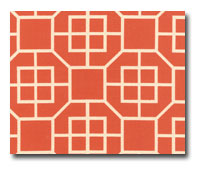
F. Schumacher & Co., New York City, has introduced its Schumacher Terra™
eco-friendly fabrics and wall coverings, including the By Nature collection of organic cotton
fabrics. Schumacher will donate 2 percent of proceeds from sales of By Nature fabrics to WaterAid
America, New York City.

bbpattern
Organic cotton fabric from F. Schumacher & Co.’s By Nature collection

Bonjour/Schlossberg Switzerland, Clinton, N.J.,  has introduced Sensitive
Towels, a terry towel bath line that is manufactured in an eco-friendly manner and is suitable for
users with skin sensitivities. The line has received Cradle to Cradle™ certification from McDonough
Braungart Design Chemistry, Charlottesville, Va.

Research and Markets Ltd., Ireland, has released the report “China Apparel
Industry – New Opportunities for Growth.”

Kaeser Compressors Inc., Fredericksburg, Va., has released its Air Demand Analysis
program, a complete compressed air auditing system that uses data loggers and precision sensors to
create a detailed air usage profile for individual facilities.


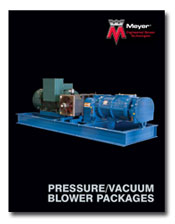
bbbrochure


Wm. W. Meyer & Sons’ Pressure/Vacuum Blower brochure


Wm. W. Meyer & Sons Inc.
, Libertyville, Ill., has released a comprehensive
brochure detailing its pressure and vacuum blower packages.

March/April 2009

MSJ Associates Established

MSJ Associates LLC has opened for business in Greenville. Headed by Michael G. Smith, the
manufacturer’s representative and sales/marketing company supplies custom-designed creel racks and
powder coating capabilities, information systems, and carpet manufacturing systems solutions and
automation technology, among other products and services. MSJ also buys and sells used textile
machinery.

March/April 2009

Primer On Nonwoven Fabric Filtration


N
onwoven fabrics have seen impressive growth with penetration into a number of filtration
industry end-use market segments. Until nonwovens began to seriously access the market in the
1970s, woven textiles were the material of choice in many industry sectors. Nonwovens offered a
less expensive alternative and often a distinct technical advantage by the basic attributes of the
nonwoven construction. Today, the filtration industry worldwide is growing at 2 to 6 percent per
year above gross domestic product. Even so, the industry’s best years are ahead, with steady and
accelerated growth expected for the foreseeable future.
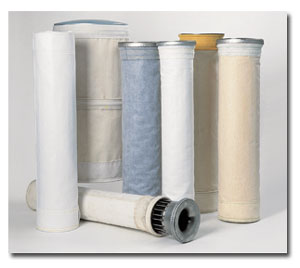
gefilters
An assortment of nonwoven baghouse filters used on GE air filter systems


Filtration Market Size


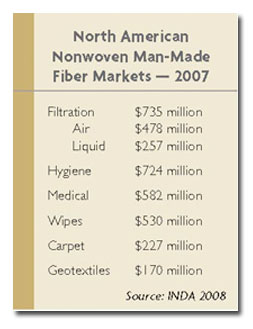
In terms of synthetic nonwoven fabric sales, filtration totaled $735 million in 2007,
according to the Association of the Nonwoven Fabrics Industry (INDA), which reported filtration as
the largest dollar end-use nonwovens market in North America. It is arguably the most profitable
segment. If one were to add in wetlaid cellulose filtration media, total nonwoven fabric filtration
media sales approach $1 billion for North America and $2.1 billion to $2.3 billion worldwide. The
only other filtration media of comparable volume are membranes, with $2 billion to $2.2 billion
worldwide roll good sales in 2007. Together, nonwoven fabric and membrane filtration media dominate
the filtration media market, with more than 90-percent combined market share in terms of roll goods
filtration media volume in comparison to all other material forms. Nonwovens and membranes never
compete with each other in a specific application, as each has its specific advantages, and they
often are combined to complement each other. Typically, nonwoven fabrics add backup support and/or
mechanical strength to comparatively weak membrane media, allowing membranes to function at peak
performance. 

Nonwoven fabric filtration media have dominated in applications such as coolant filtration,
baghouse filtration media, vacuum cleaner bags and many heating, ventilating and air conditioning
(HVAC) applications. In these and other applications, nonwovens are highly price-competitive. Yet,
a number of other end-use segments generate impressive profits, especially in liquid applications
when combined with membranes. 

Air applications consume approximately 65 to 70 percent of the nonwoven filtration media,
with liquid uses consuming the remaining 30 to 35 percent. Liquid application end-uses tend to
generate higher margins for the nonwovens producer because of the specialized constructions and
performance requirements, particularly in the medical, pharmaceutical and microelectronics
industries. In addition, there are rapidly expanding global needs for pure and potable water.
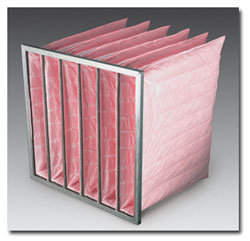
pocketfilter
This pocket air filter from Filtration Group is made of meltblown fabric.


Trends And Drivers 


Several factors are driving nonwoven fabric filtration media growth, but two megatrends
dominate. First, manufacturers worldwide are filtering with greater frequency at finer micron
levels to achieve higher product quality. Examples include chemical processing, “produced water,”
mining, food and beverage, including high-purity processes such as pharmaceutical and
semiconductor. Second, environmental thinking worldwide is expanding at an increasing rate in
virtually every segment of our economy. Federal, state and local regulators are enacting laws and
regulations specifically targeted at discharges and waste streams at an accelerating rate. Most
industry followers believe the new administration in Washington will support further initiatives
and regulations, with the filtration industry being a major beneficiary.


Where Nonwoven Fabrics Dominate


To understand nonwovens growth in filtration, one must understand the close relationship with
membrane filtration media. In many liquid applications, microporous and reverse osmosis membranes
are experiencing rapid growth. Most membrane applications are growing by 8 to 10 percent annually.
Those dealing with water and wastewater are growing up to 15 percent per year and more.  In
light of requirements for finer levels of filtration in many market segments, a number of industry
experts believe this or even higher levels of growth will be sustainable for many years. The major
beneficiary of membrane growth and market penetration continues to be nonwovens used in combination
with membranes in various configurations. For example, nonwoven wetlaid polyester substrates
support reverse osmosis membranes in spiral wrap modules in a $30 million worldwide nonwovens
market. The modules are found in systems predominantly located in arid regions where seawater is
converted to potable water. Spunbond fabrics are used as pleat supports and separators in virtually
every microporous membrane cartridge sold, accounting for nonwoven sales of approximately $35
million per year. 

Nonwoven meltblown and spunbond fabric along with nonwoven glass filtration media are the
principal air filtration media for HVAC – an 825 million- to 850 million-square-meter nonwoven
market in North America. High-efficiency particulate air (HEPA) wetlaid glass nonwoven filtration
media represent an additional 90 million to 100 million square meters. Air filters are found in
end-use markets from general dust filtration to high-efficiency filtration in many different
configurations. These filters are rated by a Minimum Efficiency Reporting Value (MERV) standard,
which rates filters from 1 to 20 in terms of their degree of efficiency. At the high end, MERV 17-
to 20-rated HEPA filters are typically used in situations that require absolute cleanliness for the
manufacture of microchips, liquid crystal display screens, pharmaceutical production and
microsurgery in hospital operating rooms. HEPA filters are primarily constructed from wetlaid glass
nonwoven filtration media, with a smaller portion of the market serviced by polytetrafluoroethylene
(PTFE) membranes laminated to a polyester base substrate for support. MERV 1-16, considered
HVAC-grade filters, are principally constructed of synthetic meltblown, spunbond or glass fabrics.
Overall, 75 percent of synthetic nonwoven media go into commercial markets, such as manufacturing
facilities, offices, theaters, hospitals, cruise ships, casinos and other such markets; with about
25 percent found in residential and general consumer air filters.

Nonwoven fabrics are also used as stand-alone filtration media in pleated cartridges. One
noteworthy example is cartridges, principally spunbond media, in the $30 million pool and spa
market. Other recognized cartridge applications include pleated cellulosic automotive engine
air-intake filters and oil filters on the family car, large semi-rigs and off-road vehicles; as
well as the smallest fuel filters on home lawnmowers, chain saws, power washers and other small
engines. Cellulosic media are relatively inexpensive, and are self-supporting when pleated, a key
factor along with the compatibility of construction materials with fluids and temperatures found
under the hood. 

Wetlaid cellulosic and spunbond polyester media that range from 200 to 300 grams per square
meter (g/m
2) are used in pleated dust collection cartridges. In North America, dust collection
media represents a 15 million-square-meter market that is growing at 5 percent per year, according
to INDA. Pleated cellulose- or polyester-based filters offer significantly greater surface area
than needlefelt filter bags for a given space as an alternative filter configuration in baghouse
applications. Typically, dust collection cartridges and baghouse filters are found in manufacturing
environments and facilities that process materials that generate large quantities of fine, airborne
particles or dust. The filters are used to reduce particulate exhaust and prevent spontaneous
explosion when large quantities of fine particles accumulate in factory air. 

Although pleated dust collection cartridges are an alternative to needlefelt baghouse
filters, needlefelt filter bags remain the clear industry leader in terms of dollars. Needlefelt
sales approach $120 million in North America and $530 million worldwide, with China being by far
the major driver of growth in recent years. Approximately 10 percent of the baghouse needlefelt
fabrics are laminated with a PTFE membrane providing for finer filtration and/or longer bag life.
Separately, the value of micron rated needlefelt fabrics constructed into liquid filter bags is
approximately $25 million to $30 million in North America and $65 million worldwide. For liquid
applications, nonwoven filter bags are used as final filters and in some cases as prefilters,
prolonging the life of final filters in heavily contaminated streams.
pleats
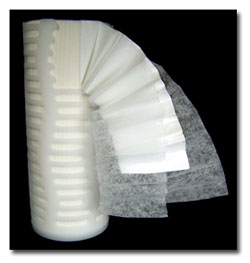
Pictured above is a cutaway of an Entegris Intercept® HSM 20 nm pleated cartridge filter.


Nanofibers In Filtration


Pleated dust collection and engine air-intake filters have a lightweight cover of synthetic
nanofibers over a base substrate of a wetlaid cellulosic or polyester nonwoven in a growing number
of applications. The nanofibers are as fine as 200 to 300 nanometers (nm) in diameter, with the
amount of nanofiber add-on being quite thin in cross-section and typically weighing less than 1 g/m
2 to 2 g/m
2. The nanofibers are laid down over what will become the upstream side of the substrate
using an electrospinning process, and in one case, an ultrafine meltblown process. These nanofibers
create a labyrinth of fibers with pores finer than particles in the incoming air stream.
Particulate deposits and resides on the surface of the fine nanofiber web, allowing the user to
clean the filter by shaking off loose particles from the surface or by using an automated clean-air
back-pulse system. The market is growing rapidly and is becoming an important market sector. All
major suppliers of air filters to the automotive and dust collection market have either internal
manufacturing processes in place or access to nanofiber media from outside suppliers.

By last count, more than 30 companies worldwide have electrospinning manufacturing processes,
but only a few have decent commercial volume. Many have the objective of producing a
heavier-weight, 15- to 90-g/m
2 stand-alone nanofiber web, without the cellulose or polyester base substrate. The
primary goal is to create filtration media to fill the micron rating gap between the finest
meltblown media and microporous membranes. Some manufacturers seek to mimic microporous membrane
micron ratings with higher flow rates. With regard to manufacturing costs, the relatively low
production speed of electrospinning is ideally suited for lightweight covers over substrates in the
dust collection and engine air-intake filters, as these applications require only a few grams of
fiber to cover the base substrate. Thus, heavier-weight electrospun webs have remained a challenge
because of low process throughput and high production cost compared to alternative filtration media
choices. However, there has been some headway by air filtration media producers who seek to replace
glass media in MERV 17-20 HEPA applications. Nanofiber nonwoven filtration media for applications
in the MERV 10-16 range and potentially for liquid applications clearly remains the largest
untapped potential. Should a lower-cost and/or alternative manufacturing process to electrospinning
be developed that can produce 15- to  60-g/m
2 nanofiber filtration media in the $3- to $5-per pound range, enormous opportunities
exist for the first successful producer.
p34


Conclusion


Nonwoven fabric contributions have been an important mainstay for the success of the
filtration industry for many years, and the future is very bright. As the industry grows, new
constructions will be the order of the day, as there are many unmet media end-use needs and growth
opportunities for an innovative nonwovens producer. The filtration market has a large number of
application niches in which customers are willing to pay for performance. Thus, the most profitable
nonwoven fabric producers offer proprietary materials in less than commodity run size for niche or
near-niche applications. Some of today’s mainstays are gradually fading as new nonwoven fabrics
come to market as differentiated constructions for customers seeking solutions to unmet industry
needs.


Editor’s Note: Edward C. Gregor is managing director of Edward C. Gregor & Associates LLC,
a Charlotte-based consultancy that brings new technologies to market and provides merger and
acquisition services in the fiber, technical textile, nonwoven fabric and filtration industries.

March/April 2009

Clemson, Milliken, Michelin Team For Lunar Wheel Project

Researchers at Clemson University, Clemson, S.C., and Milliken & Company, Spartanburg, are
working with Michelin North America Inc., Greenville, to improve tire tread materials that may be
used on National Aeronautics and Space Administration (NASA) Moon rovers.

Michelin is testing its new non-pneumatic Lunar Wheel, based on its Tweel non-pneumatic tire
technology, on the next generation of All-Terrain Hex-Legged Extra-Terrestrial Explorer (ATHLETE)
Moon rovers as part of a NASA Lunar Analogs testing and evaluation project. The ATHLETE rover is
able to navigate undulating as well as extremely rough or steep terrain such as is found on the
Moon’s surface; therefore, the tread and wheels must be tough yet flexible. The materials also must
endure extreme temperatures and be resistant to ultraviolet and cosmic radiation.

Clemson researchers are in the process of identifying the best tread materials. Fabric
possibilities include nonwoven felts, flat weaves, and cut- and loop-pile fabrics. Possible fibers
include polyaramids, polytetrafluoroethylenes, polyamides, polyimides and polyethylene
terephthalates. Researchers also are designing test equipment and developing computational models
to create tire-sand traction systems that eventually could result in improved tread material.

March/April 2009

Sponsors