ITM 2009: Positive Feedback


I
TM 2009, the International Textile Machinery Exhibition, took place in Istanbul, Turkey,
in June. Despite the world financial crisis, most globally focused exhibitors reported better
feedback than expected, with even some sales and new projects. Show organizers Tüyap Tüm Fuarcilik
Yapim A.S. and Teknik Fuarcilik, Yay. Tic. Ltd. Sti., and supporting partners the Turkish Textile
Machinery and Accessories Association and Turkish Textile Employers’ Association reported nearly
1,000 exhibitors from 26 countries and 31,000 visitors from 59 countries attended this year’s ITM.

In recent years, textile machinery and related equipment sales dropped remarkably in Turkey,
but exports of Turkish textile machinery grew by 31 percent to $312 million last year, thanks to
increased investments in Syria, Egypt, Bangladesh and Uzbekistan; and also to good pricing
policies. The sector is optimistic European purchasers will return to Turkey and expects a revival
in the domestic market despite a projected 10-percent drop in exports in 2009.

itmgroup
Playing up the slogan “Textile Exhibitions in a Textile Manufacturing Country,” ITM 2009
officials cut the ribbon to signal the exhibition’s opening in Istanbul, Turkey.


Quality Visitors

Most exhibitors were positively surprised regarding ITM. Rudolf Meier, Switzerland-based
Rieter Textile Systems’ head of sales, Europe/Africa, reported some interesting visits. But he also
said it was strange to be at a show without any machines, adding it should be mandatory for an
exhibitor to present machinery.

Osman Balkan, owner of Balkan Textile Machinery, Turkey, was pleased with visitor feedback,
as was Fred Maletschek, division manager, Karl Mayer Textilmaschinenfabrik GmbH, Germany. But Iris
Biermann, head of markets and products strategy, Oerlikon Textile Components, Germany, was not
happy, with one exception: Oerlikon Textile presented a new store concept to push spare parts
sales.

Harold Hoke, executive vice president, Uster Technologies Ltd., Switzerland, said some
visitors are discussing new projects. Customers want to keep or even improve product quality, both
to get new customers and to keep existing ones. Some 80 percent of ITM visitors came from Turkey,
but there also were a lot from Iran, Syria and Egypt. Visitor quality was judged as good. Erwin
Devloo, marketing communications manager, Picanol NV, Belgium, said Picanol representatives talked
mostly to decision-makers.


Important Turkish Market

Turkey is a very important market for textile machinery manufacturers. Meier said it is
Rieter’s most important market and will remain stable. Devloo believes if the global economy picks
up, Turkey again will be a dominant textile products supplier.

Mehmet Saracoglu, managing director, Sarteks Tekstil, Turkey, said Uzbekistan, Turkmenistan
and neighboring countries are also important. Syria, Iran, Iraq and India are important for
everybody; and Syria and Iran are very important for local producers.

All over Turkey, there are discussions about projects that were postponed because of the
recession. In spinning, Turkey is doing quite well, with compact spinning at full strength, and
rotor at 60 to 70 percent. But, Meier said, many countries are upgrading their production levels,
so Turkey must move fast to offer added-value products. In the next 10 years, Saracoglu said,
technical textiles and nonwovens will play a very important role in Turkey. Only top-quality, niche
products “Made in Turkey” will survive. Biermann also sees slow but steady positive trends.

September/October 2009

ITMF: Serving The Global Textile Industry


F
or more than 100 years, the Zürich, Switzerland-based International Textile Manufacturers
Federation (ITMF) has served the entire textile industry around the world. ITMF organizes an annual
conference and publishes much-appreciated statistics on shipments and stocks from the entire
textile production chain. The conference is considered to be the most important gathering of the
global textile industry. In an exclusive interview with

Textile World
, ITMF Director General Dr. Christian P. Schindler explained ITMF’s activities and the
reasons Shanghai was chosen as the host city for this year’s conference.

ITMF – one of the oldest non-governmental organizations and probably the most important and
highest-ranking textile association around the world – was founded in 1904 at a meeting convened in
Zürich at the initiative of the British cotton spinning industry. Initially, it established its
headquarters in Manchester, England, and for many years, ITMF represented and promoted the
interests of the cotton spinning and manufacturing industries around the world. The rapid
development of man-made fibers broadened the range of membership. At the same time, vertical
integration in textile enterprises changed the structure of the industry, and the federation
enlarged its scope and became a multi-fiber and multi-process industry association.
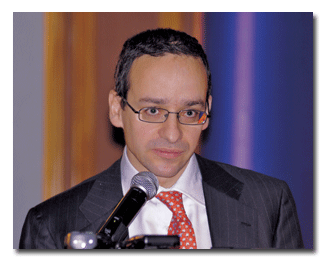
schindler
Dr. Christian P. Schindler started his work with ITMF as an economist and was elected
director general effective Jan. 1, 2007.


Move To Switzerland

ITMF was directed for many years by Dr. Herwig Strolz, who appointed Schindler as ITMF’s
economist on Oct. 1, 2004. Schindler was promoted to the position of director in 2006, and at the
federation’s annual conference in Dubai in September 2006, he was elected director general
effective Jan. 1, 2007.


TW
: Dr. Schindler, in 1963, the federation’s headquarters were moved from Manchester, England,
to Zürich, Switzerland. Why was that done?

Schindler: Well, this was for the purpose of facilitating international contacts
and improving administrative services and communications. On top of that, Switzerland was and is a
neutral country and therefore an ideal place for an international association.

Since 1960, ITMF’s membership has expanded significantly and today embraces most of the
world’s textile production. The location of global textile industry capacities has undergone
far-reaching changes, and the readjustment process has also affected the structure of industry
trade associations. The former fragmentation of those organizations has shifted gradually as their
framework of representation has become more concentrated and integrated.

In 1978, the federation changed its name to International Textile Manufacturers Federation.
With its current structure and scope, ITMF is eligible to represent the broadest possible range of
the world’s textile industries, and it does.


Membership

Like every association, the body of ITMF is composed of its members – associations and other
constituted organizations of textile manufacturers. There can be only one member association from
each country. The members have access to all annual statistics as well as other important data and
committee papers. It is also possible to become an associate member. These are associations and
other constituted organizations of textile manufacturers in countries in which there is already a
member association, as well as associations allied to the textile industry.

In recent years, corporate memberships have been made available to manufacturers of textiles
or of products allied to the textile industry, such as textile machinery.


TW
: Is it easy to become a corporate member of ITMF? What are the costs of the membership?

Schindler: The main purpose of offering corporate membership is to offer companies
that are not represented already by a national textile association access to our international
platform. It is a fairly easy procedure to become a corporate member. An interested company applies
in writing for corporate membership. Afterwards, the existing membership is informed and asked to
approve the application. The cost for corporate membership is between 5,000 and 10,000 Swiss
francs, depending on the turnover.


Main Objectives


TW:
What are the main objectives of ITMF?

Schindler: First of all, we provide a neutral forum and platform for discussions
of matters appropriately within the common interest and concern of textile companies. The ITMF
conferences offer an ideal forum to discuss and exchange views and opinions in a relaxed atmosphere
outside the day-to-day business. Furthermore, we act as a central agency of the textile industries
for the collection of information, statistical and otherwise, on textile manufacturing developments
in all countries of the world. Another important point is the role as a voice for the world textile
industry in issues relating to raw materials. Different committees serve as a forum for the
industry and its partners as a platform like the Spinners Committee, the Joint Cotton Committee and
others. The federation also acts as a kind of liaison agent among the textile industries and
governments and intergovernmental organizations interested in the textile industry.

p31


Meeting Point

ITMF is without any doubt the most important global meeting point for networking. The
highlight of ITMF is the annual conference, held in different locations around the world. The
conference provides an opportunity for the most important top-ranking people to meet – to attend an
excellent conference, but also to exchange and strengthen contacts with the leaders of the global
textile machinery and textile industries and, last but not least, with governmental officials.

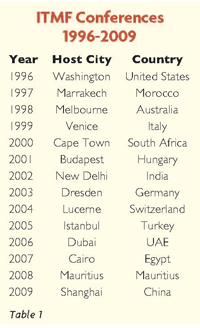
These high-level gatherings are probably even more important than the statistics. Venues
from 1996 to the present are shown in Table 1.


TW
: How do you organize the annual conference, and who is responsible for the program?

Schindler: As you know, the conference moves around the world every year. Members
of the federation are usually hosting the conference and are therefore assisting in organizing the
event. It really is a joint effort. The special feature of an ITMF Annual Conference is its truly
international character with regard to speakers and attendees combined with the possibility for the
national host association to direct broad attention to its textile industry.
itmfgroup
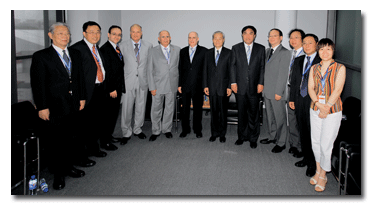
On April 17, 2008, the China National Textile and Apparel Council (CNTAC) officially joined
ITMF as a new member association in an official ceremony at ITMA Asia + CINTE 2008. Former ITMF
president Walter Simeoni (sixth from left) and CNTAC President Du Yuzhou (seventh from left) were
at the center of attention.


China, 2009 ITMF

Annual Conference Host Country

On April 17, 2008, the China National Textile and Apparel Council (CNTAC) officially joined
ITMF as a member association. This membership is considered to be very important for both
organizations. CNTAC represents the largest textile-producing, -consuming and -exporting country in
the world and strengthens ITMF’s international representation. On the other hand, ITMF offers an
ideal international platform for the Chinese textile industry.


TW
: This year’s conference is something special for ITMF. For the first time in its long
history, the ITMF Annual Conference takes place in Shanghai, Oct. 23-25, 2009. What does it mean
for ITMF to hold its annual conference in China?

Schindler: It is indeed special to hold this year’s ITMF Annual Conference in
Shanghai, one of the most booming cities in the world, with a huge textile cluster in and around
the city. As the world’s biggest producer of textiles with the largest domestic market and one of
the fastest-growing economies in the world, China is and will be of great importance as a
production site and increasingly also as an export market. The conference is therefore an ideal
opportunity for everybody who is interested to learn more about China and its future role in the
global textile arena.


Committees


TW
: How do you cover the different areas within ITMF?

Schindler: We offer these groups different committees in which they can meet and
work. All member associations and associate and corporate members are entitled to be represented,
as appropriate, on these sub-committees and to take an active part in their work.

The Spinners Committee’s main objectives are to support the development of quality cotton
fiber based on modern spinning requirements; to provide advice relating to the harvesting, handling
and ginning of cotton; and to promote the mechanical testing of raw cotton.

The Joint Cotton Committee is composed of delegates who represent sellers and buyers of raw
cotton. It is concerned with any matters pertaining to raw cotton production and marketing,
including international cotton marketing policies.

ITMF deals with governments, international organizations and trade associations interested
in raw cotton production, trading and marketing through the Joint Cotton and the Spinners
Committee.

The task of the Statistical Committee is to supervise, improve and extend ITMF’s statistical
services; and to keep member associations and associate members informed of relevant statistics
that are compiled by other international organizations.

The International Committee on Cotton Testing Methods is mainly concerned with matters
related to cotton fiber testing and standardization. The Man-Made Fibres Committee deals with
specific matters in the production, distribution and processing of man-made fibers on an ad-hoc
basis.


The Future Of ITMF


TW
: The ITMF statistics are very much appreciated among the members and recipients for their
high value. Are you pleased with the content, or is there a way to further enhance the results?

Schindler: Well, among our various publications, ITMF’s International Textile
Machinery Shipment Statistics is certainly the most renowned. It is unique in the world and serves
the entire industry as basic information on ongoing structural changes in the scale and scope of
textile production capacities around the world. To readers of these statistics, it wasn’t a
surprise that the investment boom in new textile machinery during the past six years was not
sustainable. The statistics have been collected for 30 years, and its coverage was expanded
constantly. We now cover the different segments of spinning, texturing, weaving, and circular and
flat knitting as well as finishing machinery. In the future, we also intend to include the segment
of printing machinery. The world’s most important textile machinery manufacturers are participating
in this statistics already, but we are, of course, always welcoming any new participants. In
general, the compilation of statistical information on textile production has become more difficult
these days due to a lack of official data being available in many countries.


TW
: Are you happy so far with how ITMF is presenting itself today?

Schindler: The global textile industry has been undergoing tremendous structural
changes in the past 10 to 15 years and is now affected by the most severe global economic crisis
the industry has seen since the Great Depression in the last century. These structural changes ask
for continuous adaptations of the federation’s activities and services. Despite the current crisis,
we will continue to work hard on offering enhanced and new services.


TW
: And what are the next targets of the federation?

Schindler: Our target is always to provide our members an attractive international
and neutral platform where they can meet, learn and exchange their views. The value of our
conference lies in the opportunity to get a feeling for the international development and changes
as well as an outlook of the global textile industry, and to build an international network with
partners from the entire textile value chain including scientists and other experts from the
industry. Additionally, we are always trying to improve our existing publications and to develop
new ones.TW: We wish you all the best to achieve your targets.


Dr. Christian P. Schindler,

ITMF Director General


German-born ITMF Director General Dr. Christian P. Schindler studied economics at the
University of Fribourg, Switzerland, graduating in 1994. Between 1995 and 1998, he served as
personal assistant to two members of Parliament in Germany’s Bundestag. In 1998, he joined the
Federation of German Wholesale and Foreign Trade as personal assistant and speechwriter for the
association’s president. Between 2001 and 2004, he studied at the Institute for Economic Policy at
the University of Cologne, Germany, where he wrote his dissertation and earned a doctorate in 2004.

September/October 2009

China Hosts ITMF In Shanghai


T
he 2009 Annual Conference of the International Textile Manufacturers Federation (ITMF)
will take place October 23-25 in China. ITMF and host member China National Textile & Apparel
Council (CNTAC) are expecting top-level delegates from all over the world to meet in the booming
city of Shanghai.

The general theme of the conference, “Structural Adjustments in the World Textile Industry,”
reflects the current state of the world textile industry, which faces various challenges – namely,
structural technological adjustments, short supply of resources, increasing obligations related to
environmental concerns, and global financial and economic challenges. The industry sees continuous
opportunities to upgrade its technology for reasons of both efficiency and ecology. In the past few
years, economic globalization and the instable world economic situation have sped up the need to
make structural adjustments with regard to technologies, products, fibers, energy and
interdependent relations among all countries and regions throughout the value chain. All textile
nations and regions are charged with confronting a variety of important issues concerning economic
developments, interdependent relations and mutually beneficial cooperation.

The 2009 ITMF Annual Conference will provide opportunities for in-depth presentations and
discussions on all these aspects of the general theme, with the goal of promoting mutual
understanding, enhancing cooperation and creating new prosperity for the world textile industry.

CNTAC is pleased and honored to host the conference, and believes convening in China will
help participants better understand the challenges the global textile industry is facing today and
in the future and thus develop strategies for successful adaptations.

pudong
The skyline of Shanghai’s Pudong New Area is dominated by the 1,535-foot-high Oriental
Pearl TV tower.


Textiles: China’s

Most Important Industry Sector

The textile industry, serving as a pillar industry in China, plays a significant role in
providing employment, meeting huge domestic demand, and promoting trade and economic cooperation.
In the three decades since China opened up and reform policies were introduced, its textile
industry has developed into a highly globalized, market-based industry, following a new roadmap
focused on upgrading its technology, providing good profits, and reducing resource consumption and
environmental pollution, as well as making full use of its human potential. The industry is working
to enhance the share of upgraded technology and brands in the industrial value chain, with the goal
of increasing quality, innovation, quick response and social responsibility. China endeavors to
carry out the opening up and reform measures and broaden international cooperation, aiming to
maintain a fast but healthy growth of its textile industry.


Ancient Culture

China is an ancient civilization with brilliant multi-ethnic cultures and traditions. To
date, 37 natural and cultural locations in China have been listed as World Heritage sites by the
United Nations Educational, Scientific and Cultural Organization. This cultural heritage possessed
by the country’s 56 ethnic groups attracts visitors from around the world. The phenomenal rise of
contemporary constructions, harmonious coexistence of old and new in the vibrant cities,
well-preserved ancient cities and towns, and prehistoric sites illustrate China’s modern prosperity
and historical origins.

For more information about the 2009 ITMF Annual Conference, including an online registration
form, visit
www.itmf.org.


September/October 2009

PGI Sells FabPro Unit To Tricor Pacific Capital

Polymer Group Inc. (PGI), Charlotte, has sold its Kingman, Kan.-based FabPro Oriented Polymers LLC
subsidiary to an affiliate of private equity firm Tricor Pacific Capital Inc., based in Chicago and
Vancouver, B.C., Canada, as part of PGI’s strategy to focus on its core nonowovens business in
hygiene, medical, wipes and industrial markets. 

FabPro, acquired by PGI in 1998 from Exxon Chemical Co., produces high-performance polymers
and man-made fibers for agricultural, construction and commercial applications. The sale will
include production sites in Kingman and Clearfield, Utah; and a converting facility in Guntown,
Miss.

“FabPro has top leadership positions in the agriculture and construction segments in North
America and recognized brand names,” said Brad Seaman, Tricor Pacific Capital. “We are eager to
assist the management team in executing their growth plans and see strong growth potential as
synthetic fibers increasingly replace steel and wire in many applications.”

September/October 2009

DuPont Forms Protection Technologies Business Unit

Wilmington, Del.-based DuPont has merged its Advanced Fiber Systems, Nonwovens and Personal
Protection businesses into DuPont Protection Technologies, based in Richmond, Va. Products and
technologies offered include Tyvek® and Sontara® nonwovens, Kevlar® and Nomex® advanced fibers, and
Tychem® protective apparel, among other offerings.

“We believe we will be able to quickly simplify internal processes, increase the speed of
decision-making, and more fully leverage our large investments in research and development across
market segments,” said Thomas G. Powell, vice president and general manager of the new business,
who formerly led Advanced Fiber Systems. “These changes will lead to more rapid innovation and
improve our responsiveness to customers.”Production and research facilities of the three businesses
will continue to operate as before. “These businesses … represent applications and technologies
that DuPont is counting on for future growth. We are committed to continuing to invest in capacity
and innovation to meet the current and future needs of our customers,” Powell said.

September/October 2009

Short, Quick Runs Dominate Production


A
s the close of the third quarter draws near, spinners are beginning to ask themselves one
oh-so-important question: Where are the holiday orders?

“Normally, we would have seen at least some begin to trickle in by now,” said one Georgia
specialty spinner. “But I expect it will be just like everything else this year – at the last
minute, with very tight turnaround and delivery. Retailers still seem to be waiting until they just
can’t wait any longer to place orders.”

Another spinner agreed: “In a typical year, we would already have some idea of what to
expect. This year, who knows? We’ll get what we get when we get it. Hopefully, it will be enough to
keep us going.

“It’s the same story most of the industry has been telling for the past six months. Orders
are good for ring spinning, just short. “We’re running flat out,” one spinner noted, “but our
pipeline is four to six weeks. It makes planning difficult. Two months from now, we may still be
running flat out, or we may be idle. Fifteen years ago, I might have been running with a year’s
worth of orders in the pipeline. This time last year, the backlog could be measured at least a
quarter out. Now we are down to just a few weeks, four or five at the most. The good thing is that
these short orders keep coming in.”

Another spinner said he also is running a full schedule, but with lots of small orders.
“There are some days when we think things are going to turn around and we get a number of orders,
and other days when the phone doesn’t ring at all. There is just no long-term business out there
right now. In normal times, 10,000 to 20,000 cases would be a good-sized order for us. Today, it’s
more like 5,000.”

As is often the case, shorter orders are accompanied by very tight delivery schedules. “Our
customers don’t want much, and what they do want, they want yesterday,” said one spinner. “We
consider ourselves to be very good at customer service and quick turnaround, but we’ve had to turn
down some orders based on what the customer wanted and when. It was high-volume work, but we just
couldn’t get it done quickly enough. It’s painful in today’s climate to turn down business.”

Additionally, he said, small orders, combined with quick turns and fierce competition, have
placed a burden on margins. “We had to cut some prices earlier in the year to get the business, and
we haven’t been able to get those prices back up. That’s the standard today: customers want it
cheap, and they want it quick.”


Payment Cycle Issues

Placing additional burden on already razor-thin margins is the tendency of many customers to
use a delayed payment cycle. “To me, it seems that many companies in Central America pay late,
often 120 days or more out. We are carrying a lot of receivables, which creates a potentially
difficult situation for us. Their problem is that they are waiting on the retailers to pay, and
they have been slow as well. It’s just a Catch 22.”

Hope for improvement before the end of 2009 is waning, driven by continued reluctance of many
consumers to resume their pre-recession spending habits. “Right now, we hope to see some movement
in the first quarter of 2010. From what I hear, that’s where everyone is looking for some possible
relief,”said one spinner.


Business Investment Remains Crucial

In times of economic difficulty, a competitive advantage becomes more important than ever.
That’s why several spinners say they continue to invest in new equipment, even when orders are not
materializing in the desired quantity and quality.

“It is tremendously important to take advantage of the productivity and quality improvements
of newer machinery,” said one North Carolina spinner. “We’re currently doing that at [one of our
plants]. We’re taking older equipment out and replacing it with spinning frames that provide better
quality and speed. And we’re overhauling older stuff, such as roving frames, where you can’t really
buy productivity gains with newer equipment. We continue to reinvest money we’ve earned back into
equipment because that’s the only way we are going to survive. We have got to have the absolute
best quality available. The demands put on yarns today are immeasurable compared to what they were
just a few years ago.”

Even many smaller companies are following suit. “We can’t do it on a large scale, but we are
constantly updating our equipment here and there. Our situation dictates that we pay for what we
get out of earnings, not financing. But we can’t afford to be without the latest improvements in
quality and productivity.”


September/October 2009

An Improved Cost-Price Picture


E
ncouraging cost and price trends continue to blunt the impact of this year’s
recession-driven drop-off in mill activity. Costs are still pretty much under control, and prices
for the most part remain fairly firm.

Looking at raw material costs, tabs for man-made fibers are now lagging year-earlier levels
by about 5.5 percent. And the news is even more encouraging for cotton, where latest spot prices
are off by 13 percent. And this fiber weakness is likely to persist – especially in man-mades,
where tags will be pressured by both continuing relatively low feedstock costs and more-than-ample
global capacity. And in cotton, any increases should be held in check by expectations of another
good crop year, a substantial inventory overhang, and less-than-sensational global demand.

The picture is pretty much the same for labor. Specifically, average mill pay has remained
virtually unchanged over the past 12 months. Add in the fact that productivity continues to inch
ahead, and it suggests unit labor costs may even have inched lower.

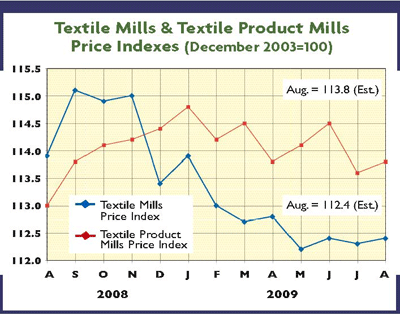
Meantime, prices haven’t fared all that badly either. Indeed, greige goods, finished mill
products and industrial textiles have increased 2 percent, 1 percent and 2.5 percent, respectively,
over the past year, thus helping avoid any cost-price squeeze. All this is why mill profits – while
still falling because of lower demand – are managing to remain in positive territory.

bftable


More Thoughts On Demand

A few words on the demand outlook may also be in order. To be sure, 2009 numbers continue to
paint a dismal picture – with this year’s expected production total likely to tumble some 15
percent. And compared to just four years ago, the drop should be an even more precipitous 35
percent. On the other hand, all these negative numbers have to be put in proper perspective. As
pointed out previously, this huge drop-off seems to be coming to an end. Thus, production activity
has been bottoming out, with little or no appreciable change noted for some four straight months.

The Institute for Supply Management (ISM), which monitors change at the grass-roots
manufacturing level, also seems to back up the changing industry climate. Specifically, four of its
textile indicators – production, order backlogs, inventories, and export orders – have turned
positive over the latest reported month. One top mill executive seems to confirm all this, noting
his firm now sees the first signs of improving activity – though he adds that much of this may
reflect customer rebuilding of inventories. Upshot: The worst seems to be over, and what happens
over the next few quarters will depend on both how fast the economy recovers and how effective the
United States is in keeping textile and apparel imports under control.


Near-Term Question Marks

As far as the overall economic trend is concerned, the news is basically a little better than
it was only a few months ago. Indeed, the bottoming out in gross domestic product – first noted in
the second quarter when this key indicator fell only about 1 percent – is expected to continue.
Most business analysts now predict some growth through the remainder of the year – a marked change
from the decline of the previous five quarters. On the other hand, any gains that do occur are
expected to be relatively modest, probably something in the order of 1 to 2 percent. Implication:
only a limited positive impact on textile and apparel activity.

Meantime, it’s also doubtful whether there will be any help from imports. For one, China
shows few signs of making any further upward revisions in its currency, the yuan, and also seems
determined to provide its producers with additional tax and other incentives. Moreover, other
foreign suppliers seem equally determined to push their exports to the United States as they strive
to recover from their own business downturns. Still another big  import problem is continuing
lax US enforcement of trade rules, as texile fraud – most notably in the form of country-of-origin
mislabeling – soars to new heights. The inescapable conclusion: Given all of the above, textile and
apparel imports are likely to remain a king-sized headache – not only for the remainder of the year
but also for the foreseeable future.

Trützschler Restructures Into Three Units

Trützschler GmbH & Co. KG, Germany, has reorganized into three groups -Trützschler Spinning,
Trützschler Nonwovens and Trützschler Card Clothing – to better serve its customers. Its management
team consists of Managing Partners Heinrich Trützschler and Dr. Michael Schürenkrämer, and Managing
Directors Dr. Dirk Burger, CEO, and Andreas Ebenhöh.

Trützschler Spinning, based in Mönchengladbach, Germany, includes an operation at American
Truetzschler Inc., Charlotte; Trumac, India; Truinco, Brazil; and TTMS, China. The division offers
fiber preparation equipment including blow room and carding machinery, draw frames, and combing
machinery.

Trützschler Nonwovens, led by Marc Wolpers, comprises Fleissner GmbH, Egelsbach, Germany,
led by Managing Directors Hans-Georg Buckel and Dr. Dieter Zenker; and Erko Trützschler GmbH,
Dülmen, Germany, led by Managing Director Erwin Kock and Director Stefan Flöth; and an operation at
American Truetzschler. The division offers complete systems and solutions for nonwovens production;
and a product range including staple fiber preparation and web formation machinery, crosslappers
and web drafters, and polyester staple fiber production machinery and equipment.

Trützschler Card Clothing, Neubulach, Germany, also uses plants in Brazil and India. The
division manufactures a complete range of card and roller card clothings; as well as metallic wires
for openers or opening rollers for open-end spinning machinery.


September/October 2009

OC Oerlikon Names Ziegler Acting CEO

The Board of Directors of OC Oerlikon Corp. AG, Switzerland, has named Hans Ziegler a delegate of
the Board of Directors and acting CEO, effective immediately. Ziegler, a corporate restructuring
and turnaround management  specialist who has served on the Board since 2008, replaces
previous CEO Dr. Uwe Krüger, who is leaving the company.

“Our decision was made in light of OC Oerlikon’s semiannual results,” said Vladimir
Kuznetsov, chairman of the Board of Directors. “OC Oerlikon’s sales fell by 40 percent and order
intake by 39 percent in the first half [H1] of 2009 compared to H1 2008 amid an economic downturn
of unprecedented proportions. The company urgently needs to secure coordination of strategic
portfolio decisions with operational measures of OC Oerlikon’s businesses. The announced management
change ensures the alignment of the company’s strategy with the interests of all stakeholders.”

The company has identified more than 700 initiatives to cut operating costs, including site
consolidations, temporary plant closures, reductions in workforce and work hours, vacation
extensions, hiring and pay freezes, product line discontinuations, supplier contract
renegotiations, and other measures. In H1 2009, the company eliminated almost 1,500 jobs across all
businesses, and it plans a further reduction of 2,500 positions in the second half of the year.

OC Oerlikon’s textile business, Germany-based Oerlikon Textile GmbH, reported H1 2009 orders
47 percent below H1 2008 levels, with sales 55 percent lower than year-earlier sales. Restructuring
initiatives undertaken thus farto improve performance include consolidation of three manufacturing
sites, elimination of 700 jobs worldwide and reduction of work hours for some 2,000 employees. Its
performance has shown some improvement, with higher incoming orders than sales in the second
quarter of this year, and the company reports what appears to be a “sustainable upward trend” in
the man-made fibers market. Improvement in sales is expected in the second half of the year.

Overall, OC Oerlikon spent 100 million Swiss francs in research and development in H1 2009,
and it anticipates sustained improvements in performance and a return to profitability in 2010.

September/October 2009

Invista Licenses BDO, PTMEG Technologies To Jian-Feng, Increases Stake In Ashburn Hill

Wichita, Kan.-based Invista, a global integrated fibers and polymers manufacturer, has signed an
agreement to license its 1,4 butanediol (BDO) and polytetramethylene ether glycol (PTMEG)
technologies to China-based Chongqing Jian-Feng Industrial Group Co. Ltd. Jian-Feng is investing 2
billion renminbi (approximately US$300 million) to build a manufacturing complex that will produce
BDO and PTMEG at Chongqing Chemical Industry Park in the Fuling district of the Chongqing
Municipality.

“We are proud to support Chongqing’s continuing technological and industrial development
through our licensing of BDO and PTMEG technologies,” said Jeff Gentry, CEO and chairman of the
Board of Directors, Invista. “Our technology licensing organization, Invista Performance
Technologies, has over 40 years of technology transfer experience and has participated in over 40
projects in China. We are pleased to provide Jian-Feng with the design and know-how for its
manufacturing operation in Chongqing.”

The agreement includes the manufacturing processes, required technologies, product
formulations and the expert engineering services for the complex’s two plants, which are expected
to produce 60,000 tons of BDO and 46,000 tons of PTMEG annually. BDO is used to make polyester
resins and polyurethanes. PTMEG is a polyether glycol used as a building block in high-performance
polyurethanes, polyesters, copolymers and other polymers, with end-uses including spandex fibers,
thermal plastic elastomers and cast elastomers for apparel, automotive and industrial
applications. 

In other company news, Invista’s Performance Surfaces and Materials division has announced it
will enlarge its investment in Ashburn Hill Corp., a Greenville-based manufacturer of
fire-retardant (FR) apparel for industrial and firefighting applications. Invista announced last
year that it would collaborate with Ashburn Hill to create a new generation of industrial FR
apparel
(See ”
Invista
Partners With Ashburn Hill To Expand Product Offerings
,” Dec. 2, 2008)
.

“Invista is delighted to be able to invest additional funds in order to support Ashburn Hill
in realizing its potential,” said Jeff Brown, vice president, Invista Performance Materials. “We
anticipate that the revolutionary protective apparel developed with Ashburn Hill Corp.’s Tecgen®
fiber will offer significant improvements in comfort and protection to workers requiring protection
to NFPA 2112 and 70E standards.”

September 8, 2009

Sponsors