Senate Bill Calls For Major Changes In Trade Policy

Five Democratic senators and one Independent are supporting legislation calling for sweeping
changes in US trade policy, similar to legislation that has been introduced in the House with 127
co-sponsors.

The Senate bill, entitled the Trade Reform, Accountability, Development and Employment
(TRADE) Act, mandates a review of existing trade agreements and provides for more Congressional
involvement in future trade agreements as they are being negotiated, and it establishes guidelines
to ensure that all agreements are effectively implemented.

Sen. Bernie Sanders of Vermont, the Independent sponsor of the bill, said: “As a result of
our disastrous trade policy, millions of decent jobs have been shipped overseas, turning American
jobs into our number one export. We need to do everything possible to reverse this trend and
develop a new trade policy that reduces our record-breaking trade deficit and increase American
jobs.”

Other sponsors of the bill are Sens., Sherrod Brown, D-Ohio, Bob Casey, D-Pa., Byron Dorgan,
D-N.D., Russ Feingold, D-Wis., and Jeff Merkley, D-Ore.

Like the House version of trade reform legislation, the Senate bill directs the US Government
Accountability Office to conduct a comprehensive review of existing trade agreements with an
emphasis on economic results, enforcement and compliance. It also spells out standards for labor
and environmental protection, safety standards and national security considerations. Another key
provision calls for the President to submit a negotiating plan to Congress prior to entering into
negotiations and provides for more congressional oversight with respect to implementation of
agreements.

December 15, 2009

Textile Manufacturers Seek Changes In Tariff Legislation

US textile manufacturers have urged Congress to eliminate some textile products from the list of
products slated for duty-free treatment under a miscellaneous tariff bill, claiming the products do
not qualify for such treatment. Both the House and Senate are expected to act before adjournment on
legislation granting duty-free treatment for a wide range of products, including textiles and
apparel, that are given special tariff treatment because they do not compete with US-made products.

Both the National Textile Association (NTA) and the National Council of Textile Manufacturers
have objected to nearly 30 product lines because they compete with products made here or are not
eligible for the special treatment under terms of free trade agreements. In addition, they have
suggested that duty-free treatment be given to an additional number of textile fiber products,
which they say that do not compete with domestic products. Those include such things as some rayon
and acrylic fibers, cashmere and camel hair. 

The NTA filing cites opposition to 24 proposed duty suspensions included in the miscellaneous
tariff bill. For example, NTA says some garments made in Costa Rica do not qualify for duty-free
treatment under the Central America-Dominican Republic Free Trade Agreement (CAFTA-DR) because they
are made of fabric from outside of the CAFTA-DR region, and the association points out there are
domestic manufacturers of the fabric. NTA says “CAFTA is very specific in that it requires garments
of this type to be constructed from fabrics that were formed either in the United States or one of
the other CAFTA countries.”

Other bills NTA objects to cover certain women’s sports bras and tank tops made with fabrics
its members make. Other objections are raised with respect to certain warp-knit fabrics and
nonwovens and a number of fire-retardant fabrics.

NTA says the miscellaneous tariff bill is intended to promote US manufacturing by providing
limited tariff relief to domestic manufacturers that use inputs that are not available from a
domestic source, and “not as a vehicle to swell the profit margins of importers and retailers of
finished goods to the discouragement of domestic manufacturing.”

More detailed descriptions of the products in question are available on the NTA daily blog:
http://nationaltextile.blogspot.com.

December 15, 2009

Bierrebi Puts 2009 In The History Books And Focuses On The Future

2009 was a very difficult year for the large majority of textile and apparel producers and as a
result, sales for their suppliers of production machinery likewise suffered. For Bierrebi, the well
known producer of automated die cutting equipment to the tubular knit industry, it was no
different. In addition to bad market conditions other forces acted in unison to create the perfect
storm for the Italian company which has been in business for 35 years in the Bologna region. All
major producers of T-shirts, underwear and fleece products depend heavily on their Bierrebi
machines to efficiently produce the enormous volumes required for their operations. It has been a
testimony to the value of Bierrebi technology and to the dedication of the employees, that the
company weathered the storm and has emerged with a youthful and dynamic new ownership. The new
company BRB Italia, SRL will remain privately held with its headquarters located in Pontecchio
Marconi Italy. The exclusive North American distributor of all Bierrebi technology, (machines,
parts, supplies and technical service), Bierrebi International will continue to operate in
Greenville, SC. The company will continue to service its traditional markets with an added emphasis
on finding new applications and applying new technology to the cutting process. 

Press Release Courtesy of BIERREBI INTERNATIONAL

December 11, 2009

Genencor Adds EcoLight 1 Enzyme To PrimaGreen® Portfolio

Genencor — a manufacturer of enzyme product solutions for a variety of industries, and a division
of Denmark-based Danisco A/S — has added esterase enzyme EcoLight 1 to its PrimaGreen® line of
enzymes suitable for textile processing. EcoLight 1 is a bleaching enzyme designed to produce a
vintage look.

Genencor reports the PrimaGreen portfolio of products — which consists of PrimaGreen Super
for stone-washed effects, PrimaGreen EcoFade LT100 for denim fading and PrimaGreen EcoLight 1 —
allows a textile manufacturer to save on water and energy costs when compared to using traditional
hypochlorite treatment baths. Specifically, using PrimaGreen EcoLight 1 in combination with
cellulase enzyme PrimaGreen Super, Genencor estimates a manufacturer can achieve a vintage denim
look while reducing water usage by more than 50 percent and energy usage by more than 40 percent.
Or, mixing PrimaGreen EcoFade LT100, a lactase enzyme, with PrimaGreen Super reduces water usage by
more than 60 percent and energy usage by more than 70 percent, according to Genecor’s estimates.
(See ”
Genencor
Develops Eco-Friendly Enzyme For Denim Bleaching And Shading
,” February 17, 2009)
The
company currently is performing a life cycle assessment to quantify the ecological impact of the
PrimaGreen products. Genecor also reports that by using the latter combination of enzymes, it also
is possible to change the cast and bleach sulfur-dyed denim.

“Today, textile manufacturers and consumers are looking for more environmentally friendly
fashions without sacrificing style or quality,” said Glenn Nedwin, executive vice president,
Technical Enzyme Business Unit, Genencor. “The PrimaGreen portfolio of products provides the tools
to create just that kind of apparel.”


December 15, 2009

Zagis USA Commissions Louisiana Cotton Spinning Mill

Lacassine, La.-based Zagis USA — a partnership between majority owner Grupo Zaga S.A. de C.V., a
Mexico-based conglomerate, and several North Carolina textile executives — has completed
construction of its 128,000-square-foot spinning mill in Lacassine and has begun production of
cotton sales yarn. The facility is the first of two mills in Louisiana in which Zagis will invest a
total of $75 million
(See ”
Zagis
USA To Build Cotton Processing Facilities In Louisiana
,” June 24, 2008)
. Combined, the two
mills will employ at least 160 workers by 2012, and the Louisiana Economic Development Department
(LED) estimates the mills also will generate an additional 645 indirect jobs.

“This investment by Zagis USA is huge news for Lacassine and all of Louisiana,” said
Louisiana Governor Bobby Jindal, who participated in the commissioning ceremony. “With this new
facility, we are keeping more of our homegrown cotton in our state and turning it into valuable
textile fibers to create good jobs for our people right here at home. Indeed, instead of Louisiana
exporting our raw goods so others can profit, we are now creating value added jobs here and helping
our farmers at the same time.”

According to Zagis, the facility, which is located in a 200-acre industrial park in
Jefferson Davis Parish in southwest Louisiana, is one of the most modern open-end spinning plants
globally, and yarn manufacturing costs will be among the lowest worldwide, partly because of the
mill’s access to the state’s cotton supply. Annual production capacity will total 50 million pounds
of cotton.

“LED estimates that when the new Zagis spinning mills are in full production they will
utilize up to 15 to 20 percent of Louisiana’s cotton crop to spin yarn,” Jindal said. Zagis has not
announced the location of the second mill.

December 15, 2009

Textile Machinery Offers Interesting Careers


T
he French Textile Machinery Manufacturers’ Association (UCMTF) once again brought
together the students from the four French universities that train engineers for the textile
industries. The goal was to further enhance relations with the students and to review the careers
offered to them both in France and worldwide.

The forum was organized on the campus of l’Ecole Nationale Supérieure d’Ingénieurs Sud Alsace
(ENSISA), located in Mulhouse. Students from l’Ecole Nationale Supérieure des Arts et Industries
Textiles (ENSAIT), Roubaix; ITECH-Lyon; and the textile department of Haute Etudes d’Ingénieur
(HEI), Lille, joined the forum. More than 250 manufacturers, teachers and students participated.

speakers
Forum speakers gather for a group photograph.

Despite the economic crisis, the French manufacturers’ dynamism is obvious. To become even
stronger when investments recover, they are increasing their research and development and marketing
budgets.

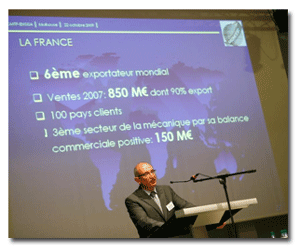
The 30 companies that make up UCMTF achieve a turnover of nearly 1 billion euros, making
France the sixth-ranking textile machinery exporter worldwide. They employ directly or indirectly
more than 8,000 people, and more than 90 percent of their sales comprise machinery exported to more
than 100 countries all over the world. Presenting these figures, UCMTF Chairman Bruno Ameline
emphasized that the textile machinery market is still dominated by the European manufacturers —
for historical reasons, of course, but mainly thanks to their commitment to answering their
customers’ needs, providing machinery for developing new products and/or for optimizing the
production processes.

students
Textile engineering students from four French universities participated in UCMTF’s forum
promoting careers in the textile machinery sector.

After welcome speeches given by Ameline, UCMTF Education Commission President Marc Brabant
and ENSISA CEO Gérard Binder, Gildas Minvielle of the French Fashion Institute analyzed the state
of the textile industry and the main trends that are shaping its future. He explained how the
textile industry was one of the first industrial sectors to face the globalization process and how
it has adapted itself to this new environment. The students expressed their realism about the
challenges and their hopes for new products, particularly in the industrial fabrics sector.

ameline
UCMTF Chairman Bruno Ameline stressed that European textile machinery manufacturers
dominate the market and are committed to providing their customers with machinery for new product
development and/or for production process optimization.

Three panel discussions provided an opportunity for UCMTF members to present their strategies
and their new machines:

•    Combing, spinning, yarn processing and weaving

Participating companies : N. Schlumberger S.A.S., RITM, Petit, Superba S.A.S, Stäubli
France 

•    Nonwovens

Participating companies: Asselin-Thibeau, Laroche S.A., Rieter Perfojet S.A.S.

•    Finishing and air engineering

Participating companies: Alliance, Rousselet S.A., Dollfus & Muller S.A.S, AESA Air
Engineering.

brabant
Marc Brabant, president of UCMTF’s education commission, welcomes participants at the
forum, held at l’Ecole Nationale Supérieure d’Ingénieurs Sud Alsace.

Following the panel discussions, Claude Levy-Rueff of Brouardel Communication — organizer of
SECURIVET, a conference focused on the protective garment sector — introduced a study conducted
with the machinery manufacturers that shows the importance of the return on investment in
customers’ decisions, with the cost savings in energy consumption being particularly important.

Levy-Rueff also reported on SECURIVET 2009, which took place last June in Paris. The
conference demonstrated that the protective garment sector is still a growing industry that offers
multiple career opportunities to textile engineers.

Then followed a roundtable discussion of today’s and tomorrow’s job opportunities for textile
engineers. Five alumni of different ages presented their own careers, the know-how and the
interpersonal skills required for one’s own success.

Editor’s note: This report was based primarily on information provided by the French Textile
Machinery Manufacturers’ Association (UCMTF). For more information, contact UCMTF
info@ucmtf.com.

December 2009

DyStar Finds Buyer

After an active search for buyers produced three potential investors,
(See ”
DyStar
To Continue Production As Bankruptcy Moves Forward
,” Dec. 1, 2009)
, Germany-based DyStar
Textilfarben GmbH has negotiated and signed a purchase agreement for the company and three of its
manufacturing facilities with India-based Kiri Dyes & Chemicals Ltd. (KDCL), a manufacturer of
reactive dyes, and supplier of reactive, acid and direct dyes as well as dyeing intermediates. KDCL
will assume operations at the DyStar Group in Frankfurt, its production sites in Leverkusen,
Ludwigshafen and Brünsbuttel, and 36 international subsidiaries.

The manufacturing facility in Geretsried is not included in the purchase agreement. “We will
continue working on a solution for the Geretsried site, but we are still looking for potential
investors here,” said Stephan Laubereau, attorney, Pluta Rechtsanwalts GmbH, and court-appointed
insolvency administrator, DyStar Textilfarben GmbH & Co. Deutschland KG.

The deal is awaiting regulatory approvals, but both parties hope the process will move
quickly so that KDCL can assume control of the DyStar assets in January, allowing production to
continue seamlessly at Ludwigshafen, and resume at Leverkusen and Brünsbuttel.

It is hoped some 800 Germany-based jobs and another 2,000 international positions will be
saved after the takeover.

“With the help of KDCL we are in a position to offer staff at the sites in Frankfurt/Main,
Leverkusen, Ludwigshafen and Brunsbüttel a transfer company for employment and qualification,” said
Laubereau, together with Miguel Grosser, attorney, Jaffé Rechtsanwälte Insolvenzverwalter, and
court-appointed preliminary insolvency administrator, DyStar Textilfarben GmbH. “If the deal with
KDCL is completed as planned, the latter will likely be able to reemploy the majority of those
released from work as early as mid-January. The exact details of the deal are still being
negotiated.”


December 15, 2009

A Few Positive Signs


T
he year is ending on a relatively upbeat note. To be sure, industry activity remains far
under the levels prevailing at the start of the current recession. But the tide finally seems to be
turning. Note, for example, the flattening out in mill production and shipments — first noted this
past spring — has been continuing now for some three consecutive quarters. More important, it’s a
trend that seems to be embracing both key segments of the industry — basic textiles — fibers,
yarns and fabrics — and more highly fabricated textile products — carpets, rugs, home furnishings
and industrial textiles. True, a few fairly good quarters do not necessarily guarantee a meaningful
trend. But it’s certainly much better than the steady tattoo of declines recorded over the past few
years.


Apparel Follows Suit

Adding to the current somewhat rosier picture is the brightening outlook for downstream
apparel — as consumers’ purchases in October (the latest available month) ran 3.4 percent above a
year earlier. And that estimate is confirmed by the very same 3.4-percent increase being reported
by MasterCard Spending Plus, which tracks spending by credit cards, checks and cash. Point to keep
in mind: This marks the first apparel-buying advance in some 14 months — an increase that, in
turn, seems to be sparking a pickup in garment maker bookings. According to the Institute for
Supply Management, a group reflecting the grass roots reports of the nation’s top purchasing
managers, for example, domestic apparel producers’ new orders and backlogs have now jumped back
into the plus column. Also on an upbeat note: Economists are becoming considerably more optimistic
about purchases of clothing and other consumer goods over the current holiday season — with many
upgrading their predictions from a previous “iffy” to something suggesting a small gain. Analysts
at Standard & Poor’s Equity Research perhaps best sum it all up — noting that “consumers
appear to be shopping again for apparel and home furnishings.”

textilechartDec09


Inventory Paring Also Helps

Additional industry stimulus could also come from today’s relatively trim mill inventory
positions. At last report, stocks at the basic mill level were put at only the equivalent of a
1.33-months’ supply. That’s well under the 1.54 level of December 2008. A similar but smaller
inventory reduction is noted for the more highly fabricated mill product sector, where the
inventory/sales ratio dropped from 1.66 to about 1.55 over the same period. Other things being
equal, these reductions suggest that any increase in new orders will be increasingly filled from
new production rather than from merchandise already on the shelves. Nor do all of the above factors
exhaust the list of encouraging industry signs for upcoming 2010. Another key one is the improving
macroeconomic climate — with growth over the second half 2009 now estimated at near 3 percent —
about double the projection made only a few months ago. If nothing else, rising gross domestic
product is bound to put a bit more money into consumer pockets for new apparel and home furnishing
purchases.


Prices Hold Firm

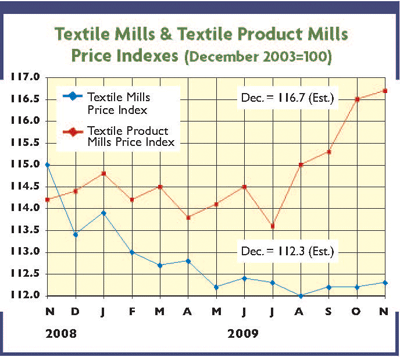
The fact that mill prices have been relatively steady can also be regarded as a good omen.
Uncle Sam’s latest round of price reports provide the details. Tags for both basic textiles and
more highly fabricated products, for example, are being clocked in at pretty much the same levels
prevailing a year ago when the recession first hit. And the picture is much the same for some key
individual subsectors like greige goods and finished fabrics. Moreover, zero in on some of the
industry’s more highly fabricated areas, such as home furnishings and carpets, and quotes are
actually running somewhat higher than a year ago. Bottom line: Lower demand has not really eroded
prices. And the same seems to be true in the apparel sector — at least as far as overall price
averages are concerned. Again citing government indexes, the apparel price yardstick at last report
was running about 1 percent above year-ago levels. All this is in sharp contrast to many other
consumer products — especially electronics and autos, which have experienced declines of 10
percent or even more. More important, there is little to suggest this textile/apparel firmness
won’t continue — particularly now that demand seems to be bottoming out. Indeed, while

Textile World
is still in the process of preparing projections for next year, preliminary evidence
suggests that some spotty price advances will become increasingly likely over the next six to 12
months.

December 2009

2009: A Year To Remember Or A Year To Forget?


S
pinners began the year with official confirmation of what they had known for months —
that the US economy was in recession and had been since December 2007. Bad enough news on its own,
the near collapse of the global financial services industry added insult to injury and had many
spinners wondering if this was, indeed, the year in which the United States would cease to be a
viable player in the global yarn market.

Signs of serious trouble emerged when orders for the 2008 holiday season did not materialize
as expected. As one spinner noted at the time, “The signs of a recession appeared for us when we
didn’t get the spike in sales we would normally expect for the holiday season. Retailers stopped
replenishing inventory, and they aren’t buying anything now if they absolutely don’t have to. We
had hoped to see a little bit of a surge early in the year as stores restocked. But it hasn’t
happened.”

Throughout 2008, the industry noted the passing of smaller, previously robust companies,
including Spectrum Yarns, Burke Mills and Grover Industries. Then, in January, a bombshell: R.L.
Stowe announced it would end more than 100 years of continuous operation in March. Orders for
others continued to spiral downward, often precipitously. Spikes here and there sent waves of
optimism, but, for the most part, the first half of the year finished well below projections. 

Business was conducted literally on a day-to-day basis by a number of spinners. Order
pipelines that had stretched from six weeks to a year fell to only days for some. Those orders that
did materialize were usually very short and required aggressive turnaround times.

Further complications arose as a global credit crisis meant that many companies, particularly
those in Central and South America, could no longer secure financing for their orders. And several
US spinners suffered several months of severe cash flow issues as a result of carrying the debt of
their customers. It was, as one spinner said, a no-win scenario for all involved.

Yet, despite the overall gloomy outlook, some companies continued to thrive. In April,
Tuscarora Yarns, Inc., and CloverTex LLC, both successful specialty spinners, brought their
complementary offerings together to create a single spinner with a broader, more diverse product
offering.

Looking back, the Tuscarora/CloverTex merger was one of the few bright spots of the year.
Another, perhaps, could be summed up by this observation from a major spinner: “It has been worse
than we expected, but not as bad as we feared.”

In fact, it looked for some time like the deepest US recession in 75 years might plunge the
world into a global depression. But after the declines of the first quarter, many spinners found
business stabilizing mid-year. Cotton prices, which had plummeted from their 2008 highs, began to
inch back up as spinners began buying in anticipation of recovery.


Business Picks Up,

And Spinners Wonder “What If?”

The combination of increased consumer confidence and fewer spindles available saw many
spinners ramping up production in June and encountering significant backlogs for the first time all
year. Companies that were running with two-week order pipelines in March found themselves with six,
eight or more weeks of business on the books. Some spinners, having downsized to remain
competitive, even found themselves in the position of having to turn down business.

And suddenly, for the first time in a long time, spinners started wondering if enough
production capacity was in place to handle the business that could come their way.

As is often the case with innovative companies in demanding markets, many of America’s most
successful spinners had reinvented themselves in the wake of intense competition from low-wage
counties. With reduced capacity, streamlined operations, innovative product development and
quick-response capability, these spinners tailored their offerings to serve domestic and Central
American markets with quality, value and turnaround that foreign competitors could not match.

But, with a weakened US dollar and numerous quality issues arising from some foreign
suppliers, domestic spinners found themselves operating flat-out by year’s end — and with some
concerns about how they might handle additional business increases.

One spinner observed: “We’ve seen so much constriction in spinning, that if business returns
to three-quarters of what it was in 2008, there won’t be enough yarn, particularly in ring. You’ve
got R.L. Stowe gone, Ramtex gone and others that have shut down some capacity. That’s a lot of
spinning gone. If business comes back, we’re going to be under some real pressure. Prices are going
to go up, customers are going to have to wait on some deliveries, and relationships are going to be
more important than they ever have been.”

In the darkest hours of the first quarter, few spinners would have projected that business
would be so robust by year’s end. For a few companies, 2009 was the end of the line and, as such,
was a year to forget.

But for others, it will be the year in which disaster was averted and prosperity restored.
That makes it one definitely to remember.

In January, Yarn Market will take a look ahead at what to expect for 2010.

December 2009

DyeCoo Wins Herman Wijffels Innovation Award

The Netherlands-based DyeCoo Textile Systems BV, a carbon dioxide (CO2) dyeing equipment supplier
founded in 2008, has won the eighth annual Herman Wijffels Innovation Award and the accompanying
50,000-euro prize. The incentive award to encourage sustainable innovations, sponsored by the
Netherlands-based financial institution Rabobank Nederland, was established in 1999 in honor of the
bank’s then-retiring Executive Board Chairman Herman Wijffels.

DyeCoo’s water-free CO2 dyeing machine beat out 552 other entries in this year’s contest to
take the top prize. Dry fabric is placed into the machine, which uses CO2 and high pressures of 300
bar to dye the cloth saving 50 to 100 liters of water for every kilogram (kg) of fabric dyed
compared with traditional dyeing technologies. Fabric is dry once the DyeCoo process is complete,
which also eliminates energy-intensive drying steps. The necessary CO2 can be sourced from other
industrial process emissions and is recycled during the dyeing process at a 95-percent rate.

The technology originally was developed through a partnership among DyeCoo’s parent company
Feyecon Development & Implementation BV, the Delft University of Technology and Stork Prints
BV, all based in the Netherlands.

The Herman Wijffels Innovation Award jury said the invention is: “a solution to a global
problem. It does not unnecessarily pollute drinking water and uses CO2 smartly.”

“The principle of dyeing with CO2 was invented in Germany 25 years ago,” said Reiner Mommaal,
DyeCoo. “Developing a well-functioning machine, however, turned out to be too expensive.”

Using carbon dioxide to dye fabric offers many benefits, according to Mommaal. “There is no
water consumption, no use of chemicals, no drying and it is twice as fast,” he said. “This also
makes it attractive in terms of energy. It is consequently not surprising that people from around
the world have shown interest in this new machine. The Herman Wijffels Innovation Award is a
fantastic recognition for us, and a tremendous boost for our name awareness. We are going to use
the [prize] money to establish new patents.”

December 15, 2009

Sponsors