ITMA Technology: Nonwovens

ITMA 2011 was another phenomenal success. In the style of previous ITMAs, the event was
thoughtfully organized and comprehensive. Given the recent volatility in the economy, expectations
were more reserved. Compared to ITMA 2007, the nonwovens machinery industry appears to have
embraced more fully participation in ITMA — another landmark.

Many visitors came from India, Pakistan, Middle East and Gulf countries, and North and Latin
America. Attendance from Europe and Asia was as expected, with a limited number of Chinese
customers present at the event.

The following discussion is focused on companies that have established themselves as leaders
of the nonwovens industry. Notably, some established leaders in this segment were missing — partly
due to the fact that companies exhibiting at ITMA were primarily focused on the conversion of
staple fibers into nonwovens through carding/crosslapping, pseudo airlaid, and associated bonding
technologies.
Hills Inc. was present, but Hills is more known for its innovations in fiber and
filament equipment and, therefore, is not just a nonwovens machinery supplier.

The nonwovens machinery industry is going through massive changes — reconsolidation together
with product differentiation has resulted in many advanced systems — changes that only benefit
their consumers. More on this later.


Wide-ranging Sector


Today’s segments of the industry include raw material suppliers; roll goods producers;
converters/fabricators of the end-use products; the machinery industry supporting the previous
three categories; auxiliary material suppliers; winding, slitting and packaging equipment makers;
and other segments. Even this segmentation does not offer as clear a picture as one might imagine,
because the picture is further clouded by varying degrees of vertical and horizontal integration in
the industry. Globally, the picture is further complicated by the local market and economic
nuances. In terms of market segments, nonwovens products are used in medical and hygiene,
filtration, wipes, automotive, industrial and interlining — the only segment directly related to
apparel. This segmentation has come about because the industry has looked at itself at the macro
level from two distinct but entirely overlapping perspectives: process technologies and markets.
The two are intimately tied together through overlaps. For example, needlepunching technology is
important to both automotive and geotextile applications. Or, the filtration market is served by
wetlaid, needlepunched and meltblown technologies, among others.

The nonwovens section at ITMA is certainly growing, albeit not fast enough. At ITMA 2011,
many of the major nonwovens equipment suppliers were assembled at the same location. All those
present, however, were showcasing technologies for staple-fiber processing. The ones present were
Andritz Group — comprising
NSC nonwoven (Asselin-Thibeau),
Perfojet and
Küsters;
Autefa Solutions;
Bettarini & Serafini S.r.l. (Bematic);
Bonino Carding Machines S.r.l.;
Cormatex S.r.l.;
DiloGroup;
Groz-Beckert KG; Hills;
Laroche S.A.;
Trützschler Nonwovens GmbH; and others. Among those absent from the show were most
of the spunbond/meltblown machinery and auxiliary machinery suppliers. While the nonwovens sector
had a very significant showing at ITMA 2011, it was still much less significant than expected. ITMA
is dedicated to textile machinery; consequently, the customers walking the show are interested in
textile products. Most nonwovens users and customers are not drawn to ITMA as much. The nonwoven
customer base is rather different, and these customers typically walk their own specific shows,
such as INDEX, IDEA, and ANEX. Those shows, however, are not limited to machinery exhibits only and
include the other industry segments mentioned above.

In North America and Europe, the spunmelt technologies — spunbond and meltblown technologies
and their composites — dominate, while in the rest of the world, the staple-fiber process
technologies dominate. The spunmelt technologies have also become significant in Asia Pacific.

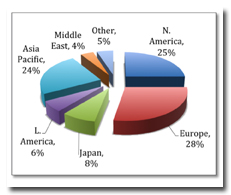
Figure 1 shows the breakdown of the nonwovens roll goods production by region. Note that
Europe, North America and Asia Pacific are almost equal in their market shares and represent more
than 75 percent of world production.
ITMAchart1

Figure 1

As indicated in the review of ITMA 2007 developments, it has been suggested by many that
spunmelt technologies will continue to grow while carding technology will continue to decline (See
“Nonwovens
Technology: Implications For The Nonwovens Industry,”


Textile World, January/February 2008
). Today, this is potentially true with
regard to lightweight disposable products for which spunmelt products can compete favorably with
carded products. There are multi-beam spunbond/meltblown/spunbond machines — six- or seven-beam
machines are common — producing multi-layered composites that weigh between 10 and 20 grams per
square meter (g/m2), with each beam laying down 1 to 2 g/m2. This would be impossible for carding
technologies. Note, however, that recent and continuing advances in high-speed carding technology
will allow this technology to continue to compete in certain markets such as hygiene and other
lightweight products, and the advances in crosslapping technology and higher-weight nonwovens
through chutefeed systems will encourage the use of such technologies for heavier-weight products.
It is believed that the high-speed carding technology and its associated processes are not maturing
technologies that are holding their own. A recent installation of a Trützschler nonwoven card at
the facilities at the Nonwovens Institute at North Carolina State University was successful in
processing as much as 400 kilograms per meter per hour, a rate that competes with the highest
throughputs possible on a spunbond machine.

However, the composite pulp-based airlaid products are finding applications in co-form
process technologies as opposed to stand-alone systems utilizing pulp and latex binders.

The choice of technology is often dictated by the type of product being produced. Nonwovens
offer a very diverse range of products globally. Generally speaking, nonwovens can be broken into
two broad classes: disposable and durable. Durable, as opposed to multi-use, here refers to the
length of time the product is in place and to its life.

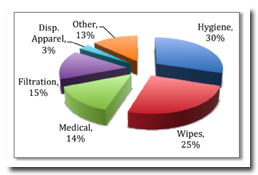
Figure 2 shows the breakdown by market segment for disposable products. The products in these
market segments are quite diverse and unique. In these markets, lightweight medical and hygiene
products make use of spunbond and meltblown technologies significantly. The wipes market, however,
is dominated by staple, carded and hydroentangled products; while the filtration market is rather
broad and is made up of wetlaid glass products, meltblown webs, and carded/crosslapped
needlepunched products.
ITMAchart2

Figure 2

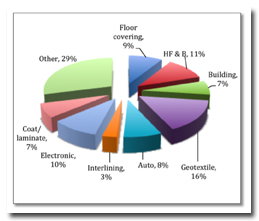
The breakdown for durable nonwovens is given in Figure 3. There, products are not dominated
as much by the spunmelt processes. Here, spunmelt as well as the carding/crosslapping/airlay
technologies are often used to produce innovative solutions.
ITMAchart3

Figure 3


Industry Consolidation


Starting in the late 1980s and early ’90s, alliances and mergers began to take place within
both the nonwovens and the textile industries. Some took the form of horizontal integration: buyout
of parallel or competing technologies. Some took the form of vertical integration that encouraged
one-stop shopping: the buyer could purchase complete manufacturing lines to produce nonwovens for
specific markets. In the latter case, the machines from different parts of the alliance, merger, or
partnership were better integrated as well. ITMA 2011 will likely be remembered with regard to
mergers and acquisitions.

Trützschler, Germany, with its acquisition of
Fleissner and now
Erko, has become a dominant player in the area of nonwovens. Its own developments
of needlepunching, aircard systems, staple-fiber production and crosslapping equipment as well as
carding technologies capable of dealing with recycled materials are now allowing the group to offer
complete turnkey systems from production to sales and service globally. The only exception is that
Trützschler does not produce calenders for thermal bonding.

Austria-based Andritz’s acquisitions of Perfojet, Küsters, and now Asselin-Thibeau are
allowing the company also to offer complete lines produced in three key regions in Europe. Andritz
Asselin-Thibeau, France; Andritz Perfojet, France, and Andritz Küsters, Germany, together will form
the Nonwoven platform within the Andritz Group. This is going to be a formidable group.

DiloGroup, Germany, has been offering complete systems for some time and continues to be a
major innovator in the field of machinery for forming staple fiber products from hygiene to
industrial.


Overall Impressions, Most Significant Technologies


These three giants of the nonwovens industry are offering technologies that are unrivaled.
For the consumers, this is all good news. Equipped with Germany-based Groz-Beckert’s components
such as needles and jet strips, these turnkey systems are capable of dealing with a wide range of
product needs. The report below will try to bring together the recent developments in these key
nonwovens companies that were present at ITMA.


Trützschler Nonwovens


Trützschler Nonwovens was very prominent at the show. The company now offers a full array of
process technologies for staple-fiber nonwovens including, but not limited to, staple fiber
production, carding, needlepunching, hydroentangling, thru-air thermal bonding and coating. All of
the groups were exhibiting in one stand.

The Trützschler systems have become the industry standard for fiber opening, mixing and
feeding. They are being used throughout the world in conjunction with other equipment such as those
offered by other machinery makers. With its entry into nonwovens, one will expect the same level of
excellence, and Trützschler will be a company to watch over the coming years. The speed with which
this group has managed to develop new machinery to deal with various forms of staple fiber web
production is impressive. The developments are too many to mention, and the ITMA 2007 nonwovens
technology review gave a rather full picture of the company’s various technologies from fiber
opening to web forming. Here, the latest and newest innovations are the focus. The latest
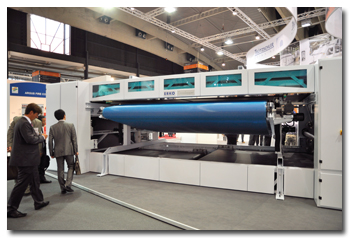
innovation unveiled by Trützschler is the Erko crosslapper EKLB439.
ITMARupp3

Figure 4: Trützschler Nonwovens’ Erko crosslapper EKLB439

What is new about crosslappers of today compared with the old camelbacks is that increased
requirements for throughput have led to ever-increasing line speeds necessary to be compatible with
the carding speeds available today.

Today, crosslapping lines are operated at the limits of their capacities — limits which are
difficult to be pushed, if at all, with conventional technology. Trützschler’s new system appears
to have overcome these limitations in terms of productivity as well as quality.

The new material guidance allows a reduction in the moving mass of the crosslapper to a
minimum, which results in reduced machine load and increased energy efficiency. The number of belt
and deflection rollers has been reduced from the original nine to now four rollers. This measure
results in significantly less acceleration and brake pipes, which has a positive influence on the
energy balance of the new crosslapper.

Additionally, the elimination of airflow and centrifugal forces now allows the processing of
even difficult materials at high speed.

Another feature is web profiling within the crosslapper. A clearly defined drawing zone,
consisting of a clamping point just before the delivery of the process materials from the layering
belts and the fixation of the process material at the permeable laydown belt, will prevent
undefined drafting zones. This technique reduces or eliminates any disturbances that could
influence the material between the drawing unit upstream of the crosslapper down to the delivery
point at the outlet belt.

The features of the new crosslapper can be summed up as follows:

  • A new material guidance system avoids the negative influence of dynamic factors on the
    process.
  • Significant reduction of the oscillating masses results in a lower machine load and less energy
    consumption.
  • Elimination of air masses and increased friction of process materials at machine components and
    web laydown enables difficult materials to be processed.
  • A defined drafting zone results in a higher profiling efficiency exactly at that point where an
    adjustment of the web profile is required.


Andritz Group


Andritz’s expansion and acquisition is a major development in the industry, and NSC was
exhibiting separately at ITMA probably because of the timing of its acquisition by Andritz. A major
press conference was held at ITMA to discuss the acquisition. The combined technologies give
Andritz the ability to offer complete turnkey systems for the production of staple nonwovens. While
Andritz does not currently offer spunmelt processing equipment, with its acquisition of Reiter
Perfojet, it can certainly do so if it so desires. NSC’s Excelle® Isoweb® TT card as well as the
A.C.S. Profile crosslappers and the SDV-2 needleloom for velour applications are major. Küsters
calenders are unrivaled.

Excelle Isoweb is the inline card solution to obtain good machine direction/cross direction
(MD/CD) strength ratio on final product, even at high speeds greater than 250 m/min. Controlling
the anisotropy is critical in many nonwovens applications. Typically, higher speeds lead to higher
orientation in the machine direction. To control the isotropy at high speeds requires control and
management of the laydown and the web. A radical feature of the Excelle card is that it puts all
the accessory card cleaning systems inside rather than outside the drives and adjustment points.
Operator convenience and accessibility are unparalleled.

A.C.S. is also a high-speed crosslapper. A crosslapper has historically been the bottleneck
in the high-speed production of lapped webs. To overcome this problem lowers the cost of
production. This is a critical development for technical products such as those used in headliners
and for other automotive applications.

Perfojet is the world leader in hydroentangling, and its equipment is well-known for
manufacturing high-quality spunlaced products.

With the acquisition of Perfojet and now Asselin-Thibeau, Andritz can now build on their many
years of experience and the multiple innovations on the different components of a line to make a
first-quality finished product, with optimum aesthetics, performance and fiber yield.
ITMA6

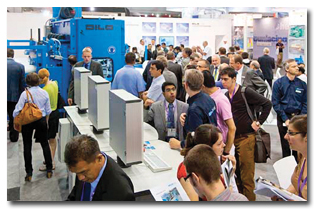
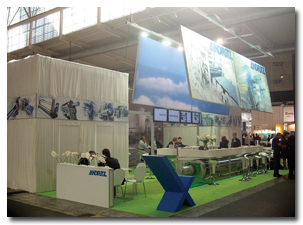
Figure 5: Andritz’s booth at ITMA 2011

On display also was an innovation by Küsters, which has been the world leader in thermal
calendering machinery. At ITMA, Küsters was displaying a 5-meter-wide unit capable of running at
1,250 m/min — another first. This is an incredible achievement and will push the best of spunmelt
machinery to catch up.


DiloGroup


DiloGroup was also very prominent at the show. Dilo has been a major innovator in the area of
process technologies for staple products. A complete review of the various and numerous innovations
by Dilo is included in the 2007 write-up.

One novel innovation is the Clean Card Concept. Along with highest production speeds, fiber
throughput, web regularity and evenness, the efficiency of the carding operation is very relevant
to the economics of a web-forming line. Downtime for product, fiber and color changes will have to
be minimized.

The quick and easy cleaning of a card, however, requires a design that allows immediate
access to all relevant working areas of the unit. Also, a prerequisite is the provision of a strong
and efficient suction system to deal with fiber flow and dust within the housing of the card with
its safeguards, doors and flaps. The card cleaning system is achieved by:

  • Internal Suction: Airflow is provided in all areas of the carding compartment. A suction system
    provides vacuum to catch the fiber debris and dust particles that have left the carding surfaces of
    the rollers. Two ducts, one in the breast and one in the main section, are connected to the central
    suction system to provide sufficient airflow within the complete carding compartment. The airflow
    is designed in such a way that it allows enough airflow at any point on any roller to help free the
    carding surfaces of fiber accumulations. A key and unique feature of the unit is that at the
    central suction and filtering station, fibers and dust particles are separated. Fibers are recycled
    back to the feeding section to be reprocessed.
  • Worker and doffer trim suction (Direct Suction System): This trim suction restricts the fiber
    coverage of the rollers. Fiber contact with the side frames is avoided. In addition, a new feature
    for wrap protection minimizes fiber accumulation and clogging between rollers and side frames.
  • Internal rim suction (Overflow): Fiber flow between main cylinders and side frames is vented
    via radial fins into a suction trough.
  • Air conditioning: The card compartment is vented with fresh, humidified or conditioned air
    supply. This is critical for specialty fibers sensitive to static and dust generation.

Another new development from Dilo is aerodynamic web forming. This is critical when shorter
staple fibers; recycled fiber, or shoddy; various natural fibers such as flax, kenaf, hemp and
cotton; or mineral fibers, particularly glass, are considered. These materials are used in numerous
applications. The automotive industry, for example, uses such products that are subsequently
molded, or those that are used for thermal or acoustical insulation. These types of highloft and
highly voluminous product are also used for insulation in buildings or for waddings and paddings in
garments, upholstery and bedding. Aerodynamic web forming is particularly useful for producing such
products. In addition to web forming by carding and crosslapping, DiloGroup offers two series of
aerodynamic web forming machines:

  • the TurboUnit and TurboCard series for fine fiber and the lower weight range with applications
    in the medical, hygiene and cosmetic fields; and
  • the new Fiberlofter series for the medium to higher weight range for universal applications and
    for any type of fiber — especially, however, for recycled, natural and mineral fibers.

Dilo is also the world leader for needlepunching. A complete review of its innovations in
needlepunching is included in the ITMA 2007 report. These innovations will likely lead to new
products that will potentially compete with some products currently produced by hydroentangling.
Watch for lightweight needlepunched products.


Groz-Beckert


Groz-Beckert was also quite prominent at ITMA, and exhibited a number of key technologies for
both felting and hydroentangling. The company also is known for its leadership position in
supplying key components to the knitting, weaving and felting industries.

Groz-Beckert is known as the world leader for needles for needlepunching. The company,
however, is a latecomer to the world of hydroentangling jet strips. But, in the short period it has
been involved with this segment, it has established its leadership there as well. Its jet strips
are known for their long service life.

A typical jet strip may have as many as 1,600 to 2,000 orifices per meter. The quality of
each orifice is critical to the quality of the final product. Defects in orifices can result in
streaks in the final fabric. Zero defect is a requirement for these types of products.

The Groz-Beckert jet strip combines long service life with unmatched quality, leading to
uniform product quality. The durability is achieved by providing resistant surfaces controlling the
wear at the edge of the capillaries. Consequently, the orifices retain their edge sharpness for
longer periods. More importantly, this longer life results in better and more consistent products
over the life of the jet strips.

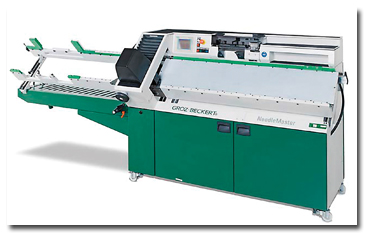
Groz-Beckert also displayed the Groz-Beckert NeedleMaster, a complete system designed for
more efficient, reliable needle board handling. These major innovations were reported fully back in
2007. In brief however, the basis of the system is a semi-automatic device for the insertion and
removal of needles in needle boards. This unit is going to become more and more of a necessity with
the ever-increasing trend toward using higher-density needle boards. Dilo offers needle boards with
as many as 20,000 needles per meter. A 3-meter-wide, four-board needle loom will require 240,000
needles. Preparation of these boards manually is time-consuming. Further, the consistency with
which a board is built will be reflected in the product quality. With critical applications such as
automotive headliners and the like requiring zero-defect products, the NeedleMaster will be a key
player. The ergonomically designed and CE-compliant components make for fast, reliable and timely
needle board handling.
ITMA7

Figure 6: Groz-Beckert’s NeedleMaster unit


Other Exhibitors


Among other exhibitors, one would note Bonino, Italy; Laroche, France; Cormatex, Italy;
Bematic, Italy; and others offering highloft nonwovens production system using airlaid and/or
chutefeed systems unique for recycled and natural fiber nonwovens utilizing fibers that cannot be
easily handled by carding. Cormatex as well as Bematic exhibited their simple chutefeed systems
processing a variety of recycled fibers at the show. Automotive, building, home furnishing and
geotextiles are areas that would likely be targeted. The challenge for these technologies will be
competing with aerodynamic cards offered now by industry giants such as Dilo, Trützschler and
Andritz Asselin-Thibeau. This is an interesting area to watch. With sustainability becoming a
global issue, watch for further developments in this area. The limiting factor today remains the
lower basis weights achievable on such systems. With the technology being improved continuously,
the anticipation is that the boundaries will be pushed and newer products will appear between now
and the next ITMA.

Hills, West Melbourne, Fla., was the only company present that is involved in the spunmelt
sector. Hills is well-known for its bicomponent fiber technology, and earlier reports have covered
its contributions fully. Hills began offering both meltblown and spunbond equipment some years
back, and its spinbeam and bicomponent/multicomponent technology has been used together in systems
offered by Reifenhäuser Reicofil & Co. KG, Germany, and others.

It is unfortunate that this report does not deal with the spunmelt technologies because they
were not present at ITMA. The spunmelt technology is also one to watch. Many technical textiles
products are anticipated that will be created using these technologies. This perhaps will form the
topic of a separate discussion in the future.


TW‘s ITMA technology coverage will continue in the March/April 2012 issue with
reviews of the flat knitting and quality control/textile testing sectors; with further coverage in
subsequent issues.


January/February 2012
ITMA Technology: Weaving & Weaving Preparation

ITMA 2011, which was held for the first time in Barcelona, Spain, at the Fira de Barcelona Gran
Via, marked the 16th show and the 60th birthday of one of the major textile machinery shows. The
show was well-attended with more than 100,000 visitors, representing 138 countries, who came to
learn and invest in technologies shown by 1,350 exhibitors from 41 countries. The show definitely
met the expectations of the visitors in terms of innovation and versatility that the machinery
manufacturers exhibited, which covered fiber formation to end product. The innovation and
versatility in the areas of weaving and weaving preparation got a significant share of attention by
the visitors. This report covers the most innovative weaving and weaving preparation technologies
shown at ITMA 2011. The author provides technical critical evaluation whenever appropriate. A
substantial part of this report follows the recent historical innovation of technologies. To get
full benefits and better understanding, it is recommended that the reader review the author’s
previous articles covering ITMA 2003 and 2007 technologies that have appeared in

Textile World
‘s print and online publications.


Winding


Oerlikon Schlafhorst, Germany, exhibited the Autoconer X5, a new variation of the
Autoconer 5 automatic package winders shown at the previous ITMA, with new features introduced. The
winder is equipped with a separate motor for feeding the supply packages to the active position. A
feeding motor operates only if a bobbin is depleted and a new bobbin is required, which saves
energy compared to the previous bobbin feeding system that used a continuously running centralized
motor and belt to drive the feeding positions.

The Autoconer X5 produces cone or cylindrical packages. The doffer detects the empty cylinder
or cone package shape and rejects the package if it is not the shape that is programmed to process
at the specific spindle. Further, if a magazine of a position does not have empty packages, the
doffer takes a correct package from a neighboring magazine to avoid loss of production.

With previous Autoconer models, when a new lot starts, the operator has to manually wind the
reserve of the first package for all positions. The Autoconer X5 forms the reserve on each package
of the new lot automatically. The recognized advantages of this new feature are an increase in
productivity; and consistency in position, winding tension and the amount of the reserve yarn,
which results in avoiding problems for the next processes including packages for warping and weft
packages for weaving.

Savio Macchine Tessili S.p.A., Italy, continued to show its Polar package winders
that were exhibited at ITMA 2007. Two Polar package winders were shown at this ITMA: Polar E and
Polar I/DLS (Direct Link System). The previous version of Polar E was equipped with automatic
bobbin loading and manual doffing. Polar E now is offered with automatic bobbin loading and
automatic doffing.

Polar I/DLS is similar to Polar I shown at ITMA 2007. However, the link to the spinning frame
in Polar I/DLS is designed to work with ring-spinning machines that have a much higher number of
bobbins.


Warping


Karl Mayer Textilmaschinenfabrik GmbH, Germany, continued to show its impressive
innovations in warp preparation for sample and short orders. The company showed its new
Multi-Matic® sample warper with creel capacity of 128 yarns or colors, which is a significant
increase compared to the capacity of the Gir-O-Matic (GOM) 24 sample warper that was shown at the
previous ITMA. This feature increases the capability of producing more intricate striped warps.
Other features of the Multi-Matic sample warper include: warp length range of 35 to 1,500 meters;
working width up to 2.25 meters; maximum warping speed of 800 meters per minute (m/min); and
maximum color change speed of 800 m/min. The warper is equipped with a user-friendly interface to
preprogram the leasing pattern and color selection. After the preprogramming and setting of the
packages on the creel, the rest of the warping process is automatic, including the leasing for
drawing-in and size rod separation, and there is virtually no need for operator intervention. The
beaming process requires the operator to transfer the warp from the pattern drum to the warp beam.
The beaming speed is 150 m/min. With such features and capabilities, the Multi-Matic sample warper
can be used for extremely short samples, as short as 35 meters, or for short orders of 1,500-meter
increments, which sets this warper to compete with sectional warpers.

ITMA3

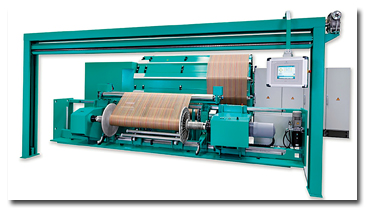
Karl Mayer Multi-Matic® sample warper

CCI Tech Inc., Taiwan, specializes in sample weaving equipment. The company showed
its Lutan sample warper, which uses a ring to wind and traverse the warp yarn coils in such a way
that the yarn coils are fixed once they are laid on the pattern drum. The company offers sample
warpers of two different pattern drum sizes to provide a range of warp lengths. The warpers are
equipped with a computerized system for programming the color sequence. Three types of warp creels
are available — stationary, rotary, and super. The stationary creel for up to eight colors supplies
different packages of different colors or yarn types; the rotary creel for up to 12 packages allows
for simultaneous warping of multiple yarns and is dedicated for solid color or simple warp
sequence; and the super creel for up to 12 colors allows for simultaneous warping of multiple
colored yarns and thus is designed for intricate striped warps. Lutan v3.6 with 3.6-meter drum
circumference can produce warps ranging from 11 to 200 meters in length, and Lutan v5.0 with
5-meter drum circumference can produce warps ranging from 15 to 500 meters in length.

ITMA2

CCI Tech’s Lutan sample warper with super creel (right)


Drawing-in And Tying-in


Stäubli Group, Switzerland, introduced its Magma tying-in machine — which is
capable of handling spun, multifilament and monofilament as well as polypropylene ribbons — for the
first time at ITMA 2007. At the 2011 show, Magma T12 was exhibited. The new version is equipped
with new optoelectronic patented system for detecting double yarns and separates them from the
lease. The system does not need thread-specific separation needles or settings.

Stäubli introduced the Safir automatic drawing-in machine at ITMA 2007, and exhibited the
new-generation Safir S80 drawing-in machine at this ITMA. Like the previous version, the S80
integrates the Delta drawing-in and the Opal leasing technologies. In the S80 model, a new thread
separation unit detects double yarn using an imaging technique with a camera. The separation unit
checks for yarn color and its correct sequence in the color pattern repeat. In case of the color
not being in sequence, the system picks up the correct color without operator intervention. S80 is
equipped with a user-friendly interface via intricate display to allow easy programming of
drawing-in including color sequence. The system is network-compatible, which makes it possible to
transfer drawing-in data created by computer-aided design, and thus repetition is avoided and
errors are eliminated. Stäubli reported that the Safir S80 has been installed in many plants since
its launch.


Weaving


The competition in shed forming systems that started at ITMA 1999 with the introduction of
the Grosse UniShed and Stäubli Unival 100 Jacquard systems continued. In fact, the competition
expanded to include more shedding systems by other machine producers.

Stäubli commercialized Unival 100 in 2003. In 2007, the Unival concept was expanded in Unival
200 to individually control warp yarns using actuators in label machines. In Unival 200, the
actuation is not limited to controlling only the shedding motion, but also main motions of the
machine. The actuators are used to control: weft tension with individual control for each weft yarn
that can be preprogrammed digitally; weft feed rate; warp tension; cloth take-up rate; latch needle
for securing the filling yarn; and filling selection of up to eight colors. The concept was also
expanded in Unival 500 to individually control harnesses in dobby shedding systems. Unival 500 uses
more powerful actuators to control harness movement in a dobby shedding system. Each harness is
controlled by an actuator that controls links connected to the harness. Clockwise and
counterclockwise rotation of the actuators is decided based on which harnesses need to be
raised/lowered to form the shed according to the weave design.

At this ITMA,
Toyota Industries, Japan, joined the competition for individual harness control of
dobby shedding systems with the E-shed Electronic Shedding Motion.

Mageba Textilmaschinen GmbH & Co. KG, Germany, exhibited its narrow shuttle
weaving machine SL-MT 1/180 combined with a Mageba dobby shedding system in which a separate motor
drives each harness. Each harness can be raised or lowered at different levels to form multisheds
and allow for multi-weft insertion.

At this ITMA, Stäubli expanded the Unival 100 applications. A small-size Unival 100 combined
with a narrow fabric shuttle weaving machine was shown at Mageba’s booth to form multi-weft
insertion for the production of medical and technical products. A very small-size Unival 100 termed
Univalette, which is intended for working with a dobby shedding system, was shown at Stäubli’s
booth for weaving selvage labels.

GITEC Grosse Internationale Technologie GmbH, Germany, commercialized the improved
UniShed 2 about two years ago. At ITMA, the unit was shown at Japan-based
Tsudakoma Corp.‘s booth on the ZW8100 water-jet weaving machine. It should be
pointed out that this is the first time water-jet weft insertion has been combined with a Jacquard
shedding system at ITMA.


Advantages Of Individual Yarn And Harness Control


The advantages of individual control of warp yarns and harnesses in Jacquard and dobby
weaving allowed the separation of the Jacquard/dobby drive from the main weaving machine drive,
leading to elimination of the complexity associated with coupling the weaving machine main drive
with the shedding system; increased weaving speed; elimination of stop/start marks owing to
reduction of load on the main motor; and formation of multisheds, enabling the formation of 3-D
woven structures for medical, shaped preforms for composites. These systems set the stage for the
development of multiphase weaving with intricate designs using the advances of the new
dobby/Jacquard shedding systems.


Integration Of Weaving And Embroidery By Dornier


A highlight of the show was Germany-based
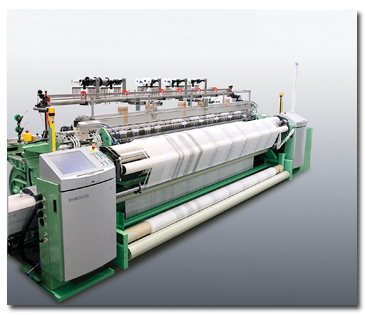
Lindauer Dornier GmbH‘s air-jet weaving machine AWS 6/S 12 OC integrated with an
embroidery mechanism that controls a set of yarns. The embroidery yarns are guided by needles and
are raised up to move out of the reed dents — the reed is open-top. While they are out of the reed,
these yarns are moved laterally depending on the embroidery design, and then are lowered and
entered into the reed dents. The embroidery yarns form sheds to interlace with the weft yarns
according to the design. The sequence is repeated until a design repeat is formed. Besides the
competition with embroidery machinery, the system could replace the weaving technique known as
extra warp figuring that requires dedicated Jacquard hooks. The system also competes with the
embroidery effect produced by yarn lay-in in warp knitting. While intricate design could be
obtained by the system, the degree of intricacy is limited compared to that of traditional
embroidery because of the limitation of the lateral movement of embroidery needles or yarns.
Another limitation of the system is that the embroidery yarn size is limited to the reed dent
width.

ITMA1
 

Dornier Air Jet Type AWS 6/S 12 OC with Embroidery Unit weaving embroidered
curtain


Speed And Versatility


Weaving speeds and filling insertion rates reached their maximum at previous ITMA shows. The
machine manufacturers competed mainly by showing different machines weaving a broad range of
fabrics for different markets, emphasizing diversity that includes weaving articles for home
textiles; apparel textiles; and technical textiles such as filters, preforms for composites,
medical and ropes. Examples of diversity offered by various machine manufacturers include:

  • Dornier: embroidered curtain fabric – A1 air-jet, Jacquard African damask for shirting –
    air-jet, womenswear – rapier, filter fabric – rapier;
  • ITEMA Weaving, Switzerland, including
    Sultex,
    Vamatex and
    Somet: coating – rapier, shirting – rapier. fancy apparel – rapier, fancy denim –
    air-jet, sheeting – air-jet, geotextiles – projectile, home textiles – rapier, terry towel –
    rapier;
  • Panther Textiles Co. Ltd., Hong Kong: labels – rapier, technical – rapier,
    shirting – rapier, fancy womenswear – rapier;
  • Picanol NV, Belgium: stretch denim – rapier, para-aramid – rapier, worsted fabric
    – rapier, coating – rapier, upholstery – rapier, lining – air-jet, parachute fabric – air-jet,
    automotive – air-jet, sheeting – air-jet, terry – air-jet, apparel – air-jet, womenswear –
    rapier;
  • Toyota: gingham shirting – air-jet, wool suiting – air-jet; fancy voile curtains – air-jet,
    denim fabric – air-jet, terry towel – air-jet;
  • Tsudakoma: pongee – air-jet, Jacquard terry towel – air-jet, heavyweight Jacquard fabric –
    water-jet, womenswear – air-jet.
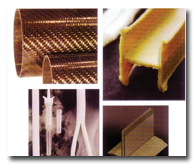
  • Mageba shuttle weaving: medical, net shape for composites – T-beam, I-beam, tubular and such,
    ropes with sheath/core layers;
  • Jäger of Schlatter Industries AG, Switzerland: technical fabrics – SK560 rapier
    weaving machine equipped with high tension let-off and beat-up;
  • Vúts Liberec, Czech Republic: leno fabrics for the production of glass fiber
    preforms for fiber reinforced composites – Cam El and Combine air-jet; and
  • Jürgens Maschinenbau GmbH & Co. KG, Germany: technical textiles including
    multi-axial fabrics – JP-4000 projectile 6-10-meter wide weaving machine equipped with ITEMA
    projectile and Stäubli Unival 500 dobby.


Multiphase Weaving


The absence of the Sultex M8300 multiphase weaving system from the show for the second
consecutive time is a disappointment. The author addressed the reasons behind the limitations of
the M8300 in previous ITMA reviews. Its greatest disadvantages are the limited weave design
capability and warp yarn densities. However, with the new development in shedding systems addressed
above, it is believed that opportunities are emerging to develop multiphase weaving using
dobby/Jacquard shedding systems with individual harness/yarn control.


Mageba Shuttle Weaving


The comeback of shuttle weaving as seen at ITMA 2007 continued at this ITMA. Mageba showed
its narrow shuttle weaving machine SL-MV 140 1/315 combined with Stäubli ‘s Unival 100 Jacquard
shedding system. The combination of the weaving machine and Unival 100 permitted the formation of
multisheds and multi-weft insertions to form shaped and 3-D articles for medical and technical
applications such as bifurcated and trifurcated grafts; tubular structures for fire and garden
hoses; and T-, I- and C-shaped preforms for fiber-reinforced composites. While these products have
been produced using traditional technologies, the use of Unival 100 with shuttle weaving provides
an ultimate electronic system that allows switching from weaving a shaped article to weaving
another with ease and speed that have never before been seen.

ITMA4

Application examples of woven fabrics formed using Mageba shuttle loom

Mageba also exhibited its narrow shuttle weaving machine SL-MT 1/180 combined with its dobby
shedding system, in which each harness is driven by a separate motor. Thus, each harness can be
raised or lowered at different levels to form multisheds and allow for multi-weft insertion.


Energy Reduction


ITMA 2007 witnessed serious developments in air-jet weaving to reduce energy consumption to
offset the increase in energy costs. Further developments were exhibited at this show. Dornier
showed its TandemPlus system, consisting of a movable tandem nozzle attached to the reed bar for
variable-width weaving and a third fixed-position nozzle for weaving slick or subtle filling yarns.
On wide machines, the Dornier TRIM system features the movable tandem nozzle and movable third
nozzle. Both systems reduce the air pressure and power consumption.

Picanol exhibited four Omni
plus Summum air-jet weaving machines equipped with a patent-pending AirMaster software
system that monitors air consumption and detects leakage and clogging. AirMaster also could be used
to carry testing procedures to check all air elements. Identifying leaks and clogs, and managing
air lead to reduced air consumption.


Wireless Smart Label


TexTrace AG, a subsidiary of
Jakob Müller Holding AG, Switzerland, demonstrated a new wireless smart label for
article identification using radio frequency (RF) technology. The label can be read from a distance
of up to 7 meters using a RFID reader. The smart label consists of two parts: a woven antenna
comprising textile yarns and electrically conductive yarns; and a chip with integrated circuit. The
integration of the antenna and the chip is achieved with precise placement using a new automated
process that applies pressure and heat to connect the chip to the antenna using thermoplastic
adhesive. The system has a range of applications that include the detection of numerous articles
simultaneously, sales tracking, checkout, counterfeit detection, theft protection, inventory, order
tracking and more. TexTrace reports repeated laundering does not affect label performance. An
additional feature of the system is its ability to connect to mobile phones, thus allowing remote
tracking of data. While the cost of the smart label is expected to be much higher than the
traditional label cost, the time and labor savings in conducting the above tasks would translate to
higher profit.


Conclusion


Developments introduced at previous ITMAs — such as automatic pattern change, direct drive,
quick style change, variable pick density, variable speed, automatic stop/start mark prevention,
on-loom woven fabric inspection and adaptive control system for air-jet weft insertion — are
well-established and are becoming the standard owing to the demand for versatility and high-quality
fabrics.

It is strongly believed that the new dobby and Jacquard shedding systems will revolutionize
weaving technology and help weavers find new uses for these technologies in intricate textiles as
well as functional smart, industrial, and technical fabrics. Given the establishment and the spread
of the individual harness/yarn control of dobby/Jacquard shedding systems, multiphase weaving with
no limitation in design capability or thread density is expected to be developed soon. Such
development will take the weaving speed to new levels while producing intricate as well as
technical textile products. Another route for increasing the weaving speed is twofold: continue the
increase of electronic controls and thus reduce heavy mechanical parts; and replace heavy metal
parts with much lighter fiber-reinforced composites.

The new developments in weaving and weaving preparation equipment provide a range of
opportunities for woven fabric manufacturers and allow the production of much smaller orders than
ever before with minimal waste.

The shuttle comeback for two successive ITMA shows is a welcomed event owing to its success
in producing specialty industrial and medical products. Shuttle weaving is a viable technology for
the formation of net-shaped products for medical and technical textiles including preforms for
fiber-reinforced composites.

Manufacturers have responded to the need to reduce environmental impact through reduction in
energy consumption and raw material waste including reduced selvage waste. Future ITMAs are
expected to reveal more advances in this direction due to the mounting pressure resulting from
increases in the costs of energy, raw material and waste disposal.


TW’s ITMA technology coverage will continue in the March/April 2012 issue with
reviews of the flat knitting and quality control/textile testing sectors; with further coverage in
subsequent issues.


January/February 2012
Oerlikon Textile Reorganizes

Oerlikon Group, Switzerland, has announced changes to its Oerlikon Textile GmbH & Co. KG
business, including simplifying its structure, moving its headquarters and increasing R&D
investments.

Oerlikon Textile’s five textile machinery and components businesses are being reorganized
into three business units: Manmade Fibers, comprising Oerlikon Barmag and Oerlikon Neumag; Natural
Fibers, comprising Oerlikon Schlafhorst and Oerlikon Saurer; and Textile Components. Current
branding of products will remain as is.

Oerlikon Textile’s headquarters have relocated from Remscheid, Germany, to Shanghai. In
connection with the move, CEO Thomas Babacan has left the company and has been succeeded by
Singapore native Clement Woon, an executive with considerable experience in international and Asian
business. The position of CFO also is moving to Shanghai. By the end of 2012, more than 40 percent
of the company’s senior management will operate out of Shanghai.

Oerlikon Textile’s 2012 R&D investment will grow to approximately 80 million Swiss francs
worldwide, including some 60 million Swiss francs in Germany, and R&D capacity will increase in
China. R&D in Germany will center on development of leading-edge technologies, while in Asia,
it will focus on adaptation for the regional market.

Oerlikon Textile’s sales in Asia account for some 70 percent of total 2011 sales. Some 45
percent of its employees currently are based in Asia, and by 2014, that portion is expected to grow
to 50 percent. 

“We have seen strong improvement in our Textile business, resulting in record margins,” said
Dr. Michael Buscher, Oerlikon Group CEO. “To ensure the continuation of this success, we will
manage the textile business directly out of its most important market and at the same time
strengthen R&D capabilities, especially in Germany.”

January/February 2012

Indorama Acquires FiberVisions

Polyester producer Indorama Ventures PCL (IVL), Thailand, has acquired specialty polyolefin staple
fiber and bicomponent fiber producer FiberVisions Holdings LLC, Duluth, Ga.

FiberVisions’ production capacity totals more than 200,000 tons per year at facilities in the
United States, Denmark, Argentina and China. The company devotes 75 percent of that capacity to
fiber production for disposable branded feminine hygiene products and 25 percent to fiber
production for automotive and industrial applications. FiberVisions also has a joint venture (JV)
with bicomponent fiber producer JNC, Japan.

Over the last year, IVL also acquired Wichita, Kan.-based Invista’s U.S. and Mexican
polyester assets; Ireland-based Wellman International Ltd.’s recycling and fiber businesses in
Europe; polyester fiber and filament producer Trevira GmbH, Germany, acquired through a JV with
Sinterama S.p.A., Italy; and South Korea-based SK Chemicals Co. Ltd.’s polyester assets in
Indonesia and Poland.


January/February 2012

Quality Fabric Of The Month: Spider Silk — Potential Unleashed

Spider silk has been the subject of advanced research and development efforts for years because it has exceptional strength, elasticity and abrasion resistance, as well as numerous potential technical textile applications — if only it could be produced in commercially viable quantities. That’s been a problem because spiders are not exactly social creatures and, in fact, tend to be cannibalistic, so farming them as one would silkworms is not an option. However, a breakthrough has
occurred thanks to collaboration involving the University of Notre Dame, Notre Dame, Ind.; Kraig Biocraft Laboratories Inc. (Kraig Labs), Lansing, Mich.; and the University of Wyoming, Laramie, Wyo.; and the first result — a hybrid silk produced by transgenic silkworms — is well on its way to commercialization primarily for traditional silk applications including apparel and medical applications such as sutures.

QFOMspidersilk

Armed with an exclusive license to use patented technologies developed by Randolph Lewis at the University of Wyoming, Kraig Labs Founder and CEO Kim Thompson began working with Malcolm Fraser at Notre Dame, developer of piggyBac gene-splicing technology, and Donald Jarvis at the University of Wyoming. PiggyBac vectors have been used to combine certain spider silk proteins with silkworm proteins to create a transgenic silkworm that produces a composite silk that, while it
comprises only about 5-percent spider silk protein, exhibits significantly increased strength and elasticity when compared to conventional silk. This hybrid silk is called Monster Silk, “a beautiful product,” Thompson said, that has an entirely different hue and sheen than traditional
silk. “The percentage of spider silk proteins in the fiber is not indicative of the fiber’s strength,” he said. “Those proteins are acting sort of like rebar in concrete, to create a reinforced fiber.”

Monster Silk can be produced in commercially viable volumes, and Kraig Labs, which has signed a commercialization agreement with Notre Dame, is exploring the possibility of acquiring an end-product manufacturer working in its target market.

A Generation II 100-percent recombinant spider silk for technical textile applications is in advanced stages of development and soon is expected to be ready for commercialization. This fiber, developed using St. Louis-based Sigma-Aldrich Corp.’s zinc finger gene-splicing technology, would
have advanced medical, composite and possibly ballistic applications, among others — spider silk is said to be stronger than aramid and 10 times as strong as steel. “I would like to see testing data before we make ballistic claims,” Thompson said, “but there is discussion in the scientific literature that this material would be like a miracle product for ballistic resistance. I imagine it would be used in a composite product to reinforce, for example, ultra-high molecular weight polyethylene.”

A customizable Generation III fiber that can include various mechanical and chemical properties is also in development.


For more information about Kraig Labs’ recombinant spider silk technologies, contact Kim Thompson +517-336-0807; kraiglabs.com.


January/February 2012

Barcelona: Center Of The Textile Universe In 2011 (Part II)

Since ITMA 2003 in Birmingham, United Kingdom, there have been a lot of discussions within the
global textile industry, and among Western European machinery suppliers in particular, about
whether an ITMA in Europe still makes sense. It seems these discussions are over now. Reflecting on
the recent ITMA Europe in Barcelona, Spain, one can say this event is still the top performance
show for high-quality machinery, especially for nonwovens and technical textiles production.


Increasing Importance


It took quite a while to convince officials from ITMA owner CEMATEX (European Committee of
Textile Machinery Manufacturers) that nonwovens machinery is not a part of spinning equipment in
spite of the cards, which to some extent apply the same technology. Since ITMA 1999 in Paris,
nonwovens has had its own nomenclature in the ITMA catalog. And with its steady growth, this
important sector is today one, if not the, cornerstone of the Western textile industry. On top of
that, other fabric production machinery, such as that for woven and warp-knitted technical
textiles, is classified in the catalog in a much better way.

Even one decade ago, the nonwovens sector was rather a mass market. Those days are gone
forever, at least for durable and custom-made products. Today, there are two different nonwovens
manufacturing sectors: disposables including products such as feminine care products, wipes and
other one-use items; and tailor-made nonwovens, which are becoming more and more a specialized
niche market with a growing demand.

That’s one reason why high-quality nonwovens machinery is still produced mainly in Western
Europe, and particularly in Germany and France. There are companies such as Andritz Küsters GmbH,
Germany; NSC nonwoven (now Andritz Asselin-Thibeau), France; Trützschler Nonwovens GmbH, Germany;
and Andritz Perfojet, France, just to name a few — but also France-based Laroche S.A. with its
recycling equipment, which today is an important part of the nonwovens business.

DiloGroup, Germany, was the only ITMA exhibitor to present a complete nonwovens production
line, on which it ran fiber to show a number of newly developed characteristics. According to
DiloGroup Chairman Johann-Philipp Dilo, this line attracted some 3,500 visitors to the company’s
1,000-square-meter booth.

ITMARupp1

DiloGroup presented a complete nonwovens production line in its booth and ran fiber on it
to show a number of newly developed characteristics.

Top products were the new Alphamix as well as suction, filtration and sound insulation
techniques from DiloTemafa; MultiFeed and MultiCard from DiloSpinnbau; and the Webguide of the
DiloLayer as well as the Isomation Process to produce a more consistent fiber mass flow and a more
even end product.

Of course, one must not forget weaving and warp knitting machines for technical textiles —
with labels such as Dornier, Karl Mayer and Sultex. The Sultex P7300HP projectile weaving machine
still plays a prominent role for technical textiles as well as polypropylene ribbons. All these and
other companies prominently exhibited their top products. Many confirmed that only at ITMA in
Europe would they show the high end of their production lines. For Asian fairs, the products
exhibited are mainly produced at their Far Eastern production sites.

ITMARupp2

The Sultex P7300HP produces fabrics of high quality, from all raw materials and for all
applications, as well as fabrics made of polypropylene ribbons.


Europe In The Foreground


Visitors for nonwovens and technical textiles came mainly from Western Europe and North and
Latin America. Visitors from India, Pakistan, Bangladesh, Turkey and the Middle East mainly were
looking at traditional textile manufacturing machinery. China was absent, which is no surprise
considering there are a lot of domestic events in China — in particular, ITMA Asia + CITME next
June in Shanghai.

The importance of European markets for technical fabrics and nonwovens is a fact. Marc
Wolpers, sales director, nonwovens, Trützschler Nonwovens, said his company is enjoying very good
business in Europe, particularly in the fields of filtration, automotive and hygiene products. It
is very difficult to get firm facts and figures for European nonwovens and industrial fabric
production, but experts say that today, some 40-plus percent of all textile articles produced in
Europe are made of woven fabrics and nonwovens.


However, Asia Is Keeping Up


On the other side, Wolpers mentioned, “China, India and Indonesia are becoming more and more
important also for the nonwovens industry. Further industrialization, rising standards of living as
well as improvement in infrastructure will support further growth in the next few years.”


Good Show


Most of the exhibitors were very pleased with visitor quality and level. “The quality of the
visitors was excellent; we have been busy every day and were able to fulfill our entire goals for
the show and are very satisfied with ITMA 2011,” Wolpers said.

Trützschler Nonwovens presented two new machines: the Streamliner drum dryer with improved
air flow distribution and higher drying capacity with lower energy consumption; and the Erko
EKLB439 crosslapper with improved material guidance for enhanced web qualities at speeds greater
than 160 meters per minute. “At the same time, we have been able to reduce the energy consumption
of the crosslapper drastically,” Wolpers added. Both machines received excellent feedback from the
industry, and Wolpers is sure these products will be top sellers for Trützschler Nonwovens in the
future.

ITMARupp3


Trützschler’s Erko crosslapper EKLB439 offers improved material guidance to enable enhanced
web qualities at speeds above 160 meters per minute.


It seems the nonwovens industry is not that jeopardized by the current financial turmoil.
Furthermore, Wolpers added, “We don’t see any slowdown in order income or requests for new quotes.
We feel well-positioned because we can offer all major staple-fiber-based web forming and bonding
technologies. Therefore, we are not dependent on certain product markets. We can fulfill most
requirements of our customers from our portfolio, which certainly helps to continue our growth. In
addition, we can offer know-how from staple fiber production to the final product. This will help
us to support our customers even more in developing new products.”


Concentration Of Producers


The manufacture of machinery for technical textiles and particularly nonwovens production
requires a certain company infrastructure and size. Until recently, there were many more players in
this sector. As seen in the past few months and at ITMA in Barcelona, there is an ongoing
concentration in these markets. One big issue was the takeover of NSC nonwoven by the Andritz
Group. Andritz had already acquired Perfojet from Switzerland-based Rieter Group some months
earlier.

Another astonishing move was the acquisition of Autefa Solutions  by the China Hi-Tech
Group Co. Ltd. (CHTC). CHTC’s target is to become a number-one player in the nonwovens business to
manufacture complete lines for spunbonds, spunlace, needlepunching, through-air thermal bonding,
hot-calendering, melt-blowing and composite material.

That’s quite a challenge for the established suppliers. Wolpers mentioned that “the group
formation in our industry seems to be finalized with the acquisition of NSC by Andritz and the
Oerlikon Carding Unit [Autefa Solutions] by the China Hi-Tech Group. This will help us to position
ourselves even more strongly as a family-owned company that is a technology leader.”


Market Situation


None of the companies mentioned sees any real difficulties with the actual market situation.
Most of the order books are full, and the only problem is delivery time. For the future, there is
no trouble, either. Comments were unanimous that nonwovens and technical textiles are cornerstones
of the future for the Western textile and textile machinery industries.

One thing is certain: The markets for these products and the man-made fibers markets —
particularly, filaments — will further grow. In contrast to the traditional textile industry, the
nonwovens and technical textiles sectors comprise strictly innovative businesses and solution
providers. And there is no sign that fewer solutions will be needed in the future.

And yes, in spite of all rumors in the markets and the ongoing discussions about the
frequency of the ITMAs, everybody will attend ITMA Asia 2012 in Shanghai as well as ITMA 2015 in
Milan.

January/February 2012

Avery Dennison To Shutter Facility In Greensboro, N.C.

Pasadena, Calif.-based Avery Dennison Corp. — a producer of identification and decorative solutions
for a variety of applications — has announced plans to shutter its Summit Avenue manufacturing
facility in Greensboro, N.C., eliminating 59 jobs. The company reports it is reorganizing its U.S.
operations in an effort to more efficiently serve its global customers. The facility is part of
Avery Dennison’s Retail Branding and Information Solutions (RBIS) business and manufactures graphic
tickets and apparel tags.

Approximately 78 employees from the facility will be relocated to Avery Dennison’s 16th
Street facility in Greensboro, where the company plans to operate a quick-response manufacturing
facility for price tickets and printed fabric labels to serve U.S. retailers and apparel brands. A
total of 130 people in operations, commercial, customer service and other functions will be
employed at the 16th Street location.

In other company news, Avery Dennison has signed an agreement to sell its Office and Consumer
Products (OCP) business to St. Paul, Minn.-based 3M for $550 million. The company’s OCP business is
among the leading suppliers globally of printable media and other products with expected sales in
2011 of approximately $765 million.

“The sale of our Office and Consumer Products business to 3M presents the best opportunity to
maximize OCP’s value for Avery Dennison’s shareholders, and complements 3M’s global portfolio,”
said Dean A. Scarborough, chairman, president and CEO, Avery Dennison. “Our industry-leading
Pressure-sensitive Materials and Retail Branding and Information Solutions businesses, combined
with our strong balance sheet, make us well positioned for profitable growth and increased return
of cash to shareholders.”


January 24, 2012

Teijin Introduces Twaron® 550f1000

The Netherlands-based Teijin Aramid BV — manufacturer of aramids including Twaron® Sulfron®,
Teijinconex® and Technora®; and a subsidiary of the Tokyo-based Teijin Group — has launched a new
higher-performing lightweight aramid yarn that offers improved ballistic protection in body armor
for police, military and law enforcement officers.

According to Teijin, Twaron 550f1000 is the finest filament aramid-based yarn in the world.
It comprises 1,000 filaments, offering significantly better performance than comparable yarns; and
has the highest tenacity combined with breaking strength of all the yarns in Teijin Aramid’s
porfolio. Twaron 550f1000 offers improved resistance in exposure to the blast effects of roadside
bombs, good fragment resistance, and enhanced bullet protection.

The yarn will be used primarily in soft anti-ballistic products for the police, military and
law enforcement markets; but may also be used in a woven fabric for anti-ballistic and anti-stab
products.

“This new yarn is our response to the demand for lightweight ballistic protection, which
itself is the result of the increasing threat of violence in society,” said Karl Henke, business
manager, Ballistic, Teijin Aramid. “Police officers, soldiers and even private citizens who require
protection will start wearing a bulletproof vest earlier when the weight and comfort is even better
than nowadays.”


January 24, 2012


New Research Reveals Benefits Of RFID For Apparel Suppliers

ARLINGTON, Va. — January 15, 2012 — New research from the University of Arkansas quantifies
benefits that apparel suppliers can gain from the use of radio frequency identification (RFID), it
was announced today by the American Apparel & Footwear Association (AAFA) and GS1 US, the
study’s sponsors.

In a year-long project, researchers found the potential for suppliers to realize both top-
and bottom-line improvements via increased inventory accuracy, cycle count reductions and minimized
chargebacks. The results were presented during a workshop held by the VICS Item Level RFID
Initiative at the National Retail Federation’s Big Show in New York. The research is available for
download from the University of Arkansas Web site.

“The University of Arkansas report published today offers a greater understanding of the many
uses of RFID technology for the apparel industry particularly in the area of inventory accuracy,”
said AAFA Special Advisor Mary Howell. “By exploring these use cases, apparel and footwear brands
can begin to see the full range of benefits RFID can provide when working to remain competitive in
the global market by streamlining the supply chain and continuing to deliver quality, safe, and
affordable clothes and shoes to American consumers.”


Key Findings


The research — titled “Supplier Return on Investment Use Case Data Collection and Analysis” —
is the second phase in a three-phase study commonly referred to as the “Many-to-Many study.” It
focused on three supplier use cases identified during Phase I of this research published in January
2011.

Researchers measured the benefits that apparel suppliers can achieve by adopting RFID based
on GS1 Electronic Product Code (EPC) standards. They quantified the effects of EPC-based tracking
on improving the suppliers’ inventory accuracy, along with the effects on their productivity,
costs, and revenues.

In one use case, increased inventory accuracy, researchers discovered that suppliers’
estimates for their outbound shipments were much higher than the actual shipment count accuracy, in
part because the companies were auditing very small percentages of those shipments. The costs of
incorrect shipments, including chargebacks, are very high. With EPC-based RFID enabling audits on
100 percent of shipments, the frequency of incorrect shipments can drop to zero, creating savings
equal to the cost of implementing the RFID system.

“The research captures the first efforts of retail suppliers to shift their focus from just
playing ‘catch up’ to retailer source tagging requirements, to truly leveraging the full value of
item level tags by discovering the benefit and the value in their own supplier operations,” said
Justin Patton, Managing Director, ITRI/RFID Research Center, University of Arkansas.

“The simple concept behind the study is to answer the question, What happens when suppliers
move beyond EPC tagging just for their retail partner’s sake, and begin to internally capture and
use EPC data from their tagged items?” said Patrick Javick, vice president, industry engagement,
GS1 US. “Retailers use standardized RFID technology to improve inventory accuracy, and now with
EPC, suppliers can also feel confident of the high level of accuracy in their shipments.”

In addition to the key findings, the research highlights the critical relationship between
apparel suppliers and retailers and encourages continued collaboration in the widespread adoption
of RFID. As such, AAFA and GS1 US are active supporters of the VICS Item Level RFID Initiative
(VILRI). The initiative, formed in 2010, is an inter-industry group of retailers, manufacturers,
and industry stakeholders with the mission of exploring the benefits that EPC-enabled RFID
technology holds for the retail industry.

Research results for the Phase II University of Arkansas supplier study were captured in a
paper available on the University of Arkansas Web site. They were also discussed during webinars
hosted by AAFA and GS1 US in December. Recordings are available for replay on the AAFA Web site.

Posted on January 24, 2012

Source: AAFA

Lectra And Walter Wilhelm Associates (WWA) Renew Their Global Partnership

PARIS — January 18, 2012 — Lectra, the world leader in integrated technology solutions dedicated to
industries using soft materials — textiles, leather, industrial fabrics and composite materials —
is pleased to announce the renewal of its global partnership with Walter Wilhelm Associates (WWA)
for a three year period.

“Our customers in the fashion world are increasingly aware of the strategic importance PLM
plays and the immediate benefits a fashion and apparel-specific solution can bring to their
development process. It is also critically important to find a partner who grasps the subtleties of
this industry. With close to forty years of expertise and countless technology implementation
projects between us, Lectra and WWA both understand the economic realities and challenges unique to
fashion companies. Lectra’s strength — and the strength of our partnership with Walter Wilhelm
Associates — lies in an exhaustive knowledge of the tasks essential to apparel development, from
design through product development and production,” explains Daniel Harari, Lectra CEO.

Initiated in February 2009, this partnership and its renewal signify how well aligned the
Lectra and WWA teams are. In an increasingly mature market focused on achieving greater
profitability and reducing time to market, Lectra and WWA have been able to successfully complete a
range of PLM initiatives, thanks to their combined expertise in fashion.

Lectra Fashion PLM is the only fashion-specific PLM solution on the market. It combines
management tools such as flexible workflow and sourcing functions, tailored to the needs of the
fashion sector, with applications and features specific to job roles found in the fashion industry,
such as textile and fashion design and product development. The arrival of this break-through
technology in today’s economy presents an opportunity for apparel companies to look at how they do
business, re-assess their priorities and, quite simply, improve how they make what they sell.

“Deploying PLM in an unstable economic context demands quick implementation — often in no
more than six months. At every stage of collection development, fashion companies want immediate
proof of hard and soft ROI, regardless of whether project implementation is complete. This agile
way of working requires knowledgeable process analysis based on industry standards and best
practices, which Lectra Fashion PLM incorporates. Thanks to their respective industry experience,
Lectra and WWA experts master this methodology,” explains Walter Wilhelm, founder and CEO of Walter
Wilhelm Associates.


Posted on January 24, 2012

Source: Lectra

Sponsors