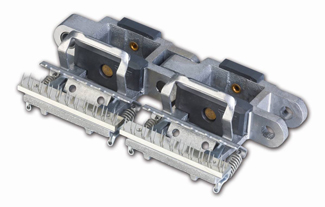
Monforts Introduces Hercules-V Tenter Chain

Germany-based dyeing and finishing machinery manufacturer A. Monforts Textilmaschinen GmbH &
Co. KG has introduced a new generation of vertically guided tenter chains that are especially
suitable for knitted fabrics and are designed for heavyweight knitted, nonwovens and technical
textile applications.

The Hercules-V tenter chain features a sturdy gray cast-iron construction with reinforced
chain track, and operates with transverse forces up to 1,500 newtons per meter, at running speeds
up to 100 meters per minute, and at temperatures up to 260°C. It also features a maintenance-free
design and long device life of the slide blocks. Optional depinning protection flaps are available.

MonfortsHercules


Monforts’ Hercules-V tenter chain

August 14, 2012

Wilcom AutoTuft Adds Representatives In India, China

Australia-based automated robotic tufting machine developer Wilcom AutoTuft Pty. Ltd. has added new
agents in India and China.

India-based IIGM Pvt. Ltd., a supplier of Wilcom’s embroidery offerings for more than 15
years, is adding Wilcom’s AutoTuft product range to its portfolio. IIGM also offers product support
and training to customers throughout the Indian subcontinent.

In China, Shun Long Machinery Co. Ltd. will carry Wilcom’s AutoTuft machinery. According to
Wilcom, the company is well-known in China and represents other prominent carpet machinery and
software suppliers.

Wilcom’s AutoTuft machinery uses pneumatic or mechanical tufting heads to produce custom
rugs and wall hangings with a “hand-tufted” look at a lower price than hand tufting. Additionally,
textures — such as 3-D and automatic cut-loop effects — not attainable on handmade products are
possible using AutoTuft.

August 14, 2012

IVL Completes PT Polypet Karyapersada PET Acquisition

Thailand-based polyester producer Indorama Ventures PCL (IVL) recently added 100,800 metric tons of
polyethylene terephthalate (PET) capacity with the acquisition of Indonesia-based PT Polypet
Karyapersada’s PET assets. The new PET capacity is located in West Java adjacent to PT Indorama
Petrochemicals’ PTA assets, which IVL acquired last year.

“The acquisition of PT Polypet Karyapersada creates synergies due to it being co-sited with
our PTA plant PT Indorama Petrochemicals in Indonesia, making it a strategic investment in the most
populous country in ASEAN,” said Aloke Lohia, Group CEO, Indorama Ventures.

“We are very pleased to be participating in the strong growth of Indonesia. The country is a
very attractive market for long-term investment and the Polypet deal will allow us to keep pace
with and serve the growth of our major customers in the country.”

Indorama has made numerous global acquisitions over the past year including two in North
America: Clear Lake, Texas-based Old World Industries
(see ”
Indorama
Acquires Old World
,”
TextileWorld.com, February 7, 2012)
; and Duluth, Ga.-based FiberVisions
Holdings LLC
(see ”
Indorama
Acquires FiberVisions Holdings
,”
TextileWorld.com, January 10, 2012)
.


August 14, 2012

The CETI Opens Its Doors In October 2012

ROUBAIX, France — August 2012 — The CETI is the world’s most recent research and prototyping centre
dedicated to new textile applications. At the heart of a first-class scientific network, the CETI
uses creativity techniques that accelerate the innovation process leading from uses to solutions.
Bringing together state-of-the-art equipment in one place allows industrialists to quickly advance
from research to prototypes and small series as soon as possible. The CETI’s inauguration is
scheduled for 10th and 11th October 2012.

The CETI’s mission

The CETI’s mission is to promote innovation through applied research by bringing
universities, laboratories and industry closer and creating links with the markets in order to
offer textile materials excellent prospects for the future.This involves understanding innovation
by rethinking its applications, combining skills, pooling resources and optimising solutions.

The CETI’s objectives

The CETI’s priority is to place innovation at the forefront of winning strategies by
facilitating technological development and industrial transfer. By creating a unique technological
platform in Europe with all technologies for developing innovative textiles, the CETI has set
itself several objectives:

• Developing new applications for intelligent textiles,

• Boosting the textile sector by diversifying technological research in various sectors,

• Developing cross-sector collaborative projects,

• Favouring interdisciplinarity and exchanges between application research and industrial
production,

• Accelerating the innovation transfer processes with concrete and rapid
applications(prototyping, small series, etc.)

The CETI’s players

Initiated by the UP-tex cluster, the CETI brings together various regional, national,
European and international players.The CETI is co-funded by Europe, the State, the local
authorities, the Ville Renouvelée semi-public limited company, the Union, the Caisse des Dépôts and
Batixia. It is supported by its historical partners: ENSAIT, HEI, Ecole des Mines de Douai,the IFTH
(French textile-apparel institute), Lille 1 University, the Nord Textile Industries Union and
CLUBTEX.

The CETI participates with them in an active network established with researchers from
business schools, universities,UP-tex competitive clusters, Techtera and Natural Fibre Clusters.


The CETI’s means


The CETI, a scientific research and development pool situated at the crossroads of Northern
Europe in the new Roubaix/Tourcoing/Wattrelos eco-district of “L’Union”, the CETI is housed in a
daring and high-performance multi-purpose architectural complex comprising:

• A unique 8000 m² research platform equipped with high-tech laboratories, state-of-the-art
equipment intended for prototyping and small series and independent workshops equipped with the
latest machines.

• A 6000 m² building housing the UP-tex competitive cluster, the CLUBTEX business cluster,
the Pole of Textile Excellence,the INNoTEX incubator, the IFTH (French textile-apparel institute) ;
the site is equipped with a conference room, meeting rooms, offices and various exhibition areas
for welcoming companies and private laboratories.


The CETI’s equipment

The spinning tool (Phase 1) is used to develop tomorrow’s new high-performance fibres
essential for markets such as ultra-filtration,medical devices, intelligent textiles. There are
only 4 tools of this kind in the world

The Non-woven fabrics tool (Phase 1) is used to develop new industrial solutions with new
technological combinations. This market is expected to grow by 21% by 2017.

Phase 2 planned for 2013 and 2014 focuses on the manufacturing processes (knitting, weaving,
braiding), especially for the composite or technical fabric markets.

The CETI works with the PIVERT and IFMAS IEEDs (Institutes for Research Excellence in
Decarbonated Energy) to develop textile applications from the biopolymers that will be developed
there. This responds to a strong demand from companies in search of new raw materials
(biocompatible PET, biocompatible PP, biocompatible PLA, etc.).

The CETI’s customers

The CETI is open to all those looking for innovative solutions through a technological
textile platform associating high-performance tools, skills and specialist expertise: SMEs and
companies from all sectors, the sector’s industrialists and specifiers; technical centres and
R&D departments in major companies; private and public laboratories, competitive clusters, etc.
• The CETI’s customers (Phase 1) are major companies using textiles, especially in the
hygiene, filtration and medical sectors.

Companies producing Non-woven fabrics as well as polymer and fibre producers are also
concerned.

• SMEs also find new opportunities for cooperating with major clients within the CETI and can
also develop specific small series with Phase 2 tools.


The CETI in the world

From Phase 1, the CETI positions itself as an exceptional world-class centre. It
can be compared in terms of equipment to the “Non-Woven Institute” (NCRC) which federates over 60
major companies around the development of new textile materials from Raleigh in the USA. This
centre generates an annual turnover of over $ 4m.

In Europe, the offer is split between the major German centres (STFI (Saxon Textile Research
Institute) in Chemnitz and ITV (Institute of Textile Technology and Process Engineering) in
Denckendörf) and the CENTI (Centre for Nanotechnology and Smart Materials) in Portugal which also
has Hills tri-component spinning equipment.

It is in Phase 2 that the CETI comes into its own as it will then be the only platform in the
world to bring together in one place as much technological equipment associated to cutting-edge
research as is mainly found in the Advanced Textile Materials scientific interest group (GIS
MTA).The CETI’s challenges Beyond its commitment to the future of an entire sector, the CETI is
going to:

• Change the image of textile in order to make it an innovative material turned towards the
future in diverse leading markets (health, transport, protection, industry, environment, etc.)

• Create richness and jobs with new profiles and equip the region with an internationally
renowned high-performance tool

• Attract investors and generate collaborative projects for developing tomorrow’s textile.

Posted on August 14, 2012

Source: Re-Activ/Association CETI

Home Textiles Sourcing Expo Closes With Record Exhibitor And Attendee Numbers

ATLANTA — August 2012 — After three days filled with plenty business talks and busy show aisles,
Home Textiles Sourcing Expo closed its doors on July 26 with excellent results. The event drew 146
exhibitors from 13 countries, an 11 percent increase over July 2011. The third edition of Home
Textiles Sourcing Expo was again co-located with Texworld USA, the largest apparel fabrics show in
North America, and the International Apparel Sourcing Show. The triple event as a whole welcomed
5,285 attendees, a 5 percent increase over July 2011.

“Based on these results, Home Textiles Sourcing Expo has certainly reinforced its position as
a leading sourcing event in North America to solely focus on fabrics and finished soft goods for
all home applications,” says John. P. Gallagher, President & CEO of Messe Frankfurt USA.
“Thanks to our partners and the show’s co-location with the apparel events, we achieved yet another
attendee and exhibitor record.” Messe Frankfurt organizes the show in partnership with the
Sub-Council of Textile Industry, China Council for the Promotion of International Trade (CCPIT
TEX).

Mr. LinYunfeng from CCPIT says, “This edition of the show marks the rally of local market
demand. The exhibitors of China Pavilion are stratified with the quality of attendees. This show
will be playing a more important role in bridging Chinese manufacturers and the American business
community.”

Lenzing Innovation

Lenzing Fibers continued to partner with Messe Frankfurt for the third edition of
Home Textiles Sourcing Expo and supported the show with the popular Lenzing Innovation Pavilion.
“As a leading producer of fibers, this Home Textiles Sourcing Expo is a very important platform to
showcase our Tencel® and MicroModal® fibers use in every aspect of bedding and also the innovations
in new product categories including upholstery and carpeting for the home that our customers are
able to achieve to U.S buyers, designers, merchandisers and sourcing professionals,” says Nina
Nadash from Lenzing AG.

Lenzing also organized a well attended seminar program in partnership with Messe Frankfurt.
Among the many highly praised seminars, Mark Woodman from Global Color Research introduced
attendees to the latest Home Textiles Sourcing Expo Trends by using themes from the acclaimed
Heimtextil Montage. Other popular seminar topics included “Sourcing Hot Spots” and “Mega Trends for
Fall/Winter 2013”.

Trend Forum

New for 2012, was the trend forum collaboration with Global Color Research. Global
Color Research was the curator of the trends on display in January at Heimtextil in Frankfurt. Four
color stories, from the official Heimtextil trend book ‘Montage’, set the stage for the latest in
trend themes for the upcoming season.

Exhibitor Statements

Kirsten Lambert, Co-Founder, Beantown Bedding, LLC, USA


“Our experience as first time exhibitors at the Home Textiles Sourcing Expo has been both
rewarding and productive. As an entrepreneurial venture introducing a new product, the event
provided the right location for us to establish valuable contacts, generate product awareness and
open doors to supply chain opportunities.”

Neil Prescott, Business-Development Manager, Textile City, Inc., Canada

“Overall the event was a good show for us. We saw many different types of buyers from the
brand, retail and institutional markets. We are glad we participated.”

July 2013

The fourth edition of Home Textiles Sourcing Expo will take place July 16 – 18,
2013 at the Javits Convention Center in New York City.


Posted on August 14, 2012

Source: Messe Frankfurt USA

Marchem’s Aqua-Tite Green New And Improved

NEW HAVEN, Mo. — August 13, 2012 — AQUA-TITE GREEN, MarChem CFI, Inc.’s post treatment water
repellant, has been reformulated and now uses silicone as the active ingredient, while still
adhering to all known VOC (volatile organic compound) standards.

By using silicone, which is one of the most effective water repellant substances
available,  AQUA-TITE GREEN now provides a finished product that is easy to apply,
environmentally friendly and has the same performance characteristics of the original AQUA-TITE
product.

“The project to create the new formula with silicone and stay within the VOC standards took
two years of intense research and crafting by our lab”, stated Glennon Boresi, MarChem CFI General
Manager. He added “Hats off to our technical team for developing  this new formula and
providing a product that meets MarChem CFI’s high expectations.

The New and Improved AQUA-TITE GREEN, with newly designed labels, is available now.


Posted on August 14, 2012

Source: Marchem CFI Inc.

Camira Goes From Fabric To Farming To Secure Supply Of Bast Fiber

United Kingdom — August 2012 — Textile innovator Camira have stepped back into the supply chain to
work directly with farmers who grow the innovative raw material input for the company’s sustainable
bast fiber fabric Hemp. The fabric uses hemp cultivated as agricultural crops to provide 40% of the
fiber blend, the rest comes from wool.

Camira’s hemp is grown as agricultural crops under licence from the UK Government on farms in
England. This bast fibre plant – like nettles, flax and jute – contains naturally occurring textile
fibre just inside the outer bark to give the stem both strength and flexibility.

Hemp is sown from seed in the springtime and is one of the fastest growing biomasses known,
reaching over 10 feet in just 120 days, without the need for agro-chemicals. After harvesting, the
long stems are left in bundles on the field, while its leaves decompose and act as natural
fertiliser for the following year’s crop. A process called dew retting breaks down the fibres
inside the stalks, the stalks are then baled ready for final separation. Mechanical decortication
breaks the brittle, woody stems which gradually fall away from the lighter, flexible fibre. The
woody shive is used for bio-degradable animal bedding, while the textile fibre is blended with pure
new wool.

Camira plant 40lbs of hemp seed per acre. 1 acre produces 2.5 tonnes of hemp straw, yielding
1,000lbs of hemp fiber, which – in a 60% wool, 40% hemp blend – makes 2,500 yards of fabric. The
company currently has 12 acres under cultivation which should provide enough hemp to make 137,000
yards when blended with wool.

The wool hemp yarn is blended and spun locally near the Camira manufacturing facility in
England. The fabric is then woven on energy efficient high speed dobby looms. Finally the fabric is
piece-dyed in low liquor dye vessels using non-metallic dyestuffs and a natural water supply
flowing directly from local hills.

The combination of blending bast fiber with pure new wool, makes an inherently fire retardant
fabric without the requirement for FR chemicals, post treatments or backcoating. Providing enhanced
fire security for commercial interiors.

Soft to handle, naturally inspired and manufactured using locally grown materials, Hemp is
Camira’s most sustainable fabric ever.


Posted on August 14, 2012

Source: Camira Fabrics Ltd.

Statement By U.S. Trade Representative Ron Kirk On President Obama’s Signature Of Key Job-Supporting Trade Legislation

WASHINGTON — August 10, 2012 — United States Trade Representative Ron Kirk today released a
statement following President Barack Obama’s signature into law of legislation that makes critical
amendments to the African Growth and Opportunity Act (AGOA) and the Central America – Dominican
Republic – United States Free Trade Agreement (CAFTA-DR).

“By signing this important legislation into law today, the President is ensuring job
protection for thousands of textile and apparel industry workers in the United States, Africa and
Latin America,” said Ambassador Kirk. “I am proud to say that this bill passed with immense
bipartisanship in both the House and the Senate last week. I commend Members of Congress on both
sides of the aisle for coming together to support American jobs and strengthen our relationship
with these key U.S. trading partners. The Administration looks forward to working with AGOA
stakeholders on both sides of the Atlantic to grow the U.S.-Africa trade and investment
relationship by taking full of advantage of this and other provisions of AGOA.”

Specifically, the bill extends until September 2015 the third-country fabric provision of
AGOA, which will enable the continuation of duty-free access into the U.S. for qualifying apparel
exports from sub-Saharan Africa. This provision was due to expire at the end of next month. It
would have been detrimental to many workers and apparel producers in sub-Saharan Africa had
Congress and the Administration not acted to renew it. The bill also adds South Sudan to the list
of sub-Saharan African countries that might become eligible for AGOA benefits once it meets
eligibility criteria. 

In addition, the bill provides for several technical amendments to CAFTA-DR. Among them is
one that ensures that all sewing thread used in CAFTA-DR qualifying garments must originate in
Central America, the Dominican Republic or the United States. Prior to this legislation, there was
a loophole in the Agreement that allowed for a type of sewing thread to originate in other
countries, like China. This amendment eliminates that loophole and, therefore, provides job
protection for thousands of American apparel and textile workers. 


Posted on August 14, 2012

Source: USTR

More Efficient Than Ever – The New JL 65/1 With Its Different Versions

OBERTSHAUSEN, Germany — June 27, 21012 — Lace is feminine, sexy and seductive, and is the result of
sophisticated, carefully considered, high-tech solutions. The Jacquardtronic® Lace machine is one
such example. The machines in this successful range of machines manufactured by KARL MAYER produce
lace with a smooth, fine, filigree appearance, can process different band widths without any
transition points, and are extremely efficient – and this level of performance has been improved
constantly. The result of the latest upgrade made to the Jacquardtronic® range was the optimisation
of the JL 65/1B. In this case, the development work did not only focus on making the machine
“faster and wider”.

Improved efficiency by increasing the working width and speed

The development work carried out by KARL MAYER involved making specific
modifications and changing the technical design, changes which considerably increased the
productivity of the Jacquardtronic® Lace with 65 guide bars.

These innovations on the new JL 65/1B and F models with a working width of 132″ enable them
to reach maximum speeds of 800 min-1, which means that they are 60% faster than their predecessors.
The older machines operated at speeds of up to 500 min-1.

Also in this range is the JL 65/1B with a working width of 168″ which, because of its overall
design, can reach almost the same speed as its sister machine with a width of 132″. It is more
efficient than the previous 132″-machine with its old design.The performance has been increased by
25%, just by extending the width of the new machine from 132″ to 168″.

The new machine concept also involved repositioning the pattern drive, with the string bars
being controlled from one side. This change enabled the performance potential to be fully utilised
for the relevant widths, and guarantees smooth machine running.As well as being extremely
efficient, the new JL 65/1B operates at the same high level of precision offered by all KARL
MAYER’s machines, and is easy to operate. All the operating elements are arranged ergonomically and
are also easy to see. Data can be transferred easily and clearly, either via an Ethernet interface
or touchscreen.

Huge patterning potential – as always

The JL 65/1B and F are fitted with electronically controlled systems for the yarn feed,
fabric take-down and pattern drive, as well as with KAMCOS® technology and its Motion Control/Multi
Speed system. These enable this multibar jacquard raschel machine to work a wide range of design
options. Clipped looks, muted, three-dimensional effects, and distorted grounds in a wide range of
structures and variations can be produced, as well as large-repeat pattern motifs and sweeping
contours processed in bourdon yarns. Different yarn materials can also be used to produce a greater
range of designs. Another advantage of the Jacquardtronic® Lace machine is that it is still
possible to change the starting position of the pattern quite freely – to make optimum use of its
patterning potential.

The latest optimised features have not reduced the patterning potential in any way. The
patterns that could be produced on the existing JL 65/1 with a working width of 132″ can be adapted
for processing on the new machine, simply by modifying the pattern data.Once again, the JL 65/1B is
being launched onto the market with the focus on versatility, productivity and technical
perfection.

The first patterns produced by KARL MAYER’s product developers can be found in the Patterns
section of this issue.

Posted on August 14, 2012

Source: Karl Mayer Textilmaschinenfabrik GmbH

ColorZen Offers Water-, Energy-, Chemical- And Time-Saving Cotton Dyeing Technology

ColorZen LLC — a new company formed to provide technology that eliminates the use of
environmentally detrimental chemicals and significantly reduces the amount of water, energy and
time needed to dye cotton — unveiled its new technology recently at The Continuum Show, a New York
City-based trade show that is focused on sustainability in textile manufacturing. ColorZen™
technology involves the pretreatment of cotton using a process that renders the fiber more
receptive to dye intake, does not require use of salt or other chemicals to fix the dye, and
enables the desired color to be achieved using half the amount of dye, with a 97-percent exhaustion
rate of the dye onto the cotton, compared to traditional cotton dyeing technologies. The company
reports the treated cotton can be dyed using conventional dyeing machinery, but the dyeing process
uses 90-percent less water than is required for conventional cotton because fewer rinses are
required and the water is recycled. The process also consumes 75-percent less energy because color
is applied at lower dyeing temperatures and the entire process is completed in one-third the time
needed for conventional dyeing.

The ColorZen process, which alters the cotton fiber’s molecular structure to attract the dye
naturally, has been in development over a number of years and has some basis in cationic chemistry,
which offers similar environmental benefits. However, according to Tony Leonard, the company’s
technical director, cationic chemistry has not been successful outside of a laboratory setting for
reasons related to cost effectiveness, complexity of the treatment and difficulty achieving
consistent results, among other factors. By contrast, said Michael Harari, president, “ColorZen
cotton can be produced on a mass scale at a cost that is effective, and most of the cost can be
offset by savings in water, energy, chemicals and time, all of which flow to the bottom line.”

“We took a lot from cationic chemistry because of the environmental side of it, and we
improved on it,” Leonard added. “We’re looking at supplying a treated product that is ready to use
with no concern about variations because we know how to control our whole operation. If we can
control the dye fixation, we can control the product.”

The company points out that although chemicals are used in the process, which has received
Oeko-Tex® Standard 100 certification, they become inert upon application to the cotton fiber, and
the treatment process produces zero discharge of toxic chemicals, or any chemicals. In addition,
the minimal amount of water used in the process is recycled.

ColorZen has opened its first processing facility in China because, as Harari explained,
“China is the most prolific textile export country, and most of the negative environmental effects
of textile production have occurred there.” In the future, the company plans to expand its
operations to other locations.

The company anticipates cotton products bearing the ColorZen hangtag will be available in
stores as early as next year. “We will now be able to offer brands, retailers, and manufacturers a
sustainable choice for cotton dyeing that will protect the fresh waterways and reduce energy
consumption,” Harari said.

August 7, 2012

Sponsors