ICAC: The Long Reach of China’s Cotton Policy

WASHINGTON — May 1, 2014 — Since the beginning of April when the Chinese government announced a lower starting auction price, the pace of sales from China’s reserve increased and the Type 328 China Cotton Index (a daily index of prices for domestic cotton offered to mills in China) fell from this season’s nine-month average of 144 cents/lb. to about 129 cents/ lb. by the end of April.

Although lower cotton prices are welcomed by the mills in China, a lot of damage has been done to the industry in the past few years by the Chinese government’s cotton policy. Since the start of its reserve policy in 2011, mill consumption has declined by 17%, from 9.6 million tons in 2010/11 to 7.9 million tons in 2013/14. In 2014/15, the decline in consumption in China is expected to slow, falling by just 1% to 7.8 million tons. However, the next three largest consumers, India, Pakistan, and Turkey are all expected to see growth in their mill use in 2014/15. World consumption in 2014/15 is expected to reach 24.3 million tons, an increase of 3% in comparison with the previous year.

While world mill use is expected to increase in 2014/15, world production is forecast to decline by 2% to 25.2 million tons, narrowing the gap between world production and consumption. In 2014/15, India is expected to produce nearly 6.3 million tons, which is a decline of 2% due to the expectation that the monsoon weather will not be as favorable as in 2013/14. Most of the decline in world production will occur in China, where production is expected to decline by 10% from 6.7 million tons in 2013/14 to 6 million tons in 2014/15. As the Chinese government has restricted its support for cotton to just the Xinjiang region, area outside is expected to fall significantly.

World trade is expected to decline in 2014/15 to 8.2 million tons from 8.7 million tons forecast for 2013/14. As with production, this decline stems mostly from China, where imports in 2014/15 are expected to be 2.2 million tons, down by 30% from 2013/14 and 60% from its peak of 5.3 million in 2011/12. However, China’s decline will be partially offset by imports from Bangladesh, Indonesia, and Vietnam, which are expected to import a total of 2.4 million tons in 2014/15, an increase of 13% from 2013/14.
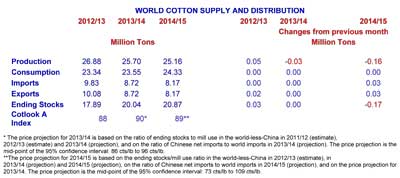

Please click chart to view larger

Posted May 6, 2014

Source: International Cotton Advisory Committee
 

Pima Cotton Trust Fund Distributions May Now Be Claimed

WASHINGTON — May 02, 2014 — The Department of Agriculture’s Foreign Agricultural Service is accepting through June 2 claims from eligible individuals or firms for distributions from the Pima Agriculture Cotton Trust Fund authorized by the farm bill enacted earlier this year. Such distributions, which will total up to $16 million per year for each of calendar years 2014 through 2018, aim to reduce the injury to domestic manufacturers resulting from tariffs on cotton fabric that are higher than tariffs on certain apparel articles made of cotton fabric.

Distributions out of the trust fund are payable to one or more nationally recognized associations established for the promotion of pima cotton for use in textile and apparel goods (25% of the total), yarn spinners of pima cotton that produce ring spun cotton yarns in the United States (25%), and manufacturers who cut and sew cotton shirts in the U.S. who certify that they used imported cotton fabric during calendar year 2013 (50%). To claim a distribution, eligible parties must submit a notarized affidavit affirming that they meet the statutory requirements, and shirting manufacturers and yarn spinners must provide definitive statements and supporting documentation verifying their eligibility. All claims, affidavits and supporting documentation for calendar year 2014 distributions are due no later than June 2.

Posted May 6, 2014

Source: Sandler, Travis & Rosenberg Trade Report
 

Art Novel, Schoeller Technologies Present The New energear™ Textile Technology On Upholstery Fabrics

SEVELEN, Switzerland — May 1, 2014 — Art Novel and Schoeller Technologies are presenting the new energear™ textile technology on fabrics for upholstered furniture. The energear™ finish ensures that any energy released by the body is returned to it. This additional energy can have a positive effect on the body and its energy balance.

Inspired by far eastern medicine
The knowledge of Far Infrared Rays and their positive properties has its origins in Asian curative medicine, which has focused for centuries on vital energy, known in Chinese as “Qi”. More and more people are discovering that their performance potential is more intensive when balance and flow of energy are in harmony. Schoeller Technologies has transferred this function to textiles and Art Novel is now using the textile finish in the area of upholstery fabrics.

Upholstery fabrics with energear™ technology
Humans constantly release energy into their environment in the form of Far Infrared Rays. energear™ has the ability to reflect these Far Infrared Rays and thus the radiated energy is returned to the body. The technology consists of a titanium-mineral mix which is applied to the fabric. energear™ is suitable for use with every type of furniture covering made of fabric, leather, imitation leather or flock. As a 100% add-on article, energear™ is applied only to the surfaces which can actually reflect the rays. The seat and back receive an additional layer of fabric, finished with energear™. “Furniture is not intended only for relaxation; rather in the future will also serve as an active source of energy. The fact that in the future every item of upholstered furniture can be available with energear™, regardless of the upholstering material, is just perfect,” says Stephan Eckerlein from Art Novel.

Positive effect on the energy balance
Art Novel furniture fabrics with energear™ technology can have a positive effect on humans’ energy balance. This can increase general wellbeing and balance, improve sleep, contribute to fast revitalization and prevent premature fatigue. energear™ can also positively impact concentration and performance capacity. “Positive results have been achieved in studies conducted by the Hohenstein Institute. Our customers are already applying the technology successfully in other segments, for example in the area of sportswear or therapeutic aids,” comments Hans U. Kohn, COO Schoeller Technologies.

Art Novel and Schoeller Technologies are presenting the energear™ technology on furniture fabrics for the first time from 7 to 9 May, 2014 at Proposte.

Posted May 6, 2014

Source: Schoeller Technologies

SSM Industries Launches Customer Service Initiative

SPRING CITY, Tenn. — May 2, 2014 — Tennessee based SSM Industries Inc. (SSM) is pleased to announce the launch of their new Customer Service Initiative. SSM’s enduring success is largely due to our partnerships with our customers. Guided by a core value of excellence, our Customer Service team is now making available a Binder Program that will provide our partners a valuable resource tool.

The Binder Program launch will create an efficient tool for all of our customers. The Binders will be provided along with sample headers (fabric samples and all relevant spec information) at no cost to our customer. This reference guide will be key to providing excellent customer service. As new fabrics are developed and come on-line, the Customer Service team will provide our customers, in the Binder Program, these new informational resource headers. Our Customer Team will also follow up with customers to discuss our dynamic fabric options.

SSM Industries, Inc., Vice President, Sales & Marketing, Steve Smith says, “SSM is initiating this program to better deliver our cutting edge fabric options to the market. We are ready to work one-on-one with our customers to design and personalize all of their specific fabric needs.”

SSM is dedicated to providing better connections and information for our customers regarding our fabric offerings. This investment will also provide convenience and will help simplify the ordering process. The Binder Program is a tool for research and will support our customer’s long term needs.

Please feel free to contact one of our customer service representatives to request a binder or visit our booth at Techtextil in Atlanta, Ga., to be put in the program. SSM customers will enjoy courteous, knowledgeable service from our team of professionals committed to delivering an outstanding customer experience.

Posted May 6, 2014

Source: SSM Industries
 

Zumba Selects Lectra Fashion PLM

PARIS — April 30, 2014 — Lectra, the world leader in integrated technology solutions dedicated to industries using soft materials—fabrics, leather, technical textiles and composite materials — is pleased to announce that Zumba is implementing Lectra Fashion PLM to manage its active wear line.

Founded in 2001, Zumba is the largest dance-fitness company in the world with a following of 15 million fans in more than 180 countries. The lifestyle brand also designs, develops and sells apparel from active wear essentials to fashion-infused designs, offering a range of pieces that transition effortlessly from the studio to the streets.

“Our goal at Zumba is to grow a successful apparel brand that can transcend any space, whether fitness or every day life,” says Gabriel Bottazzi, President of apparel at Zumba. “Visibility and clarity are of major importance in the development process and Lectra seamlessly connects teams throughout the product development ecosystem. Partnering with Lectra is a smart investment for us as we continue on our growth trajectory and evolve our collections.”

Lectra Fashion PLM will be used for Zumba’s apparel line starting with design, incorporating product development and sourcing. This will allow for the brand to better manage efficiencies with factories to understand sample development process, fabrics and trims, lab dips and more.

“With a vast network of partners within the supply chain, we look forward to helping Zumba achieve their business objectives through the process expertise and advanced technology we are able to offer,” says Roy Shurling, President, Lectra North America. “We welcome the opportunity to collaborate with such a growing brand that promotes health and wellness throughout the world.”

Posted May 1, 2014

Source: Lectra
 

The Rupp Report: The MMF Industry Is Preparing For Its Summit

The 53rd Dornbirn Man-made Fibers Congress (MFC) will be held in Dornbirn, Austria, Sept. 10-12, 2014. The congress is without any doubt the most important event for the global man-made fibers (MMF) community. It is organized by the Austrian Man-made Fibers Institute and supported by the Brussels-based European Man-Made Fibers Association (CIRFS).
 
Most Important Fibers
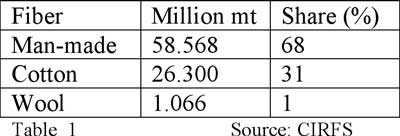
Man-made fibers are by far the most important global fiber consumption sector. Up to the 1990s, the ratio of natural versus man-made fibers was even at 50:50. In the last 15 years, the ratio has changed completely, mostly due to the increasing demand for industrial textile applications and nonwovens. At the moment, the ration is some 68 percent for MMF, and 32 percent for natural fibers. In the year 2012, world fiber production was 85.9 million metric tons (mt). The fiber breakdown and the share of each fiber material speak for themselves:

Is There A Future?
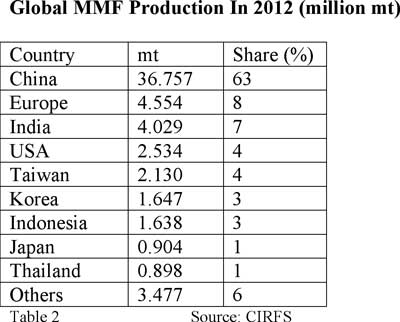
The 53rd Dornbirn-MFC has a very ambitious motto: “Communicating the Future of Man-made Fibers.” This motto is very appropriate if one looks at the situation of the global MMF production sites: During the 1950s up to the mid-1990s, Europe and the United States dominated the man-made fibers market. With the rise of China, this situation has changed completely. The table shows where man-made fibers were produced in 2012:
 

Broad Spectrum Of The Industry
Dornbirn-MFC organizers say that all the presentations are under the guideline “Innovation, Efficiency and Competitiveness.” As ever, Dornbirn is well-known and appreciated by the broad (sometimes even too wide) spectrum of papers in three different sessions. Some 100 lectures will be given by experts — representatives from the man-made fibers industry, the processing chain and academic research. All of them will use the Dornbirn communication platform for an intensive exchange of ideas. And this platform is very much needed: The organizers mention that “The global challenges of the developments in the financial sector and economies show that along with innovation (cost) efficiency and competitiveness become the decisive key factors for success of the European fiber industry.”
 
Opening Session
As in every year, the traditional plenary session on the opening day will start with presentations from Austria-based Lenzing AG’s Friedrich Weninger for the Austrian Man-made Fibers Institute and Frédéric Van Houte of CIRFS, and the awarding of the Paul Schlack Prize for outstanding research achievement. These presentations will be followed by a lecture by Oliver Börsch of Germany-based Bionic Strategy, titled “The Re-enchantment of the World – Survival Strategies with Brands as Modern Storytellers in an Engineered World.”
 
After a short break, Pierre Wiertz of the Brussels-based European Association Serving the Nonwovens and Related Industries (EDANA) will speak about new developments in nonwovens; and Peter Askew of the Organisation for Economic Co-operation and Development (OECD) will give a lecture on the standardization of antimicrobial testing methods. This lecture should be very interesting and is needed because all over the world, testing methods and standards for all kinds of testing often produce confusion more than they provide a helpful guideline.
 
Of course, every event is a costly matter. The organizers underline the fact that they enjoy a strong commitment and support by the main sponsors from the industry, and are writing that “due to the active involvement in an enlarged base the continuous expansion of the congress can be guaranteed in turbulent times as well.”
 
Key Factors For Success
 Following are the main themes:
 

  • global strategies in a changing environment;
  • fiber and filament innovations;
  • nonwovens/filtration;
  • automotive; and
  • key technologies.

 
The congress’s main theme, “Global Strategies in a Changing Environment,” will treat some of the decisive key success factors. The European Commission will present a paper on the “horizon of experience 2020,” which will focus on innovations and sustainable resources. This paper will be followed by Fenwis GmbH’s report about future textile and MMF markets and developments.
 
Invista will report on its market research results on consumer trends in textiles. Italy-based Radici Partecipazione S.p.A. will report on “sustainability as a source for market opportunities meeting the challenges of an integrated production.” The well-known German research institute and university RWTH Aachen will close with an industry report, focusing on textile industry workers.
 
Key Technologies
One of the most important factors for every successful industry is key technologies. This now enlarged section will report on recent findings in the areas of finishing, coating, machinery for spinning/extrusion and joint academic research and industry developments.
 
Today, quality is an important prerequisite for success. The enhancement in quality is another topic of the congress. Guidelines for this section are global strategies for a change, market specials, new business models and fiber/filament innovations referring to oil- and bio-based fiber raw materials, carbon fibers and functionalities.
 
The ever-increasing importance of nonwovens is reflected in a section that will have presentations about nonwovens and filtration. Another will cover automotive applications as well as transport products in trains, ships and airplanes.
 
The Place To Be
The Dornbirn-MFC is an event not to be missed not only for people in the man-made fibers industry but also for professionals who want to know more about the future of nonwovens and the European textile industry. And, last but not least, as at every important gathering of the global textile industry, networking is the key word. More information can be obtained at dornbirn-mfc.com.
 
April 29, 2014
 

Milco Industries Acquires Fablok Mills

Bloomburg, Pa.-based knitted fabrics supplier Milco Industries has acquired Fablok Mills Inc. — a Murray Hill, N.J.-based producer of raschel and tricot fabrics for filtration, geotextiles, tents, medical, athletic apparel, military and government, and other markets. The acquisition is expected to enhance Milco’s textile capabilities, enabling it to offer a diversified product line geared toward automotive, health care and government applications.
 
“Fablok Mills is a unique and well established company in our industry with a product line that will complement our already broad offering of quality knitted products,” said Joe Lurato, vice president, Milco Industries. “Fablok Mills has distinguished itself as a quality maker excelling in customer service and is a valued addition to our business. We believe our combined capabilities will benefit everyone in the textile supply chain.”
 
April 29, 2014
 

Formax Selects Karl Mayer Malitronic® Multiaxial Machine

Formax Multiaxial Reinforcements — a United Kingdom-based manufacturer of carbon fiber and specialty composite reinforcements — has installed a 35-meter Malitronic® Multiaxial machine manufactured by Karl Mayer Malimo Textilmaschinenfabrik GmbH, Germany, as part of a 2.5-million-euro investment program.
 
Formax installed the cut-and-lay machine at its new 5,000-square-meter automotive facility, which produces tailored non-crimp fabrics specifically optimized for high-volume automotive applications. According to Formax, the Malitronic machine will enable original equipment and Tier 1 automotive manufacturers to design a bespoke fabric or preform that will fit the structure being built as well as the manufacturing process, offering fast, cost-effective and efficient conversion of carbon fiber into parts.
 
Features of the Malitronic Multiaxial machine include: a variable width of 1,270 to 1,600 millimeters; three axes; the capability to lay ply angles ranging from 20 to 90 degrees with both in-line and off-line spreading technology, with ply weights starting at 50 grams per square meter; and electronic pattern cams that enable the generation of fabric-specific stitch patterns.
 
“Formax has recognized the demand being shown within the Automotive industry to include carbon composite structures within their multi material platforms,” said Dan Norton, Automotive sector manager, Formax. “With this machine, and its cutting edge spreading technology, we are able to increase fibre throughput whilst maintaining and delivering high manufacturing efficiencies.
 
“Resin and tooling technology are all advancing at a rapid rate to help deliver the magic 60 second cycle time the Automotive industry is pushing for, and we are confident that textile reinforcements can now be added to this list.”

 
Formax’s new Karl Mayer Malitronic® Multiaxial Machine

 
April 29, 2014


World Yarn Output Down But Fabric Output Up In Q4/2013: Estimates For Q1/2014 For Global Yarn And Fabric Output Are Positive

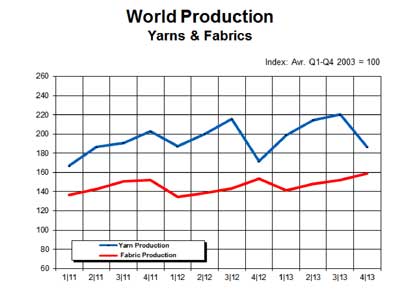
ZURICH, Switzerland — April 29, 2014 — Global yarn production dropped in Q4/2013 in comparison to the previous quarter as a result of lower output in Asia, South and North America while production in Europe was up. Year-on-year global yarn production was up with all regions – except South America – recording higher output levels. Worldwide yarn stocks rose due to higher inventories in Europe and Asia and despite lower ones in South America. On an annual basis global yarn stocks were up as well in all regions, except in South America. Yarn orders in Europe increased slightly but dropped in Brazil in Q4/2013. Compared to last year’s quarter yarn orders were lower both in Brazil and Europe.

Global fabric output was up in Q4/2013 as a consequence of higher production in Europe and Asia and despite lower output in South America. Year-on-year world fabric production rose due to increases in Asia and Europe and despite a drop in South America. Fabric stocks were slightly higher globally as a result of higher inventories in North and South America, while stocks were reduced in Europe and Asia. In comparison to last year’s quarter worldwide fabric stocks fell due to lower inventories in South and North America while stocks rose in Asia and Europe. Fabric orders in Brazil and Europe decreased in Q4/2013. On an annual basis fabric stocks were up both in Brazil and Europe.

Estimates for yarn production for Q1/2014 are positive in Asia, Europe, North and South America. Estimates for fabric production for Q1/2014 are positive in Asia, Europe and South America and negative in North America. The outlook for yarn production for Q2/2014 is positive in Asia and unchanged in Europe and South America. The outlook for fabric production for Q2/2014 is positive in Asia and unchanged in Europe and South America.

In comparison to the previous quarter world yarn output dropped in Q4/2013 by -15.4% due to lower output in Asia (-16.1%), South America (-14.7%) as well as in North America (-6.7%) and despite an increase in Europe (+4.6%). In comparison to Q4/2012 global yarn production rose by +8.7% as a result of higher production levels in Asia (+9.6%), North America (+5.0%), Europe (+0.7%) irrespective of a decline in South America (-6.7%).

Compared with the previous quarter global fabric production rose in Q4/2013 by +4.3% with Europe and Asia recording higher outputs of +6.4% and +5.6%, respectively, while South America’s production fell by -15.3%. Year-on-year global fabric production was up as well (+3.5%) with Asia recording a production jump of +5.4% and Europe of +2.0%, while South America recorded a slump of -19.8%.

Global yarn inventories were up by +1.2% in Q4/2013 due to higher stocks in Europe (+3.3%) and Asia (+1.4%) with stocks in South America down by -0.7%. On an annual basis global yarn inventories rose by +3.9% with Europe’s yarn inventory up by +4.6% and Asia’s by +3.2%. In South America yarn stocks were reduced by -5.5%.

Global fabric stocks in Q4/2013 increased slightly by +0.1% resulting from higher inventories in North America (+1.5%) and South America (+0,4%) and despite lower stocks in Europe (-1.1%) and Asia (-0.2%). Global fabric stocks were down year-on-year by -3.1% resulting from lower stocks in South America and North America (-16.8% and -0.2%, respectively). Fabric stocks in Asia and Europe on the other hand rose by +0.9% and +0.2%, respectively.

Yarn orders in Q4/2013 were up in Europe by +0.8% and down in Brazil by -18.7%. Compared to last year’s quarter, yarn orders recorded a fall in Brazil and Europe of -15.8% and -0.3%, respectively.  

In Q4/2013 fabric orders fell in Brazil by -7.7% and by -2.9% in Europe. On an annual basis they were up in Brazil by +25.1% and in Europe by +3.8%.
 
Posted April 29, 2014

Source: ITMF
 

Cotton Outlook Continues To Indicate Further Rise In World Ending Stocks

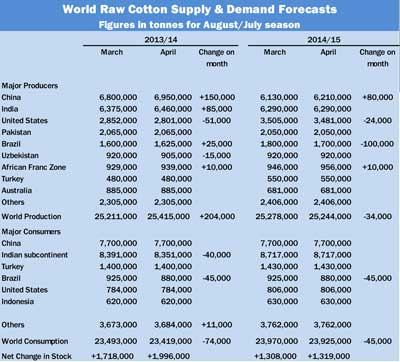
BIRKENHEAD, England — April 24, 2014 — Cotton Outlook’s world production number for 2013/14 has been raised by 204,000 tonnes, leading to greater carryover at the end of the season. The biggest increases are for China, India and Brazil. This was partially offset by decreases for the United States and Uzbekistan.

The 2014/15 world production figure has been reduced by 34,000 tonnes, owing to changes for Brazil and the US.

Global stocks are expected to rise by 1,319,000 tonnes next season, in comparison to 1,996,000 added during the current season.


Please click chart to view larger

Posted April 29, 2014

Source: Cotton Outlook
 

Sponsors