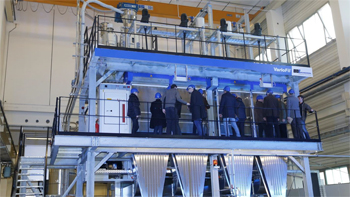
Johnson Controls Teams Up With adidas Group And Other Partners To Redefine The Way Textiles Are Manufactured

PLYMOUTH, Mich. — May 8, 2014 — Johnson Controls, a global multi-industrial company with core businesses in the automotive, building and battery industries, is working with leading sportswear manufacturer adidas Group and other partners to redefine the way textiles are manufactured.

The partners want to increase automation in the production of textiles. In doing so, Johnson Controls as the leading manufacturer of vehicle seats and seating components, intends to optimize seating trim cover production.

“Process innovations are just as important to Johnson Controls as product innovations,” said Andreas Eppinger, group vice president technology management for Johnson Controls Automotive Seating. “The majority of sewing required for vehicle seat covers is largely done by hand. Although increasing automation in this area is very complex, we are convinced that it is feasible.”

SPEEDFACTORY, as the project is known, aims to combine the capabilities of both humans and machines. At the project’s conclusion, the prototype of a system should be in place in which humans and robots work together to produce textile products.

While adidas Group seeks to automate the production of sporting goods, Johnson Controls’ goal is to automate the production of vehicle seat covers. The company intends to optimize the cutting and sewing process as well as the handling of textiles. This new process will involve textiles being cut in a certain way, aligned and then joined to make trim covers.

Johnson Controls is working on SPEEDFACTORY with the leading manufacturer of sports clothing and accessories, adidas, the mechanical engineering company, KSL Keilmann Sondermaschinenbau, the Institute of Textile Technology at RWTH Aachen University, and fortiss, an institute associated with the Technical University of Munich with the mandate to facilitate research and technology transfer in software-intensive systems and services. The research project is being sponsored by the German Federal Ministry of Economics and Technology.

Posted May 13, 2014

Source: Johnson Controls Inc.

Infinity Compounds Is Renamed Americhem Infinity Engineered Compounds To Reflect Continuing Synergies With Americhem

CUYAHOGA FALLS, Ohio — May 6, 2014 — Infinity Compounding, a leading manufacturer of custom compounded engineered thermoplastics, has taken on a new identity and now will be known as Americhem Infinity Engineered Compounds to reflect its close association with sister company Americhem, Inc. The renaming reflects business synergies between the two companies and the fact that Americhem Infinity has the backing and capabilities of Americhem and all that those attributes offer to their customers. 

“The new name and brand identity for Americhem Infinity reflects the similarities between the two companies, in that both companies enhance the properties of polymers for our customers,” said Rick Juve, CEO of Americhem. “Combining the size, scale, reach and the unique technologies of the two companies will further benefit the customers of both organizations.”

Americhem Infinity’s products are currently manufactured at its Swedesboro, New Jersey, headquarters. Going forward, Americhem’s plants in Liberty, North Carolina, and Suzhou, China, will also manufacture Americhem Infinity compounds.

“Our customers can expect the same partnership that they’ve enjoyed with Infinity since our founding in 2005,” said Carlos Carreno, president of Americhem Infinity. “We will maintain our focus on speed-to-market, service, and technical expertise, and our customers will only benefit from our continued affiliation with Americhem, who focuses on the same facets of customer partnership.”

In recognition of the rebranding of the company, Americhem Infinity has launched a new website — www.americheminfinity.com — focusing on its products, markets and applications. It is fully integrated with the new Americhem website, which was launched in January.

Purchased in December 2012, Americhem Infinity specializes in highly engineered thermoplastic compounds, serving a variety of industries including medical, electrical/electronics, business machines, IT/disk drive, aerospace, industrial and consumer products. Americhem Infinity’s compounds are made with a wide variety of engineering resins, feature a multitude of reinforcement and filler options along with specialty additive packages to meet stringent demands.

Posted May 13, 2014

Source: Americhem Inc.

Nordson VersaBlue Plus Melters Promote Higher Disposable-Hygiene Product Quality And Production Efficiency

DULUTH, Ga. — May 6, 2014 — Nordson® Corporation (Nasdaq: NDSN) introduced the VersaBlue® Plus melters with optional pattern placement and material flow monitoring and control at last month’s INDEX 2014 in Geneva, Switzerland. Incorporation of monitoring and control into the melter simplifies installation into the production process, as well as provides ease-of-use of these functions through the VersaBlue melter’s graphical, touch screen interface. Utilization of these expanded optional capabilities helps disposable hygiene product manufacturers produce higher-quality products faster, more efficiently and at lower cost.

 
Optional melter-integrated flow monitoring and control for up to four (4) channels for continuous or intermittent dispensing applications is an addition to the existing full-feature set that VersaBlue melters have delivered for more than a decade. Integrated closed-loop control continuously measures and compares the material flow rate to the application’s flow requirement, automatically adjusting material delivery in real-time to minimize the difference between the requirement and actual flow rates.
 
VersaBlue Plus melters also offer optional integrated closed-loop pattern control for up to eight (8) channels for intermittent dispensing applications. This functionality compensates for possible pattern drift over time, particularly in demanding, high-speed intermittent applications. Additionally, module response monitoring of up to thirty-two (32) channels verifies correct adhesive placement while enabling predictive maintenance and extending service life.
 
The VersaBlue melter’s intuitive, easy-to-use graphical touch screen interface simplifies set-up and operation of pattern and flow control, in addition to providing system status for various melter functions. Basic pattern and flow monitoring and control reporting are available on the melter display, or more detailed pattern and flow information can be exported to a laptop or via field bus.

Posted May 13, 2014

Source: Nordson Corp.


TW Graphics And Kiian USA Strengthen Partnership

SODDY DAISY, Tenn. — May 6, 2014 — TW Graphics and Kiian USA have agreed to strengthen their partnership and merge all digital operations. The acquisition of TW Graphics’ digital business is part of Kiian’s continued global growth strategy. Its aim is to concentrate on optimizing activities to strengthen support for customers, whilst improving product delivery, product development and overall service.
 
With a clear focus on continuity, the TW Graphics team will become part of the joint sales, logistics and customer service for Kiian Digital’s distribution in America.
 
Kiian President Dennis Wilby explains, “This development marks a very important step in the continued growth of Kiian’s global business. Our successful relationship with TW Graphics has already proved to be a close partnership, but now Kiian gains the value of synchronizing our business with a supplier with a strong track record and excellent reputation. For Kiian, already with a global reach in over 90 countries worldwide, this development underlines our commitment to improving our local support and increasing our competitive position.”
 
Earlier this year, Kiian made considerable investments in its operational structure and the set-up of a new production facility for digital ink manufacturing in Europe. Simultaneously, Kiian has invested in a production facility in the USA, new offices in Asia and the recruitment of talented and experienced team members to further extend its expertise and increase value to its customer base.
 
Kiian USA has officially opened in September 2013 in Hamilton County, Tennessee. Alessandro Ratti, who has experience and success in developing Kiian’s digital textile ink range, leads the regional office of Kiian Digital. Kiian USA produces and delivers its products throughout the Americas.

Posted May 13, 2014

Source: Kiian Digital

Jing Jin, Wei Dong, and Yong Liang Receive AATCC’s J.W. Weaver Paper of the Year Award

RESEARCH TRIANGLE PARK, N.C. — April 15, 2014 — Jing Jin, Wei Dong, and Yong Liang, who co-authored a paper on “Determination of Acrylamide in Textiles by GC-MS using 13C3-labeled Acrylamide as Internal Standard” published in the January/February 2013 issue of AATCC Review, have been selected as the writers of the best peer-reviewed paper published in AATCC Review in 2013.
 
For their significant contributions to textile science literature, the authors were honored with the J. William Weaver Paper of the Year Award on April 3, 2014, at an awards ceremony held at the AATCC 2014 International Conference.

Jing Jin obtained her Masters from Sichuan University in 2004. She is currently the Associate Director of the Sichuan CIQ Laboratory of Textiles in Chengdu, Sichuan, China. Wei Dong graduated with a BS from Zhejiang Sci-Tech University in 1992. He is currently Associate Director of the Sichuan CIQ Technology Center in Chengdu, Sichuan, China. Yong Liang has a Masters from Sichuan University in 2004. He is currently the Associate Chief Physician at the 363 Hospital in Chengdu, Sichuan, China.

The Weaver Award:  In February 1979, AATCC established an award for the best peer-reviewed paper published annually in the Textile Chemist and Colorist (afterwards AATCC Review; now these papers are published in the AATCC Journal of Research). In 1990, the award was named for J. William Weaver (1916-1990), who was chair of AATCC’s Editorial Board at the time of his death.
 
Posted May 13, 2014

Source: AATCC
 

Kadant Solutions Introduces Compact Roll Cleaner Assemblies

AUBURN, Mass. — May 7, 2014 — Kadant Solutions, a division of Kadant Inc. announced the launch of its VeriKleen™ and patent-pending VeriLite™ roll cleaner assemblies used for cleaning belt and roll surfaces. The new roll cleaner assemblies are compact, lightweight, and rugged devices designed to effectively and safely remove contaminants such as dirt, scale, coatings, and adhesives from belts and rolls. The proprietary self-pivoting blade holder provides precise blade loading against the belt or roll resulting in highly uniform cleaning and improved line productivity.

According to Jerry Vandoros, product manager at Kadant Solutions, “The VeriLite and VeriKleen products were designed specifically for applications where installation space is tight and the cleaning uniformity demands are high. Utilizing strong, yet lightweight, alloys allowed us to design a system that is both ultra-compact and can be used in applications where conventional roll cleaners cannot. Our customers using the assemblies have been pleased with the ease of installation, cleaning effectiveness, and the low maintenance requirements.”

Posted May 13, 2014

Source: Kadant Solutions
 

The Rupp Report: Spanish Fashion On The Way To The Top

While Spain’s economy is leaving its financial crisis with a lot of problems, the fashion industry is permanently recording new success stories. In 2013, the Spanish apparel industry exported products and services worth nearly 20 billion euros, representing an increase of 47 percent since the beginning of the crisis in 2008. Shops bearing the labels Zara, Mango and Desigual have conquered the top league of fashion around the globe.
 
Zara As A Pioneer
It was the Inditex daughter company Zara that showed the Spaniards the way. The textile giant has emphasized export markets for a long time. The international conquest started in 1988 in Porto, Portugal, where the first Zara store was opened beyond Spanish borders. Today, 26 years later, the group has 6,300 shops in 87 countries and a global turnover of 16.7 billion euros. Meanwhile, Inditex earns only 19 percent of its revenue in Spain; ten years ago, it was 46 percent.
 
However, for the first time since going public in 2001, Inditex — the world’s largest apparel group — couldn’t increase its operating profit in the last fiscal year. With 3.9 billion euros, the operating profit stagnated. Also, the currency collapse in key emerging markets continued to be alarming to the company, which for the first time ever netted more turnover in Asia than in Spain. In total, revenues grew by 5 percent to 16.7 billion euros.
 
Inditex knows how to detect trends, to produce — and copy — chic catwalk fashion, and bring it to market quickly and at moderate prices. More than half of all garments are made in Spain, Morocco or Portugal. This is a more expensive approach; however, it allows great flexibility and lowers transport costs and ways. Zara and other Inditex brands work almost without any traditional advertising. They rely mainly on stores in prime locations around the globe.
 
Mango
Mango, the second-largest textile giant in the country, is more global than Zara. The internationally recognized company is engaged in the design, manufacture and sale of garments and accessories for men and women. Based in Barcelona, the company is present in 107 countries and operates more than 2,415 stores. In 2013, Mango recorded nearly 1.8 billion euros in turnover, of which only 17 percent was generated in Spain.
 
Mango made a quick and steep path to the top: The first shop was opened in 1984 in Barcelona, and the next, one year later in Valencia. By 2000, Mango had become the second-largest Spanish textile exporter. It entered the North American market in 2006 with the first stores in Costa Mesa, Los Angeles, San Francisco and Santa Monica, Calif.; Dallas; Chicago; McLean, Va.; and Orlando, Fla. Today, the company has more than 11,200 employees, of whom 1,800 work at its Hangar Design Centre and its headquarters.
 
Quality Management
The expansion into future markets is still going on. Among the latest openings were shops in important cities such as Tokyo; Xiamen, China; Erlangen, Germany; and Verona, Italy. The fashion concept is said to be a combination of a quality product and original design and results “in a coherent and consistent brand image.”
 
In order to develop further to another level, Mango assigns the inventory to its franchisers. In 2000, the company inaugurated a logistics system specially designed to enable the handling and distribution of 30,000 garments per hour.
 
Last year, Mango opened its new Dynamic Distribution Centre (CDD) in Barcelona. This 24,000-square-meter warehouse specializes in the distribution of folded garments. From now on, the head office is only responsible for hanging garments. In CDD, all loading, storage, handling and shipping processes are automated. In this way, the cost of labor is considerably reduced and employee performance is optimized. Mango claims that its system is the most efficient one in the sector and five to seven times faster than its competitors’ systems.
 
The high-tech logistics system is characterized by high speed and a large flow of information, and can serve each branch worldwide at any time, subject to demands. Through the production and distribution of 90 million pieces per year, a constant renewal of inventories and the respective production rhythm is guaranteed, based on both the quantity and the variety of items.
 
Desigual
Barcelona-based Desigual, with its colorful patchwork fabrics, has grown very strongly in recent years. “Desigual” in Spanish means unequal, different. In 2012, Desigual, which was founded in 1984 by Swiss designer Thomas Meyer, sold more than 22 million items through its retail channels in more than 100 countries — including more than 330 of its own stores, 9,000 multi-brand stores and 2,200 concessions in department stores. The company employs 3,800 people from 85 different nationalities.
 
Desigual’s slogan is “La Vida es Chula,” which means “Life is Cool, Chic and Bold” in English. As the company states, “This is the brand’s battle cry, an enthusiastic, stimulating, positive, optimistic slogan and a true declaration of intent.” And it is committed to seven values: recognition, positivity, tolerance, respect, commitment, fun and — last but not least — constant improvement.
 
The brand is widely available in stores in Japan, the United Kingdom, Hong Kong, Korea, Australia, Germany, France, Italy and Scandinavia. In the last year, new stores opened in cities including Vienna, Antwerp, Paris, Los Angeles and Rome.
 
Desigual is among the fastest-growing fashion groups in the world. In 2012, CEO Manel Adell predicted the company would reach a turnover of 1 billion euros within two years. From 2001 to 2011, its turnover grew from 8 million to 560 million euros. In 2013, the group netted a turnover of 828 million euros, an increase of 18 percent, compared to 2012. Only 23 percent of the revenues were generated in Spain and in Portugal. This year, Desigual wants to push ahead with its international expansion and is already aiming for a result beyond 1 billion euros.
 
Desigual wants to be represented with its own stores in the 1,000 main shopping streets of the world. “But currently we have only 300 stores,” Adell said recently. Asia and America are especially in the company’s focus. The intention is to be more independent from Europe in order to spread the risk. According to Desigual, Europe currently has a share of 85 percent, but the target is 30 percent.
 
Be Fast
Spain has a long tradition in the production of textiles. This know-how is also used by foreign world brands, which had returned to Spain for some years to manufacture a big portion of their products. The trend of producing apparel only in Asia is reverting to producing in Spain. Bangladesh as a production site is less attractive anyway, and not only for moral reasons due to the catastrophic working conditions. Producing in Spain is also important for the fashion industry, and this is old common sense, to be as close as possible to the demand in order to respond rapidly to any change. This trend could leave some Asian countries in the long run with sleepless nights.
 
May 6, 2014
 

DAP America Named Exclusive Western Hemisphere Importer Of Pfaff Industrial Products

Germany-based industrial sewing and seam welding equipment supplier Pfaff Industriesysteme und Maschinen AG (Pfaff Industrial) has named DAP America Inc., formerly known as Dürkopp Adler America Inc. — a Norcross, Ga.-based supplier of industrial sewing equipment, and a subsidiary of Dürkopp Adler AG, Germany — the exclusive importer of Pfaff industrial equipment and spare parts in the Western Hemisphere. The partnership is intended to expand distribution of Pfaff Industrial equipment throughout the Americas as well as improve its customer service and speed up response times.
 
DAP America now imports parts from Germany daily as opposed to the previous weekly program.
 
May 6, 2014
 

INDA Earns U.S. EPA Environmental Merit Award For Campaign To Reduce Flushing Baby Wipes

CARY, N.C. — May 5, 2014 — INDA, the Association of the Nonwoven Fabrics Industry, has been recognized for its environmental stewardship with a 2014 U.S. Environmental Protection Agency (EPA) Environmental Merit Award for a public awareness campaign that successfully reduced the amount of non-flushable baby wipes found in the wastewater system in Portland, Maine.
 
INDA was lauded for its outstanding efforts in preserving New England’s environment with the award for the campaign, “Save Your Pipes: Don’t Flush Baby Wipes.” The award was presented to INDA during ceremonies on Earth Day, April 22, in Faneuil Hall, Boston, Mass.
 
The campaign, a joint effort with the Maine Wastewater Control Association (MWWCA) and Portland Water District, included television and print ads, social media as well as supermarket signage. Initial post-campaign survey results showed the campaign led to a 50 percent reduction in baby wipes found in the wastewater systems with additional studies on the environmental impact continuing.
 
Dave Rousse, INDA President, said, “Being selected as the recipient of the 2014 EPA Environmental Merit Award is an honor and great recognition of this collaborative campaign and INDA’s efforts over the past decade to reduce the amount of non-flushable material in the wastewater stream.”

In presenting the award, Patricia Aho, Department of Environmental Protection (DEP), Commissioner for the State of Maine, said the campaign represented a first of its kind collaboration in North America by three entities to address this environmental consumer, municipal and industry issue.
 
“Treatment operators have told the Maine DEP that with the sales of wipes and new products growing exponentially, consumers can be confused by which ones can be flushed or not, leading to clogs,” said Commissioner Aho. “Our wastewater treatment operators who are truly on the front lines of environmental protection are facing more and more of these challenges every day. INDA is playing an important role in a creative and innovative solution to a national problem.”
 
The wipes category represents a $6 billion dollar industry that is growing 4-5 percent annually. The development of new flushable wipes is contributing almost 10 percent of the industry growth. INDA has been leading the nonwoven industry’s efforts to build awareness for the proper disposal of nonwoven materials designed to be flushed and those that are not. 
 
According to a recent study by INDA and Maine wastewater entities, materials found on pump station inlet screens consisted of non-flushable paper, like hand towels or napkins (46 percent); non-flushable baby wipes (18 percent); non-flushable feminine hygiene products (13 percent); non-flushable household wipes (14 percent) and wipes labeled as flushable (8 percent).
 
INDA, with its industry association partner in Europe, EDANA, jointly introduced the Third Edition Guidance Document for Assessing the Flushability of Nonwoven Disposal Production in June, 2013. The associations not only strongly urge that products pass these guidelines before being labeled as flushable, they also developed a voluntary Code of Practice that urges a “Do Not Flush” logo to use on product packaging of wipes that are not designed to be flushed.

INDA was among 26 recipients honored for contributing to improving New England’s environment with the annual merit awards that have been given out since 1970.

Posted May 6, 2014

Source: INDA

International Textile Group Announces Gorga Retirement, Appointment Of Kunberger As CEO

GREENSBORO, N.C. — May 1, 2014 — International Textile Group, Inc. (“ITG”) announced today that Joseph L. Gorga, President and Chief Executive Officer, has announced his plans to retire from the Company effective May 31, 2014, having served as President and Chief Executive Officer since the Company’s formation in 2004. In connection with Mr. Gorga’s announcement, the Board of Directors has appointed Kenneth T. Kunberger as the Company’s President and Chief Executive Officer effective May 1, 2014. Mr. Kunberger has served as the Company’s Chief Operating Officer since December 2011 and has also been with the Company since its formation.

Mr. Gorga will assist Mr. Kunberger in a transitional capacity through May 31. Mr. Gorga will also retire from the Board of Directors on June 30, 2014.

Gorga’s distinguished career in the industry, spanning over forty years, included service with Milliken and Company in a variety of executive roles and service as Chairman and CEO of CMI Industries prior to joining Burlington Industries in 2002. He was named President and CEO of Burlington upon its acquisition by WL Ross & Co. in 2003. Gorga was named President and CEO and a member of the Board upon ITG’s formation in 2004. Throughout his career, he has been a proponent and strong supporter of the textile industry, having previously served as a director and vice chairman of the American Textile Manufacturing Institute (ATMI) and chairman of the National Textile Association (NTA).

“Joe was instrumental to the Company in its formation, integration activities, international development and transition to its role today as a preeminent supplier of technology and innovation in the industry supply chain,” said Wilbur L. Ross, Chairman of ITG’s Board of Directors. “With his leadership during these past ten years, ITG is now positioned for continued growth in many key areas. I appreciate Joe’s contributions, leadership, and his development of a strong management team poised for the opportunities we have going forward. I know that everyone within the ITG organization and in the Greensboro community will join me in wishing him well.”

Kunberger joined Burlington Industries in 1998, having previous experience with Liz Claiborne in New York, where he held a number of management positions in sales and marketing, merchandising and operations, and with VF Corporation, where he held various executive positions for VF Licensed Jeanswear and Marithé et Francois Girbaud, a fashion jeans company.

At Burlington, Mr. Kunberger served in various executive capacities in its sportswear, denim, and apparel businesses.

Upon the formation of ITG, Mr. Kunberger served in a number of executive positions with increasing levels of responsibility. From his position as President of Burlington WorldWide, he was subsequently named President of ITG’s Apparel and Specialty Fabrics Group, where he assumed responsibility for the Cone Denim business and its operations in the U.S., Mexico, and China. He was subsequently named Chief Operating Officer.

In addition to his duties to ITG, Mr. Kunberger also serves on the Industry Advisory Board of the North Carolina State University School of Textiles.

“Ken has made many contributions to the Company in his previous roles, and we believe he is the right person to lead ITG as it moves to expand its brand, product, and customer bases,” said Joe Gorga. “Ken’s past experiences and skills, along with his passion for the Company’s businesses and products, will be invaluable as ITG continues to build upon its heritage as the preeminent supplier of innovative products in its various marketplaces.”

Said Wilbur L. Ross, “We are very pleased to have Ken as President and CEO and look forward to his leadership as ITG embarks on the many opportunities it has as the product and innovation leader in its marketplaces. We value his past contributions to the Company, to Burlington, and to Cone Denim, the leadership he has provided in the growth of the denim business, and are excited about the possibilities for the future as he leads the Company into the next chapter.”

Posted May 6, 2014

Source: ITG

Sponsors