
National Cotton Council 2015 State Unit Officers Named

MEMPHIS, Tenn. — National Cotton Council state unit officers for 2015 were elected at the industrywide organization’s annual meeting held here on February 6-8.

Chairmen, vice-chairmen and secretaries, respectively, of the state units are:  ALABAMA – Steven Sterling, producer, Tuscumbia; Joseph Scarborough, III, producer, Shorter; and Nicholas McMichen, producer, Centre; ARIZONA – Dan Thelander, producer, Maricopa; Bill Brackett, ginner, Buckeye; and K.C. Gingg, producer, Buckeye; ARKANSAS – Herrick Norcross, III, producer, Tyronza; Rick Bransford, producer, Lonoke; Nathan Reed, producer, Marianna; CALIFORNIA – John E. Seiler, producer, Blythe; Mark C. McKean, producer, Riverdale; Joseph Cain, warehouser, Hanford; FLORIDA – B.E. “Sonny” Davis, Jr., producer, Cottondale; Joseph Diamond, producer, Jay; Scott Mitchell, ginner, Donalsonville, Ga.; GEORGIA – Ralph Sandeford, ginner, Midville; Steven Meeks, producer, Screven; and Jaclyn Ford, producer, Alapaha; KANSAS –Thomas Lahey, producer, Moscow; Stuart Briggeman, producer, Pratt; Gary Feist, ginner, Anthony; LOUISIANA – Ted Schneider, producer, Lake Providence; Jason Condrey, producer, Lake Providence; and Ben Guthrie, producer, Newellton; MISSISSIPPI – David C. Camp, cooperative, Greenwood; Patrick Johnson, Jr., producer, Tunica; Coley Bailey, Jr., cooperative, Coffeeville; MISSOURI/ILLINOIS – A.C. Riley James, ginner, New Madrid, MO.; William Hunter, cooperative, Bell City, MO.; Stephen Harris, ginner, Senath, MO.; NEW MEXICO – Alberto Pando, ginner, Mesquite; Nathan Jurva, producer, Carlsbad; Keith Franzoy, producer, Hatch; NORTH CAROLINA – Joseph Martin, II, producer, Conway; Brad Warren, producer, Faison; Kent Smith, producer, Rocky Mount; OKLAHOMA – Randy Squires, cooperative, Altus; Cary Crawford, cottonseed, Oklahoma City; Jeannie Hileman, ginner, Carnegie; SOUTH CAROLINA – Kendall Wannamaker, producer, Saint Matthews; Levin Lynch, ginner, Florence; Drake Perrow, ginner, Cameron; TENNESSEE/KENTUCKY –Jason Luckey, producer, Humboldt, Tenn.; John Lindamood, producer, Tiptonville, Tenn.; Will Wade, III, ginner, Kenton, Tenn.; TEXAS – Doyle Schniers, producer, San Angelo; Jim Bradford, ginner, Dimmitt; Jon Whatley, producer, Odem; VIRGINIA –James Ferguson, producer; Joey Doyle, producer; and Mark Hodges, III, ginner, all of Emporia.

Posted February 10, 2015

Source: National Cotton Council
 

National Cotton Council Names 2015 Directors

MEMPHIS, Tenn. – The National Cotton Council directors for 2015 were announced at the NCC’s annual meeting held here on February 6-8.

Elected to the NCC Board during segment caucuses were:
Producers – Ronald Lee, Bronwood, Ga.; Ted Schneider, Lake Providence, La.; Shawn Holladay, Lubbock, Texas; Cannon Michael, Los Banos, Calif.; and Bowen Flowers, Clarksdale, Miss.
Ginners – Robert Waters, Jr., Scotland Neck, N.C.; David Blakemore, Campbell, MO; Levin Lynch, Florence, S.C.; Ron Craft, Plains, Texas; and Robert Gladden, Stanfield, Ariz.
Warehousers – David Fields, Corpus Christi, Texas; Charlie Jackson, Memphis, Tenn.; Thomas Clodfelter, Seminole, Texas; Donald Robinson, Garner, N.C.; and Ron Harkey, Lubbock, Texas.
Merchants –Jordan Lea, Greenville, S.C.; John Mitchell, Prattville, Ala.; Doug Christie, Cordova, Tenn.; Bobby Walton, Memphis, Tenn.; and Anthony Tancredi, Cordova, Tenn.
Cottonseed – Andy Borem, Tifton, Ga; Austin Rose, Oklahoma City, Okla.; Paul Scruggs, Overland Park, Kan.; Sammy Wright, Tifton, Ga; and Robert Lacy, Jr., Lubbock, Texas.
Cooperatives – Zane Burkhead, Jay, Fla.; Michael Quinn, Garner, N.C.; Sam Hill, Lubbock, Texas; David Camp, Greenwood, MS; and Jarral Neeper, Bakersfield, Calif.
Manufacturers – Anderson Warlick, Gastonia, N.C.; Robert Chapman, III, Inman, S.C.; James Martin, Gastonia, N.C.; Robin Perkins, Sanford, N.C.; and Owen Hodges, III, Columbus, Ga.

Posted February 10, 2015

Source: National Cotton Council

 

Johnson Controls Renews Strategic Partnership Agreement With Lectra

PARIS — February 5, 2015 — Lectra, the world leader in integrated technology solutions dedicated to industries using soft materials—fabrics, leather, technical textiles and composite materials—is pleased to announce that Johnson Controls has reaffirmed its confidence in Lectra by extending their global partnership agreement for an additional three years. To preserve and strengthen its position as a market leader, Johnson Controls will acquire all of its high ply fabric cutting equipment and related services exclusively from Lectra.

Johnson Controls is the world’s largest complete automotive seating supplier, providing innovative, stylish seating systems to vehicle manufacturers worldwide. The company supplies over 50 million cars every year from 220 production plants worldwide.

During the first 10 years of the agreement, Lectra supported Johnson Controls in transforming their automotive trim cutting rooms worldwide, as they abandoned traditional die presses in favor of more flexible automated cutting. The company now has more than 180 Vector® solutions installed worldwide. Johnson Controls’ adoption of the Vector solution—ideal for high-volume cutting of a wide variety of automotive seat materials—and the resulting increase in production flexibility, throughput and material efficiency has provided the seating supplier with a significant advantage in the highly competitive automotive industry.

The renewal of this agreement is testament to the role of Lectra’s customer care, expertise and state of-the-art technology in enabling a company such as Johnson Controls to improve its operational and manufacturing performance. The continuing collaboration will focus on optimizing the agility of Johnson Controls’ production processes, a strategic necessity in the increasingly complex automotive parts supply business.

“At Johnson Controls, we are continually investing in technologies and solutions that will allow us to produce more efficiently, while still providing our customers with consistent quality products. Extending this agreement underscores the value of our relationship with Lectra to help us achieve our strategic objectives,” says Willy van-Looy, Global Director, Advanced Manufacturing Engineering, Trim Operations, Johnson Controls.

As part of the new agreement, Johnson Controls will also migrate to the latest generation of Lectra services for all of its Lectra equipment. Working 24 hours a day, the company cannot afford to lose production through unexpected stoppages. Lectra’s expertise and technology, combined with its predictive maintenance services, deliver maximum uptime of the cutting solutions, reduce the cost per cut piece and ensure Johnson Controls has the ability to honor their commitment to deliver on time.

“It is an honor for Lectra to have such a long-standing relationship with Johnson Controls, one that is based on a common culture of innovation and best-practice sharing. With Lectra’s 40 years’ of expertise and experience in developing and implementing the most advanced technology solutions, and Johnson Control’s skillful application of them to manufacture their seating systems, we are confident that this will continue to be a rewarding collaboration between our two companies,” says Daniel Harari, Lectra CEO.

Posted February 10, 2015

Source: Lectra
 

ACIMIT: Only Domestic Orders On The Rise For 4th Quarter In 2014

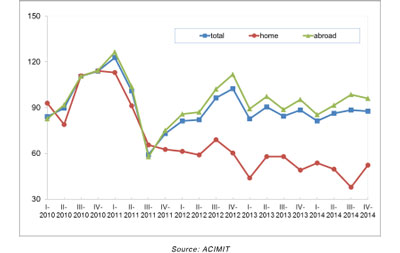
MILAN — February 6, 2015 — For the textile machinery sector, the year’s fourth quarter resulted in a decline in orders, mainly due to a negative performance recorded in foreign sales. These findings have been reported in an economic survey conducted by ACIMIT, the Italian Association representing the industry, indicating a 4% drop over the previous quarter. The value of the orders index for the period from October to December 2014 came in at 85.0 points (basis: 2010=100).
 
This decline in the index can be blamed on the overall negative performance recorded for this period in markets abroad, where orders effectively came in at an index value of 92.7 points (-6% over the previous period). On the other hand, domestic orders rebounded compared to the third quarter (+34%), for a value of 50.8 points.
 
ACIMIT President Raffaella Carabelli explained the positive data for the domestic market, “The growth in orders in Italy over the last segment of 2014 appears to be a good sign for 2015, during which we will reach an apex with ITMA, the premier trade fair in the industry, to be held in Milan from the 12th to 19th of November. This climate of greater confidence at a macroeconomic level seems likely to become contagious for various sectors of our economy,” continues Carabelli. “I’m certain that the entire textile industry can benefit from the current global economic trends, and I’m referring especially to the weaker European currency and lower interest rates.”
 
Optimism is the key word for Italy’s textile machinery sector on the eve of hosting ITMA; a sense of optimism that is already evidenced by the event’s updated figures. Indeed, the Milan edition will exceed the 100,000 sq. meter threshold (the previous edition held in Barcelona in 2011 covered 80,000 sq. m of exhibition space). By end of January, 388 Italian exhibitors had confirmed their commitment to participate in the event, out of a total of 1500 participants, for an overall growth in acquired exhibition surface area of 48% compared to the previous edition. Lastly, requests for increased exhibition space already optioned and demands put forward by new exhibitors continue to pile into an already crowded waiting list.


Posted February 10, 2015

Source: ACIMIT
 

Raw Cotton Destocking Could Bring Quality Issues For Spinners

USTER, Switzerland, February 4, 2015 – As worldwide stocks of cotton continue to build up, spinners might be eagerly anticipating a period of lower prices for their raw material. But there are serious risks ahead, particularly when the market is likely to be flooded with some cotton which has been stored in warehouses for lengthy periods.

This issue was highlighted at the recent ITMF Conference in Beijing and the ICAC Plenary Meeting in Thessaloniki, with experts warning that stockpiled cotton can degrade over time.  Quality problems are inevitable: color loss (‘yellowing’) and deterioration of spinning quality are the biggest concerns. Accurate testing with USTER® HVI 1000 is the only sure way to check that cotton supplies are fit for purpose.
 
Prices on world cotton markets look set to fall, against a background of inventory levels which have risen massively over recent years. It is estimated that more than 100 million bales now sit in warehouses around the world – a stockpile which would supply the entire textile industry for a whole year. China alone has more than half of this total inventory, at 62 million bales, which would be enough for two years of domestic textile needs in this, the largest single cotton-consuming, country.
 
Cotton growers are bound to cut back outputs as demand falls and the cotton supply chain starts destocking on a large scale. So, is this good news for spinners, if a glut of lower-priced cotton is soon to hit the market? The answer is ‘probably not’ – if spinners forget the ancient Roman maxim ‘Buyer Beware’.
 
Storage effect on cotton quality
The big problem is likely to center on how long the cotton stocks have been warehoused, and under what conditions. It is an acknowledged fact that raw cotton quality declines over time, even when stored in excellent conditions. The major issue is loss of color grade, often referred to as ‘yellowing’ – and it is not always readily apparent without proper testing. So, a cotton may emerge from the gin and into the warehouse with excellent quality ratings, recorded and tagged at this point. But, over time, color degradation will take its toll on the quality level, especially when the cotton is warehoused for long periods.
 
Special attention should be paid to cotton sourced from areas with enormous stockpiles, where storage options are often poor, with farmers keeping cotton loose in sheds, exposed to changing environmental conditions and moisture – a clear quality risk.
 
In the near future, there will be acts to balance mill consumption with cotton production. One way will be to cut back on imports, so that domestic mills will buy warehoused supplies. But if Chinese spinners are aware that this cotton may have been in the warehouse for as long as three years, they might baulk at the potential quality risks it carries. In those circumstances, some of these supplies might be unloaded to world markets – spreading the risks to spinners everywhere.
 
Customers who purchase cotton which has been in long-term storage will almost certainly not be able to rely on the quality data tagged on the bales. And this can affect the value – the price paid may be higher than it’s really worth – as well as the quality performance of the cotton through yarn production and into the finished fabric. Careful testing of incoming cotton for key quality parameters is vital if spinners are to avoid these potentially serious problems from damaging their business prospects.
 
Is color grade really important?
Color grade is a key driver of raw cotton pricing, always a factor in buying and selling negotiations. That is because a number of serious fabric faults can be traced back to color grading issues. It is essential that spinners know exactly the correct color data for every cotton purchase, so they can ensure that mixing of the bales at the start of the spinning process is appropriate for the yarn quality being produced.
 
Extensive testing of color degradation of cotton under various environmental conditions has resulted in clear evidence of the seriousness of the problem. The longer that cotton is in storage, and the worse the warehousing conditions, the quicker and more severe will be the loss of color grade.

Even in an ideal storage environment, in a cool and dry warehouse, cotton that is kept for more than a year will start to degrade. If conditions are unsuitable – a hot and humid warehouse, for example – the ‘yellowing’ will occur after only six weeks.
 
The impact on spinners
Most spinners will be fully aware of the risk of color grade loss with cotton that has been in long-term storage. But the effect of the storage conditions on this problem is less widely known. In any case, it may often be impossible for spinners to check on the detailed warehousing environment of a cotton purchase.
 
What spinners will realize only too well is that yarn quality can be drastically affected by inaccurate color grade data. The defect known as barré is an unwanted striping effect in woven or knitted fabric, which becomes visible only during fabric manufacture or even at dyeing – the worst possible times to detect off-quality. The barré effect can be caused directly by inaccurate color grade data, often taken from outdated bale tags. As has been explained, quality tags on the bales are only completely valid for the time of issue. So spinners can be faced with costly quality claims and lost reputation for this single issue.
 
David McAlister, Product Manager for Cotton Classing within Uster Technologies, says: “Relying on data that does not represent the current quality of the cotton results in unavoidable issues of unforeseen enormity, with repercussions along the entire textile value chain in terms of both quality and profitability – and spinners will be the ones in the firing line.”
 
The only sure safeguard
The solution for spinners is effective cotton classing, in other words re-testing raw cotton samples before making a purchase decision. For this task, the USTER® HVI 1000 is the globally-accepted instrument, used to set cotton calibration standards by the world’s leading cotton authorities, including USDA in the USA, CFIB in China and many other national bodies. The HVI provides fast and accurate data on color grade levels, so that spinners can compare quality data from bale tags with their own test results. Not only does it give them security that their cotton purchase is good value, it also helps to determine the optimum mix of qualities for the start of the spinning process.
 
McAlister says: “The USTER HVI 1000 will not only prevent pricing and quality problems, it will also provide a rapid payback on the initial investment in the system. It will give spinners confidence that the yarn quality they are producing will be exactly what their customers have ordered.”
 
McAlister points to a 2002 study by Cotton Incorporated for some stark illustrations of the financial impact of the barré problem – and the massive cost savings possible with the USTER HVI 1000. “The study showed that producing fabric with barré costs about 21,400 Euros (USD 27,000) for every 1,818 kg (4,000 lbs.) of fabric. That means a typical 50,000-spindle mill, producing 30,000 kg of standard-count yarn per day, would be losing 400,000 Euros (USD 500,000) each day. At this rate, a single day of preventing barré would more than cover the investment cost of HVI instrumentation – as well as protecting hard-won profit margins.”
 
“Rising worldwide yarn quality requirements and the realistic risks from long-term raw cotton stocks cannot be ignored. There could be a serious impact on world markets for many years to come. But the situation also presents an opportunity for smart spinners who can deliver consistent yarn quality levels supported by accurate raw material testing.”

Posted February 10, 2015

Source: Uster Technologies
 

Utah State University Begins Production Of Biosynthetics For Commercialization

LOGAN, Utah — February 5, 2015 — During an event held today at Utah State’s newly constructed Bioproducts Scale-Up Facility on the university’s Innovation Campus, officials announced that the new facility will enable synthetic spider silk to be produced in commercial quantities. Funding for the facility was provided by the Utah Science Technology and Research (USTAR) initiative.

“Within this new, state-of-the-art facility, Utah State will begin the process of producing synthetic spider silk and other biosynthetic materials in quantities that have not yet been achieved, which will enable commercial partners to take advantage of years of USU faculty research on new biomaterials that can be used for a wide variety of applications,” said H. Scott Hinton, director of the USTAR Synthetic Biomanufacturing Institute at Utah State. “This new USTAR Bioproducts Scale-Up Facility can provide large quantities of these new biosynthetic materials to companies for innovative bioproducts that range from medical devices to textiles.”

In addition to manufacturing large quantities of bioproducts for commercialization the USTAR Bioproducts Scale-Up Facility has been designed to enable the optimization of upstream and downstream processes to enhance the production of bioproducts, including synthetic spider silk, produced by fermentation.

“Spider silk has long been known to contain properties that make it an incredibly strong material with potential applications in many different industries,” said USTAR Professor Randy Lewis. “The production of mass quantities of spider silk has been limited by the process in which we can harvest it.”

Stronger than Kevlar and more elastic than nylon, spider silk, until now, could only be produced in limited quantities. The USTAR Bioproducts Scale-Up Facility at Utah State will enable scientists to produce synthetic spider silk, and other synthetic bioproducts, in quantities that will be useful for the production of real-world products.

Lewis has been at the forefront of researching spider silk, an ancient biomaterial for the future. He is considered one of the leading experts on the production of synthetic spider silk for potential uses such as ligament and tendon repair, advanced coatings, high-tech clothing, parachutes, bioadhesives, time release coatings and gels, and airbags, to name a few.

For large-scale fermentations, the facility houses two 500-liter fermenters, which have a variety of setup options and data collection resources that allow process optimization. A 125-liter fermentation system, which is also fully automated and sterilizable-in-place, is available to serve as a seed reactor. For cell and product recovery, several sizes of centrifuges are available. In addition, a chromatography system makes it possible to purify production quantities of spider silk proteins.

“The capabilities of this fermentation facility enable scale-up of fermentation bioproducts that can be grown and analyzed under a variety of growth conditions for maximum product yield and quality with the room for growth necessary to add additional equipment as demand increases,” said Hinton.  “The facility is an incredible addition to the USTAR Synthetic Biomanufacturing Institute and was designed to provide the flexibility to create and produce many new and exciting bioproducts that have been invented and developed here at USU.”

The USTAR Bioproducts Scale-Up Facility is part of Utah State University’s USTAR Synthetic Biomanufacturing Institute and provides an infrastructure that enhances research and commercialization opportunities. The Institute provides the framework necessary to strengthen the communication and coordination between university faculty, industry partners, research centers, and the Bioproducts Production Laboratory.

Posted February 10, 2015

Source: Utah State University
 

Cotton Council International Elects 2015 Officers

MEMPHIS, Tenn. — February 6, 2015 — Dahlen K. Hancock, a Ropesville, Texas, producer, will serve as president of Cotton Council International (CCI) for 2015. He and other CCI officers were elected at CCI’s board meeting held during the National Cotton Council’s (NCC) 2015 Annual Meeting on February 6-8. CCI is the NCC’s export promotions arm and carries out programs in more than 50 countries globally under the COTTON USA trademark.
 
“I know that these are difficult times for the cotton industry with such a large surplus of cotton globally,” Hancock said. “CCI, working for the U.S. cotton industry, will continue to do a great job of promoting and sourcing our quality cotton into export markets around the world. I look forward to leading CCI as we address this challenge.”
 
Hancock, who moves up from CCI first vice president, succeeds Jordan Lea, a merchant with Eastern Trading Company in Greenville, S.C., who becomes CCI board chairman. Hancock has been farming for 35 years. He is a fourth generation farmer following in the footsteps of his father, grandfather and great-grandfather, who also chose farming as their professions. Hancock serves as chairman of New Home Coop Gin, as well as a delegate and marketing pool representative at Plains Cotton Cooperative Association in Lubbock, Texas.
 
Other 2015 CCI officers elected include: first vice president, Keith Lucas, cooperative official, Garner, N.C.; second vice president, Anthony Tancredi, merchant, Cordova, Tenn.; and treasurer, Stewart Weaver, Jr., an Edmondson, Ark., producer. In addition, Gary Adams, Cordova, Tenn., was elected as secretary and Vaughn Jordan, Washington, D.C., was elected as assistant secretary.
 
Producers Lee Cromley, Brooklet, Ga., and Craig Heinrich, Lubbock, Texas, were elected 2015 CCI directors.
Re-elected 2015 CCI directors were: Producers – Cannon Michael, producer, Los Banos, Calif.; Michael D. (Mike) Alexander, Colorado City, Texas; Richard Kelley, Burlison, Tenn.; Taylor Slade, Williamston, N.C.; and Gregory C. (Greg) Wuertz, Casa Grande, Ariz.; Ginners – Thomas S. (Sid) Brough, Odem, Texas; and Kent D. Fountain, Surrency, Ga.; Merchants – E. Hope (Hopie) Brooks, III, and Steven (Steve) Dyer, both of Cordova, Tenn.; Philip R. (Phil) Bogel, II, and R. Eduardo L. (Eddy) Esteve, both of Dallas, Texas; and Ernst D. (Ernie) Schroeder, Jr., Bakersfield, Calif.; Cooperative Officials – Frederick Barrier and Hank Reichle, both of Greenwood, Miss.; and Lonnie D. Winters, Lubbock, Texas; Cottonseed Handler – James C. Massey, Harlingen, Texas Warehouser – Vance C. Shoaf, Milan, Tenn.; and Manufacturers – Daniel G. Morrison, Gastonia, N.C.; and Robin Perkins, Sanford, N.C.

Posted February 10, 2015

Source: Cotton Council International
 

New Nordson Dual-module, Variable-dispense Applicator Improves Elastic Strand Performance For Disposable Hygiene Products

DULUTH, Ga. — February 10, 2015 — Nordson Corporation just released the Duet variable dispense applicators to help improve product quality and performance of nonwoven disposable hygiene products. The patented, dual-module applicators deliver different add-on weights at the ends of an elastic strand than in the middle. This variable add-on produces the high bond strengths needed to secure the ends of elastic to a nonwoven garment while helping retain retractive forces in the center of the elastic strand. Applications that can benefit from this capability include elasticized legs, leg cuffs and waistbands on disposable nonwovens infant diapers, training pants and adult incontinence products.
 
Duet applicators provide complete adhesive coverage of the entire strand in a single pass using two independently-fed, independently-cycling Speed-Coat® modules to optimize adhesive use and deliver excellent cutoff. The lighter add-on weight in the center of the elastic strand provides a stabilizing bond while supporting high-performance elastic features. Meanwhile, heavier add-on weights at the ends of the elastic securely bond the elastic strand to the product to provide durability in use.
 
Compatibility with Nordson’s Allegro® and SureWrap® elastic attachment nozzles further improves product quality and optimizes adhesive use. These nozzles use the patented Nordson Universal clamping feature for quick, easy nozzle changes to maximize machine up-time and the patented integral strand guide to stabilize the elastic at the point of application for reliable elastic coating.
 
Increased production efficiency and simplified maintenance are further supported by quick-change heaters, sensors, filters and modules. And, Duet applicators’ narrow profile and small footprint facilitate installation in tight spaces.

Posted February 10, 2014

Source: Nordson
 

Santex Group, Solwa Cooperate

Solwa S.r.l., an innovative start-up that marks its third anniversary on January 12th, has opened its company’s capital to Santex Group, a leading company in the textile and composite materials machine manufacturing with operation sites in Italy, Switzerland, India and China.  

Stefano Gallucci, President of Santex Group, said: “Solwa has a large market ahead, because it solves our clients’ environmental problems thanks to a system able to dry waste sludge and reduce greenhouses gas emissions. The innovation of Drywa, one of Solwa’s systems to manage waste and pollutants, integrates Santex Group innovative machineries.” Mr. Gallucci continues: “When this technology was presented to us, the initiative was welcomed by the Group that immediately decided to invest and located it in our Italian site in Trissino (Vicenza), with Isotex Engineering and Sperotto Rimar”. The young start-up is also enthusiastic about the new adventure, as the CEO of Sowla, Dr. Paolo Franceschetti underlines “our technologies, which are based on the optimization of thermodynamic processes, needed a company able to guarantee their industrialization and sales, exporting this green technology all over the world. Santex Group has shown affinity not only with our objectives, but also with our innovation and developing strategies”.  

This synergy of tradition and innovation, experience and vivacity, organization and creativity represents a new forward-looking winning vision that emerges from the Italian territory. 

Solwa is known for its modules to treat polluted and salty water powered by solar energy. Solwa has developed intensive research on evaporation and optimization of fluid and thermodynamic processes, awarded by national and international institutions: the Gaetano Marzotto Prize, the “Innovation for Human Development” recognition of the United Nations, the “Enterprise Europe Award” final and the “Grands Prix de l’Innovation” participation, the MIT Boston Award as “Italian Innovation of the Year” to name a few. Solwa will attend the Expo Milano Universal Exposition at various booths.

Solwa has a rich commercial network in Italy and in developing countries. With Santex Group the next step is to open the Asian markets.

Posted February 10, 2015

Source: Santex Group
 

National Cotton Council: Global Stocks Making For Challenging Year

MEMPHIS, Tenn. – National Cotton Council economists say 2015 will be another challenging year for the U.S. cotton industry – as global cotton stocks remain at very high levels and uncertainties remain regarding global mill cotton use.

Dr. Gary Adams, the NCC’s vice president Economics & Policy Analysis, told delegates at the NCC’s 77th Annual Meeting here today that, “While world mill use in 2015 is expected to exceed world production in 2015, the differential does little to reduce global cotton stocks.”

Regarding domestic cotton mill use, Adams sees ongoing growth in U.S. textile industry consumption in 2015 with the Economic Adjustment Assistance Program continuing to spur investment in U.S. mills. He projects a 100,000-plus bale increase in U.S. mill cotton use bringing total use to 3.7 million bales in 2015.

He said exports continue as the primary outlet for U.S. raw fiber. China is still the leading customer even though that country’s imports have declined over the past year.

Adams said that China has amassed more than 50 million bales in its government reserves, thus leading to less need to import cotton from the world market. For 2015, China’s imports are projected at 6.2 million bales, down from 7.1 million in 2014 and well below levels observed in 2011 through 2013.

China’s mill use, though, is only seen realizing modest growth in 2015, Adams noted. He said that China’s cotton price is almost twice the price of polyester – a relationship that is not allowing cotton mill use in China to recover.

India is projected to continue as the world’s largest cotton producer and seen exporting 5.9 million bales in 2015. Adams said, though, “The potential for greater exports exists if the (Indian) government chooses to be more aggressive in the pricing of cotton from reserves.”

Adams projects U.S. offtake of 14.3 million bales in 2015, leading to a decline of 250,000 bales in ending stocks. A world cotton stocks reduction of 440,000 bales, though, will do little to reduce global inventories that begin the year at 109.8 million bales.

“In addition, stocks outside of China – an important barometer of price conditions – are projected to increase by 900,000 bales,” the economist said. “Record levels of cotton stocks, smaller imports by China, weakness in other commodity markets, and a strengthening dollar have created a bearish climate for U.S. and world cotton prices. The “A” Index and December cotton futures are at levels not seen since 2009.”

In his analysis of the NCC Annual Planting Intentions survey results, Adams said the NCC projects 2015 U.S. cotton acreage to be 9.4 million acres, about 15 percent less than 2014. Average abandonment and yields in line with recent trends for each state result in 2015 Cotton Belt harvested area of 8.2 million acres and production of 14.0 million bales, with 13.3 million bales of upland and 700,000 bales of extra-long staple fiber.

He said a question mark for 2015, though, is cotton acreage outside the United States – as projections do not see other countries matching U.S. cotton producers’ 15 percent cotton area reduction.
Additional details of the 2015 Cotton Economic Outlook are on the NCC’s website.

Posted February 9, 2015

Source: National Cotton Council

 

Sponsors

