Techtextil North America 2018 Exhibitor Preview: Covestro

PITTSBURGH — May 17, 2018 — From wound dressings and wallpaper to apparel and shoes, textiles can be found in widely diverse markets. While the applications are varied, they have something in common: Textile manufacturers and designers are looking for sustainable materials and technology that provide the right look, feel and performance attributes. With a wide range of raw materials and products, including various polyurethane technologies and thermoplastic polyurethane (TPU) films and fiber, Covestro has the right solution for a variety of textile applications.

At Techtextil North America, May 22-24 in Atlanta, Covestro will showcase its products and expertise across all parts of the textile industry. Here’s a sneak peek at the different materials Covestro will display at its booth (#2023).

New TPU Fiber for fabrics

Covestro will showcase its new TPU Fiber, which is made with Desmopan® TPU and a polyamide. This material features superior properties when compared to traditional polyethylene terephthalate (PET) fiber, such as enhanced abrasion resistance and heat pressing at lower temperatures. It can be used in footwear, functional textiles, sport accessories and casual wear. TPU Fiber also provides several advantages to finished products, including:

  • 3D heat press embroidery;
  • Abrasion resistance;
  • Tear resistance; and
  • Good haptic properties.

High-performance polyurethanes for textiles

Covestro will highlight INSQIN®, its high-tech waterborne polyurethane technology for textiles. This solvent-free technology uses a more sustainable manufacturing process to reduce pollution and the amount of water and energy needed. With INSQIN, apparel and footwear applications benefit from enhanced design, comfort, performance, durability and breathability.

The company also offers several grades of Impranil® high-solid polyurethane dispersions for the formulation of textile coatings, including Impranil DLU, Impranil DL 1380, Impranil DL 1554 and Impranil DL 1537. With outstanding adhesion, flexibility, and chemical and hydrolysis resistance, these products help create stable, open cell foam structures as films.

Sustainable raw materials for medical applications

Under the Baymedix® portfolio, Covestro offers raw materials for sustainable, waterborne textile coatings that can be used in medical applications such as surgical wear, hospital bed linens and medical furniture. Textile coatings made from Baymedix waterborne raw materials boast a variety of features, including:

  • Resistance against disinfectants and bodily fluids;
  • Water resistance;
  • Chemical stability;
  • “Soft touch” feel; and
  • Excellent mechanical properties.

Versatile films for functionality and comfort

Platilon® and Dureflex® TPU films from Covestro offer a variety of benefits to apparel and textile applications. When laminated to fabrics, these films provide excellent water resistance, low noise and breathability. They can also be used to seal textile seams—keeping jackets or trousers watertight. Additionally, Platilon and Dureflex films are used as an adhesive layer to bond various substrates, such as textile wallpapers, insulation materials or complex composite automotive components. Lastly, Platilon can be used as multilayer TPU films for opaque blinds, curtains and projection screens. Laminating these black-out films to textiles in a one-step process is both cost- and energy-efficient.

Techtextil North America attendees are welcome to visit Covestro at booth #2023 to learn more about its materials offering for the textiles industry.

Posted May 17, 2018

Source:  Covestro LLC
New Subsidiary In Thailand To Expand Global Sales Network Of Jowat SE

DETMOLD, Germany — May 17, 2018 — The adhesives specialist from Detmold continues to systematically implement the strategy of serving important markets in the Asia-Pacific region via the Group’s own sales network. After having opened a new sales company in Vietnam in the year 2017, Jowat pushes ahead with international growth and opens a subsidiary in Thailand.

In the future, the globally active manufacturer of industrial adhesives will be able to meet regional customer demands directly and effectively due to a new location in Bangkok. The subsidiary in Thailand is the sixth sales company in the Asia-Pacific region, following locations in China, Malaysia, Vietnam, Australia and the United Arab Emirates. The remaining region is served via a close-knit network of distributors managed by the Asian Head Office in Beijing, China.

Coupled with the sales network expansion, Jowat also pursues a triad strategy in manufacturing. This is underlined by two regional production sites – one in Australia and the already in 2009 opened plant in Malaysia – which ensure the supply of Jowat products to the rapidly developing Asia-Pacific region.

The foundation of the new Jowat Thailand Co. Ltd. under direction of General Manager Khachadpai Areeprasertsook is consistent with the Group’s strategy of providing the best possible sales as well as technical advisory service for the regional markets in Asia.

“As the most ‘mature’ market in the Asia-Pacific region, Thailand is of outstanding importance to us. The country has a highly qualified workforce and labour costs at a competitive level. We look forward to having a direct point of contact for customers in this country as well,” says Dr Ralf Schelbach, Vice President Asia Pacific of Jowat SE.

Posted May 17, 2018

Source: Jowat SE

JEC Group Sets The Stage For Composites Materials At Upcoming International Motor Shows

PARIS — May 17, 2018 — In its mission to address composites end-use industries specifically, JEC Group, the world leading organization for the promotion of composite materials, moves up a gear to target the automotive industry. Introduced many decades ago in car manufacturing, and not only for high-end performance models, composites are now offering many alternatives to steel and aluminum, thanks to their specific features, which go far beyond their lightweight properties.

“Today, nearly 2.9 cars are produced and sold worldwide every second. Yet growth potential is still enormous. In value, the automotive industry makes up 20 percent of the total composites market with promising opportunities for lighter, stronger and more efficient materials in the years to come. They offer new design opportunities, enable a reduction in tooling investment and allow several functions to be integrated in one, on top of their corrosion and impact resistance.

Furthermore, composite materials contribute to the development of a new generation of cars, offering innovative battery integration solutions for electric vehicles, as well as a new generation of fuel storage tanks for hydrogen-powered vehicles. JEC Group is moving forward in its strategy to democratize and promote the use of composites materials among end-user segments that, in this case, are OEMs and car manufacturers,” said Frédérique Mutel, JEC Group president and CEO.

With this in mind, JEC Group will invest in a significant number of composites pavilions at key automotive events in Europe, America and Asia. The first of these will be at Mondial.Tech Paris, part of Paris Motor Show, held on October 2-6, 2018, in Paris. The composites pavilion will include an innovation showcase, expert presentations and networking activities. The second composites pavilion will be at the North American International Auto Show in Detroit on January 14-18, 2019, and will focus on the same goals of sharing knowledge and developing networking.

Additional events, particularly in Asia, are being planned to cover the global automotive market.

Although the composites pavilions are organized by JEC Group, they will be supported by major composites manufacturers. These combined efforts will enable stands to showcase several solutions provided by composites for the automotive industry, driving innovation in this sector.

Posted May 17, 2018

Source: JEC Group

World’s Largest Automotive Interiors Supplier Adopts Lectra’s Agile High-Volume Fabric-Cutting Solution

PARIS — May 17, 2018 — Lectra, the technological partner for companies using fabrics and leather, is pleased to announce that Yanfeng Global Automotive Interiors (YFAI), the world’s largest supplier of vehicle interior components, has adopted the Vector iX6® advanced fabric-cutting solution to stay apace of evolving production needs.

YFAI supplies a broad range of products spanning instrument panels, cockpit systems, door panels, floor consoles and overhead consoles — the majority of which incorporate vinyl and laminated woven fabric pieces.

Growing consumer demand for personalization and customization is contributing to an overall increase in soft trim content in vehicle interior components. The Vector iX6 provided by Lectra is intended to help YFAI increase the capacity and fabric-cutting efficiency of its new vehicle program in Anting.

In the manufacturing of vehicle interiors, cutting level precision is of the utmost importance because pieces must fit into door panel designs with a high degree of accuracy. Equipped with a special cutting blade, Vector iX6’s ultra-precise cutting improves material utilization by minimizing buffer between parts. The solution’s superior cutting control software and high-frequency vibration cutting also enable a considerable improvement in productivity.

“As vehicle interior designs become increasingly complex, process requirements change accordingly,” remarks Guan Qinghua, director, Advanced Manufacturing Engineering, YFAI. “The ability to achieve greater productivity and precision for the smaller fabric and vinyl pieces becomes particularly critical. Lectra’s Vector iX6 satisfies this need while also improving fabric utilization and cutting efficiency.”

“Understanding evolving market trends lies at the heart of what we do,” states Javier Garcia, senior vice president, Automotive Sales, Lectra. “Since its launch, Vector iX6 has been quickly adopted by interior component suppliers like YFAI. VectorAuto iX6 contributes to a drastic reduction in the manufacturing cost per set, especially for small parts produced using vinyl and other materials complex to cut.”

Posted May 17, 2018

Source: Lectra

Techtextil North America 2018 Exhibitor Preview: Bally Ribbon Mills

BALLY, Pa. — May 17, 2018 — Bally Ribbon Mills (BRM) announces it will highlight its creative solutions for product design and development at Techtextil North America, which will be held May 22-24, 2018, at the Georgia World Congress Center, Atlanta, Booth # 2508. On display will be samples of advanced textiles suited for a wide range of technical requirements.

BRM enjoys the challenge of assisting customers in problem resolution and innovation creation regarding material selection in their design and development phases. BRM’s services include development of customized innovations, complete engineering and solutions, sample preparation, and full-scale and specialty manufacturing.

Experts will be on hand to show how BRM can design, develop and manufacture specialized, engineered, woven webbings, tapes, and specialty fabrics for the entire range of industries highlighted at Techtextil North America. BRM will showcase tapes and webbings that engineers can use to meet their advanced material needs including: conductivity properties needed for smart textiles, color requirements, flame resistance, durability, flexibility, chemical resistance, controlled elongation, specific strength, and lightness properties.

Posted May 17, 2018

Source: Bally Ribbon Mills (BRM)

Techtextil North America 2018 Exhibitor Preview: APJeT®

RESEARCH TRIANGLE PARK, N.C. — May 17, 2018 — APJeT® is hosting a booth at Techtextil North America 2018 to showcase its revolutionary Atmospheric Dry Plasma Process for applying durable finishes to multiple substrates.

The media and public are invited to visit APJeT Booth 1710 to learn more. Techtextil North America takes place at the Georgia World Conference Center in Atlanta May 22-24.

The APJeT Dry Plasma Process uses atmospheric plasma to cure durable finishes to textiles and other substrates, including nonwovens and film, and has little-to-no effect on fabric hand or color. It also safely treats fabrics and other substrates made from heat-sensitive fibers and materials.

APJeT moved into its corporate headquarters in Research Triangle Park in late 2015 allowing the company to expand its product development and production scale capabilities.  “Since that time, the response to the technology has been very enthusiastic,” said Martha A. Miller, vice president of Business Development, APJeT.

“We have seen a great deal of excitement about our durable, cost-effective, eco-friendly process, especially from industries struggling with water issues tied to traditional finishing processes.” This, she said, is because APJeT offers a clear alternative that is both effective and sustainable.

Miller added: “With APJeT’s new RTP facility we have increased our production scale and development capabilities therefore increasing our ability to run customer development and production scale trials. This is important news for companies in a wide variety of industries looking for an effective alternative to water-based finishing.”

Planet friendly, APJeT’s patented dry plasma process removes water from the finishing process and significantly reduces the energy and chemicals needed to achieve a durable, high performance finish.

Martha A. Miller from APJeT will be on hand at Techtextil for meetings.

Posted May 17, 2018

Source: APJeT®

Ritex Group: A Long History

Ritex1Ritex Group is the only company in Argentina that has a spinning, knitting and dyeing in the same mill.

By Hernán Seara, Textiles Panamericanos Argentina Correspondent

Continuous development has allowed Grupo Ritex to position itself as one of the largest textile companies in Argentina. Ritex has the backing and experience gained through its long history, as well as the necessary diligence and ability to respond to the demands of today’s dynamic textile market.

In 1962, Eduardo Ekserciyan traveled from his native Turkey to Argentina with one of his sons in search of a better life. Without knowing the language, but as a result of his vision, Ritex quickly grew from its beginnings in a place lent by a relative located in the town of Villa Crespo, Federal Capital. Initially, the company had 3 circular looms and a cutting table. Six years later and ready to expand, the company moved to a larger location in the neighborhood of Palermo. The number of employees had grown to 25 as a result of the growing demand from its customers, mainly clothing manufacturers from Barrio de Once.

Continuing its expansion, the company again moved to the neighborhood of San Justo, province of Buenos Aires, where it consolidated the production area, a workshop, the offices and warehouse in a four-floor building. And in 1982, the company decided to move the entire production plant to La Rioja province, where initially spinning capacity was installed, and in the following years, a knitting mill and a dyeing capacity were added. Ritex was the first company to settle in the industrial park at La Rioja, so the government organized a parade of their machines in the main plaza of the town to honor them.

Ritex also has offices in the Federal Capital, where its commercial department operates. Currently, Ritex Group is the only company in the country that has spinning, knitting and dyeing in the same property. The factory occupies 60,000 covered square meters and its almost 1,000 employees manufacture approximately 850,000 kilograms of cloth per day. Having the three processes in one place allow many efficiencies within the textile value chain, and allows for higher production and lower costs. Undoubtedly, this is one of the great advantages that Ritex Group has over other manufacturers. The main goal of Ritex is to sell knitted products with added value, and eventually sell raw or dyed yarns if they have a surplus in production. The alignment of the spinning mill, knitting and dyeing is essential to avoid bottlenecks. The company made large investments in latest generation dyeing machines to provide the opportunity to add value to its fabrics.

Ritex2Technology Investments

“In order to have a high level of specialization within the quality segment, we need to constantly investing in cutting-edge technology,” said Andres Ekserciyan, third generation of Ritex Group. “We travel to fairs and work with a budget that must be respected to avoid becoming obsolete. As an example, in February we will be installing a new spinning mill with state-of-the-art OE machines, fully automatic and with a new production line. Every year machines are renewed as needs are identified in each sector.”

Ritex has specialized staff in each area, with engineers with many years of experience both with the company and in the industry. This experience is basic in all areas, mainly in quality control, since one of the company´s visions is to work with the highest quality standards possible without leaving any detail to luck. It is therefore that the search for suppliers of excellence and working together with each of them is essential.

Ritex3High-Level Production

The spinning mill is equipped with the latest technology and has a production capacity of more than 11,000 tons per year. With its modern machines, the company manufactures 100-percent cotton yarn and cotton-polyester blends. It produces counts ranging from 8/1 to 60/1. Cotton fiber is its main raw material, which, after demanding quality controls, is processed and mixed homogeneously. However, new commercial policies and market needs also are leading Ritex to work with different types of fibers including viscose.

The weaving mill has more than 90 circular knitting machines covering a total area of 6,000 square meters, which is equipped with an air conditioning system that ensures the necessary humidity to obtain an optimum quality. A wide range of fabrics such as jersey, polar, plush and interlock are produced.

“Our clients are from clothing brands with shopping stores to clothing manufacturers that take part in local fairs,” said Ekserciyan. “Due to our price policy all our production is for the domestic market. Today, no Argentine company can compete on price with any other based in Asia or in the Southeast Asia. For these reasons we must be efficient, fast and provide an excellent service to our client to bring them back to choose us year after year.”

Ritex4
View of Ritex´s spinning mill, equipped with state-of-the-art equipment for the spinning of fine cotton threads.

Ritex’s commitment to their clients is to provide them the best personalized service and advice, providing expertise and permanent innovation, which together with the cooperation between the Department of Design and Development and the customer, makes high-quality products at the forefront of the fashion world possible.

Always looking to stay a step ahead and follow the market trends, Ritex engages directly with young people and the universities. They believe that industry and universities should work together so that young graduates can make a contribution as soon as they enter the workforce with less training needed. In line with that thinking, Ritex currently has an agreement in place with the University of Palermo, which covers sponsoring a university chair, providing working material twice a year, and judging a student parade with financial awards. Ritex also has similar agreement with the University of Buenos Aires.

Ritex5
Modern machines installed at Ritex for the manufacture of knitted fabrics.

Today, the Argentine textile industry is experiencing a time of uncertainty. Activity in 2016 was very bad, however towards the end of 2017 there was a slight improvement with good expectations, both for the Ritex Group and the Argentine industry. “When the country is doing well, the textile industry is also well,” Ekserciyan said. “We are the most federal industry in the country. We have a link of the textile value chain, garment manufacturers, industrials, designers … in every province of the country. Economic models are required to help our industry get back to strong basis then we can be again as strong as we always were.”

May 17, 2018

Orders Steady, But Clouds May Be On Horizon

Jim-Phillips-colorBy Jim Phillips, Yarn Market Editor

The textile yarn business remained relatively steady as mid-year approaches, continuing a period of stability that stretches back almost 12 months or more.

And many executives remain optimistic about the remainder of the year, as U.S. unemployment continues to decrease to modern historical lows. At the same time, the continued increase in the U.S. budget deficit continues to cause concern about the possibility of increased interest rates.

“We are at an odd time right now,” said one industry expert. “We have a relatively strong dollar, decreasing unemployment and increasing national debt. The combination of those three things has happened only a couple of times in the last half century, and each time has prompted an increase in interest rates.”

Of further concern to some spinners, as well as others throughout the textile industry, is the recent increase in oil prices. Oil has risen by 66 percent since January 2017, according to ABC News, as oil producers, led by Saudi Arabia and Russia, have continued to throttle back supplies. The increase in cost will deliver the equivalent of a $3.7 billion tax on consumers, according investment bank Morgan Stanley, and will have a ripple effect throughout the global economy.

“Increasing oil prices affect yarn spinners in multiple ways, particularly depending upon product mix,” said one industry executive. “First of all, your overall operating costs increase, and for those that make some synthetics, your materials costs increase. It is certainly not time to panic. But it is something we need to watch.”

On the flip side, the increase in oil prices has, at least to date, not had a significant impact on consumer confidence. When consumer confidence is high, consumers are more likely to part with discretionary income.

“Consumer confidence increased moderately in April after a decline in March,” Lynn Franco, Director of Economic Indicators at The Conference Board, said in a release. “Consumers’ assessment of current conditions improved somewhat, with consumers rating both business and labor market conditions quite favorably. Consumers’ short-term expectations also improved, with the percent of consumers expecting their incomes to decline over the coming months, reaching its lowest level since December 2000 (6.0 percent). Overall, confidence levels remain strong and suggest that the economy will continue expanding at a solid pace in the months ahead.”

Unifi Wins Sustainability Award

In a recent “Yarn Market,” it was reported that American & Efird has partnered with Unifi Inc., a major manufacturer of multi-filament and nylon textured yarns, to introduce new industrial sewing threads, Perma Core®, and Magic®, that feature Unifi’s 100-percent recycled polyester fiber, REPREVE®, made from plastic bottles.

Unifi has been recently recognized by the University of North Carolina – Chapel Hill for its efforts in sustainable fibers, such as Repreve. Unifi accepted on May 10 the 2018 UNC Sustainability Award from Kenan-Flagler Business School’s Center for Sustainable Enterprise and the Kenan Institute of Private Enterprise. The award recognizes leadership and best practices in environmental and business sustainability for North Carolina enterprises.

Leaders at UNC say the goal of the award is to highlight the exceptional work that North Carolina businesses are doing, while continuing to pursue green initiatives and goals. They hope the award challenges other businesses to look at their practices and follow sustainable suit.

NAFTA (Again) And The Possible Resurrection Of TPP

After posturing for months that the United States was prepared to walk away from NAFTA, the latest news is that U.S. trade negotiators are pushing for a quick deal, but the timing may not work out.

U.S. House Speaker Paul Ryan has said that the Republican-controlled Congress would need to be notified of a new deal by May 17 — the date of this posting — to give lawmakers a chance to approve it before a newly elected Congress takes over in January. As of this writing, the trade representatives from Canada and Mexico were not planning to be in Washington. So, it is increasingly likely that a new NAFTA agreement will not be ratified before the new Congress sits in January.

And, finally, after making U.S. withdrawal from the Trans-Pacific Partnership one of his first executive acts, U.S. president Donald Trump says the door is now open to at least consider negotiating re-entry into the agreement. The President’s willingness to at least consider negotiations is, according to sources, a result of the growing fear by some of the potential impact on U.S. businesses of a U.S./China trade war. A U.S. agreement with a coalition of Asian nations would put pressure on China to be a more fair and equitable trading partner, they say.

Cotton Prices Top 80 Cents Per Pound

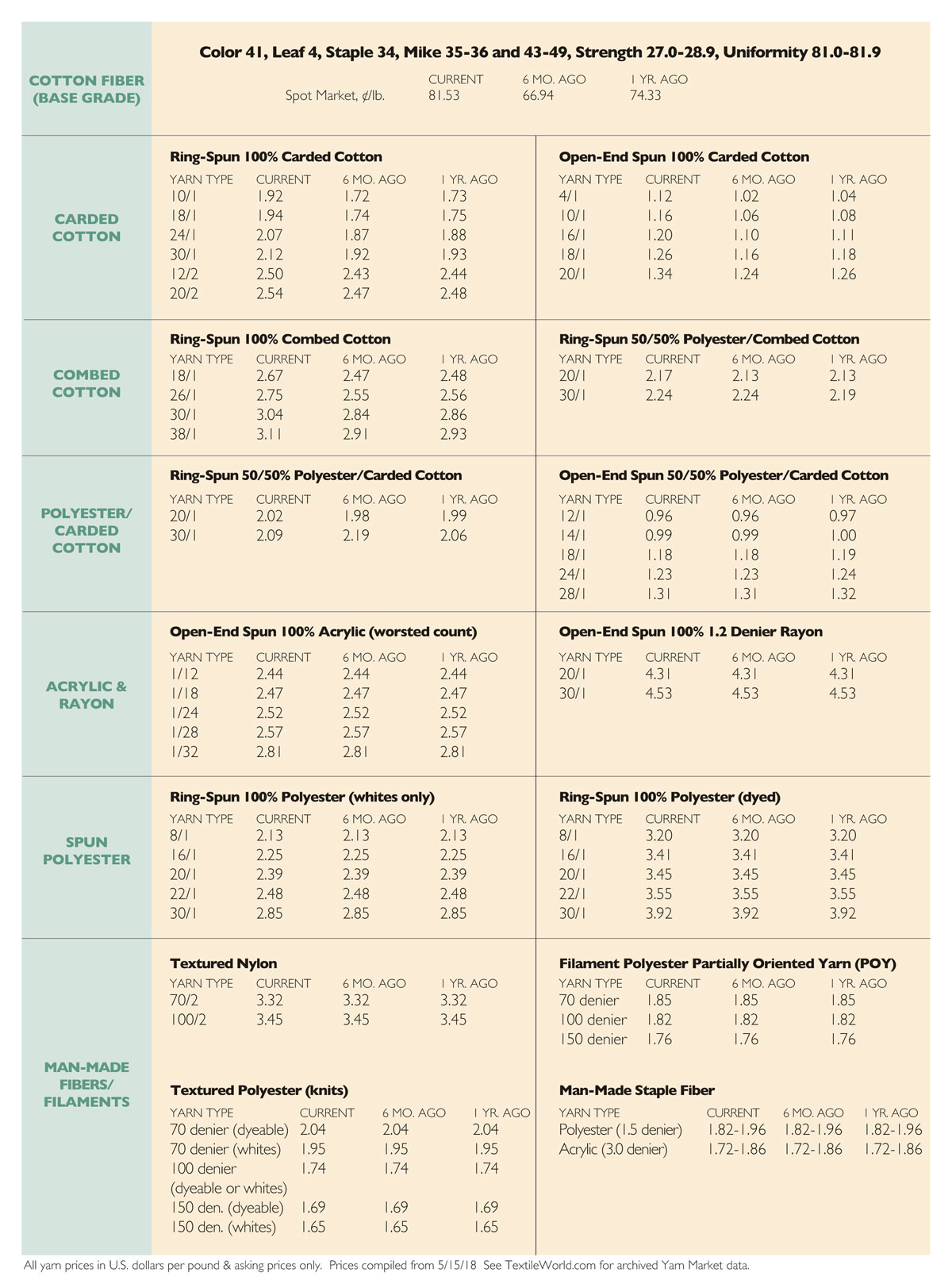
Quotations for the base quality of cotton (color 41, leaf 4, staple 34, mike 35-36 and 43-49, strength 27.0-28.9, uniformity 81.0-81.9) in the seven designated markets measured by the USDA averaged 81.53 cents per pound for the week ending Thursday, May 10, 2018. The weekly average was up from 80.22 the previous week and 74.33 cents reported the corresponding period a year ago. Daily average quotations ranged from a high of 82.71 cents Friday, May 4, to a low of 80.33 cents Thursday, May 10.

Spot transactions reported in the Daily Spot Cotton Quotations for the week totaled 35,776 bales, compared to 25,892 bales reported the previous week and 3,507 spot transactions reported the corresponding week a year ago. Total spot transactions for the season were 1,912,481 bales, compared to 1,556,676 bales the corresponding week a year ago.

The ICE July settlement prices ended the week at 84.56 cents, compared to 84.50 cents the previous week.

YMMay18

May 2018

Ricoh Enters Partnership With Coloreel

JÖNKÖPING, Sweden — May 17, 2018 — Coloreel AB has entered a long-term partnership with the global electronics company Ricoh. Together they will create a groundbreaking thread coloring unit for the textile industry. Ricoh will develop and build one of the major sub-systems in the unit, based on Ricoh’s inkjet printing technology and Coloreel’s technology for colorization.

Coloreel and Ricoh have cooperated for several years, and have now signed the final contracts. This partnership is a joint development effort to revolutionize the textile business, first with the thread coloring unit for the embroidery industry.

“This partnership is a high profile project for us; we see much potential in this product and this industry. We believe in Coloreel and their unique technology, says Tetsuya Morita,” General Manager of Commercial and Industrial Printing Development Division at Ricoh.

Ricoh has been driving innovation for more than 80 years and is a leading provider of document management solutions, IT services, commercial and industrial printing, digital cameras, and industrial systems. Ricoh will build the sub-system for the colorization process using their long experience in the world of printing and combine it with Coloreel’s new technology for colorization. The development has taken place with Ricoh’s engineers in Japan, England and Coloreel’s engineers in Sweden.

“The partnership with Coloreel further demonstrates our commitment to collaboration and pushing boundaries. Combining our history of driving innovation for over 80 years, our commitment to customer needs and intent on becoming the analog to digital transformation experts in industrial process is enabling us to disrupt this exciting industry, says Peter Williams,” General Manager of Commercial and Industrial Printing Business Group at Ricoh.

The Coloreel technology enables high-quality instant coloring of textile thread while it is in the textile production. The first product to be launched based on this technology is a groundbreaking thread coloring unit that works with any existing industrial embroidery machine. By instantly coloring a white base thread during the embroidery production, Coloreel enables complete freedom to create unique embroideries without any limitations in the use of colors.

“It feels amazing that a company like Ricoh, with their dignity and size, chooses to enter this partnership with us. To have Ricoh as our partner gives our product even more credibility, and we are excited to see what this partnership will bring,” says Mattias Nordin, CEO at Coloreel.

Coloreel will start production in autumn 2018. World-leading companies in textile, fashion and sportswear are standing in line to use this revolutionary product.

Posted May 17, 2018

Source: Coloreel

Sponsors