GenuTrace And Kinset Partner To Help Brands Defend Cotton Claims

GenuTrace and Kinset have announced a partnership to help global brands substantiate cotton origin claims amid new anti-greenwashing and forced labor regulations. The collaboration combines Brightwaters, N.Y.-based GenuTrace’s fiber level isotope testing — which scientifically determines cotton’s geographic origin — with Kinset’s Digital Product Passport (DPP) data-ready platform to provide verifiable, regulator-legible supply chain proof.

“Regulation has fundamentally changed the question brands must answer,” said MeiLin Wan, founder and CEO of GenuTrace. “It’s no longer ‘where did you intend to source from’ — it’s ‘can you prove it?’”

“Digital Product Passports only work if the data behind them is credible,” added Katie O’Riordan, CEO and cofounder of Dublin, Ireland-based Kinset. “Our collaboration links physical verification with digital traceability so companies can strengthen compliance without rebuilding their systems.”

The initiative helps brands meet Germany’s new anti-greenwashing rules and U.S. enforcement of the UYGHUR Forced Labor Prevention Act with evidence-based sourcing.


2026 Quarterly Issue I

Authentic And Guess? Inc. Founders Take Guess? Private

New York-based Authentic Brands Group and Guess?, Inc. announced the completion of their transaction to take Guess? private. Authentic now owns 51% of substantially all Guess? intellectual property, while co founders Paul and Maurice Marciano, Nicolai Marciano, CEO Carlos Alberini and affiliated entities retain 49%. With $6 billion in global retail equivalent sales, Guess? becomes Authentic’s second largest brand, bringing the group’s portfolio to $38 billion in annual retail sales.

“What makes Guess? compelling is its exceptional leadership and iconic heritage,” said Jamie Salter, founder, chairman and CEO of Authentic. “We’re honored to partner with the Marciano family, to accelerate this next phase of growth.”

“I’m incredibly proud of the brand we’ve built over 45 years,” added Paul Marciano, Los Angeles-based Guess? cofounder and chief creative officer. “Joining Authentic’s platform positions us to expand globally while staying true to the Guess? DNA.”

Guess? management will continue leading operations worldwide.


2026 Quarterly Issue I

Ibex Taps Nuyarn® For Next-Generation 3D Knit Sweaters

Partnering with Ibex, Nuyarn® Nautilus Fisherman sweater uses a 3D knitting process.
Brooklyn, N.Y.-based Ibex has partnered with Nuyarn® to launch the Nautilus Fisherman Sweater, blending traditional knitwear aesthetics with advanced twist-free yarn and 3D knitting technology. Produced in an 8-gauge, 2×2 rib using a 70% merino wool and 30% nylon Nuyarn® blend, the sweater delivers greater durability, stretch, and thermal efficiency while minimizing waste through seamless 3D knitting.

“This partnership with Ibex is a perfect example of how Nuyarn technology can be applied to redefine classic silhouettes,” said Monica Ebert, New Zealand-based Nuyarn vice president of sales. “By integrating our twist-free yarn into a bespoke 3D knitting process, Ibex is demonstrating our technology isn’t just for performance layers.”

“We’re seeing incredible opportunities in outdoor luxury — where performance meets everyday style,” added Andy Wynne, Nuyarn CEO. The made-to-order collection is produced domestically in Brooklyn with a six to nine day turnaround.


2026 Quarterly Issue I

INDEX™26: A Global Nonwovens Exhibition

EDANA hosts four days focused on nonwovens manufacturing and technology in Geneva.

TW Special Report

INDEX™26, a global nonwovens exhibition, will take place May 19–22, 2026, at Palexpo in Geneva. Organized by Palexpo on behalf of EDANA, the international association for the nonwovens and related industries, the event is designed as a comprehensive meeting place for the global nonwovens value chain — from raw materials through machinery, production and converting to end-use applications in multiple sectors.

On Display

Around 600 exhibitors from 40 countries are expected, alongside senior decision-makers from industries including filtration, transport, medicine, geotextiles, packaging, construction, cleaning and hygiene. The show positions itself as a central platform for assessing how nonwoven materials and processes are evolving, particularly as demand grows for lightweight, high-performance and more sustainable solutions.

“INDEX™26 showcases an industry that is resilient and determined to diversify,” said Magali Fakhry Dufresne, director of INDEX™. “Today, it is no longer just about mass-produced disposable items, but about high-tech, durable and sustainable solutions to the most complex challenges of our time.” Dufresne described “a fundamental change in which reducing the carbon footprint per kilogram of nonwoven fabric is becoming the most important performance indicator for the entire value chain,” and said INDEX™26 is where that shift becomes visible.

The event layout is intended to facilitate cross-sector exchanges as much as product sourcing. Exhibitors span the full process chain — raw material suppliers, machinery and equipment manufacturers, nonwoven producers, component suppliers and converters — allowing visitors to follow developments from polymer to finished article within a single venue. Free workshops, seminars and tutorials will run alongside the exhibition, offering structured opportunities for learning and discussion in smaller, more focused formats.

Seminar Program

A key feature of INDEX™26 is its seminar program, which organizers describe as a strategic counterpart to the exhibition floor. Sessions are structured around three pillars: strategic market intelligence, sustainability and regulatory resilience, and innovation in specialized sectors such as filtration, geosynthetics and mobility. Drawing on EDANA’s industry data, the market intelligence track will examine how demand is shifting across end uses such as hygiene, wipes, construction and filtration, and how sustainability has moved from trend to baseline expectation.

The sustainability and regulation sessions will address topics such as carbon footprint reduction, resource efficiency and end-of-life options, as well as the implications of emerging environmental and product-safety standards for global supply chains. Innovation-focused sessions will look at how nonwovens support infrastructure projects and new mobility concepts, including lightweighting and acoustic management for electric and autonomous vehicles.

Collaboration Is Key

“INDEX™26 is far more than a showcase for individual products. It stands as clear evidence that innovation in the nonwovens industry today is powered by global collaboration rather than isolated breakthroughs,” said Murat Dogru, general manager of EDANA. “At a time when parts of the world are turning inward, INDEX™26 demonstrates the strength of an industry built on open exchange and interconnected value chains.”


2026 Quarterly Issue I

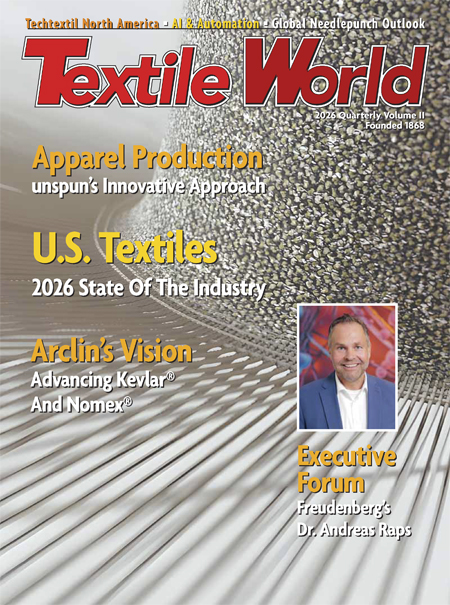
Arclin Agrees To Buy DuPont’s Aramids Business

Arclin has entered a definitive agreement to acquire DuPont’s Aramids business, including the Kevlar® and Nomex® brands, in a transaction valued at approximately $1.8 billion. The purchase broadens Arclin’s advanced materials portfolio into aerospace, electrical infrastructure, electric vehicles, defense and personal protection, complementing its existing operations in construction, infrastructure and transportation.

Approximately 1,900 employees will transfer with the business when the deal closes, expected in the first quarter of 2026 pending regulatory approvals.

“We are confident that under Arclin’s leadership, these businesses will continue to thrive and expand their impact in new industries and applications,” said Lori Koch, DuPont CEO.

Arclin, headquartered in Alpharetta, Ga., specializes in engineered materials and bonding solutions used in industrial, building and transportation markets.


2026 Quarterly Issue I

Ascend Emerges From Chapter 11

Ascend Performance Materials, based in Houston, Texas, announced it has successfully completed its financial restructuring and emerged from Chapter 11 bankruptcy protection. The company’s Plan of Reorganization, confirmed by the U.S. Bankruptcy Court on Dec. 9, 2025, is now effective.

Through the process, Ascend reduced its long-term debt by about $1.3 billion, secured a $350 million asset-based credit facility, and gained more than $600 million in new capital from shareholders, strengthening liquidity and lowering debt service costs.

“Today marks the final milestone in Ascend’s restructuring process, and we are thrilled to emerge with significantly less debt and a much stronger capital structure,” said Patrick Schumacher, Ascend’s newly appointed CEO. “Thanks to our people and new ownership group, we are better positioned for growth and continued leadership in nylon resins and engineering thermoplastics.”

Ascend plans to reinvest in reliability, efficiency and long-term growth initiatives.


2026 Quarterly Issue I

Trevira® CS Eco Fabrics Using Recycled FR Fibers

Bangkok–based Indorama Ventures is advancing circularity in home and contract textiles with new Trevira® flame-retardant fibers and filament yarns made from 50% recycled textile material. The innovation debuted at the Heimtextil trade show in Frankfurt, Germany, in mid-January.

“This innovation is possible through Indorama Ventures’ joint venture with Jiaren Chemical Recycling,” said Jesper Nielsen, global key account manager, flame retardancy. “Jiaren transforms post-consumer and industrial textile waste into recycled polyester chips, from which we produce our modified Trevira® flame-retardant fibers and yarns.”

Fabrics made with these materials can qualify for the Trevira CS Eco brand, combining circular design with the proven, permanent flame-retardant performance of Trevira CS. The partnership with Jiaren, announced in November 2025, supports Indorama Ventures’ long-term goal of achieving large-scale textile circularity without compromising safety or comfort.


2026 Quarterly Issue I

BARMAG DTY Future Of Fancy Yarns

Fabric made from cotton-like fancy yarns with a soft, voluminous structure for textile surfaces with a natural, cotton-like appearance.
As demand grows for textured and differentiated fabrics in fashion, home and automotive markets, fancy yarns are gaining new importance. Remscheid, Germany–based Barmag is advancing Draw Textured Yarn (DTY) production with flexible, modular texturing technology that creates “cotton-like, linen-like, thick & thin, two-tone, different shrinkage and elastane-covered” yarns.

According to the company, Barmag systems deliver precise, reproducible-effect structures with stable crimp and uniformity, even in complex applications. The company’s solutions allow reliable combinations of POY, FDY and elastane while maintaining energy efficiency and process control.

Barmag’s atmos.io digital platform further enhances production by tracking each yarn package and enabling real-time data-based decisions. Digitizing the entire material flow allows yarn manufacturers to intervene when necessary.

According to Barmag, integrating flexibility, quality, and digitalization, Barmag’s DTY systems provide a reliable, economical path to premium fancy yarn production.


2026 Quarterly Issue I

U.S. Textiles: Preserve and Expand Berry?

By James M. Borneman

The Berry Amendment remains the cornerstone of today’s US textile industry. Enacted in 1941 to protect manufacturing capacity — especially textiles — for military needs during World War II, it was made permanent in 1994 and codified into law in 2002.

The amendment safeguards U.S. textiles by mandating that the Department of Defense (DoD) (now Department of War) source most textiles, clothing, and materials from domestic producers — from raw fiber through finished garments. Many regard Berry as the foundation of the “Buy American” procurement policy for military outfitting.

More importantly, it incentivizes capital investment by the industry in readiness to serve the DoD as a dependable partner with the DoD offering predictable demand, allowing for capacity planning for military-focused yarn, fabric, apparel, and advanced textile solutions.

Berry has not been without opposition. Some argue that the amendment inflates procurement costs, limits competition, and guarantees demand to specific U.S. firms — effectively creating a “self-imposed blockade” on efficient sourcing from around the globe.

The National Council of Textile Organizations (NCTO) President Kim Glas notes that, “The U.S. textile industry provides $1.8 billion of high-tech and functional components for vital uniforms and equipment for our armed forces each year. The Department of War estimates that over 8,000 different textile items are purchased for use by the U.S. military — and over 30,000 line items when individual sizes are considered.”

One of the best examples of the need to protect U.S. manufacturing capacity is when the U.S. textile industry rapidly pivoted to produce Personal Protection Equipment (PPE) during COVID-19. Many say the response served as a compelling example for why sustained support like the Berry Amendment is vital. Manufacturers quickly re-tooled their plants to supply more than $2 billion in Berry-compliant gowns, masks and gear for the DoD, HHS and FEMA, proving that domestic capacity exists but relies on steady demand to remain viable amid foreign competition.

A strong Berry Amendment drives innovation and investment in the U.S. textile industry by guaranteeing a stable market for advanced materials and cutting-edge products — in effect, incentivizing R&D knowing the DoD has a steady demand to consume high-performance military gear.

Recently, the NCTO announced the launch of the bipartisan Congressional Berry Amendment Caucus, co-chaired by Reps. Pat Harrigan (R-NC) and Don Davis (D-NC), with strong backing from NCTO and groups like the Warrior Protection and Readiness Coalition.

At the time NCTO’s Glas stated that the new bipartisan Caucus is, “aimed at strengthening national security and the U.S. defense industrial supply chain through the federal procurement of American-made mission-critical clothing, textiles and gear.”

The goals go beyond preserving Berry and include modernizing the amendment, closing the $150K small-purchase loophole and pushing for multiyear contracts to stabilize supply chains for uniforms, body armor and advanced textiles.

From WWII to COVID-19—no crisis was foreseen, yet dedicated leaders and a resilient industry proved the value of a robust U.S. textile base: ready to serve, built to endure.


2026 Quarterly Issue I

CreateMe, UNTUCKit & Supima® Unite To Launch First Digitally Bonded Garments

CreateMe is partnering with UNTUCKit and Supima® to debut the first commercially available digitally bonded T-shirts, produced in the U.S., showcasing how automation can strengthen domestic manufacturing and deliver durable, premium apparel at scale.

TW Special Report

Newark, Calif.-based CreateMe Technologies has announced a strategic partnership with New York apparel brand UNTUCKit and Supima® cotton to launch the first commercially available digitally bonded garments. The partnership marks a significant step toward automated, on-demand apparel manufacturing using robotics and adhesive bonding technology.

Through this collaboration, CreateMe will debut its first bonded men’s T-shirt, made from U.S.-grown Supima® cotton and produced domestically using the company’s proprietary Pixel™ bonding and MeRA™ automated assembly systems. Supima® cotton, prized for its extra-long staple fibers, delivers greater softness, strength, and color retention than traditional cotton — qualities that align well with CreateMe’s focus on durable, high-performance apparel.

New Manufacturing Model

The partnership with UNTUCKit demonstrates the commercial maturity of CreateMe’s digitally bonded garment technology and its readiness to manufacture at scale. Pixel™, CreateMe’s digital adhesive application system, serves as the foundation of its process, enabling precision and flexibility in garment construction without traditional stitching. Together with MeRA™, the system represents a shift toward a more agile, automated manufacturing model, capable of meeting rapid market demands.

“Partnering with UNTUCKit accelerates the shift toward a more modern way of making clothes,” said Cam Myers, founder and CEO of CreateMe. “UNTUCKit built its brand by challenging convention, and this collaboration brings that same mindset into manufacturing. It proves that high-quality apparel can be produced competitively in the U.S. at scale, while giving consumers a better, more durable product. This is the first of many bonded garments we’ll bring to market.”

The partnership follows CreateMe’s commercialization roadmap, with initial product development and pilot testing leading to retail introduction. Plans call for production to scale to approximately 50,000 bonded T-shirts per year beginning in the third quarter of 2026.

CreateMe, UNTUCKit and Supima® advance U.S. apparel manufacturing with Pixel™ bonding and MeRA™ robotic assembly to craft durable, premium T-shirts through advanced bonding automation.

Bringing Innovation To Classic Apparel

For UNTUCKit, known for redefining the classic button-down shirt, the alliance offers an opportunity to apply material and process innovation to its well-established brand identity. “At UNTUCKit, we’re always exploring innovations that enhance product performance and the customer experience,” said Bjorn Bengtsson, chief product and supply chain officer at UNTUCKit. “CreateMe’s adhesive bonding technology opens exciting new opportunities to rethink how we approach apparel construction in a more efficient and responsible way.”

This approach reflects broader industry trends toward domestic, technology-driven production. Faced with rising global production costs, long lead times and supply chain uncertainty, brands are increasingly looking for solutions that balance cost efficiency with flexibility. CreateMe’s automated bonding technology reduces reliance on overseas production, shortens turnaround time and allows manufacturers to respond more closely to real consumer demand.

Supima® Strengthens The Collaboration

As the third partner, Supima® brings both material quality and deep industry heritage to the project. The American-grown cotton is a natural companion to CreateMe’s U.S.-based production and UNTUCKit’s focus on everyday comfort and quality. “Supima could not be more excited to work with fashion technology innovator CreateMe and our longtime partner and fashion disrupter UNTUCKit to bring innovation and style to the fashion market,” said Buxton S. Midyette, vice president of marketing and promotions at Supima®.

Supima’s involvement underscores how premium fiber innovation continues to intersect with technological advances in apparel production. Pairing advanced robotics and bonding with one of the world’s most recognized cotton varieties showcases the potential for U.S. textile manufacturing to combine heritage materials with next-generation processes.

Scaling A Sustainable System

CreateMe envisions the UNTUCKit partnership as a first step toward a larger ecosystem of bonded apparel. Building on its bonded T-shirt program, the company plans to extend production capabilities into women’s styles and additional T-shirt variations as part of its 2026 roadmap.

The enterprise sits within CreateMe’s broader mission to localize and digitize soft-material manufacturing through automation. The company operates on the premise that “The Future of Fashion is Bonded™”— not sewn — and holds more than 95 patents across robotics, adhesives and automation. Its proprietary technologies include Pixel™ micro-adhesive bonding, the MeRA™ robotic assembly system, and Thermo(re)set™ reversible-adhesive science. Together, these innovations enable precise, waste-reducing garment production closer to end markets.

As automation gains ground in textiles, CreateMe’s collaboration with UNTUCKit and Supima® serves as a proof of concept: that bonded apparel can meet the quality, consistency and scalability required by global brands while strengthening domestic supply chains. In a sector defined by long-distance sourcing and intensive manual labor, the move toward digitally bonded, robotically assembled garments could redefine how — and where — clothing is made.


2026 Quarterly Issue I

Sponsors