Levi Strauss & Co. Announces Pricing Of Initial Public Offering

SAN FRANCISCO — March 20, 2019 — Levi Strauss & Co. (LS&Co.) today announced the pricing of the initial public offering (IPO) of 36,666,667 shares of its Class A common stock at a price to the public of $17.00 per share. The shares are expected to begin trading on the New York Stock Exchange on March 21, 2019 under the symbol “LEVI.” The company is offering 9,460,557 shares of Class A common stock and selling stockholders are offering 27,206,110 shares of Class A common stock. In addition, the underwriters have a 30-day option to buy up to an additional 5,500,000 shares of Class A common stock from the company at the IPO price, less underwriting discounts and commissions. The closing of the offering is expected to occur on March 25, 2019, subject to satisfaction of customary closing conditions.

Goldman Sachs & Co. LLC and J.P. Morgan Securities LLC are serving as joint lead book-running managers for the offering. BofA Merrill Lynch, Morgan Stanley & Co. LLC and Evercore Group L.L.C. are serving as book-running managers. BNP Paribas Securities Corp., Citigroup, Guggenheim Securities, LLC, HSBC Securities (USA) Inc., Drexel Hamilton LLC, Telsey Advisory Group, and The Williams Capital Group L.P. are serving as co-managers.

The offering is being made only by means of a prospectus. Copies of the final prospectus relating to the offering, when available, may be obtained from Goldman Sachs & Co. LLC, Attn: Prospectus Department, 200 West Street, New York, New York 10282, by email at prospectus-ny@ny.email.gs.com, or by telephone at (866) 471-2526; J.P. Morgan Securities LLC, c/o Broadridge Financial Solutions, 1155 Long Island Avenue, Edgewood, NY 11717, by email at prospectus-eq_fi@jpmchase.com, or by telephone at (866) 803-9204; BofA Merrill Lynch, NC1-004-03-43, 200 North College Street, 3rd floor, Charlotte, NC 28255-0001, Attn: Prospectus Department, or by email at dg.prospectus_requests@baml.com; Morgan Stanley & Co. LLC, Attn: Prospectus Department, 180 Varick Street, 2nd Floor, New York, New York 10014; or Evercore Group L.L.C., Attn: Equity Capital Markets, 55 East 52nd Street, 36th Floor, New York, New York 10055, by email at ecm.prospectus@evercore.com, or by telephone at (888) 474-0200.

A registration statement relating to these securities has been filed with the U. S. Securities and Exchange Commission and was declared effective on March 20, 2019. This press release shall not constitute an offer to sell or the solicitation of an offer to buy these securities, nor shall there be any sale of these securities in any state or jurisdiction in which such offer, solicitation or sale would be unlawful prior to registration or qualification under the securities laws of any such state or jurisdiction.

Posted March 25, 2019

Source: Levi Strauss & Co.
Berry Global Group Reports Intent To Acquire RPC Group Plc, Creating Global Plastic And Recycled Packaging Product Franchise

EVANSVILLE, Ind. — March 8, 2019 — Berry Global Group Inc. announced today a recommended superior offer to acquire all of the issued and to be issued ordinary share capital of RPC Group Plc (RPC) for 793 pence per share in cash. Aggregate consideration will be approximately 5.0 billion pounds ($6.5 billion), including refinancing of RPC’s net debt.

RPC is a leading international design and engineering company, providing plastic and recycled products for packaging and selected non-packaging markets. With a focus on rigid and flexible packaging, RPC maintains strong leadership positions across a range of consumer, industrial, and healthcare end markets. Supported by 153 manufacturing locations, commercial presence in 33 countries, an employee base of approximately 25,000 and the broadest range of conversion technologies in the industry, RPC serves more than 10,000 customers, combining large company resources with local, in-market expertise. For the twelve-month period ended September 30, 2018, RPC generated net sales and adjusted EBITDA of $4.8 billion and $768 million, respectively.

“We are extremely excited about the opportunity to welcome the team and global capabilities of RPC to the Berry organization. We are highly impressed by the tremendous depth of talent and resources embedded within RPC, and are looking forward to the opportunity to strengthen our combined platform with the wealth of experience and expertise this team has to offer,” said Tom Salmon, chairman and CEO of Berry. “We believe this transaction will further enhance the long-term outlook for our business and will provide a unique value creation opportunity for our shareholders. We plan to leverage our combined know-how in material science, product development, supply chain and manufacturing technologies across resin-based applications to integrate quickly and build a best-in-class organization.”

Berry and RPC are two companies with complementary plastic packaging product offerings and strong cultural compatibility. The combined company will have combined revenue of approximately $13 billion and approximately 48,000 employees across six continents.

The board of directors of RPC has unanimously recommended the superior offer by Berry. The proposed transaction, which is subject to customary closing conditions, is expected to close early in the third quarter of calendar year 2019.

Berry has secured a fully-committed debt financing package to fund the transaction, and intends to utilize the enhanced free cash flow of the combined business to reduce leverage quickly from expected pro forma net leverage of approximately 5.0x at close. As part of the transaction, Berry expects to generate approximately $150 million of annual cost synergies.

Goldman Sachs and Wells Fargo Securities are retained as joint lead financial advisors to Berry. Freshfields Bruckhaus Deringer LLP and Bryan Cave Leighton Paisner LLP are retained as legal advisors for Berry. JPMorgan is also retained as a financial advisor to Berry.

Goldman Sachs and Wells Fargo Securities provided fully-committed financing in connection with the transaction.

Full details of the transaction are available in the announcement made today under Rule 2.7 of the UK’s City Code on Takeovers and Mergers, available here: http://ir.berryglobal.com/possible-offer-rpc-group- plc-1

Posted March 25, 2019

Source: Berry Global Group

Techtextil 2019 Exhibitor Preview: Freudenberg Performance Materials 

WEINHEIM, Germany — February 6, 2019 — Under the heading “Meet your experts,” Freudenberg Performance Materials will be presenting innovative technical textiles for the automotive, medical and apparel markets May 14-17, 2019 at Techtextil in Frankfurt, Germany, in Hall 3.1, Stand F 37.

Alongside personal discussions, the leading supplier of innovative technical textiles will be hosting a series of expert interviews at its booth. Freudenberg works with the broadest technology platform on the market. This enables the leading manufacturer of performance materials to equip technical textiles with an unparalleled variety of properties. The innovations Freudenberg will be presenting at Techtextil are excellent examples of this ability. Via the expert interviews, Freudenberg will also be giving trade fair visitors the opportunity to gain a good insight into these solutions, even if they do not wish to make an individual appointment. The interviews will be conducted several times a day at times that will be clearly communicated at the company’s booth.

For improved comfort in (electric) vehicles

Good acoustics in vehicles increase driving comfort. This factor is also very important for electric cars, as the alternative drives are quieter than combustion engines and other noises of different frequencies are more strongly perceived. Freudenberg will be presenting innovative Acoustic Pads that feature exceptionally high noise absorption in the vehicle interior. The lightweight pads are a very cost-effective solution and also help customers to reduce the weight of vehicles. Freudenberg Acoustic Pads are ideally suited for use in various automotive applications such as door panels, headliners, trunk linings, wheel arches and more.

Greater efficiency for new mobility

The fuel cell is already being used successfully in a number of applications and is regarded as a decisive energy source of the future. Freudenberg’s series-produced gas diffusion layers (GDL) contribute to making this technology more economical. Their pronounced thickness uniformity and material homogeneity increase electrical and thermal conductivity and improve the transport of gases and liquids within the fuel cell. The outstanding properties have been demonstrated in a broad range of very different customer applications. At the same time, Freudenberg’s GDL can be processed better than other products and exhibit superior mechanical properties.

For faster wound healing

Wound pads are a component of medical wound dressings. Freudenberg wound pads made from hydrophilic PU foams with a direct coating of silicone adhesives are significantly more effective than the commonly used foams with transfer coatings. They are much more flexible, adapt better to the wound bed, and enable antibacterial treatments to better develop their effectiveness. Moreover, the reduction of process steps and complexity during manufacture saves energy, avoids waste and simplifies the supply chain.

The perfect alternative to down

With comfortemp® fiberball padding eco, Freudenberg will be presenting the world’s first padding made from continuous fiber balls, which functions as a perfect substitute for down in clothing. This novel insulation material is made from 100 percent recycled polyester fiber balls and combines the advantages of both padding and down. It is the ideal solution for the sports and outdoor sector, but is also suitable for use in fashion garments. It is manufactured without the use of chemicals, offers optimum breathability and is super-soft and fluffy.

Posted March 25, 2019

Source: Freudenberg Performance Materials

Freudenberg Performance Materials Starts New Production Line In China: Expansion Of Business With Innovative Auto Headliner

WEINHEIM, Germany — March 6, 2019 — Freudenberg & Vilene Nonwovens brought a new production line for car headliners into operation at its Suzhou site in Eastern China. This enables the company to meet the increasing demand for high-quality car headliners in China and South-East Asia. Freudenberg Performance Materials is the specialist for technical textiles of the Freudenberg Group. In China, Freudenberg & Vilene Nonwovens, a joint venture with Japan Vilene Co., Tokyo, represents the group.

With the new production line, Freudenberg will increase its annual production of technical textiles in Suzhou by around 8 million square meters. Customers will particularly benefit from higher quality of the next generation headliner products. “This investment underscores our long-term commitment to Asia. We want to continue to support our customers in the automotive market with innovative and sustainable solutions that will help them grow,” commented Dr. Frank Heislitz, CEO of Freudenberg Performance Materials.

Freudenberg & Vilene headliners are based on nonwovens and can be finished in various ways to provide additional functionality. Apart from excellent surface appearance with good abrasion resistance, outstanding acoustic properties and improved stain resistance, these products contribute to higher comfort in the car interior as well as marked reduction in vehicle weight when combined with other vehicle components. In addition, the company also uses a proportion of recycled products in the manufacture of its products. In this way, Freudenberg helps its customers to reduce their environmental footprint.

“Freudenberg & Vilene Company offers its customers innovative products ensuring consistently high quality,” explained Heislitz. Freudenberg & Vilene first introduced printed headliners to the market in 2010, thus capturing a special customer need. Already in 2016, the company investment in an additional production line.

Freudenberg Performance Materials is an established and reliable partner to the automotive industry worldwide. In Asia and China, Freudenberg & Vilene enjoys long-standing relationships with Asian OEMs, where it holds a leading position in the market. A cornerstone of this success has been the ability to create numerous headliner innovations.

Alongside the production of products for car interiors, Freudenberg & Vilene’s product portfolio includes industrial nonwovens for the apparel industry, industrial ventilation and other technical applications.

Posted March 25, 2019

Source: Freudenberg Performance Materials

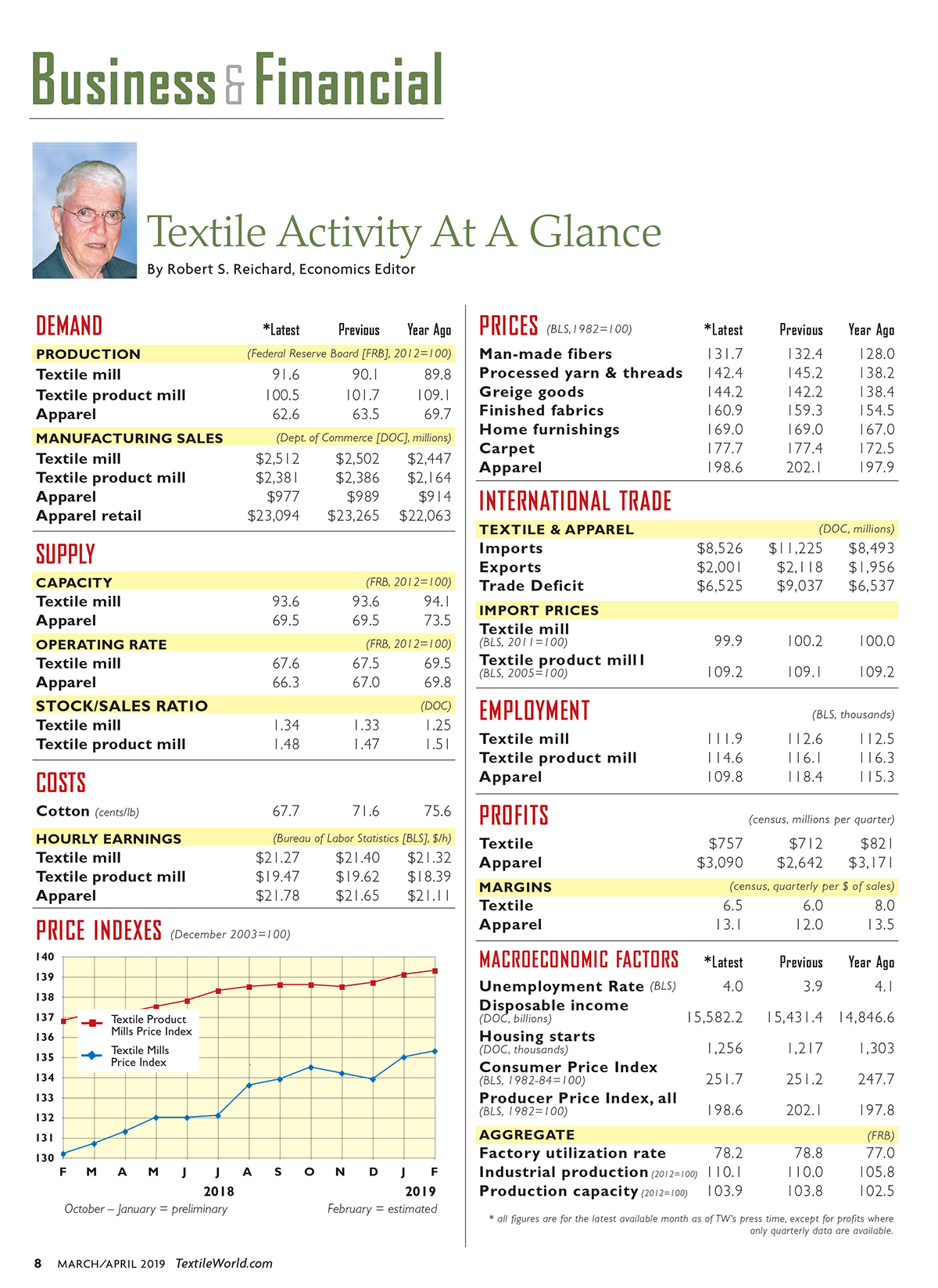
Textile Activity At A Glance: March/April 2019

BFBarometersMA19

March/April 2019

HanesBrands Receives 12th United Way Award

Winston-Salem, N.C.-based HanesBrands is one of three companies in Forsyth County and one of 33 in North Carolina honored with the United Way Spirit of North Carolina Award. It is the 12th time the company has received the award. Hanes was recognized for “exceeding their $1.8 million goal and demonstrating outstanding community support through United Way involvement.” Money pledged to Hanes’ 2018 campaign exceed $2 million, and employee participation in the program increased by 73 percent over the previous year’s campaign. The funds will help United Way of Forsyth County and surrounding counties.

March/April 2019

Oppenheimer Announces Name Change

Portsmouth, R.I.-based Oppenheimer Co. Inc. — a garment lining supplier founded in 1913 under the name Brand & Oppenheimer (B&O) — has announced a name change to Ocean State Innovations (OSI).

“In consideration of our corporate strategy and our deep roots in Rhode Island, we feel our identity is best associated with the Ocean State,” said CEO Edward Ricci. “The Brand and Oppenheimer brand represented stability and quality within a very specific segment of the textile space. Today we offer a broader scope of innovative textile expertise and needed a moniker to represent who we are.”

OSI has added the “Textile Solutions” marketing message to its corporate identity to reflect “the current and future direction of our growing company,” Ricci said.

The company has changed over the years through various acquisitions, and currently is owned by 1947 LLC, and Praesidian Capital and StoneCreek Capital LLC. OSI comprises:

  • B&O Legacy Division, Portsmouth, R.I. — a provider of textiles for the military tactical, commercial, apparel and industrial markets;
  • Performance Textiles, Greensboro, N.C. — a supplier of high- performance fabrics for parachutes, medical and high-visibility applications, among other end-uses;
  • 1947 LLC, Portsmouth — a company that specializes in military, tactical and industrial products;
  • Cutting Edge TexStyles, Bedford, Mass. — a textile converter, and producer of bias binding and trims; and
  • P&B, Pawtucket, R.I. — an international specialist in fabric for quilters.

March/April 2019

Milestone For Organic Cotton Traceability Pilot Program

Tracing materials is complex and complicated, but pressure for transparency and sustainability within the fashion industry is increasing. The Organic Cotton Traceability Pilot program reports it has reached a milestone in its efforts to improve the traceability of organic raw materials in the textile supply chain.

The pilot program, the first of its kind employed in the fashion industry, combines several technologies to trace and identify the origin, purity and distribution of organic cotton. Testing is currently underway to trace organic cotton from farm to gin. The next stage is to trace the cotton from gin to consumer, then prove the process works at scale.

The multi-stakeholder effort has Bext360 as lead technical partner. Haelixa, Tailorlux and IN-Code Technologies contribute logistics, planning and technology; while Pratibha Syntex farm groups in India are conducting field trials. Other partners in the program are Fashion for Good, C&A Foundation, Organic Cotton Accelerator, Kering, Zalando, PVH Corp. and C&A.

“With the work we have done to trace organic cotton from farm to gin, we are confident that in the next phase we will be able to make the leap from gin to consumer, eventually making it possible to swiftly and efficiently trace organic cotton straight from the farm to the consumer,” said Daniel Jones, founder and CEO, Bext360.

“These technologies will improve how companies can map, audit, certify, and monitor their value chains, allowing them to tackle issues head on and build transparent processes,” explained Katrin Ley, managing director, Fashion for Good.

March/April 2019

Glen Raven’s India-Based JV Opens New Facility

Glen Raven, N.C.-based Glen Raven Inc. reports production has begun at a new state-of-the-art Strata Geosystems production facility located in Daheli, Gujarat, India. Strata is a joint venture (JV) company that was established in 2004 as a producer of geogrids, and is now known as India’s largest producer of reinforced soil structures, according to Glen Raven. Production from the facility will fulfill growing demand for geosynthetics in India as well as globally.

“The opening of the Daheli facility is yet another milestone in Strata’s remarkable story,” said Harold Hill, president of Glen Raven Technical Fabrics LLC. “Strata’s products are being used to build critical infrastructure all around the world.”

“The growth and evolution of our Strata team in India has been nothing short of extraordinary,” said Leib Oehmig, CEO of Glen Raven Inc.

March/April 2019

U.S. Textile Investment: More On The Way?

BornemanBy James M. Borneman

One can’t throw a rock in the next several months without hitting a textile meeting or event. The industry is approaching that part of the event cycle when annual, biannual and triennial events collide.

It’s not a bad thing, particularly with the U.S. economy performing well and continuing to grow. As mentioned in the investment feature (See “Textile Investments In The Headlines,” TW, this issue), according to the latest Manufacturing ISM® Report On Business® published by the Tempe, Ariz.-based Institute for Supply Management® (ISM®):  “Economic activity in the manufacturing sector expanded in February, and the overall economy grew for the 118th consecutive month, said the nation’s supply executives.”

Not only that, but the textile mill sector is performing well, coming in third out of 16 growing manufacturing sectors.

On the world stage, the U.S. economy is a stand-out. But lack of growth in export markets are a challenge.

China is a double-edged sword. Its slowing economy can cause a global swoon. But if fair and free trade can be achieved, or if trade policy can move in that direction, positive global economic effects could result. If China’s growth is based on a strengthened internal economy rather than a sharp focus on export driven growth, a hallmark of mercantilism, the net effects globally could be tremendous.

If trade went back to the general tenets of free trade based on countries specializing in trade based on their comparative advantage rather than competitive advantage, a win-win would occur. China/U.S. trade hasn’t been based on free trade, and neither are long term tariff barriers or restrictive trade barriers.

Comparative advantage can be a challenge to understand, but it is fundamental to real free trade.

If you have two trading partners that produce goods for domestic and trade consumption, each partner needs to look at what they can produce most efficiently. If these goods are then traded, in economic terms goods and services were traded at their lowest opportunity cost, and that is why free trade is a win-win.

You can build a motorcycle for $5,000 and sell it $7,500 in the open market. A potential trading partner has higher opportunity cost, but insists on making motorcycles at $10,000 and selling at $12,500 rather than trading something with lower opportunity cost. He insists on protecting his industry, and applies a 100-percent tariff on imported motorcycles.

The end result is your $7,500 motorcycles sells for $15,000 in your partner’s country — more expensive than his $12,500 bike. The partner’s consumer is paying a high price for whichever bike they buy, the partner’s government is pocketing $7,500 for each bike of yours that sell in that country and your business volume isn’t maximized. Everybody loses.

But this unfair trade can be fixed. It turns out your partner makes roller skates much more efficiently than he makes motorcycles. Just maybe, if he lets in motorcycles tariff free and you accept roller skates tariff free, both partners can maximize efficiencies and consumers and companies are all winners.

At least that’s what supposed to happen, keep your fingers crossed on China trade — it is important on a global scale.

March/April 2019

Sponsors