LINCOLN, RI — August 4, 2026 — Organic Dyes & Pigments LLC (ORCO) is pleased to announce an exclusive Canadian Distribution Partnership with Arya Chem Inc., headquartered in Toronto, Ontario.
Arya Chem (founded in 1987 by Hamid Moshari) will be authorized to carry the full range of ORCO dyes, pigments and chemicals. This collaboration brings together Arya’s position as a leading chemical solutions provider focusing on delivering extraordinary performance and value to their partners through strong relationships, collaboration and continuity and consistency of supply. These principles align perfectly with ORCO’s mission and promise to our partners.
As ORCO’s exclusive distribution partner in Canada, Arya will represent, service and support the products and solutions developed by ORCO. The partnership will support a range of markets and applications including a full range of Dyes, Pigments, Colorants & Chemicals:
Industrial: engine additives, adhesives, sealants, plastics, oil & gas
“This partnership represents a strong strategic alignment between ORCO’s broad range of color and chemical solutions and Arya’s proven ability to support customers across diverse markets,” said Vince Hankins, Vice President of Sales at Organic Dyes & Pigments LLC.
Rogerio Galante, Product Manager – New Applications at ORCO added, “We look forward to working closely with Arya to expand their reach to new and existing partners where color is an important part of their products and services.”
For More information, Visit: https://www.organicdye.com/
OBERTSHAUSEN, Germany — August 5, 2026 — The rapid development of artificial intelligence (AI) is currently transforming entire industries – and is also driving a sustained boom in demand in the market for copper-clad laminates (CCL).
Enzo Paoli, President of Warp Preparation Business Unit
CCLs are the base material for the manufacture of printed circuit boards and are thus a fundamental component of the entire AI infrastructure. They typically consist of a composite reinforced with woven glass fabric.
For KARL MAYER’s Warp Preparation Business Unit, the enormous demand for CCLs made from glass fabric means excellent order income level.
“Currently, around four billion meters of glass fabric are produced worldwide each year. By 2028, another two billion meters will be added – a massive market in which we lead with a major market share,” says Enzo Paoli, President of Warp Preparation Business Unit at KARL MAYER.
Technological leadership through innovative products and an outstanding reputation
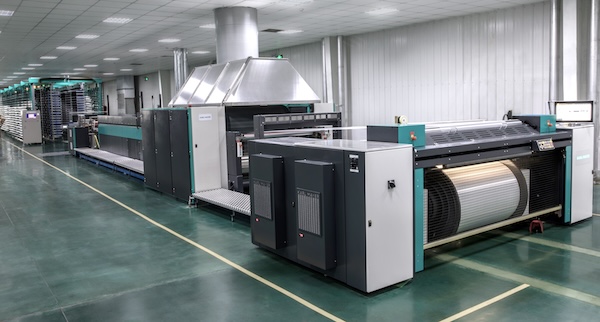
The basis for this outstanding market position is a strong product portfolio: the FILSIZE-G sizing machine and the AM-G assembling machine. Both warp preparation systems deliver the highest level of process reliability, maximum efficiency, and consistently high warp quality. Even with frequent product changes, the quality of the fabrics produced remains at the highest level.
Its unique repeatability and productivity have made KARL MAYER the preferred partner of leading glass fabric manufacturers worldwide – for nearly 20 years.
The success story began as early as 2007 with the first deliveries for one customer in China and one in Taiwan. Through continuous further advancements in the warp preparation technology for glass processing, it soon became an industry standard. A major milestone was the sale of the 100th machine for electronic glass in China in 2020. With the rise of AI, this success story is now gaining even more momentum.
New requirements posed by AI servers and modern electronics
The requirements for glass fabrics are changing rapidly. In particular, the materials used are becoming more challenging. The growing computing power of modern AI systems also demands servers with highly complex printed circuit boards (PCBs). The number of CCL-layers has risen from 6 for standard electronics to 12 for electric vehicles and mobile phones to over 24 for AI data centers. As a result, the demand of glass fiber fabrics has increased drastically.
These new materials and layer structures present greater challenges for production processes. Precisely controlled yarn tension is particularly critical during warp preparation. Even the slightest deviations can cause local differences in density within the fabric. The result: propagation time differences in high-frequency signals, known as the fiber-weave effect or intra-pair skew. This is exactly where KARL MAYER’s technology comes into play.
Perfectly positioned for the AI era
The global expansion of AI data centers is driving enormous demand for high-performance printed circuit boards and, consequently, for high-quality glass fabrics. With its many years of experience, technological innovation, and market-leading solutions, KARL MAYER is exceptionally well-positioned to benefit from this growth.
Or to put it another way: While AI is shaping the digital future, KARL MAYER is providing the technology that lays the foundation for it today.
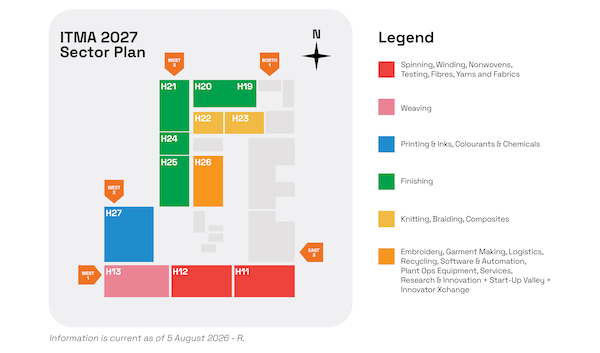
BRUSSELS — August 5, 2026 — ITMA 2027 has unveiled its sector plan, marking progress towards the 2027 edition as planning continues ahead of the show.
The ITMA 2027 sector plan covers 12 halls at the Messegelände Hannover venue, spanning over 180,000 square metres, and features 20 sectors of the textile and garment making processes, from spinning to finishing, software and automation, recycling, and fibres, yarns and fabrics.
The textile and garment technology industry has responded strongly to ITMA 2027, with more than 1,500 companies from 43 countries already securing their participation. CEMATEX, the European Committee of Textile Machinery Manufacturers comprising nine national associations ACIMIT, AMEC AMTEX, BTMA, GTM, SWISSMEM, SYMATEX, TMAS, UCMTF and VDMA, continues to demonstrate its leadership and confidence in ITMA as the premier global platform for textile manufacturing innovation. Manufacturers represented by these nine national associations account for 43% of all applicants and over 60% of exhibition space booked to date.
Beyond Europe, manufacturers from across the world account for more than 50% of all applicants and around 40% of the exhibition space booked to date. China leads international participation, followed by India, Türkiye and Japan, reflecting strong demand from key textile technology manufacturing markets worldwide. This breadth of international participation reinforces the role ITMA 2027 plays for global textile machinery manufacturers, to launch innovations, demonstrate technologies, and engage with customers across the manufacturing value chain.
Mr. Alex Zucchi, President of CEMATEX, said: “The diverse participation from around the world reinforces ITMA 2027’s position as a neutral global platform, providing manufacturers with an equal opportunity to compete and showcase their latest innovations.”
Mr. Charles Beauduin, Chairman of ITMA Services, said: “Despite ongoing geopolitical uncertainties and a challenging global economic environment, the strong response to ITMA 2027 reflects the industry’s resilience and continued confidence in investing in innovation and future growth.”
Established sectors anchor ITMA 2027
The established sectors, including Spinning, Nonwovens, Weaving, Knitting, Finishing, Printing, and Garment Making, continue to occupy the largest exhibition footprint within ITMA 2027’s sector plan. Alongside these, Research & Innovation, Services, Recycling, Fibres, Yarns & Fabrics, Software & Automation, and the Start-Up Valley which is funded by CEMATEX, underscore the industry’s growing recognition that innovation, sustainability, and digitalisation are now integral to the textile manufacturing value chain – not simply supporting activities.
Start-Up Valley has gained strong momentum since its successful debut at ITMA 2023. Applications for ITMA 2027 have doubled from its previous edition, with 64 promising young companies vying for just 20 exhibition spaces, reinforcing CEMATEX’s commitment to nurturing innovation by providing emerging start-ups a stage to showcase their technologies.
Mr. Zucchi added: “The Start-Up Valley is an important initiative for our industry. We need innovators who can challenge established thinking and accelerate technological progress. Fresh ideas and new talent are essential to ensuring the long-term sustainability and competitiveness of our industry.”
A key highlight of ITMA, the CEMATEX-supported Research & Innovation sector shows the importance of closer collaboration between academia and industry in supporting the transition from research to manufacturing.
The Recycling sector is gaining momentum, driven by regulatory initiatives such as the EU’s Sustainable and Circular Textiles Strategy and similar measures across the globe. Advances in recycling technology are also making textile-to-textile circularity commercially viable, giving recycling technology producers further reason to invest ahead of ITMA 2027.
Looking ahead
Taking place from 16 to 22 September 2027 at Messegelände Hannover, Germany, ITMA 2027 will continue to spotlight innovation across the entire textile and garment manufacturing value chain, with a focus on advanced materials, automation and the digital future, sustainability and circularity, and human-centric manufacturing.
This confirmed sector plan provides the industry with early insight into the exhibition’s structure well ahead of visitor registration opening in March 2027, allowing exhibitors and visitors to begin planning their participation.
Companies interested in exhibiting can submit stand space enquiries at:
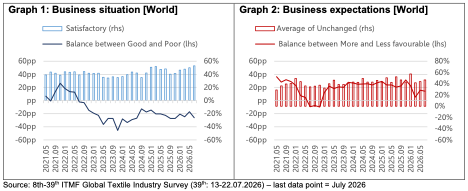
ZÜRICH, Switzerland — August 4, 2026 — The International Textile Manufacturers Federation (ITMF) has published the results of its 39th Global Textile Industry Survey (GTIS), conducted from 14 to 22 July 2026 among companies along the entire global textile value chain. Worldwide, 10% of participants rated their business situation as good, 53% as satisfactory and 37% as bad — a balance of -26pp, down from -17pp in May but still well above the 2023 lows. All regions are now in negative territory, from South Asia at -3pp to North & Central America at -58pp. Brands and retailers were the only segment with a positive balance (+11pp); machinery manufacturers were weakest at -40pp, while garment producers fell sharply from +5pp in May to -25pp.
Business expectations for the coming six months eased marginally from +16pp to +14pp, with 47% of respondents anticipating no change. Africa (+50pp) and South Asia (+32pp) were the most optimistic regions and machinery manufacturers the most confident segment (+36pp).
Order intake dropped to -27pp from -9pp in May, suggesting the May reading was an outlier. The average order backlog eased to 2.3 months and global capacity utilization slipped to 71%, ranging from 75% in South-East Asia to 64% in North and Central America.
Weak demand and geopolitics remain the industry’s leading concerns for 56% and 46% of the respondent, respectively, while raw material prices, energy costs and tariffs have all receded — tariffs to just 10%, down from a peak of 40% in September 2025. Order cancellations fell to 2% globally, and the inventory index improved despite still being under average, with stocks accumulating downstream at brands and retailers while upstream segments stay lean.
For more information, please see www.itmf.org
Posted: August 9, 2026
Source: The International Textile Manufacturers Federation (ITMF)
For decades, the medical device industry has relied on textiles to solve some of the human body’s most complex mechanical challenges. From vascular grafts replacing damaged arteries to ligament reinforcements stabilizing knees, woven fabrics have been the silent workhorses of modern surgery.
What was once a field defined by basic durability requirements for open procedures has evolved into a high-precision discipline demanding precision and control over every filament.
As someone deeply involved in the engineering and manufacturing of these materials at Bally Ribbon Mills, I have witnessed this evolution firsthand. We have moved from the era of “strong enough” to one where a single broken filament is a critical failure, and where fabrics must be thin enough to slide through a catheter yet strong enough to anchor a device for a lifetime. It is not just about making things smaller; it is about fundamentally rethinking what a woven structure can do.
The Evolution of Medical Textiles
To understand where the industry is going, it helps to look at where it started. The trajectory of medical textiles mirrors the broader trends in surgery itself.
The Early Phase (Mid-20th Century)
In the mid-1960s, Bally Ribbon Mills (BRM), already a custom textile manufacturer for 40 years, began applying its expertise to medical textiles. During this era, the focus was on basic biocompatibility and durability. Since surgeons performed open procedures with direct access to the implantation site, device size was less of a concern.
Greater wall thickness and bulk were acceptable trade-offs for strength. Woven or knitted textile structures of PET (polyester) and ePTFE became the standards for vascular grafts. Testing protocols centered on tensile strength and burst pressure, as stringent requirements for micro-defects had not yet been established.
The Maturation Phase (1990s–2000s)
As the millennium turned, the industry matured. We saw a proliferation of implantable devices ranging from stent coverings to heart valve components. The focus shifted toward long-term stability and fatigue resistance. These devices were expected to last 10, 15, or even 20 years inside the body. Regulatory bodies began to standardize testing methods (ASTM/ISO), and quality systems became far more rigorous. Manufacturers had to demonstrate full traceability and cleanroom production, marking the beginning of the highly regulated environment we operate in today.
The Modern Era: Minimally Invasive Revolution
Advances in minimally invasive surgery continue to drive demand for smaller, stronger woven biomedical textiles capable of delivering lifelong performance through catheter-based procedures.
Today, we are firmly in the era of minimally invasive surgery. Open-chest procedures are being replaced by catheter-based interventions in which devices are threaded through blood vessels to reach the heart or brain. This shift has fundamentally changed the requirements for textile components. The size of the woven structures has been reduced.
While polyester is still a primary fiber used for these applications, the demand for Spectra and Dyneema (ePTFE) has been increasing. The high strength to weight ratio of these high-performance, fibers allows for smaller woven constructions. We are no longer just making “fabric”; we are engineering textile materials for shrinking delivery systems.
The Unique Advantages of Weaving
Weaving has become the technique of choice for many critical medical textiles due to its ability to create precise, complex, and highly stable structures. Medical weaving enables near-net-shape forms, outstanding dimensional control, and the integration of multiple fiber types, all of which are vital for today’s advanced implants.
Compared to alternatives, weaving offers clear advantages:
Unlike braiding, which interlaces fibers diagonally and produces flexible but open structures, weaving creates tighter, low-porosity fabrics with exact geometries. This is essential for applications like vascular grafts, where minimal blood permeability is required.
Knitting relies on looping yarns, resulting in inherently stretchy, open fabrics. While flexible, knitted structures lack the dimensional stability and low porosity needed for precise implantable devices and are difficult to miniaturize effectively.
In short, weaving is distinguished by its ability to tightly interlace fibers, delivering multi-directional strength, minimal porosity, and the capacity for sophisticated 3D forms. These qualities are far more difficult to achieve through braiding or knitting.
Shuttle Loom Technology
Automated shuttle loom technology enables the precision weaving of seamless tubular biomedical textiles with the dimensional accuracy and defect-free construction required for implantable medical devices.
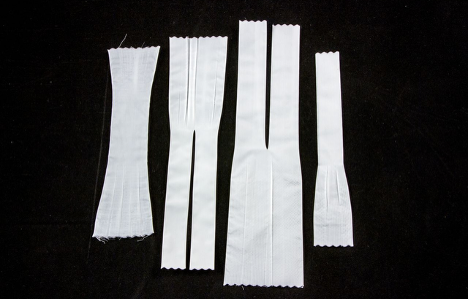
Among weaving processes, shuttle loom technology stands out for medical applications. Shuttle looms are uniquely capable of producing seamless tubes, bifurcated tubes, flared tubes, and tapered tubes. These shapes are essential for advanced biomedical devices. In contrast, needle looms and rapier looms cannot produce tubular forms without seams or defects.
For medical devices, any flaw, such as missing picks, floats, or broken ends, is unacceptable, as these can directly compromise patient safety and device performance in vivo. Superior dimensional precision is equally critical. Only automated shuttle looms consistently eliminate such defects and maintain the tight tolerances required for complex woven structures.
Continuous Fibers and Seamless Construction
This technology is especially crucial for creating complex shapes, such as bifurcated grafts. Instead of cutting and sewing flat fabric, which introduces seams as potential weak points. 3D weaving utilizes a continuous fiber approach. The fibers themselves diverge to form a graft’s legs, creating a seamless, integrated component. By eliminating seams, this method produces a significantly stronger and more reliable device, which is critical for implants that must endure decades of stress within the cardiovascular system.
The benefits of this approach include:
No Fiber Interruptions: Unlike discontinuous fibers that stop and start, continuous fibers run uninterrupted through the entire fabric structure. This creates a single, cohesive unit rather than seams that can separate.
Superior Load Distribution: The uninterrupted length of the fibers ensures that loads are distributed evenly across the entire device, thereby preventing stress concentrations that can lead to failure.
Thinner and smaller Profiles: Because strength is derived from interwoven continuous fibers, devices can be made much thinner and lighter in weight without sacrificing durability, making them ideal for minimally invasive surgery (MIS).
Emerging Requirements in Biomedical Textiles
The transition to catheter-based therapies has driven rigorous new demands that push the limits of traditional textile manufacturing.
Extreme Miniaturization Without Compromise
The primary challenge is fitting a strong, durable device into a catheter the size of a cocktail straw. This requires extremely fine fibers, often in the 10–20 denier range. However, making the fabric thin is not enough; it must also withstand the body’s harsh mechanical environment for decades.
This creates a manufacturing paradox. Fine fibers are incredibly delicate. In a standard weaving process, friction and abrasion can easily cause individual filaments to break. In apparel, a broken filament might be a minor cosmetic flaw. In a medical device, it is a critical defect that could cause thrombosis or mechanical failure years later. Manufacturers must therefore modify looms and processes to more carefuly handle these thin fibers, in order to minimize filament breakage.
Precision Porosity Control
Physicians demand near-zero blood leakage immediately upon implantation. This requires precise engineering of pore size and distribution, with repeatable performance from lot to lot. Achieving this level of consistency demands a scientific approach to loom setup, tension control, and process validation.
Integration of Smart and Functional Fibers
Materials are also evolving. Hybrid textiles now combine traditional structural fibers (such as PET or UHMWPE) with functional materials. Nitinol wire, a shape-memory alloy, can be woven directly into the fabric to create self-expanding devices that are crimped small for delivery and then “remember” their shape once inside the body. Successfully weaving metal and polymer together requires specialized expertise to manage their very different properties simultaneously.
The Art and Science of Biomedical Textiles
Producing advanced medical textiles demands more than the right equipment: it also requires a fusion of scientific precision and artisanal skills.
Handling difficult fibers such as Ultra-High Molecular Weight Polyethylene (UHMWPE) and fine-denier polyesters presents unique challenges. The weaving process demands that yarns are handled under tension. Small profile medical fabrics require very fine yarns. The smaller size of the yarn, the less strength that it has. In many cases the yarns can be so fine that manufacturing of the fabric is very difficult due to yarn and fiber breakage. Engineers must redesign guides, modify tension systems, and coat contact points to reduce friction. Mastering each fiber’s unique behavior is the result of decades of trial and error.
Despite the high-tech output, the process still relies heavily on human expertise. Designing a weave pattern that transitions from a flat sheet to a complex 3D shape is a geometric puzzle involving thousands of individual yarns.
Quality control is equally vital: every manufacturing lot undergoes critical characteristic testing for fiber identity, end count, thickness, permeability, and tensile strength under ISO 13485 standards. The tested characteristics must be both accurate and consistent. The goal is to reduce variation in the manufacturing process.
Bally Ribbon Mills’ advanced woven biomedical textiles combine precision engineering, specialized fiber expertise, and rigorous quality control to support the next generation of implantable medical devices.
The medical devices made from the woven textiles are implanted in the body and must remain there for the patient’s regular life expectancy. End-item designers and FDA regulators want the testing to be accurate and reliable over time. The testing not only verifies that the woven fabric can be used for the intended application, the testing also validates that the weaving process consistently manufactures a uniform product. Compliance with the rigorous requirements of ISO 13485 ensures long-term reliability.
The Future: Woven Piece By Piece
The evolution of woven biomedical textiles exemplifies the synergy between traditional craftsmanship and cutting-edge engineering. What began as robust fabrics for open surgery has transformed into sophisticated, small-scale, structures capable of navigating the body’s most delicate pathways while delivering lifelong performance. At the heart of this progress lies the shuttle loom, capable of turning thousands of ends of yarn into life-changing medical solutions.
As the industry continues its push toward smarter, smaller, and more personalized implants, the manufacturers who master both the art and science of weaving will define the next generation of patient outcomes. The future of medicine is not only being conducted in operating rooms but also woven piece by piece in specialized cleanrooms around the world.
Posted: August 8, 2026
Source: Amir Islam, Bally Ribbon Mills Director of Research and Development
EMIGSVILLE, PA — August 5, 2026 — Herculite Products is pleased to announce that Gwen Conley is joining Herculite as an Innovation Engineer. In this role, Lyle will focus on advancing Herculite’s innovation strategy, developing new products and solutions, and supporting growth across the organization.
Gwen has nearly 2 years of experience with product development and improvement, materials testing, and quality control. Before joining Herculite, she worked as a Junior Materials Research Engineer at Greenleaf Corporation, where she contributed to research and development projects aimed at improving existing products and processes and creating new products to meet customer needs in the metal-cutting industry.
Gwen graduated from Susquehanna University in 2023 with a Bachelor of Science in Physics and a minor in Mathematics. During her time there, she participated in undergraduate research that strengthened her analytical and problem-solving skills, was inducted into Sigma Pi Sigma – the national physics honor society – and earned the Outstanding Senior in Physics award in 2023. Gwen has always enjoyed solving problems and understanding how things work, which led her to pursue physics and a career in engineering.
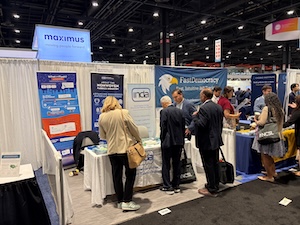
CARY, N.C. — August 5, 2026 — INDA, the Association of the Nonwoven Fabrics Industry, recently concluded a successful presence at the 2026 National Conference of State Legislatures (NCSL) Legislative Summit, held in Chicago, Illinois. Drawing over 9,000 attendees from across the country, this year’s summit marked the fourth time that INDA exhibited at the prestigious event.
Representing the association in the exhibit hall, Wes Fisher, Director of Government Affairs, and Kevin Conroy, Senior Manager of Government Affairs, engaged with thousands of state legislators, legislative staff, international delegates, and key industry stakeholders. Conference attendees visited INDA’s booth to gain insights on critical legislative and technical topics, including flushability standards, the California Collection Study, state-level wipes labeling legislation, and the broader economic footprint of the nonwovens sector.
“Securing a booth for INDA during the 2026 NCSL Legislative Summit provided numerous opportunities to speak directly with state legislators and policy stakeholders on wipes labeling and other issues prevalent in the nonwovens industry today,” said Wes Fisher, Director of Government Affairs at INDA. “The high-level conversations and product demonstrations we had were instrumental in highlighting the crucial role of nonwoven fabrics in consumer households and industrial applications.”
As one of the nation’s largest and most influential gatherings of state lawmakers, policy experts, corporations, and trade associations, the annual NCSL Legislative Summit serves as a premier platform for shaping state-level policy discussions. INDA’s participation ensures that the nonwovens industry remains a leading, science-backed voice as state legislatures consider regulations impacting essential consumer and industrial products.
Posted: August 8, 2026
Source: INDA, the Association of the Nonwoven Fabrics Industry
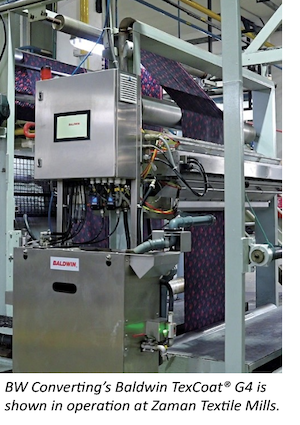
GREEN BAY, Wis. — August 5, 2026 — BW Converting will introduce textile manufacturers to the capabilities and production benefits of the company’s Baldwin TexCoat® G4 precision spray finishing system at the 33rd Apparel Sourcing Show, taking place Aug. 18-20 at the Tikal Futura Convention Center in Guatemala City. BW Converting will participate through its local agent, Maprimaq, at booths 25 and 26.
The Apparel Sourcing Show is the only trade show in Central America dedicated specifically to the apparel and textile industry in the DR-CAFTA region. The event brings together the region’s complete supply chain, including yarn, textiles, inputs, machinery and specialized services, creating an important forum for manufacturers seeking new ways to strengthen productivity and competitiveness.
Rick Stanford, VP global business development, Textiles, BW Converting
“Textile producers throughout Central America are facing the same challenge we see across the global market: They need to increase output and maintain high finishing standards while gaining tighter control over water, energy and chemistry costs,” said Rick Stanford, Vice President of Global Business Development, Textiles, BW Converting. “TexCoat G4 gives mills a practical way to address those priorities by increasing the productivity of an existing finishing line rather than requiring a major expansion of production capacity.”
The TexCoat G4 uses non-contact precision spray technology to apply a controlled and uniform amount of chemistry to one or both sides of the fabric. Because the system applies only the amount required, it can reduce wet pick-up by up to 50 percent compared with conventional finishing methods. The lower moisture load can decrease water consumption and reduce the energy required for drying by as much as 50 percent.
The system also recycles chemistry during fabric and chemical changeovers, supporting zero chemical waste from the changeover process. Automated cleaning routines, rapid job changeovers and recipe control help mills maintain production uptime while improving consistency and traceability.
Results reported by Zaman Textile Mills in Pakistan illustrate the business impact the technology can deliver in a production environment.
“Compared with machines not equipped with TexCoat G4, we have achieved 30 percent more production with the system’s aerosol spray technology,” said Atif Siddiqui, Technical Director, Zaman Textile Mills. “Chemical usage has also decreased by up to 50 percent compared to our earlier methods. Compared with the conventional method, TexCoat G4 improves the hand feel of the fabric and the overall quality of the finished product.”
Zaman also reported that the system’s precise application remained consistent across the full fabric width during long production runs. The reduced amount of finishing solution applied to the fabric allowed the mill to increase machine speed and production output while lowering utility and chemical costs.
Designed for integration with existing textile finishing equipment, TexCoat G4 provides mills with a pathway to greater output without necessarily adding another complete finishing line. Its non-contact application process also avoids bath contamination and chemical dilution in wet-on-wet applications, helping manufacturers maintain more repeatable finishing results across production runs.
Visitors to booths 25 and 26 can meet with Maprimaq representatives to learn how Baldwin TexCoat G4 can support more productive, controlled and resource-efficient textile finishing operations.
For more information about BW Converting’s textile technologies, visit bwconverting.com
NEUMÜNSTER, Germany— August 6, 2026 — In a joint development project with other partners, Barmag and Object Carpet have successfully tested BICO BCF yarn in the carpet manufacturing process. The results show that this innovative yarn technology offers significant performance advantages and opens up new possibilities for recycling-oriented carpet constructions.
Filament cross-section of BICO BCF 70% PET / 30% PBT.
These trials marked an important developmental milestone for the carpet industry. For the first time, the bicomponent technology—already known from other synthetic fiber applications—was successfully transferred to the BCF process and validated across the entire carpet value chain. The trials demonstrate the potential of a new class of yarn that combines improved performance characteristics with new possibilities for modern carpet constructions.
More volume, elasticity, and performance
“The tests show that a BICO BCF carpet offers more volume, high elasticity, and proven heavy-duty performance compared to standard carpet yarn. The PET-based material combination also enables recyclable carpet concepts,” says Product Manager Markus Reichwein, summarizing the test results.
Proven technology meets new applications
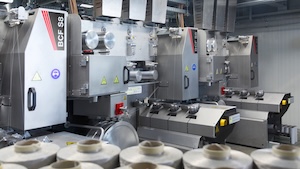
The yarn was produced on a Neumag S8 BCF system with a BICO spinning beam.
The yarn was manufactured on a Neumag S8 BCF line equipped with a BICO spinning beam. The principle of bicomponent yarn is already well-established in other synthetic fiber spinning processes—what is new, however, is its successful integration into the BCF process. Due to the differing shrinkage and elongation properties of the polymers used, the unique material combination causes the yarn to self-crimp, thereby creating its characteristic voluminous structure.
The successful trials on a Neumag S8 BCF system now demonstrate that this approach can also be implemented on an industrial scale for the carpet industry. Likewise, all subsequent process steps—from cabling and heat setting to tufting and coating—consistently yielded good results.
Impressive results throughout the entire process chain
After heat setting, the yarn exhibited pronounced bulk combined with high elasticity. The material also performed well in the tufting process: despite the increased titer, the yarn could be processed without any problems. Thanks to the yarn’s elasticity, it was also possible to produce more running meters of raw fabric than initially anticipated.
Furthermore, the yarn is characterized by its good coverage of the substrate. Process reliability was further confirmed during the coating process—both woven and knitted fabrics could be processed.
Successful quality testing for continuous use
The developed carpet constructions were extensively tested, including chair-castor and Vettermann tests in accordance with DIN EN 1307. Result: All constructions are suitable for continuous use in commercial settings and achieved a wear class of up to Class 33, depending on the carpet construction. “The results impressively demonstrate that BICO BCF technology can not only be reliably integrated into existing production processes but also offers significant advantages in product performance,” said Markus Reichwein.
A future-proof solution for a wide range of applications
The overall conclusion of the tests is clear: BICO BCF yarn impresses with its high opacity, excellent processing properties, and strong performance. The technology thus offers a promising solution with new options for developing high-performance and differentiated products for carpet manufacturers—in both the residential and commercial sectors. The successful industrial validation demonstrates that BICO BCF is not only technically feasible but also has the potential to shape future carpet constructions in a sustainable way.
BRIDGWATER, England — August 6, 2026 — One of the world’s leading nonwoven fabric-tech companies, Nonwovenn has appointed industry expert, Robert Green, as Business Development Director for its US operations. Green brings with him over 30 years of knowledge of the US market and a track record of driving commercial growth having most recently built and led the first commercially successful biopolymer fiber / nonwovens business bringing high-performance solutions to a range of markets.
Robert Green
In the next phase of Nonwovenn’s growth, further solidifying the position within the US market will be a key element. 25% of revenue currently comes from the US market, with an expectation that this will grow to 50% within the next three to five years. Nonwovenn identified the need for a senior leader to head up the US operations and strengthen client relationships, with Robert perfectly fitting that position. He will be focused on growing sales and delivering high-performance products and solutions in the market, specifically across the PouchTech and ProTech divisions. The business is also seeking acquisitions in the US technical materials sector, which Robert can lend his expertise to.
Alongside his commercial and technical experience, Robert has been actively involved in leadership positions with the two major global nonwoven industry associations, INDA and Edana.
Robert served on the INDA Technical Advisory Board and chaired the RISE Nonwovens conference for the last several years. For EDANA Robert sat on the Board of Governors for several years while growing the biopolymer nonwovens business. Robert was also a co-author of a series of articles on biopolymers recently featured in International Fiber Journal.
Commenting on his appointment, Robert Green said: “What attracted me to Nonwovenn was the impressive team offering a broad range of experience and expertise. Add to this the sharp focus on delivering big performance solutions in the markets the business serves and you have the perfect pairing. The markets Nonwovenn operates in are some of the most demanding in the industry and require the very best of the best when it comes to thinkers and solutions. It’s a fantastic opportunity for me to continue to learn and grow in this exciting industry, and I can’t wait to see where we can take the business next.”
David Lamb, Chairman of Nonwovenn Picture by Roger Moody / Guzelian
David Lamb, Chairman of Nonwovenn, added: “Robert is joining our team at a very exciting time for the business, especially as we step into the next phase of growth. It was vitally important to have a senior person on the ground in the US to lead the business, and Robert is an incredibly impressive, capable and technically qualified person who fit the role perfectly.
“His experience to date, including building his own very successful consulting business, meant we were immediately comfortable putting him in front of very high-level clients. His insight and nuances from the country will inform our growth plans and next stage of product development.”

 LINCOLN, RI — August 4, 2026 — Organic Dyes & Pigments LLC (ORCO) is pleased to announce an exclusive Canadian Distribution Partnership with Arya Chem Inc., headquartered in Toronto, Ontario.