By Amir Islam
For decades, the medical device industry has relied on textiles to solve some of the human body’s most complex mechanical challenges. From vascular grafts replacing damaged arteries to ligament reinforcements stabilizing knees, woven fabrics have been the silent workhorses of modern surgery.
What was once a field defined by basic durability requirements for open procedures has evolved into a high-precision discipline demanding precision and control over every filament.
As someone deeply involved in the engineering and manufacturing of these materials at Bally Ribbon Mills, I have witnessed this evolution firsthand. We have moved from the era of “strong enough” to one where a single broken filament is a critical failure, and where fabrics must be thin enough to slide through a catheter yet strong enough to anchor a device for a lifetime. It is not just about making things smaller; it is about fundamentally rethinking what a woven structure can do.
The Evolution of Medical Textiles
To understand where the industry is going, it helps to look at where it started. The trajectory of medical textiles mirrors the broader trends in surgery itself.
The Early Phase (Mid-20th Century)
In the mid-1960s, Bally Ribbon Mills (BRM), already a custom textile manufacturer for 40 years, began applying its expertise to medical textiles. During this era, the focus was on basic biocompatibility and durability. Since surgeons performed open procedures with direct access to the implantation site, device size was less of a concern.
Greater wall thickness and bulk were acceptable trade-offs for strength. Woven or knitted textile structures of PET (polyester) and ePTFE became the standards for vascular grafts. Testing protocols centered on tensile strength and burst pressure, as stringent requirements for micro-defects had not yet been established.
The Maturation Phase (1990s–2000s)
As the millennium turned, the industry matured. We saw a proliferation of implantable devices ranging from stent coverings to heart valve components. The focus shifted toward long-term stability and fatigue resistance. These devices were expected to last 10, 15, or even 20 years inside the body. Regulatory bodies began to standardize testing methods (ASTM/ISO), and quality systems became far more rigorous. Manufacturers had to demonstrate full traceability and cleanroom production, marking the beginning of the highly regulated environment we operate in today.
The Modern Era: Minimally Invasive Revolution

Today, we are firmly in the era of minimally invasive surgery. Open-chest procedures are being replaced by catheter-based interventions in which devices are threaded through blood vessels to reach the heart or brain. This shift has fundamentally changed the requirements for textile components. The size of the woven structures has been reduced.
While polyester is still a primary fiber used for these applications, the demand for Spectra and Dyneema (ePTFE) has been increasing. The high strength to weight ratio of these high-performance, fibers allows for smaller woven constructions. We are no longer just making “fabric”; we are engineering textile materials for shrinking delivery systems.
The Unique Advantages of Weaving
Weaving has become the technique of choice for many critical medical textiles due to its ability to create precise, complex, and highly stable structures. Medical weaving enables near-net-shape forms, outstanding dimensional control, and the integration of multiple fiber types, all of which are vital for today’s advanced implants.
Compared to alternatives, weaving offers clear advantages:
- Unlike braiding, which interlaces fibers diagonally and produces flexible but open structures, weaving creates tighter, low-porosity fabrics with exact geometries. This is essential for applications like vascular grafts, where minimal blood permeability is required.
- Knitting relies on looping yarns, resulting in inherently stretchy, open fabrics. While flexible, knitted structures lack the dimensional stability and low porosity needed for precise implantable devices and are difficult to miniaturize effectively.
In short, weaving is distinguished by its ability to tightly interlace fibers, delivering multi-directional strength, minimal porosity, and the capacity for sophisticated 3D forms. These qualities are far more difficult to achieve through braiding or knitting.
Shuttle Loom Technology

Among weaving processes, shuttle loom technology stands out for medical applications. Shuttle looms are uniquely capable of producing seamless tubes, bifurcated tubes, flared tubes, and tapered tubes. These shapes are essential for advanced biomedical devices. In contrast, needle looms and rapier looms cannot produce tubular forms without seams or defects.
For medical devices, any flaw, such as missing picks, floats, or broken ends, is unacceptable, as these can directly compromise patient safety and device performance in vivo. Superior dimensional precision is equally critical. Only automated shuttle looms consistently eliminate such defects and maintain the tight tolerances required for complex woven structures.
Continuous Fibers and Seamless Construction
This technology is especially crucial for creating complex shapes, such as bifurcated grafts. Instead of cutting and sewing flat fabric, which introduces seams as potential weak points. 3D weaving utilizes a continuous fiber approach. The fibers themselves diverge to form a graft’s legs, creating a seamless, integrated component. By eliminating seams, this method produces a significantly stronger and more reliable device, which is critical for implants that must endure decades of stress within the cardiovascular system.
The benefits of this approach include:
- No Fiber Interruptions: Unlike discontinuous fibers that stop and start, continuous fibers run uninterrupted through the entire fabric structure. This creates a single, cohesive unit rather than seams that can separate.
- Superior Load Distribution: The uninterrupted length of the fibers ensures that loads are distributed evenly across the entire device, thereby preventing stress concentrations that can lead to failure.
- Thinner and smaller Profiles: Because strength is derived from interwoven continuous fibers, devices can be made much thinner and lighter in weight without sacrificing durability, making them ideal for minimally invasive surgery (MIS).
Emerging Requirements in Biomedical Textiles
The transition to catheter-based therapies has driven rigorous new demands that push the limits of traditional textile manufacturing.
Extreme Miniaturization Without Compromise
The primary challenge is fitting a strong, durable device into a catheter the size of a cocktail straw. This requires extremely fine fibers, often in the 10–20 denier range. However, making the fabric thin is not enough; it must also withstand the body’s harsh mechanical environment for decades.
This creates a manufacturing paradox. Fine fibers are incredibly delicate. In a standard weaving process, friction and abrasion can easily cause individual filaments to break. In apparel, a broken filament might be a minor cosmetic flaw. In a medical device, it is a critical defect that could cause thrombosis or mechanical failure years later. Manufacturers must therefore modify looms and processes to more carefuly handle these thin fibers, in order to minimize filament breakage.
Precision Porosity Control
Physicians demand near-zero blood leakage immediately upon implantation. This requires precise engineering of pore size and distribution, with repeatable performance from lot to lot. Achieving this level of consistency demands a scientific approach to loom setup, tension control, and process validation.
Integration of Smart and Functional Fibers
Materials are also evolving. Hybrid textiles now combine traditional structural fibers (such as PET or UHMWPE) with functional materials. Nitinol wire, a shape-memory alloy, can be woven directly into the fabric to create self-expanding devices that are crimped small for delivery and then “remember” their shape once inside the body. Successfully weaving metal and polymer together requires specialized expertise to manage their very different properties simultaneously.
The Art and Science of Biomedical Textiles
Producing advanced medical textiles demands more than the right equipment: it also requires a fusion of scientific precision and artisanal skills.
Handling difficult fibers such as Ultra-High Molecular Weight Polyethylene (UHMWPE) and fine-denier polyesters presents unique challenges. The weaving process demands that yarns are handled under tension. Small profile medical fabrics require very fine yarns. The smaller size of the yarn, the less strength that it has. In many cases the yarns can be so fine that manufacturing of the fabric is very difficult due to yarn and fiber breakage. Engineers must redesign guides, modify tension systems, and coat contact points to reduce friction. Mastering each fiber’s unique behavior is the result of decades of trial and error.
Despite the high-tech output, the process still relies heavily on human expertise. Designing a weave pattern that transitions from a flat sheet to a complex 3D shape is a geometric puzzle involving thousands of individual yarns.
Quality control is equally vital: every manufacturing lot undergoes critical characteristic testing for fiber identity, end count, thickness, permeability, and tensile strength under ISO 13485 standards. The tested characteristics must be both accurate and consistent. The goal is to reduce variation in the manufacturing process.
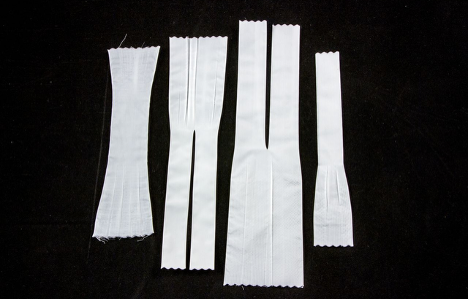
The medical devices made from the woven textiles are implanted in the body and must remain there for the patient’s regular life expectancy. End-item designers and FDA regulators want the testing to be accurate and reliable over time. The testing not only verifies that the woven fabric can be used for the intended application, the testing also validates that the weaving process consistently manufactures a uniform product. Compliance with the rigorous requirements of ISO 13485 ensures long-term reliability.
The Future: Woven Piece By Piece
The evolution of woven biomedical textiles exemplifies the synergy between traditional craftsmanship and cutting-edge engineering. What began as robust fabrics for open surgery has transformed into sophisticated, small-scale, structures capable of navigating the body’s most delicate pathways while delivering lifelong performance. At the heart of this progress lies the shuttle loom, capable of turning thousands of ends of yarn into life-changing medical solutions.
As the industry continues its push toward smarter, smaller, and more personalized implants, the manufacturers who master both the art and science of weaving will define the next generation of patient outcomes. The future of medicine is not only being conducted in operating rooms but also woven piece by piece in specialized cleanrooms around the world.
Posted: August 8, 2026
Source: Amir Islam, Bally Ribbon Mills Director of Research and Development