By James M. Borneman, Editor In Chief
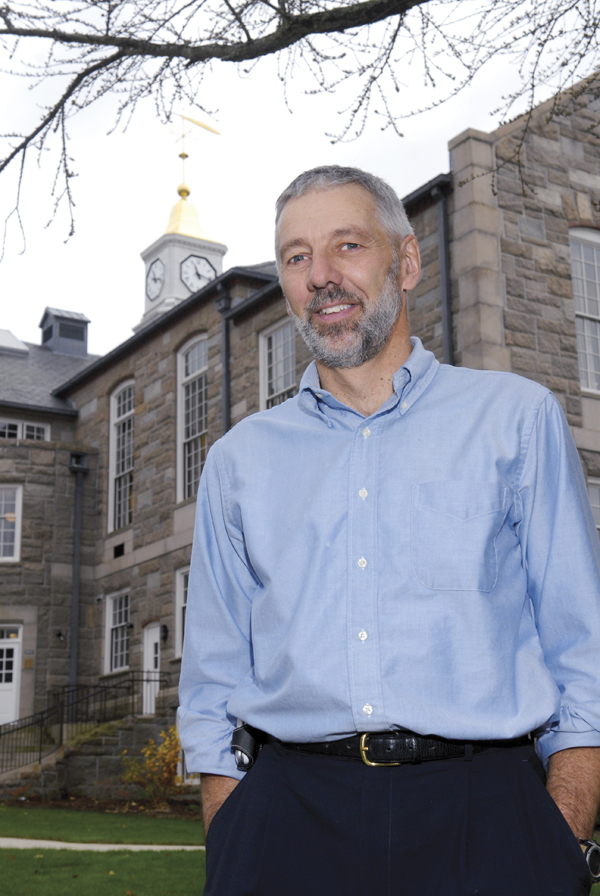
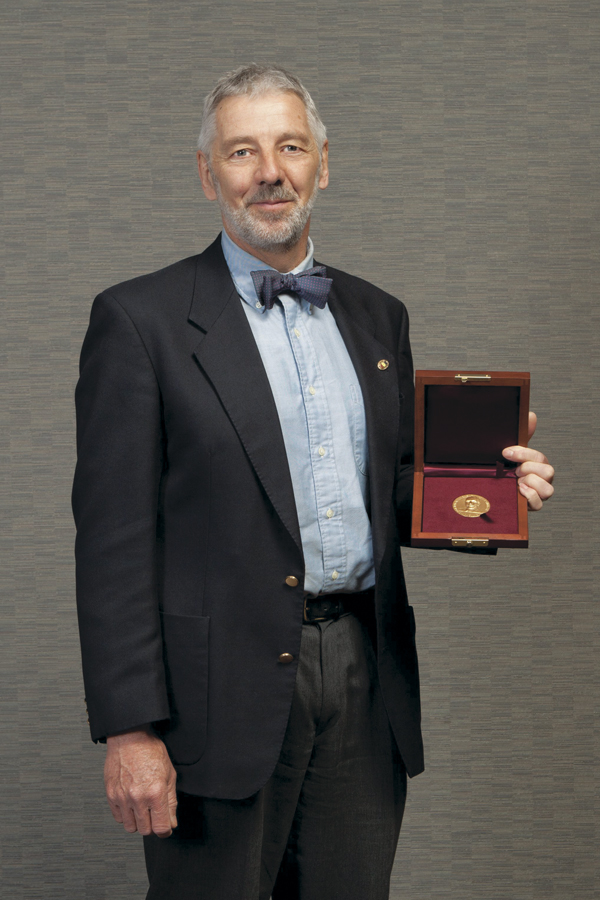
Dr. Martin Bide is a respected textile scientist whose career spans decades of teaching, research and leadership in fiber and dyeing technology. He has served on the faculty at the University of Rhode Island (URI) and at the University of Massachusetts Dartmouth (UMassD), where he has guided countless students and advanced the field of textile chemistry. Bide is the author of more than 100 papers, book chapters, and patents. His achievements have earned him the American Association of Textile Chemists and Colorists’ (AATCC) Olney Medal, one of the profession’s highest honors.
Today, Bide remains a leading voice in sustainable textile development and innovation across the global industry. He recently sat down with Textile World to discuss his career in textiles, the changing industry, and his enthusiasm for textile education as a lifelong pursuit.
Textile World: Dr. Bide, you’ve spent your career at the intersection of fiber science, dyeing and textile innovation, from the classroom to being internationally recognized for your research. Looking back, what first sparked your interest in textiles?
Bide: My 18-year-old self decided that “colour chemistry” sounded like a more interesting major than plain chemistry, without knowing it was really all about textiles and dyeing. I did this at Bradford University in the UK—they gave me a color vision test when I toured, and I thought that was smart.
And being a student was fun, so when the offer came to stay and do a PhD…. Sure!
TW: How did you transition from student to educator and researcher?
Bide: Spending a few years in UK dyestuff research, I was reading the JSDC (The Journal of the Society of Dyers and Colourists) and one Friday afternoon I saw a UMassD ad for a textile chemistry professor. I thought, “I’ll never get this, but what the heck” but I did — thanks to the Dean who looked at the search committee’s reject pile and overrode the reject reason “he’s in England” — and it was off to the USA in 1981.
TW: How did you relate to reentering the university environment, now as a professor?
Bide: The academic world is similar wherever you are, so the move was straightforward. Great students — and I am still in touch with several of them — UMassD was one of the traditional textile programs, derived from New Bedford and Fall River textile schools, supplying trained grads to industry. Our peers were NC State, Clemson, Georgia Tech, Philadelphia Textile and Auburn. There was the full spectrum of textile courses: dyeing I and II, printing, finishing, man-made fibers, yarn I and II, weaving I and II, knitting, and so on. Those university curricula have mostly disappeared or morphed into “materials”, with the notable exception of NC State.
TW: What brought about this change in textile education programs?
Bide: The industry was shrinking, along with the number of students. For me, it meant moving to URI in 1991.
URI was a different flavor of textile program, derived from the old “clothing and textile” component of Home Economics that was present in all the original land grant state universities.
URI’s program had evolved into “Textiles, Fashion Merchandising and Design,” with large student numbers, and instead of colleagues who were teaching yarn, weave, knit, testing, statistics, I had a new set who were dealing with merchandising, textile history, fashion design, social and psychological aspects of fashion.
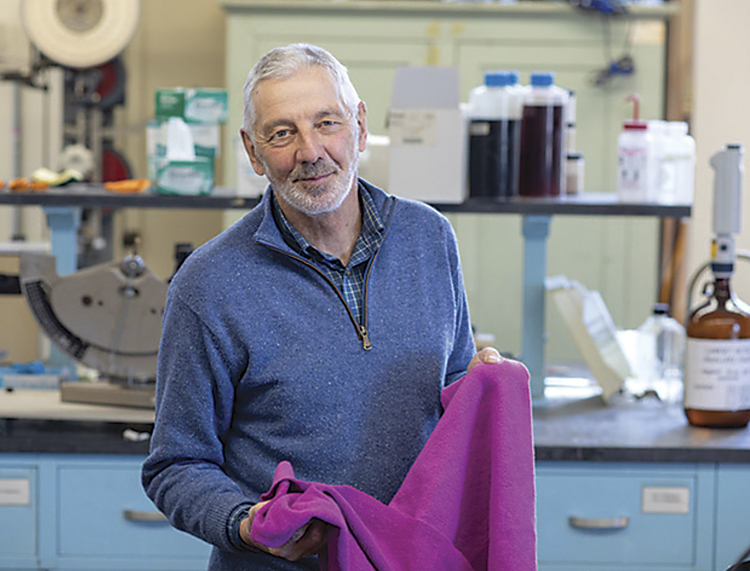
Bide: I was the lone scientist having to deal with all the technical aspects: so, I had to learn the weaving, spinning and so on. My main assignment was teaching a junior course that covered all that stuff, with a lab on fiber identification, and textile testing.
TW: How did you approach course materials?
Bide: Textbook? Tortora’s Understanding Textiles, later Collier and Tortora, and eventually Collier, Tortora and Bide — having made critical comments to prior editions, it was easier to have me inside “the tent”! I finally went on to the online text “Itextiles” that was more regularly updated, and again, I could put my 2 cents in, get inaccurate content straightened out without waiting for a new hard copy edition to come out.
TW: What interested you in remaining in an academic career?
Bide: I enjoyed my teaching career, especially trying to put myself in the shoes of a student so I could communicate complex ideas in a way that made sense to them. So, while I may know a lot about dyeing isotherms, the derivation of the CMC Color difference equation, the difference between worsted and woolen yarn production and so on, I had to distill that into its essentials and keep it simple enough for a student focused on Fashion Merchandising and Design to benefit.
My mantra was to suggest that if they were stuck on a long flight to China with a dyer, yarn spinner, color scientist, etc., then they should be able to have a sensible conversation.
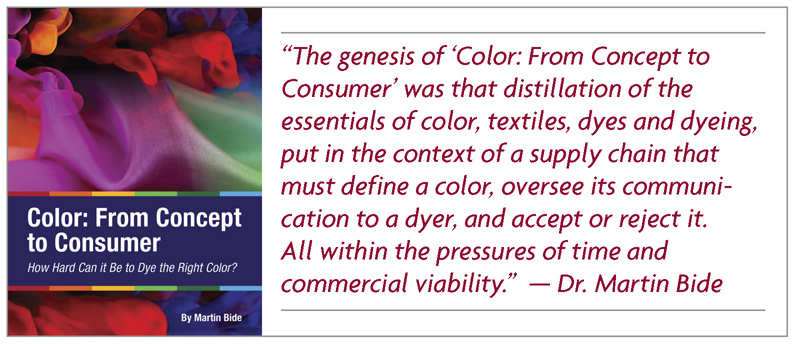
TW: You recently published “Color: From Concept to Consumer — How Hard Can it Be to Dye the Right Color?” — how did you approach the project?
Bide: The genesis of “Color: From Concept to Consumer” was that distillation of the essentials of color, textiles, dyes and dyeing, put in the context of a supply chain that must define a color, oversee its communication to a dyer, and accept or reject it. All within the pressures of time and commercial viability. And what was suitable for the students of Fashion Merchandising and Design at URI also seemed appropriate for AATCC’s “concept to consumer” interest group.
I’m not getting any royalties — this was a labor of love!
TW: What drove you to put it down on paper?
Bide: Being regularly involved with AATCC and seeing very similar questions and issues coming up at meetings. That, coupled with not being able to find a book that covered all the topics in (hopefully) an easily digestible format that I could use in my courses.
Bide: Encouragement from my boss, Ron Perry at UMassD. I learned the fact that academics share much with the “oldest profession” and will not turn down funding if an opportunity shows up — Wool scouring? Soil release on navy uniforms?…
Other inspirations from ex-students with questions: “Can you do thin layer chromatography on vat dyes?; Why is alginate better than synthetic thickeners for printing?; We have a new analytical method, will it work on dyes?”.
TW: So, applied research played an important role?
Bide: A major part of my research career — and the main reason for the AATCC Olney medal — came from the husband of a former student of mine.
In 1990, he was working on artificial artery research at a Boston Hospital. He’d ask his textile chemist wife questions about the polyester the arteries are made of, and eventually she told him to talk to me. They now run BioSurfaces in Massachusetts with a manufacturing facility and 15 employees (biosurfaces.us/).
Bumping into the attitude of non-textile people who think, “How hard can textiles/dyeing be, anyway?” led to several opportunities to be the textile voice — someone who knows the complexities — in multidisciplinary efforts. Arriving at URI, joining the chemical engineers doing pollution prevention in local textile mills. That began a long engagement in pollution prevention, later called “sustainability,” that accelerated as my more formal research projects wound down with the approach of retirement, which included a TEDx talk (uri.edu/tedx/ talks/swimming-in-a-sea-of-polyester/).
TW: Looking back at that decision by “your 18-year-old self” to pursue textiles, what are your thoughts?
 Bide: The great thing about textiles, that made my career so much more interesting — and for me, relevant — is that it is essentially practical.
We all wear clothes! It’s impossible to live/work in textiles in an academic silo. So, textile teaching and research exists side by side with what is happening in the real world, and that is where the AATCC comes in.
Life-long learning and relevance comes from conferences, technical meetings, etc. where academics and industry get together.
Learning from the formal presentations and casual conversations, and building networks — so you know who to ask later. Those activities continued my learning long past any formal education and has been essential to my teaching and research. We had enough local industry in Rhode Island that I could take students on field trips, essentially to show that I wasn’t making it up when I taught stuff! I could figure out the weaving and spinning when I went to URI. And so, on
TW: Your advice on how to enrich a textile career?
Bide: What would I say to others? Join! Go to meetings! Ask questions! Get to know people!
And I have no clue how any of this works in the age of social media!
Editor’s Note: Dr. Martin Bide’s recent publication, “Color: From Concept to Consumer — How Hard Can it Be to Dye The Right Color?” is available now at aatcc.org/colorbook25/
2026 Quarterly Issue I