By James M. Borneman, Editor In Chief
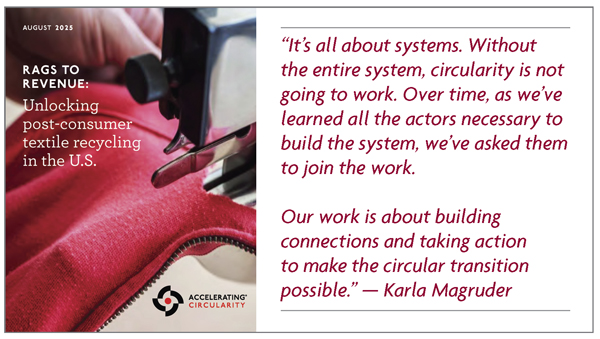
Karla Magruder is the founder of Accelerating Circularity, a nonprofit working to make textile-to-textile recycling a practical reality for the industry. With more than 30 years in textiles, she has held roles across the supply chain, including key positions with Burlington Performance Fabrics and Ingeo. Along the way, she built a reputation for connecting the dots between fiber makers, mills and brands to scale lower-impact materials and recycled polyester. That real-world textile experience inspired her to start Accelerating Circularity, bringing together a coalition of well-known companies and brands to turn used textiles into valuable new feedstocks. Recently, the organization published “Rags to Revenue: Unlocking post-consumer textile recycling in the US,” delving deeper into the business case and challenges to commercialization. Today, Magruder draws on her deep industry relationships and technical know-how to help partners move from talk to action, piloting systems and solutions that show how circularity can work in day-to-day business.
And most importantly, Magruder is, in her words, focused on “making the transition to new business models that are totally different than today’s.
Models where waste and negative environmental impacts are not options and there’s safety and equity in the employment sector.”
And — she’s an optimist.
Textile World: When did you become interested in textiles and what was your early career like?
Karla Magruder: I have always been interested in textiles. I started sewing young and went to The Fashion Institute of Technology in New York because of my love of textiles. My career was always working with textiles, from men’s silk tie fabrics in one of my first jobs to traveling around the world researching fabrics in my 20s. My career has been spent developing and marketing new materials, focusing on more sustainable options.
TW: One of your early roles in the industry in the 1990s was with Burlington Performance Fabrics. How did that experience impact your understanding of supply chains, technical aspects of textiles and textile trends?
Magruder: Burlington was great for building an understanding of how textile manufacturing works as well as learning about the needs of brands. How they ordered fabrics, timing, quality…. etc.
Importantly, the need for flexibility and staying up to date on market needs was key. At the time, Burlington was based 100% in the USA, we shipped a lot of material overseas where the manufacturing was done. It became obvious that we had to make changes to adjust to the market if we wanted to continue to do business.
Driving Toward Sustainability
TW: Later you became involved with the bio-based fiber Ingeo?
Magruder: I had been working in Italy and saw that they were much further ahead in sustainability. When I came back to the USA, I intentionally wanted to work on textiles that had a positive environmental impact versus business as usual. Burlington was compliant and very careful about their impacts, but I wanted to do more.
TW: What was it like embracing sustainability, renewable resources, and scaling an innovation into a sustainable commercial fiber product?
Magruder: There were a lot of things to learn and to teach. At the time, we spent a lot of time explaining to people the meaning of sustainability. Definitions still are very important.
On the flip side, getting the industry to transition to a new fiber was a huge undertaking: from feedstock to chip, dyeability, spinning, knitting, and weaving, all were opportunities to try to fit something new into existing systems. These challenges are true today for new fibers.
Magruder: It allowed me to understand how to develop the path to get sustainable materials into the market.
The path to circularity was not exactly straight forward. It was a matter of things coming together for me.
Circularity as a concept wasn’t in use while I worked for Ingeo. After, when people were using the word, it seemed to me that most people didn’t understand what it really meant.
So, back to the need for agreed upon definitions. I really felt that people needed to understand what circularity was … it is not recycled. Many people were equating the two, which was not true.
You may have a recycled product but that doesn’t make it circular. If that were the case, we would have more circular fabrics in the market today.
TW: With your involvement in Textile Exchange (TE), what brought about the Recycled Polyester (rPET) Working Group?
Magruder: I started the Recycled Poly working group at TE. At the time they had an organic cotton working group. I felt that the industry needed to understand and develop recycled polyester.
At the time, recycled polyester was new, there were quality issues and capabilities issues. For instance, color consistency was an issue.
Many of those issues have been solved.
Establishing Accelerating Circularity
TW: Was there a formative moment that brought you to establishing Accelerating Circularity?
Magruder: I was at the Outdoor Retailer tradeshow, in the midst of a lot of industry people. I was talking about the need for the industry to get together and define circularity …. that was basically the start.
TW: What was the initial Mission of Accelerating Circularity?
Magruder: Our mission hasn’t changed; over time we have clarified a word or two but not the foundation, which is to build circular systems to turn used textiles into new raw materials.
TW: How were the early days of Accelerating Circularity?
Magruder: Busy, we had to set both expectations and goals for the work with a wide variety of stakeholders.
TW: Who were the first to support the mission?
Magruder: We gathered major brands, like Target, Nike, VF Corp in the U.S.; and Inditex, Zalando and Amazon in the EU. And large fiber producers working on recycled fibers joined us including Unifi, Milliken and Lenzing.
TW: What was the momentum path — key date, events, milestones?
Magruder: Our 501(c)3 status was granted in December 2019.
While that was a major milestone, there were earlier meetings where we gained alignment with our founding members to move forward in our mission and incorporate.
After that, it was a matter of bringing on additional participants for trials in both the U.S. and EU.
We had the opportunity to share our message at industry events including GreenBiz, Textile Exchange, Dornbirn, Sourcing Journal and many others.
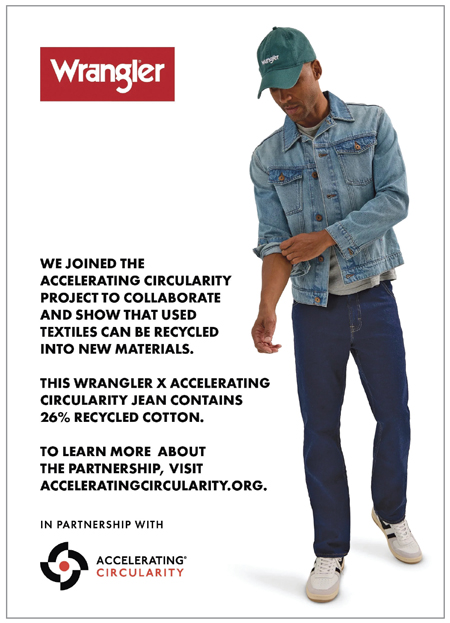
Having completed trials in the U.S. and EU, showing that textile-to-textile products from post-consumer materials was possible at commercial scale, was a highlight. Seeing products at retail at Target and Walmart through Wrangler was a big deal.
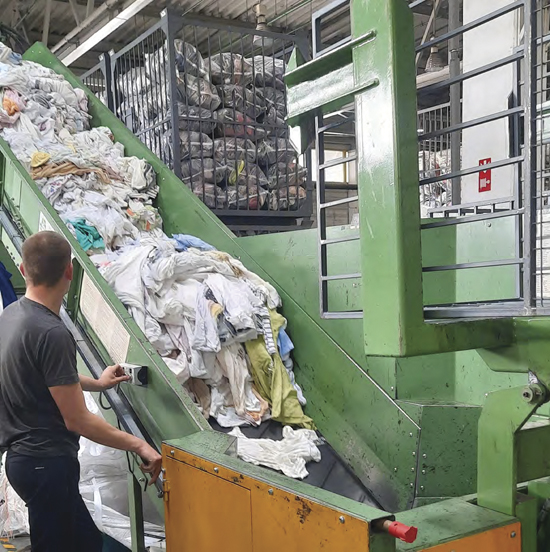
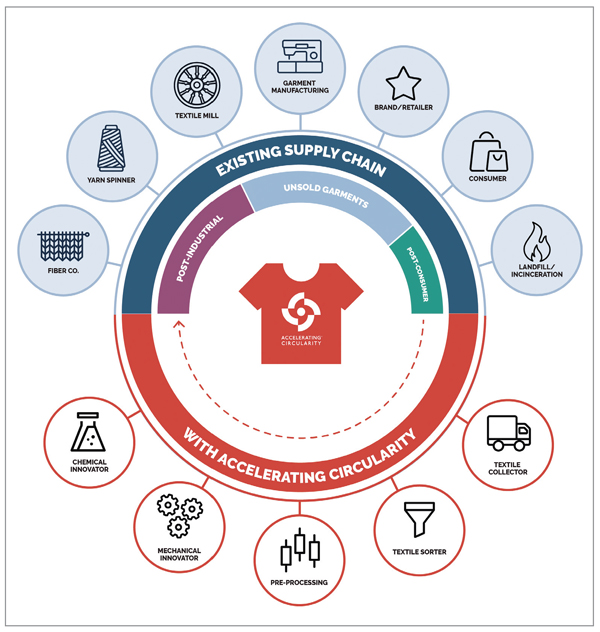
Magruder: It’s all about systems. Without the entire system, circularity is not going to work. Over time, as we’ve learned all the actors necessary to build the system, we’ve asked them to join the work.
Our work is about building connections and taking action to make the circular transition possible.
TW: How do you balance the variety of partners needs and goals?
Magruder: When you put the entire system together, and the actors in a room, they learn from one another, and understand each other’s needs. The conversation turns to what will work versus what one specific node needs. It starts to function as a system.
TW: Most recently, Accelerating Circularity published “Toward Circular Systems for Trims and Ignored Materials (CSTIM)” — how would you describe CSTIM?
Magruder: All the work that Accelerating Circularity does is in service to developing a functioning system. “Rags to Revenue” and “Toward Circular Systems for Trim and Ignored Materials” were developed to identify roadblocks and gaps in circular systems.
By understanding these gaps, they can be addressed by putting systems in place to address them.
TW: Why is CSTIM important and where does it take the process of Accelerating Circularity?
Magruder: CSTIM is a working group — a cross-sector working group — addressing the complex role trims play in sorting, deconstruction, and preprocessing, while shaping circular infrastructure and product design guidance for the industry.
I call trims the “bad boys” of circularity. They cause a lot of the problems.
A New Model
TW: What are the challenges of broad adoption — hurdles to cross in the future?
Magruder: Thinking and working in systems. Doing everything all at once.
Circularity isn’t something that can be done in pieces. Everything has to function at the same time. You can’t commercialize one step and have the system work.
Each node in the circular system must function for it to work and scale.
TW: As Founder of Accelerating Circularity, when will you know the group’s goals have taken root and what is a sign that the mission is accomplished?
Magruder: Our vision is a world in which textiles are no longer wasted. The ultimate sign would be to see functioning systems for all materials at what we now think of as their end of life.
TW: What question hasn’t been asked? Please ask and answer.
Magruder: The most important and hardest question to answer is, “How do we make a transition to a textile industry that accounts for environmental and social impacts while creating financially robust businesses?”
The answer lies in our ability to make a transition to new business models that are totally different than today’s.
Business models where waste and negative environmental impacts are not options and there’s safety and equity in the employment sector.
I’m an optimist.
2026 Quarterly Issue I