Saint Paul, MN— January 30, 2026 — Nalco Water, an Ecolab company, has entered a strategic three-year collaboration with international technology group ANDRITZ to support innovation and accelerate product development at the PrimeLineTIAC Tissue Innovation and Application Center (TIAC) in Graz, Austria.
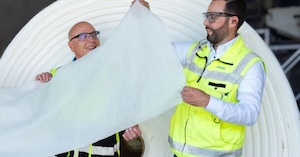 Innovation is driving the future of the tissue and towel industry, meeting rising consumer expectations for softness, strength and sustainability while enabling manufacturers to optimize production.
As demand grows for eco-friendly, high-performance products, innovation delivers smarter solutions that reduce water, fiber, and energy use, enhance operational efficiency and support long-term environmental goals.
Nalco Water will be a strategic partner for Andritz on their state-of-the-art pilot tissue machine at TIAC, enabling the company to test and validate its advanced chemistries and digital and automation solutions in a controlled, industrial-scale environment. The collaboration will allow Nalco Water increased machine access to enable faster innovation cycles and speed to market for new tissue solutions.
“This partnership with ANDRITZ allows us to bring our solutions to life in a real-world setting, accelerating development timelines and enabling our customers to trial programs before implementation on their own machines,” said Ravi Raghavapudi, SVP & GM, Global Nalco Water Paper. “It is a significant milestone for Nalco Water and our tissue customers.”
The TIAC facility features a complete tissue production line with flexible configurations—including conventional, textured, and structured (TAD) tissue formats—along with advanced automation and monitoring systems. The collaboration also includes joint development opportunities with key global tissue producers and access to TIAC’s digital innovation platform, Metris, for enhanced process optimization.
Nalco Water secured this collaboration through a competitive process, with its chemistries demonstrating superior performance during evaluation.
Posted: January 30, 2026
Source: Ecolab