Textile World Special Report
Global nonwoven technology provider ANDRITZ reports the needlepunch nonwovens market as stable, supported by diversified end-use demand and infrastructure investment.
In the following report, Austria-based ANDRITZ outlines the market forces, application trends and technology developments influencing capital investment and competitiveness.
ANDRITZ Reports
The global market for needlepunch nonwovens continues to demonstrate strong structural resilience, supported by the technology’s exceptional versatility across a wide range of applications, including geotextiles, filtration, automotive interiors, synthetic leather, insulation and technical felts. Unlike single-segment textile technologies, needlepunch benefits from highly diversified end markets, each following its own investment and demand cycle. This diversity provides a natural buffer against economic volatility.
After a short slowdown in early 2020, the market strongly recovered until the third quarter of 2023, driven by infrastructure investments and renewed industrial activity across Europe, North America and Asia. While 2024 has been a more cautious investment climate due to geopolitical tensions and inflationary pressures, the medium- and long-term outlook for 2025 and 2026 remains positive, supported by fundamental market drivers.
Regional Dynamics Shaping Demand
Europe and Turkey remain mature but strategically important markets, driven by high value-added applications such as automotive interiors, technical geotextiles, filtration media and specialty industrial felts. Investments in these regions are primarily aimed at productivity improvements, quality differentiation and energy efficiency rather than pure capacity expansion. Turkey, in particular, plays a pivotal role as a competitive manufacturing and export hub, bridging European quality standards with cost-efficient production and strong access to regional and international markets.
Asia remains the strongest growth engine for needlepunch nonwovens, driven mainly by filtration, synthetic leather and stitch-bonded applications. This region benefits from strong domestic consumption, industrialization and export-driven manufacturing strategies, supported by strong financial assets and enabling multiple line investments.
Emerging regions such as the Middle East and parts of Central Asia are also gaining importance, supported by infrastructure development and growing interest in building local nonwoven production capabilities. In North America, renewed momentum can be observed in automotive applications, such as wheel arch liners and infrastructure-related geotextiles, where reshoring strategies and supply-chain security are influencing investment decisions.
Globally, demand growth is driven by infrastructure spending, environmental regulations, lightweight construction trends and the increasing use of recycled and bio-based fibers, applications where needlepunch technology offers clear technical advantages.
Investment Trends: Productivity, Quality And Flexibility
Despite a more cautious macroeconomic environment, nonwovens producers continue to invest in new machinery and line upgrades. Importantly, many recent projects represent net capacity additions rather than simple replacement investments, reflecting confidence in long-term demand.
Service capabilities also play a decisive role. Remote support, rapid spare-parts availability, retrofit solutions and process expertise are increasingly valued, particularly in the context of workforce turnover and skills shortages.
Key Applications Driving Investments
Geotextiles remains one of the largest and most stable application segments for needlepunch nonwovens, supported by global infrastructure projects, urbanization, road construction, erosion control and drainage systems. This cost-sensitive market demands high-output lines up to 2,000 kg/hour and advanced weight regulation systems, to maintain competitiveness.
In Asia, filtration media and synthetic leather remain key drivers of needlepunch investments. Stricter environmental regulations and sustained industrial growth continue to support demand, while synthetic leather applications increasingly rely on advanced needling patterns and precise batt formation to achieve high surface quality, uniformity and mechanical consistency.
Automotive demand remains regionally diverse. While North America continues to invest in wheel arch liners, Europe focuses increasingly on aesthetic interior components and Asia shows sustained interest in velour and technical felts for both automotive and footwear applications.
Sound absorption and insulation applications, often based on recycled or natural fibers, are gaining importance across construction and mobility markets. The ability of needlepunch lines to process 100% recycled materials while maintaining consistent quality has become a key factor for producers.
Lightweight nonwovens represent a highly demanding segment, requiring precise control to achieve low basis weights with stable performance. Applications such as hygiene, filtration and medical products rely on uniform web formation, carefully controlled pre-bonding and needling processes, including elliptical needling, with efficiency and material optimization acting as key investment drivers.
Technology Developments In Andritz Needlepunch Machinery
Recent improvements at ANDRITZ reflect a strong alignment between machine development and current market expectations for productivity, quality and process flexibility. These developments address a wide range of applications, from high-output geotextiles to lightweight and quality-critical nonwovens.
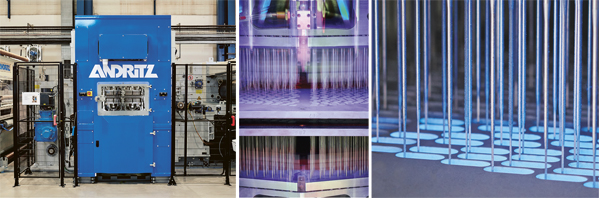
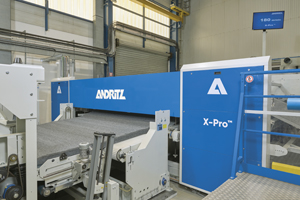
The ANDRITZ neXloom elliptica Type DF-4 needleloom represents an advancement in pre-needling technology for high-quality nonwovens. Designed for light products processed at high speed, it combines optimized pre-needling consolidation with improved surface appearance. Its elliptical needling process, using one needle per hole, eliminates surface marking, reduces fabric stretching and improves fabric uniformity, while enabling reliable and flexible operation for demanding applications such as automotive, paper felts, spunbond products and synthetic leather.
Outlook And Challenges
While the fundamental outlook for the needlepunch market remains positive, challenges persist. Investment timing remains sensitive to geopolitical tensions, energy costs and inflation, while skills development and knowledge transfer become increasingly critical as the workforce evolves. At the same time, the growing use of recycled and natural fibers (hemp, flax and jute) introduces greater variability in raw materials, requiring more robust and flexible process solutions.
Overall, the needlepunch nonwovens market enters the coming years with solid fundamentals, diversified demand and strong innovation momentum. Investments are clearly shifting toward flexible, efficient and quality-focused production solutions that offer fast returns and long-term competitiveness.
Unlock New Market Opportunities With Andritz Needlepunch Pilot Line
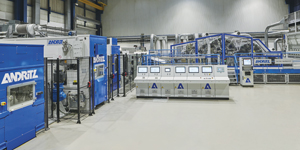
The ANDRITZ needlepunch pilot line at our Elbeuf technical center offers customers a unique opportunity to turn ideas into market-ready solutions. Built to full industrial scale and equipped with the latest ANDRITZ technologies, this pilot line enables realistic trials, rapid product development and confident investment decisions. Customers can test a wide range of fibers and applications under production-like conditions, supported by experienced process experts, advanced digital tools and an integrated testing laboratory.
Whether optimizing an existing process or developing an entirely new product, the ANDRITZ needlepunch pilot line is designed to accelerate innovation, reduce risk and unlock new market opportunities.
Executive Summary: Needlepunch Outlook
The global needlepunch nonwovens market demonstrates strong resilience, underpinned by its versatility across diversified applications such as geotextiles, filtration, automotive interiors, synthetic leather, insulation and technical felts. This diversity provides a natural hedge against economic volatility and supports long-term market stability.
Following a strong recovery through 2023, driven by infrastructure investments and renewed industrial activity, 2024 has seen a more cautious investment climate influenced by geopolitical tensions, inflation and energy costs. Nevertheless, the medium- and long-term outlook remains positive for 2026 and beyond.
Regional dynamics continue to shape demand. Asia stands out as the primary growth engine, driven by filtration, synthetic leather and industrial applications, while Europe and Turkey remain mature but strategically important markets focused on productivity, quality differentiation and energy efficiency. In North America, reshoring initiatives and infrastructure spending are reviving investments, particularly in automotive and geotextiles.
Investment decisions increasingly prioritize fast return on investment, low total cost of ownership, surface quality, productivity and process flexibility. The growing use of recycled and natural fibers is accelerating demand for robust, adaptable technologies.
Overall, the needlepunch market enters the coming years with solid fundamentals and strong innovation momentum — a clear shift toward flexible, efficient and quality-focused production solutions.
2026 Quarterly Issue II