GREENVILLE, S.C. — March 18, 2021 — Delta Apparel Inc., a provider of core activewear and lifestyle apparel products, today announced that its authentic, aspirational lifestyle brand, Salt Life, has launched The Daily Salt, a guide covering anything you want to know about living the Salt Life.
Team members, influencers, and staff will showcase, guide, and demonstrate “how-to” videos and provide exclusive articles from amazing destinations around the world. From the island surfing of Hawaii to the white sand beaches of Florida, a trip to Cabo San Lucas, and even Hong Kong, the breadth of content will whet the appetite for blue skies, warm sandy beaches, fishing, surfing, and more.
Salt Life President Jeff Stillwell commented, “We envision this as a place for our customers and others to surf for all things Salt Life, such as recipes, interviews with our team members, beach workouts, and roundups of our favorite locations around the world to catch a wave.”
Additionally, The Daily Salt is expected to expand into offering directories for the “best in” any category in specific highlighted destinations, such as Key West, Florida, Dana Point, California, Maui, Hawaii, Roatan (Central America), Cabo, Mexico, and many more.
To learn more, please visit, www.saltlife.com/the-daily-salt.
Debut features on The Daily Salt include:
How To:
Venerable Team Members Colin McPhillips and Kieran Anderson will guide you in “picking the perfect surfboard”
SUP (stand up paddleboard) World Champion Connor Baxter provides a beginner’s guide to SUP
Fishing for Bonefish and permitting in foreign waters and stateside – offering techniques, bait, and special gear
Spearfishing 101 – how to dive into an exhilarating and new fishing experience
Lifestyle:
Simple beach workouts
Create your own Ceviche (with the fish you just caught)
Uniquely designed at-home workouts with Conner Baxter
Activities:
Hear about the best surf spots on the Atlantic Coast
Best scuba places in the world
Location highlights from various favorite places to chill, workout, fish, dive, surf, and more
Whether you want to visit the Great Blue Hole in Belize, The Outer Banks surf, or the swells in Hawaii or Australia, The Daily Salt is your destination to find your muse.
FREMONT, Calif. — March 16, 2021 — Tailored Brands Inc. today announced that Dinesh Lathi will step down from his role as president and CEO, effective March 26. Board members Bob Hull and Peter Sachse will act as Interim Co-CEOs while the board searches for a permanent successor.
“It has been my pleasure to work as part of the talented and dedicated Tailored Brands team, and I want to thank all of my colleagues for their support and many contributions over the past five years,” Lathi said. “I believe in the power of our brands and am confident the hard work we have done together has put the company on a path toward long-term growth and success. I will be rooting for everyone at Tailored Brands as you take these next steps.”
In December 2020, Tailored Brands successfully completed its Chapter 11 restructuring, and earlier this month, the company announced $75 million in new financing. After these events, and with business performance beginning to recover from the impacts of the COVID-19 pandemic, the board and Lathi mutually agreed that this is the right time to re-evaluate the skills and experiences needed in the CEO role as the company prepares for its next chapter of growth and success.
“With a solid financial structure now in place and the support of its new owners behind it, Tailored Brands is well positioned for growth in its next chapter,” Hull stated. “We are immensely grateful for Dinesh’s contributions as both a director and executive of the Company over the past five years, and especially for his leadership in successfully guiding the Company through both the restructuring and the unprecedented challenges of the global pandemic. We wish him well in all of his future endeavors.”
Sachse added: “The team at Tailored Brands is incredibly strong, and even in the midst of the pandemic, Dinesh guided them to make smart investments to strengthen the brands and the value proposition they deliver for customers. As a result, the company is now delivering enhanced online and omnichannel options to shop seamlessly across channels, piloting new in-store experiences to make shopping safer and more enjoyable, and offering an expanded product assortment. We will continue to accelerate this progress to meet the evolving needs of our customers and ensure we’re earning their continued loyalty every day by helping them look and feel their best for moments that matter.”
NEW YORK CITY — March 18, 2021 — Luxury Daily® will be hosting a complimentary webinar on April 7 at 11 a.m. to Noon EST, spotlighting the new challenges fashion and apparel brands are facing with fraud return and highlighting prevention methods through a conversation in partnership with Avery Dennison.
As online shopping increases and digitalization accelerates, brands and consumers are faced with many consequences. Counterfeiters are exploiting these trends, growing in reach and becoming harder to spot — and consumers seek reassurance as they transact online. It is more important than ever for brands to invest in the right digital authentication. Connection is protection.
This fireside chat will feature a Q&A with speakers and highlight the following themes:
How consumers’ attitudes and purchase behaviors have changed since the pandemic and why authentication matters now more than ever
How the penetration of online sales has offered unprecedented opportunities to counterfeiters
The importance of brands to be able to identify counterfeits and unauthorized third-party resellers, and address return fraud
Discover the power of an army of global consumers to collect evidence cost-effectively on your behalf
The benefits for brands of offering consumer-enabled authentication as data points to support the brand protection teams
Connecting with consumers to protect your brand
Speakers to include:
Greta Moser, global director of product line management, brand protection and factory automation solutions, Avery Dennison
Michele Casucci, founder/CEO, Certilogo
David Franklin, global sales director for brand protection, NetNames
Regis Messali, communication and development director, Unifab
In conversation with Mickey Alam Khan, editor in chief, Luxury Daily
This webinar is part of a Luxury Daily® series in partnership with Avery Dennison.
BURLINGTON, N.C. — March 18, 2021 — Sunbrella and United Fabrics have unveiled “Reflections,” their second joint contract upholstery collection to help design professionals discover new opportunities for peaceful and functional spaces. Featuring 30 new durable, soft and bleach-cleanable fabrics in tactile textures and coordinating colors, Reflections is designed to complement the Origins collection and other fabrics within the Sunbrella Contract portfolio.
“Right now, we are all reflecting on the thematic moments that define us and taking time to appreciate the little things in life. This collection honors that idea with nature-inspired motifs that elicit feelings of comfort and peace,” said Greg Voorhis, executive design director at Sunbrella. “We value the opportunity to provide fabrics for a new wave of commercial design that will prioritize versatility with lasting style.”
The patterns in Reflections evoke feelings of serenity while honoring design elements that are increasingly conscious of new demands for commercial environments. Engineered to hold its vibrant color even in high-traffic spaces, the collection is durable, stain-resistant, bleach-cleanable and comfortable, with fabrics that feature soft yarns and bold design.
“We were thrilled to partner with Sunbrella again to develop our second contract upholstery collection,” said Scott Warwick, president and CEO of United Fabrics. “It was important for these fabrics to build on the success of our first Origins collection through new colors and textures that are timely and relevant.”
Patterns from the collection include:
Inga-Boho – acts as an anchor to the collection with a free-spirited nature.
Palma – featuring a loosely styled botanical leaf, this grounding and reversable graphic represents a yearning to escape through travel and the peace found in nature.
Daphne – a fresh take on a modern cabana style stripe, it brings a calming sense of order to chaos.
Miles and Velma – these new solids carry the freeing nature of Sunbrella’s outdoor performance indoors through tactile textures that feel warm and comfortable.
Reflections is suitable for a variety of commercial hospitality settings, from hotels to restaurants and beyond. The exclusive collection is available through United Fabrics.
Automation is causing seismic shifts across many industries, as the adoption of intelligent technology promises to transform the way we live and work.
At its core, automation has the potential to reduce our reliance on manual or physical labour, drive process efficiency, reduce administrative burden and produce more effective workflows in the process.
But with some estimates placing high levels of automation at just three percent of all goods produced, there is a clear need for business owners to wake up to the benefits technology can provide in building the factories of the future.
Ian Millington, managing director of adi Automation— a division of the multidisciplinary engineering company adi Group — discusses how an accelerated adoption of technology can help fix supply chain vulnerabilities and boost business prospects in 2021.
A Weak Link In The Chain
Before COVID-19 arrived on the scene, a business’ ability to adapt and respond to marketplace changes was strong indicator of its industry success. Fast forward to today, and without this kind of business mobility, manufacturers expose themselves to a ruthless economic climate, whereby manufacturers across the world are having to down tools and shut up shop, maybe for the last time.
Supply chains have been particularly exposed at this point in time, as manufacturing resiliency, flexibility and scalability is put into perspective with increased food demands, data center needs and medical responsibility.
Business owners have had to learn the hard way that a dependency on human labour and access to physical space makes it vulnerable to disruption. So with the manufacturing industry looking to fight back against the virus, we’d argue that now is the time for automation to take its place in achieving a highly cohesive, resilient and responsive manufacturing ecosystem.
Automating Fear
Manufacturers have long intimated a desire to automate systems, yet this has been juxtaposed by an ingrained resistance for decades. The cost of implementation and a fear for the loss of human jobs has been well publicized over the years, and in an economic climate whereby job safety is at a premium, it’s a little wonder bosses have further retrenched into old habits.
Low cost at a reasonable rate of quality has become the norm for the past twenty years, often meaning manufacturers have looked overseas for cheap labor, land and shipping infrastructure. But with COVID-19 rattling this old school supply chain in a massive way, now is the time for manufacturers to step up and act differently if they want to not only survive but thrive in the years ahead.
Robot And Human Efficiency
Firstly, there’s solid evidence out there that automation doesn’t really lead to a loss of human jobs. Think of one of the oldest industries out there — farming. It is true that in the early 20th century, there were more then 10 million farmers in the United States alone, compared to 1 million today. Yet this decline was accompanied by new technology, which created jobs in the service, blue collar and white collar industries. Automation creates jobs in new digital based roles that are expected to have a global economic impact of over 11 trillion British pounds by 2030.
Remote Guidance
Capital expenditure has been in heavy retreat during the pandemic, so it is of some relief that by deploying robots to automate many of the mundane, repetitive tasks associated with manufacturing processes, firms can shift their spending from capital to operating expenses, minimizing both cost and risk.
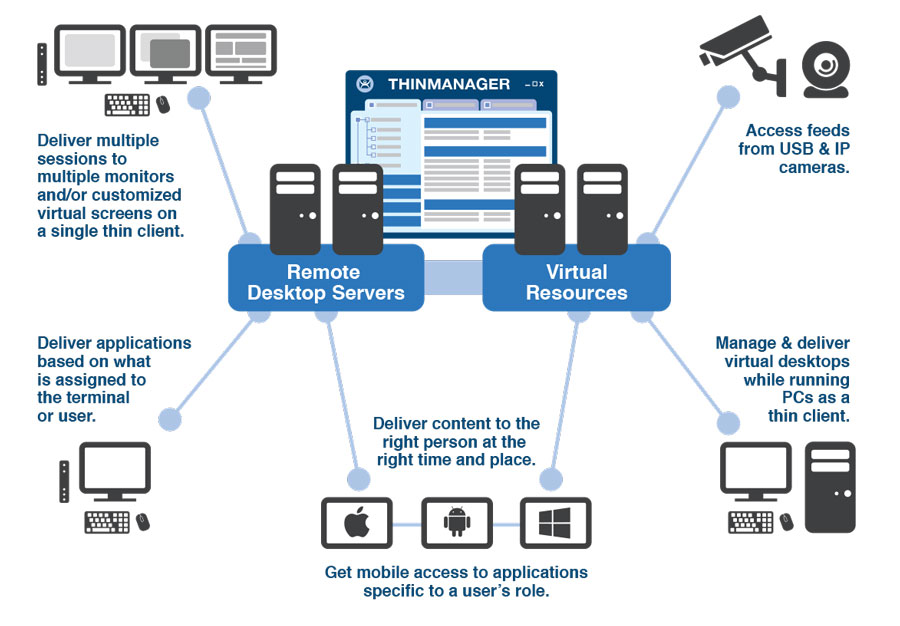
One of the huge benefits that has enabled many factories to continue operations as normal, amidst social distancing guidelines, is remote working practices. At adi, we’ve seen the benefit of this in our partnership with Rockwell Automation and its ThinManager production platform. Delivering centralized data management via a single server-based technology, manufacturers are able to shield themselves from costly periods of downtime and production outages.
Ian Millington
Understanding this further, take for example how manufacturing environments can be quite inhospitable to electronics such as computers. A typical PC may breakdown inside two to five years depending on conditions. If you had 20 PC stations in one plant, that could result in a massive outage or loss of data to your business taking approximately eight hours to fix at best. That’s one outage potentially every two months.
ThinManager utilizes Thin Clients instead of bulky PCs connected to screens on the production environment. With no moving parts, thin clients are less prone to overheating and breakdown, while they can also operate as plug-and-play devices, meaning any downtime is minimal. The ease of installation means extra screens can be easily installed for social distancing of personnel.
Similar applications can be applied for remote monitoring systems, allowing personnel to access plant data in a variety of simple to use and graphical formats, from anywhere using equipment such as laptops, tablets or mobile phones. Data can be used and updated to maximize production whilst being away from the manufacturing environment. Remote access and monitoring is therefore transforming production sectors as diverse as food and beverage, chemical and general manufacturing.
Companies are looking for ever more innovative ways to operate efficiently with less production floor operatives being available. Automation is just one of a number of technologies which can be applied to existing facilities to improve efficiencies through use of data.
By acting now, manufacturers that can set the stage for the next wave of industrial transformation and futureproof themselves against manufacturing’s next inevitable wave of disruption.
Editor’s Note: Ian Millington is MD of adi Automation, a division of the multi-disciplined engineering business adi Group. With more than 20 years of experience across technology, engineering and manufacturing spheres, Millington’s background spans a diverse mix of sectors including power generation, oil and gas, food and beverage and automotive.
WASHINGTON, DC — March 18, 2021 — This morning, United States Fashion Industry Association (USFIA) President Julia K. Hughes testified before the Senate Finance Committee on Fighting Forced Labor: Closing Loopholes and Improving Customs Enforcement to Mandate Clean Supply Chains and Protect Workers.
She testified on behalf of the industry about the fight against forced labor and how to improve enforcement to reach our shared goal of elimination of forced labor. Even before very public media reports about forced labor, the industry along with apparel, footwear, and retail associations joined together to create a forced labor working group. In addition to sharing resources and best practices, the industry is pioneering and implementing new technologies and innovative approaches to decipher where supply chains are susceptible to forced labor.
In USFIA’s testimony, we highlight the need for a multi-stakeholder approach that includes a combination of civil society, NGOs, companies, governments, and international institutions to reach the shared goal of eliminating forced labor.
Hughes also outlines how the U.S. Government can help us tackle forced labor in the supply chain. USFIA supports a “whole of government” approach that would create a strategy to span across the State Department, USTR, the Department of Labor, the Commerce Department, the NSC, and USDA.
Looking at the role of U.S. Customs and Border Protection (CBP) to implement enforcement measures, USFIA strongly encourages transparency in the approach to improve enforcement efforts. We support a series of recommendations released this week by the Commercial Customs Operations Advisory Committee (COAC) Intelligent Enforcement Subcommittee Forced Labor Working Group that urge CBP to expand its communication and collaboration with the trade and adopt “objective” methodology to measure the success of their enforcement efforts from the communities most impacted by forced labor rather than enforcement output.
“The task is not easy (to put it mildly). My personal belief is that to eliminate forced labor we need to go beyond what companies can do on their own, and go beyond an emphasis on punitive measures, to use multi-stakeholder approaches. The combination of civil society, NGOs, companies, governments and international institutions is needed to reach our shared goal to eliminate forced labor.”
Researchers are working on developing an armband with three dry electrodes that could track heart rate. Photograph courtesy of Caitlin Knowles
By Laura Oleniacz
North Carolina State University researchers took a step forward in the development of an armband that could track the heart’s electrical activity without requiring bulky wiring or sticky gel on the skin.
Specifically, the researchers determined the ideal placement for three electrodes in their band design, and how tightly the band needs to be worn, to best detect electrical signals from the heart.
The findings are the latest advance in a multi-institutional effort to develop an armband that takes electrocardiogram, or ECG, measurements in order to track heart rate. They are ultimately envisioning a device that could be worn as an arm sleeve throughout the day, powered by energy captured from body heat or movement.
“This study is the first step in identifying all of the components to make the armband a reality,” said the study’s first author, Braden M. Li, a Ph.D. candidate in NC State’s Wilson College of Textiles. “We identified the ideal electrode location to gather heart signals and figured out how the armband pressure affects the electrocardiogram quality.”
In the study, the researchers studied the placement of electrodes in various locations on a volunteer’s upper left arm in order to identify the best placement for three electrodes for tracking the heart’s electrical activity. They identified the best placement from among 50 different combinations. While electrodes are conventionally used “wet,” or along with a gel substance in ECG devices, researchers are working on a design that would use dry electrodes since they have the potential to be used over a longer period of time as part of a wearable device.
They also measured the pressure and heart signal of three different sizes of the band in order to understand how tightly it needs to be worn.
“If we don’t have enough compression, then we don’t get the same quality of data that we need,” said the study’s senior author Jesse S. Jur, professor of textile engineering, chemistry and science at NC State.
They made the band prototype by screen printing the electrodes into a plastic film through a method uncovered in a previous study in Jur’s lab at NC State. Then, they heat pressed the electrodes on to a polyester and spandex fabric.
“Screen printing is a very traditional process in textile manufacturing,” Li said. “We wanted to choose a manufacturing process that could be easily translated into the textile process.”
The work is part of a multi-institution research effort conducted through the National Science Foundation-funded, engineering research-based Center for Advanced Self-Powered Systems of Integrated Sensors and Technologies (ASSIST). The researchers in the center are working to develop wearable devices that can be powered by the body’s own thermal or mechanical energy. For the armband, they are working on the design to get the best heart signal while using the least amount of energy.
They are designing the armband with three electrodes, rather than with 12, so that it could potentially be powered by the wearer. While increasing the number of leads could capture the heart’s electrical signal with greater accuracy, they are working on a design that could be more easily worn, and by a person of any body type.
“Part of the goal for the ASSIST center is to design self-powered, wearable electronics,” Jur said. “We’re always balancing how much power would be required for the sensors system, data processing and communication in order to match that for the power you might be able to harvest from the body.”
The study, “Influence of Armband Form Factors on Wearable ECG Monitoring Performance,” was published online in IEEE Sensors Journal on February 18, 2021. It was authored by Li, Jur, Amanda C. Mills, and Tashana J. Flewwellin, Jacklyn Herzberg, Azin Saberi Bosari, Michael Lim and Yaoyao Jia. The study was supported by the U.S. National Science Foundation through the Engineering Research Center for Advanced Self-Powered Systems for Integrated Sensors and Technologies (ASSIST) under grant EEC 1160483.
Editor’s Note: Laura Oleniacz is Public Communications Specialist at NC State News Services.
GREEN BAY, Wis. — March 17, 2021 — Paper Converting Machine Company (PCMC) — a division of Barry-Wehmiller and a supplier of high-performance converting machinery for the tissue, nonwovens, package-printing and bag-converting industries worldwide — is pleased to announce that Stan Blakney has accepted the position of president of its global operations. In addition to leading the company’s U.S. business, as he has since February 2019, Blakney now will assume leadership of operations in Italy and Serbia as well.
Since Blakney joined PCMC, he has led the company’s expansion in flexographic-printing, bag-converting and hygiene solutions, while also continuing to drive growth in tissue converting and packaging.
The creation of this new role enables PCMC to further unify its operations worldwide and expand into new geographies across all of its markets. It also enhances aftermarket support globally for its customers.
“We’ve seen tremendous growth and opportunity with the introduction of STAX Technologies and Hudson-Sharp to the PCMC family in the last two years,” Blakney said. “As we continue to bring our teams closer together, we are able to build our capacity to provide unified industry-leading service in all regions of the world. This includes enhanced access to parts, aligned Industry 4.0 solutions and around-the-clock care. Our goal is to give our customers a strong global service organization, with the support they need to keep their businesses moving forward.”
USTER, Switzerland — March 18, 2021 — Which yarn clearing technology should spinners choose? Now there’s only one answer, as Uster launches the new Quantum 4.0 clearer generation. This world-beating innovation combines both capacitive and optical sensors in one — delivering comprehensive security, prevention and flexibility.
The Smart Duo system offers the best of both worlds for intelligent yarn quality control and optimized profitability. It means mills can now focus on meeting the fast-moving market challenges, instead of pondering technical options.
Security and reliability: the basis of yarn quality
Quantum 4.0 is like a dream come true for the industry. For years, spinners have wished for a way to bring the best of different technologies together, for secure quality and maximum flexibility.
Spinners can now access full security in quality control, ensuring the best clearing mode is applied. The Quantum 4.0 enables this through a simple Capacitive/Optical switch. This allows greater flexibility in the types of yarn which can be produced, while also dealing with factors such as humidity variations.
Intelligent sensors in tandem
The capacitive and optical sensors work intelligently in tandem through an innovation known as Cross Clearing. This locates and eliminates hidden defects by means of a double check, in which the main sensor’s signal is supported by the assistance sensor. This deals with issues such as unnoticed fluff events, which might otherwise cause breaks downstream.
Today’s market trends show strong demand for compact yarns. Here, spinners can trust Quantum 4.0 to tap this potential and deal with any quality issues. The density feature, for example, protects mills from substandard cops caused by ring spinning malfunctions such as blocked compacting zones, or twist problems. The Smart Duo has the advantage of monitoring yarn density continuously and after every splice. “No matter where density variations originate, be it compacting, different twist levels due to slip spindles or otherwise, Uster Quantum 4.0 takes care of it – and this is a real technical innovation,” says Katrin Hofer, Product Manager at Uster Technologies.
No more material mix-ups
A further valuable innovation with Quantum 4.0 is the Blend Mix-up option, which now enables mills to identify mix-ups of different types of raw materials. This long-awaited market request detects any wrong raw material in greige and white yarns, combating the infamous, but serious, barré effect in fabrics. Cop mix-ups can happen in mills, since differences are hardly visible to the human eye. But Quantum 4.0 stops the problem before it becomes an issue, thanks to significantly improved hardware and software — all underpinned by the Smart Duo.
The higher processing power of the new sensors brings additional benefits such as the enhanced Continuous Core Yarn option, which detects both missing and off-center core continuously.
Innovations in Quantum 4.0 also focus on contamination, with deeper analysis of polypropylene and foreign matter. A new PP classification gives users the overview of polypropylene content, while the Advanced FD classification now shows extra classes below the 5% lines. Both these features add to the value of the contamination function, together with Total Contamination Control (TCC).
Quantum 4.0 gives spinners the ultimate confidence through the intelligent interaction of capacitive and optical sensor technology. It achieves ‘one of a kind’ security levels in basic clearing, while also cutting only what’s necessary.
Prevention pays off
As well as identifying defects at winding, preventing defects at source is also in focus with the clearer’s new Expert System. The new Quantum Expert is now included in the product offering. Thanks to many added intelligent analytical features, the Uster Quantum Expert enhances process control and prevention of defects, through Total Contamination Control, Ring Spinning Optimization and the RSO 3D Value Module.
Latest innovations in the new clearer protect spinners from claims and waste — but enabling business success is the real purpose of Quantum 4.0. Latest clearing technologies work with Uster’s unique data analysis to enable flexible data-based decisions using Application Intelligence. “Failure prevention is the key to success and tackling issues at source is the way to do it. Uster Quantum 4.0 plays an important role in this, offering options to strengthen it,” says Hofer.
Secure and user-friendly
The secret of true innovation is how well it is designed through to the point of user interaction. No matter how much data — in terms of quantity and different parameters — is collected for analysis, Uster Quantum Expert manages the complexity, while staying as intuitive as ever.
With Quantum 4.0, a new central Smart-Limit button enhances flexibility, since operators can adjust all available smart limits with a single tap, based on the unique Yarn Body concept. Each individual limit can be simply fine-tuned as preferred.
Users enjoy the established Quantum workflows and embrace the new customer-centered user interface with a 16:9 touchscreen on the 7th generation control units`.
Nothing gets in the way of success with this prevention strategy. Uster recognizes that today’s challenges are tough, can be overcome with prevention, security and flexibility on your side — and Quantum 4.0 on your winding machine.
COEUR D’ALENE, Idaho — March 17, 2021 — Continuous Composites today announced that Saint-Gobain, a 38.1-billion-euro-turnover French multinational manufacturer and distributor of high-performance materials, has invested in the company for the development and commercialization of Continuous Composites’ patented technology, Continuous Fiber 3D Printing (CF3D®). In parallel to the investment, the two companies executed a joint development agreement for the commercialization of CF3D.
CF3D combines high performance continuous fiber with rapid curing thermoset resins to enable affordable manufacturing of complex composite structures. CF3D is an industry agnostic automated solution comprised of configurable hardware, proprietary software, and tailorable materials solutions for strong, lightweight applications.
As one of the oldest companies in the world, Saint-Gobain has a rich history of adapting to market changes spurred by technology advancements and industry shifts spanning over 350 years. As a pioneer of innovation, Saint-Gobain delivers high value solutions across many industrial markets. This strategic investment is an initiative of NOVA, the external ventures arm of Saint-Gobain, which connects startups with the company’s resources to nurture their ideas and grow their companies to scale.
“Saint-Gobain recognizes the incredible opportunity and the potential of Continuous Composites’ CF3D technology,” said Minas Apelian, vice president of Internal and External Venturing, Saint-Gobain. “This partnership will bring innovative solutions to our customers and we are excited to take this strategic step with the Continuous Composites team.”
“The investment by Saint-Gobain allows our team access to an extensive pool of resources and expertise across their eight research centers worldwide,” said Tyler Alvarado, Continuous Composites CEO. “We are proud to be a portfolio company of NOVA by Saint-Gobain and together we are establishing CF3D as a foundational technology in the AM 2.0 industry.”