The Secondary Materials And Recycled Textiles Association (SMART): Celebrate Earth Day By Recycling Unwanted Textiles

ABINGDON, Md. — April 8, 2021 — For this year’s 51st Earth Day on April 22, don’t forget about the importance of reusing and recycling textiles. According to the Secondary Materials and Recycled Textiles Association (SMART), a global organization of companies involved in the reuse and recycling of textiles and related secondary materials, 95 percent of textiles (any fabric made of interlacing fibers) can be reused and recycled: old clothing (including undergarments), curtains, bath towels, bedsheets, pillowcases, table linens, shoes, stuffed animals, scarves, pet beds and more.

The largest recruiter to the environmental movement, Earth Day brings together people in 192 countries from all over the globe, making it the world’s most widely observed civic event, according to EARTHDAY.ORG. This year, Earth Day is being treated as an opportunity to declare the day a global recommitment to save our planet, its people, and open a revolutionary new era of healing, restoration, learning, and unity.

Clothing and household textiles currently make up 6.3 percent of the waste stream or the equivalent of 81 pounds per person thrown away annually in the US. Meanwhile, textile reuse and recycling reduces the need to create more landfill space, reduces pollution created by incinerators, saves the environment from tons of harsh chemicals and more.

One way to make a difference is by giving your textiles a second life. Majority of donated textiles are reused and recycled into three grades: usable clothing, fiber conversion grade and wiping cloth grade. This means a lost sock can be made into pillow stuffing, ripped denim can transform into household insulation, an old towel can become a wiping rag and your barely-worn prom dress can get a second life with a teen going to their first dance.

Any clothing, household textile or commercial linen textile, as long as it is clean, dry odor-free, can be reused and recycled. Even if the item is stained, torn, overly worn or out-of-date, do not throw it away; it has a use in the textile recycling industry. Only items that are wet (mildewed) or have been used with a solvent-type liquid such as gasoline or Goof Off cannot be recycled.

So, what should consumers do with their unused or otherwise unwanted textiles? SMART recommends looking for clothing collection boxes their neighborhoods. These bins are often operated by companies, like SMART members, who follow a strict code of conduct and are deeply committed to recycling and waste reduction. Through their business activities, SMART members are responsible for diverting billions of pounds of used textiles and other household wastes from landfills each year. Consumers may also check their favorite local charity or thrift store about collection locations or other socially-distant way to drop off their unwanted textiles. SMART encourages those concerned about the environmental impact of textile waste to seek out creative ways to reuse or “upcycle” their items throughout the home.

When it comes to refreshing Spring wardrobes, SMART recommends consumers consider shopping secondhand at well-known thrift stores, like Savers, and charities like Goodwill, Salvation Army or St. Vincent DePaul. According to ThredUp, one of the largest online retail businesses for secondhand shopping, the practice displaces the need for new clothing production and diverts items from landfills. Further, buying one used item reduces its carbon, waste, and water footprints by 82 percent.

“There are many options available to those who want to give back this Earth Day by way of thinking about their textile waste habits,” says Jackie King, executive director of SMART. “While there are many in-person ways to celebrate this year that will abide by updated safety guidelines, textile recycling is a fun way for families who aren’t quite ready to step out into the community to participate and make a difference for the environment.”

Posted April 8, 2021

Source: The Secondary Materials And Recycled Textiles Association (SMART)
Applied DNA CEO Discusses Relevance Of DNA-Based Cotton Traceability As Enabler Of Ethical And Responsible Textile Manufacturing On BBC Business Daily

STONY BROOK, N.Y. — April 8, 2021 — Applied DNA Sciences Inc. announced an interview with President and CEO Dr. James A. Hayward conducted by the BBC’s Business Daily as part of an episode titled ‘Tracing cotton’s DNA’. The episode is available at https://www.bbc.co.uk/sounds/play/w3ct1jn9.

CertainT® for Cotton Traceability

CertainT, Applied DNA’s traceability platform, provides an approach to authenticate goods within large and complex supply chains for materials such as cotton, and leather, home textiles and apparel, pharmaceuticals and nutraceuticals, personal care, cannabis, and other products. To date, CertainT has ensured the authenticity of approximately 300 million pounds of North American Pima and Upland cotton and has been deployed to secure Egyptian and Australian cotton.

CertainT begins by authenticating the fiber content in cotton to confirm its origin. The platform then employs a unique molecular identifier produced by the Company’s LinearDNA™ platform to mark cotton fibers in bulk. The cotton fiber is then tested for the presence of the identifier via the Company’s proprietary, portable readers as the cotton fiber travels throughout a global supply chain and is converted into yarn, fabric, and finished goods. The detection of the identifier confirms origin and authenticity; its absence can signal for blending with illicit cotton, including cotton potentially produced by means of forced labor. The CertainT logo signifies to consumers of cotton products that they can trust the products they are buying with said trust grounded in forensic, science-based authentication. Consumers can therefore be confident in the knowledge that Brands and their supply chains have taken the necessary steps to assure that the cotton product itself is authentic and sustainably and responsibly sourced from a known origin.

Posted April 8, 2021

Source: Applied DNA Sciences Inc.

TRSA — COVID-19, Year II: Laundries Confront Staff Woes

ALEXANDRIA, Va. — April 8, 2021 — Among the roughly 215 linen, uniform and facility services operator and supplier partners who attended five, 90-minute online TRSA Regional Town Hall sessions on March 30, 31 and April 1, pretty much everyone could agree on two things. First, they’re relieved that the economy in most parts of the U.S. has begun to emerge from last year’s COVID-19-related shutdowns. However, there also were widespread concerns expressed by each of the U.S. regional town halls that a severe labor shortage could stymie the recovery.

Attendees at this week’s Regional Town Halls (Northeast/Mid-Atlantic, Midwest, South/Southeast, West/Northwest and Southwest) predicted that the labor shortages could begin easing this September when additional unemployment relief provided in President Joe Biden’s recently approved COVID-19 aid bill expires. A big part of the problem with recruitment/retention is that government aid is discouraging people from paid work, several attendees said. Examples of how operators are addressing the labor shortage include:

  • Reducing people to part-time: One operator said with reduced demand from restaurant customers, he’s cut employee hours sufficiently that they can still qualify for unemployment benefits.
  • Expanding onboarding programs to foster teamwork, coupled with in-depth exit and “stay” interviews to get a better handle on what’s working and what needs to work better to satisfy employee needs. One attendee emphasized that the challenge is not just hiring but avoiding a “Tsunami of turnover” in staff.
  • Enhanced flexibility: This means showing that you care, especially for employees required to work overtime due to labor shortages, by providing pizza parties and other perks, plus paid time off for COVID-19 vaccinations or other personal needs.
  • Increased pay, including retention bonuses: Many companies have already done this, but the problem is the difficulty of passing these added labor costs on to hard-hit customers such as restaurants and hotels that are themselves struggling with labor shortages and trying to survive government-mandated COVID restrictions that limit capacity to 25%-50%. Industry supplier partners face similar recruitment/retention challenges in terms of boosting pay for staff at a time when many laundries have cut capital spending due to reduced sales. One supplier described a “catch 22” situation in which material costs, such as steel, keep rising, yet it’s extraordinarily difficult to pass any costs on to customers.
  • To the extent that companies can retain staff, they are taking advantage of Employee Retention Credits in combination with Paycheck Protection Program loans. In earlier versions of this program, you couldn’t take advantage of both programs at the same time. In the latest bill from the Biden administration, you can pursue both simultaneously.

One upside of the labor shortage for laundry operators in the hospitality sector is that it’s pushing hotels to close their on-premise laundries due to the difficulty of keeping them staffed. The pandemic has accelerated an ongoing trend in favor of hotel laundry outsourcing, several operators said. One noted that in most cases he’ll decline to take on OPL work — unless the hotel agrees to close the facility permanently in favor of outsourcing their laundry operation.

Another positive consequence of the pandemic is that it has increased the focus of laundry customers in all sectors, but especially healthcare, hotels and food processing, on ensuring textile cleanliness. This, in turn, has enhanced the value of programs such as TRSA’s Hygienically Clean program. The third-party auditing of laundry hygiene that this program provides to linen, uniform and facility services companies confers a sense of “validation” to customers. That means that customers know that their textile provider follows best practices for laundering, including periodic testing of textiles to ensure that they are safe for use by staff and the public.

One factor that makes Year II of the COVID-19 pandemic a continuing challenging for operators is the uncertainly that goes with it. No one can predict with any certainty what’s coming as far as the reopening of customer businesses or the imposition of new restrictions with each succeeding “wave” of COVID cases. One operator said this unpredictability factor aggravates planning efforts. Laundry operators long for a return to stability that can allow them to reduce costly overtime, and, in turn, lower, employee stress levels.

A related issue is the wide variation in government rules related to the pandemic. Attendees at the Town Halls confirmed that states like Florida and Nebraska are largely wide open for business, while others, such as California and Michigan, are nearly as restricted as they were a year ago.

Despite all these challenges, most attendees still said they’re better off than they were a year ago. Industrial operators said their sales are near the level of pre-COVID, with extra demand for facility services products helping to make up the gap with customers whose uniform business is down. Some industry segments such as clean room and food processing also are experiencing brisk growth.

Healthcare too has largely recovered, but not completely. Hospital flatwork business is typically at about 90% of pre-COVID levels, several Town Hall attendees said. Operators speculated that a combination of COVID patients, who typically use fewer linens, and patient fears about going to the hospital have contributed to the downturn. Most said that outpatient medical business had recovered to pre-COVID levels.

As more people get vaccinated for COVID-19, a robust recovery and a loosening of business restrictions could follow this spring. And while there are no easy answers for the recruitment/retention issue, most operators and suppliers will settle for any sign of progress. “We’re still scratching our heads on labor,” one operator said, adding that, “I’d still rather take this over last year.”

Posted April 8, 2021

Source: TRSA

More Than 600 People Receive Covid-19 Vaccination At Culp On-Site Vaccination Clinics

HIGH POINT, N.C.  — April 8, 2021 — Culp Inc. partnered with North Carolina vaccine providers to offer on-site COVID-19 vaccination clinics to eligible company employees, their families, and the public. The clinics were held March 25-27 at two of Culp’s facilities located in High Point and Stokesdale, N.C.

Iv Culp, president and CEO of Culp Inc. said: “I am so grateful for our CULP HR Services team and the healthcare providers for creating this opportunity for our employees and our great community. Throughout this pandemic, we have all focused on maintaining a safe work environment, and we believe that offering vaccinations on-site to those that choose to participate is a tremendously positive step.”

More than 600 people received vaccinations at two CULP locations. Attendees took advantage of the availability of appointments to register for the event. One resident said he had been trying for three months to register for the vaccine, but couldn’t find any available spots. When he heard there were available time slots for eligible individuals at the CULP locations, he quickly registered and said he was happy to make the drive to Stokesdale in order to get the vaccine. Both the Pfizer and the Moderna vaccines were administered, and second doses will be offered at the recommended intervals at the same locations.

Expressing her gratitude for CULP associates, senior vice president of Human Resources Teresa Huffman said: “We value our associates and their families. We are so glad to have had the chance to provide them with the opportunity to receive the COVID vaccine if they were interested. Being able to help offer the vaccine to the community was an added bonus and an especially proud moment for Culp.”

Posted April 8, 2021

Source: Culp Inc.

International Textile Manufacturers Federation (ITMF): Decrease In Global Short-Staple And Rotor Capacities

ZURICH — April 8, 2021 — The International Textile Manufacturers Federation (ITMF) has published its report on International Textile Industry Statistics (ITIS) on productive capacity and raw materials consumption in the short-staple organized (spinning mill-) sector in virtually all textile-producing countries in the world.

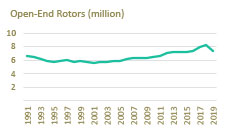
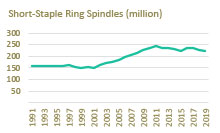
The 2019 data shows a decrease in short-staple spindles and open-end rotors capacities around the world. The number of installed short-staple spindles went down from 230 million in 2018 to 223 million in 2019. The number of installed open-end rotors decreased from 8.2 million in 2018 to 7.4 million in 2019. These changes are mainly driven by scraping of outdated machinery in China. The trends observed in other regions are stable. The number of installed air-jet spindles is increasing worldwide, mainly in Asian countries and Turkey.

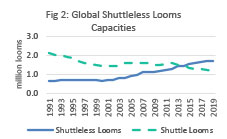
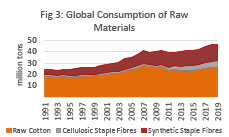
The substitution between shuttle and shuttle-less looms continues but the growth in shuttle-less looms capacities has slowed down. The number of installed shuttle-less looms increased by 1 percent in 2019 and reached 1.7 million units.  Total raw material consumption in the short-staple organized sector has stagnated in 2019. Consumption of cellulosic short-staple fiber increased by 9 percent to 5.4 million tons and consumption of synthetic short-staple fibers decreased by -4 percent to 14.2 million tons. The consumption of cotton has stabilized at 26 mill tons.

Posted April 8, 2021

Source: International Textile Manufacturers Federation (ITMF)

Embroidery and Garment-Printing Equipment From Full-Service Contract Decorator Gate NY Featured In Online Auction

HOLBROOK, N.Y.  — April 8, 2021 — Tiger Group is now accepting bids for the April 15 online auction of assets from Holbrook, N.Y.-based embroidery and garment-printing company Gate NY, which had been a major drop-ship location for garment distributors from across the Northeast.

Highlights of the auction include screen-printing machines, flash cures, dryers, folders and accessories by brands such as MHM, M&R, Dane, Hix, Interchange, OYO and NEDCO; direct-to-garment equipment by Brother; and embroidery machines and accessories by well-known manufacturers such as Barudan and Hashima.

“Embroidery and garment-printing companies are gearing up for a rebirth of live events this spring and summer as the national vaccination campaign progresses,” noted John Coelho, a senior director with Tiger Commercial & Industrial. “But brand-new equipment is taking months to ship due to disruptions in the supply chain. As a result, this online auction is particularly relevant to the needs of growth-oriented companies in this sector.”

In addition to equipment such as heat-transfer presses from Stahls and Brother and a Roland printer/cutter, Tiger is auctioning warehouse and office assets from Gate NY’s 32,000-square-foot facility in Holbrook. These include heat sealers, conveyors, forklifts, air compressors, pallet jacks, dollies and carts, as well as computers and office, reception and breakroom furniture.

Established in 1996, full-service contract decoration company Gate NY recently discontinued its operations following the death of its founder. Gate NY decorated more than 1.5 million garments a year for major distributors like S&S Activewear, SanMar and Alpha Broder. It was an authorized decorator for North Face, Under Armour and Puma, and had worked on projects involving brands such as Ferrari, Ford, Pepsi, Red Bull, BBC America, Energizer, Benjamin Moore Paints and CAT, to name a few.

“This is high-quality and, in many cases, late-model equipment that could give a competitive edge to embroidery and garment-printing companies as they position themselves for the future,” Coelho said.

Online bidding at SoldTiger.com will close on Thursday, April 15, at 10:30 A.M. (ET). All bidders are required to register prior to the sale at SoldTiger.com.

Posted April 7, 2021

Source: Tiger Group

Piper Sandler Completes 41st Semi-Annual Generation Z Survey of 7,000 U.S. Teens

MINNEAPOLIS — April 7, 2021 — Piper Sandler Companies, an investment bank, has completed its 41st semi-annual Taking Stock With Teens® survey in partnership with DECA. This survey highlights discretionary spending trends and brand preferences from 7,000 teens across 47 U.S. states with an average age of 16.1 years. Generation Z, which contributes approximately $830 billion to U.S. retail sales annually*, represents an influential consumer group where wallet size and allocation provide a proxy for category interest.

This year’s Spring 2021 survey was impacted by the COVID-19 pandemic. The survey was conducted from February 19 to March 24; 58 percent of teens have returned to school in either a hybrid format or in person this Spring while 42 percent remained fully virtual. We received the highest amount of responses from the South at 48 percent of the mix and 10 percent of the responses from the Northeast — similar to Spring and Fall 2020.

For the survey infographic and more information, visit pipersandler.com/teens

“Our Spring survey gave rise to a number of themes emerging for GenZ as we think about the path to reopening. We are seeing a female-led spending recovery with upticks in spending on clothing, handbags and skincare in particular. Within apparel, athletic is still the dominant trend with Nike & lululemon taking new highs and Under Armour seeing improved mindshare. Simultaneously, we are seeing a revival of the 1990s fashion trend flannel shirts, baggy pants, mom jeans & eclectic hair trends all in vogue.

“GenZ is a conscious generation as teens this Spring cite Racial Equality & the Environment as their top-two social issues. We have also seen “thrifting” emerge as a strong trend as thinking secondhand is becoming second nature to teens. In fact, 47 percent of teens have purchased and 55 percent have sold secondhand.

“In the wake of COVID-19 and given these consumers are digitally-native, we are not surprised to see online adoption at its highest ever this Spring. Snapchat & TikTok are the top-two social media platforms. While Amazon remains the No. 1 website, we are seeing a rise in female-centric platforms like SHEIN, Revolve and Princess Polly,” said Erinn Murphy, Piper Sandler senior research analyst.

Spring 2021 Key Findings

Spending & Shopping Behavior

  • Areas of wallet share contraction included: Concerts/Events & Car (remains below multi-year average);
  • Areas of wallet share expansion included: Clothing & Accessories (especially for females);
  • Amazon remains teens’ No. 1 preferred online shopping mind-share at 56 percent;
  • Skincare spending for females ranks ahead of makeup spending;
  • TikTok influencers have significantly reshaped skincare brand preferences; 86 percent of females use online influencers as a source of discovery for beauty brands and trends;
  • Video games hold approximately 16 percent of teen wallet share; 53 percent of gamers plan to purchase the new console system in the next 2 years; and
  • Teens allocate 8 percent of their shopping to secondhand; 47 percent of teens have purchased and 55 percent have sold secondhand — thrift/consignment stores ranked No. 10 as favorite brand/retailer, compared to No. 23 in the Spring 2020 survey.

Brand Preferences

  • Chick-fil-A remains No. 1 restaurant for 7 consecutive surveys; Starbucks maintains No. 2 and Chipotle remains No. 3;
  • 49 percent of teens either consume or are willing to try plant-based meat with Impossible Foods as the No. 1 choice, followed closely by Beyond;
  • For more than 10 years, Nike remains No. 1 apparel brand; Nike also holds No. 1 spot for footwear brand and preferred athletic apparel & footwear brand;
  • PacSun moves up from No. 5 apparel brand to No. 3; adidas falls to No. 5 — lowest level since Fall 2017;
  • 96 percent of females claim to shop online versus 88 percent last year, while 92 percent of males claim to shop online versus 91 percent last year;
  • Lays is most preferred snack brand among teens at 11 percent, followed closely by Campbell’s Goldfish (9 percent);
  • Ulta maintains No. 1 preferred beauty destination against Sephora for fifth survey in a row (46 percent share vs. 39 percent LY); 80 percent of female teens willing to spend more for “clean” or natural beauty;
  • Tarte remains top-ranked cosmetic brand for 7 consecutive surveys; e.l.f. registers all-time high in survey at No. 2 preferred makeup brand;
  • CeraVe holds No. 1 spot as top skincare brand for the second survey in a row; The Ordinary remains in the No. 4 spot similar to Fall and up from No. 14 last Spring;
  • Teens spend 32 percent of their daily video consumption on Netflix, down slightly from 34 percent in Fall 2020, followed by YouTube (No. 2) and Hulu (No. 3);
  • Half of the list of favorite social media personalities is dominated by YouTube and TikTok content creators;
  • 88 percent of teens own an iPhone and 90 percent expect an iPhone to be their next phone, both record survey highs.

The Piper Sandler Taking Stock With Teens® survey is a semi-annual research project that gathers input from 7,000 teens with an average age of 16.1 years. Discretionary spending patterns, fashion trends, technology, and brand and media preferences are assessed through surveying a geographically diverse subset of high schools across the U.S. Since the project began in 2001, Piper Sandler has surveyed more than 201,800 teens and collected over 49.7 million data points on teen spending.

* Source: Fung Global Retail & Technology

Posted April 7, 2021

Source: Piper Sandler Companies

Alliance Laundry Systems Announces Its Third Acquisition of 2021

RIPON, Wis. — April 7, 2021 — Alliance Laundry Systems is acquiring the distribution assets of Chicago-based D&M Equipment Co. D&M is a distributor of laundromat equipment based in the Midwest.

This is Alliance’s third acquisition of 2021 and the first acquisition of a distributor of multiple manufacturers’ products. The deal is expected to close later this month.

“Our strategy has been clear from the start: we will pursue partnerships with exceptional companies,” said Rick Pyle, president and chief commercial officer of Alliance Laundry Systems. “For decades, D&M has shown market leadership and we are excited to welcome them to Alliance.”

Founded in 1965 by respected laundromat leader, Don Tomasian, D&M Equipment Co. has delivered exemplary service and support to customers in and around the Chicago area. The company has further distinguished itself with expert in-house installers and a well-stocked parts department.

D&M will represent the Speed Queen® brand. A week ago, Alliance announced its acquisition of Chicago-based UniMac® distributor, Washburn Machinery Inc. These recent additions to the Alliance family illustrate the company’s commitment to expanding service and distribution offerings to customers in the greater Chicago area.

Joe Frankian, president of D&M Equipment, will join Alliance in a leadership role. He will continue to oversee the business and build on the company’s record performance of the last few years as part of Alliance Laundry Systems. D&M will carry on its family tradition with Joe’s son, Connor, also staying on to serve customers.

“This is an exciting new chapter in our company’s history,” Frankian said. “With the power of a global leader behind us, I’m confident customers will see next-level service.”

Posted April 7, 2021

Source: Alliance Laundry Systems LLC

Champion® Athleticwear Launches Two New Collections In Support Of The Brand’s Overall Sustainability Efforts

WINSTON SALEM, N.C. — April 7, 2021 — Just in time for Earth Day, Champion Athleticwear, makers of authentic athletic apparel since 1919, is driving its commitment to sustainability forward by introducing two new environmentally conscious collections — Natural State Reverse Weave and Rally Pro Earth footwear.

The new lines are being introduced as part of the Champion MADE promise to create athleticwear that feels good, looks good and, most importantly, does good. As part of this commitment, the brand is working to increase the use of responsibly made fabrics and create new products that continue to reduce the brand’s energy use and water consumption during the manufacturing process.

“We are dedicated to helping protect the planet by creating best-in-class sustainable products,” said David Robertson, director, Champion Global Brand Marketing. “The launch of Natural State and Rally Pro Earth are only the beginning of what we have in-the-works to protect the place we all call home.”

Robertson notes that the brand has a strong foundation on which to build its sustainability program.

“All Champion products can be washed in cold water, which reduces energy and water usage, and our Powerblend sweats are made with a portion of recycled polyester fibers,” he said. “And I’m very proud of the fact that by 2025, as part of the HanesBrands family, Champion will use 100-percent recycled polyester and 100-percent sustainable cotton in all of its apparel, achieve zero waste across operations and reduce the absolute weight of packaging materials used for products by 25 percent.”

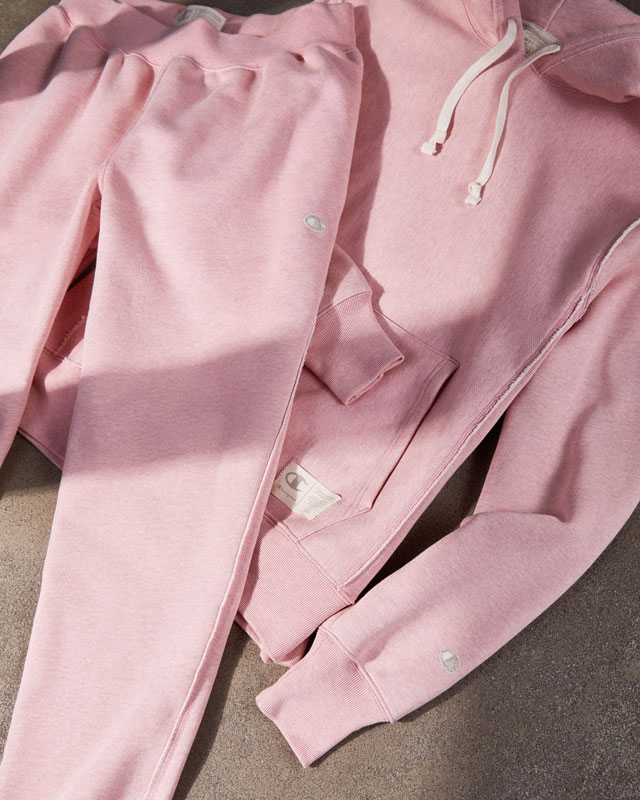
The Natural State product line contains recycled polyester fibers, celebrating the brand’s iconic Reverse Weave fabrics in their natural, raw state. The collection uses minimally processed and unbleached fabrics, along with all-natural dyes derived from flowers, roots and plants. The Natural State collection, which is characterized by natural, muted tones, raw edges and logos that include recycled fibers, allows the brand’s fans to be environmentally conscious from head to toe in the line’s tees, hoodies, crew-neck sweatshirts, joggers and shorts.

With the launch of the Rally Pro Earth, Champion’s iconic Rally Pro sneaker gets a refresh using more earth-friendly materials. This is Champion’s first sneaker assembled with 25 to 45-percent upcycled and 50 to 65-percent recycled materials, with percentages varying by shoe color. The Rally Pro Earth sneaker, which is being launched with the brand’s licensee, BBC International, also contains an upcycled EVA rubber outsole and rubber logo sole for traction and is packaged in recycled boxes.

Apparel in the Natural State collection ranges from $35 to $75 and will be available to shop in-store and online at Champion and Urban Outfitters on April 19. The Rally Pro Earth will retail for $104.22 (a nod to Earth Day) and be available to shop in select Champion stores and on Champion.com on April 22.

Posted April 7, 2021

Source: Champion Athleticwear

New Composite Bridge In Tennessee Showcases Sustainable Solution For Aging Infrastructure

KNOXVILLE, Tenn. — April 7, 2021 — On the surface, it looks like any of the thousands of small, narrow two-lane bridges across America.

But a new, high-tech bridge in north central Tennessee is equipped with a fiber-reinforced polymer (FRP) composite material bridge deck embedded with fiber optic sensors. It replaced a damaged, decades-old concrete crossing which, like thousands of rural, low-volume bridges across the state and nation, was rated structurally deficient and outdated.

According to the American Society of Civil Engineers, about 8 percent of the more than 617,000 bridges in the U.S. are structurally deficient and need repair. FRP composites offer a low-cost, low-maintenance option and the new structure in rural Tennessee and is intended to demonstrate the benefits of composite materials for rural bridge work.

“This composite bridge has already made a positive impact on Morgan County,” said Morgan County Highway Superintendent Joe Miller, who added county officials were looking for a low-maintenance bridge that could be installed fast and at a lower cost than traditional methods. “We have numerous bridges within the county and hundreds across the state that are in need of repair and could benefit from this technology.”

For Morgan County, the lightweight, easy-to-install bridge comes at no cost, courtesy of the composites industry. Working together under the umbrella of the Institute for Advanced Composites Manufacturing Innovation, or IACMI—The Composites Institute®, almost a dozen private companies led by Tennessee-based Composite Applications Group (CAG) partnered with industry organizations and university researchers to make the composite bridge a reality.

Developed by Structural Composites Inc. (SCI), the 16-feet-long and 25-feet-wide bridge deck is engineered for high-strength and is 90 percent lighter than concrete. It has two 8-by-25-foot corrosion resistant FRP deck panels that were fabricated off-site in a controlled environment.

Because the completed bridge sections were so lightweight, they could be transported to the bridge site and installed in one day using a forklift, reducing installation time and energy costs by requiring less construction equipment for on-site preparation.

IACMI Technology Manager John Unser, who is also vice president of program and project management for CAG, said composites have been used for bridge deck applications for more than 20 years and have exceeded all performance and safety standards set by the American Association of State Highway and Transportation Officials (AASHTO). But when it comes to composite bridge decking, he said, many transportation departments across the country, especially those from smaller jurisdictions, are not familiar with the technology.

IACMI and its industry partners are developing a comprehensive case study based on the Morgan County bridge project, including comparing total costs of a typical concrete bridge and one using an FRP bridge deck. Unser said the results will be shared with federal, state and local officials, transportation departments and the civil engineering community so FRP composites will be more a “known” to them.

University of Tennessee, Knoxville (UTK) researchers and engineering students from the Fibers and Composites Manufacturing Facility are part of the bridge partnership. They embedded smart fiber optic sensors developed by Luna Innovations into the bridge surface during production. These high-density sensors are being used to monitor the composite deck system over time to give critical performance and safety data, thus providing a sustainable solution for aging infrastructures such as bridges. In addition, wireless technology developed at UT is being utilized for monitoring the response of the bridge system and traffic counts remotely via cloud computing.

“Lack of durability data is one of the major barriers of the adoption of novel and advance materials including carbon, basalt, or glass fiber reinforced polymeric composites in civil infrastructure,” said Dayakar Penumadu, the Fred N. Peebles Professor in the Tickle College of Engineering at UT and Characterization Fellow for Materials and Processing for IACMI.

Penumadu added, “this is a major obstacle for integrating new materials and structures quickly and thus require successful demonstration as being done through this IACMI project. Bridge decks are the most damage prone elements, and we are integrating smart sensors distributed throughout the composite bridge deck that will provide us valuable performance data with time for years to come.”

To learn more about the Morgan County bridge project and how FRP bridges offer a sustainable solution to the nation’s crumbling infrastructure, visit www.compositebridge.org.

Collaborative Partnership

Led by IACMI, CAG, and the University of Tennessee, Knoxville, a collaboration of private companies contributed expertise and materials such as adhesives, epoxies, coatings and resins, preforms and reinforcements to the Morgan County bridge project. These include SCI, McKinney Excavating Inc., Luna Innovations, Steffen Structural Engineering, Neel-Schaffer Inc., Interplastic Corporation, Engineered Bonding Solutions LLC, West System, Superior Fiberglass, METYX Composites and Compsys Inc.

Posted April 7, 2021

Source: IACMI – The Composites Institute

Sponsors