Newark, Del.-based Covation Biomaterials LLC, doing business as CovationBio, has introduced Sorona elasterell-p fiber, its first branded fiber and first U.S.-produced bicomponent stretch fiber.
Made with partially plant-based Sorona polymer, the fiber provides durable stretch and shape retention without elastane. It is designed for apparel applications requiring stretch and recovery, including activewear, athleisure, workwear and uniforms.
“Sorona elasterell-p fiber is our first branded fiber,” said Steven Ackerman, CovationBio CEO. “With the introduction of Sorona elasterell-p fiber, we’re pairing our reputation for trusted performance and sustainability benefits with a new stretch solution built for what brands need next.”
The fiber is commercially available in the United States and Latin America through regional distribution partner Mercados Internacionales, which will provide local inventory and customer service.
Sorona polymer is used in apparel, home goods and carpeting to add softness, stretch, durability and warm breathability.
Winterthur, Switzerland-based Rieter reported that integration of Barmag, its Man-Made Fiber Division, is on track following their completion of the company’s largest acquisition. The expanded group is now positioned as a system supplier for processing natural and man-made fibers and expects at least CHF 20 million in synergies by the end of 2028.
Rieter also entered a strategic partnership with Recycling Powerhouse to industrialize, standardize and scale textile recycling. Rieter will contribute expertise in tearing textile waste and spinning short fibers to support development of scalable circular solutions.
First-half order intake increased 56% year over year to CHF 554.1 million, including CHF 261.3 million from Barmag. Sales rose 72% to CHF 576.7 million, and the June 30 order backlog totaled approximately CHF 760 million.
Rieter confirmed its 2026 outlook for sales of CHF 1.3 billion to CHF 1.5 billion and an operating EBIT margin of 0% to 3%.
Cotton Incorporated reported that 41% of U.S. consumers are aware of microplastics pollution, compared with 17% in 2017. In addition, 59% said they are likely to seek clothing made with microplastic-free fibers. A recent industry survey found that 67% of textile professionals said their companies are taking, or plan to take, action to reduce microplastics pollution.
“Our research shows that consumers are paying closer attention to what products are made from and how those materials align with their values,” said Bev Sylvester, chief marketing officer at Cotton Incorporated. “Cotton comes from a plant, not plastic.”
Programming included educational videos, CottonWorks resources, webinars, digital communications, tradeshow activations and consumer education initiatives.
Clarkesville, Ga.-based Morito Scovill Americas has acquired Edward Segal Inc., a U.S. manufacturer of eyelet, grommet, rivet and snap-fastener attaching machines, as well as custom automated assembly systems.
Edward Segal will join Morito Scovill Americas while retaining its existing team and customer relationships. The acquisition expands Morito Scovill Americas’ manufacturing, sourcing and operational capabilities for apparel and specialty-market customers.
“This acquisition represents an important strategic step for Morito Scovill Americas,” said Shane McEntyre, chief sales officer. “Together, we will be even better positioned to serve our customers.”
Edward Segal President David Segal said: “Morito Scovill Americas’ investment in growth will allow us to stay true to the values that have defined Edward Segal Inc. for generations.”
Mount Airy, N.C.-based Nester Hosiery has been awarded three-year contracts for the U.S. Army Cold Weather Sock Program and U.S. Marine Corps Intense Cold Weather Sock Program, following novation from Fox River.
Nester will serve as provider of record for the Army program and supply the Marine Corps program. The company manufactures high-performance Merino wool socks designed, engineered and produced in the United States.
The awards reinforce Nester’s position as a provider of Berry Amendment- compliant cold-weather and performance sock systems for the U.S. military.
“These two major awards reflect the trust placed in our team, our domestic manufacturing capabilities, and our long-standing commitment to delivering premium performance products to the warfighter,” said Kelly Nester, CEO.
The company’s military programs are supported by North Carolina manufacturing, advanced knitting technology and technical product-development expertise.
Bergamo, Italy-based EFI Reggiani and Danitech Group have entered a multiyear licensing and manufacturing agreement covering Mezzera and Jaeggli textile finishing machinery.
Danitech gains global rights to manufacture, market, sell, install and service Mezzera machinery, including washing and bleaching lines, singeing machines, jiggers and Jaeggli yarn mercerizing lines. New equipment will be marketed as “Mezzera by Danitech.” EFI Reggiani will continue service and spare-parts support for the existing installed base, while Danitech will manage lifecycle support for new machines.
“Our selection of Danitech as global manufacturing partner for the Mezzera range reflects our commitment to safeguarding the brand’s longstanding reputation for quality and performance,” said Vincenzo Marino, vice president and general manager of textile at EFI Reggiani.
Danitech will use Italian and Chinese manufacturing capabilities and Greater China sales rights to expand its market reach, particularly in Asia.
Copenhagen-based Novonesis has launched DeniBrite, an enzymatic biobleaching platform for denim formulators and laundries seeking bright, contemporary and vintage finishes while reducing reliance on conventional bleaching chemistries.
The platform combines DeniBrite Cold T for low-temperature bleaching and DeniBrite Vintage for aged finishes and gray-cast effects. Products are bluepass certified and available in ZDHC Level 3-compliant formulations.
“For decades, denim bleaching was about achieving the right look. Today, it is also about proving how that look was made,” said Hans Ole Klingenberg, vice president of Planetary Health Biosolutions at Novonesis.
A screening-level life cycle assessment found DeniBrite Cold T had approximately 40% lower global warming potential and used 28% less water than conventional sodium hypochlorite bleaching under modeled conditions.
Controlled trials show that textile waste origin — not just fiber composition — can strongly influence fiber quality, carding performance and yarn outcomes in mechanical recycling.
Textile World Special Report
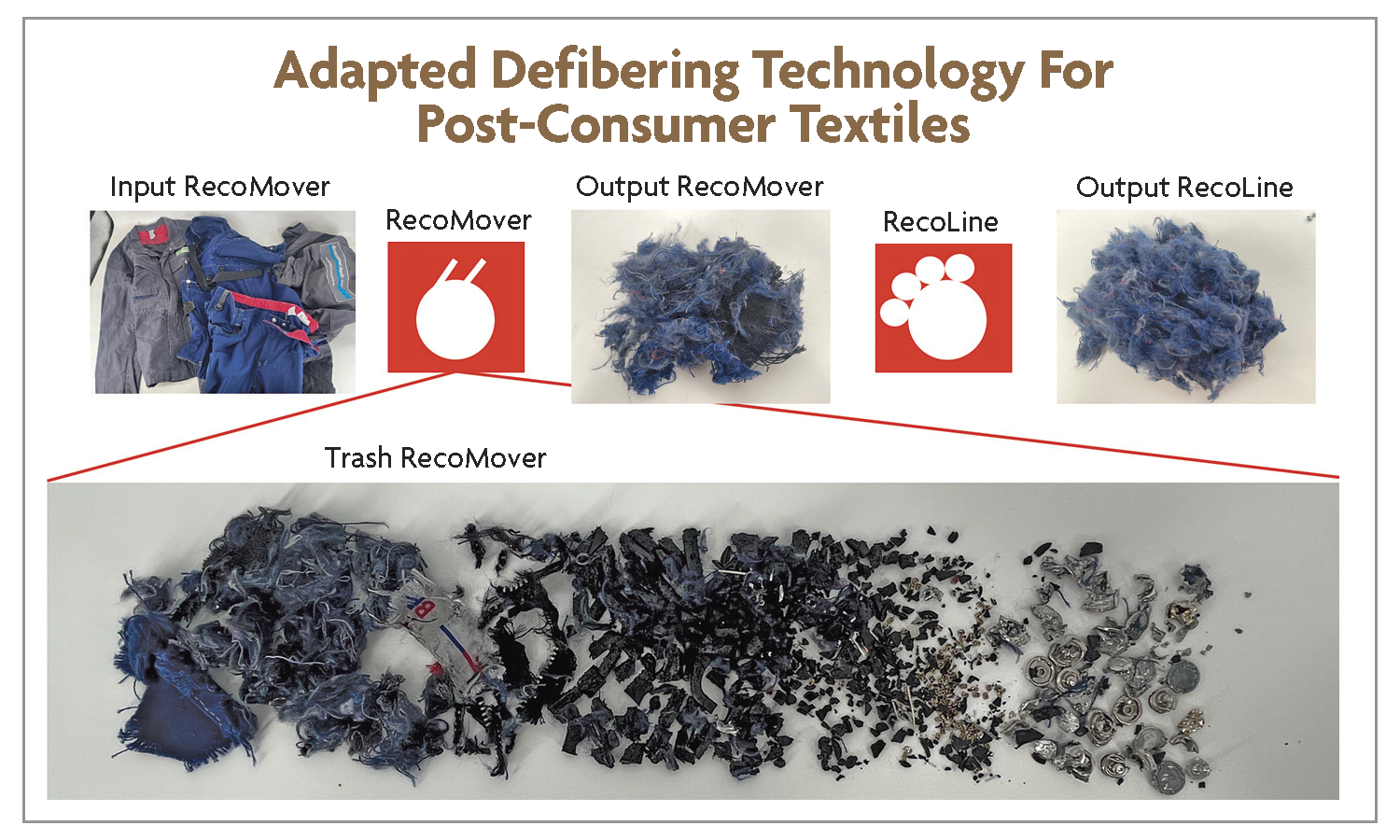
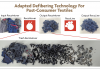
Figure 1: Tearing process for post-consumer textiles: input material, cleaning and opening stage, and the resulting fiber material after the tearing line. The figure illustrates that contaminant removal and fiber preservation already determine later process stability before carding even begins. Source: Presentation “From Torn Fiber to Yarn” / Recycling Atelier Augsburg
Researchers at Institut fuer Textiltechnik Augsburg gGmbH, in collaboration with Technische Hochschule Augsburg and Trützschler Group SE, recently reported on the role of material classification in mechanical textile recycling. Their work shows that textile waste origin can have a major impact on fiber quality, spinning preparation and final yarn performance, even when fiber composition remains the same. The report that follows highlights those findings and underscores why classification comes first in building an effective recycling route.
Introduction
Mechanical textile recycling is increasingly important in the transition toward a circular textile industry. A central question is under which conditions textiles and textile waste can be reprocessed into spinnable raw material and ultimately into high-quality yarn. Systematic material classification is essential for this purpose. It enables reliable assessment of heterogeneous waste streams, selection of appropriate recycling routes and adjustment of machine settings in spinning preparation.
In the approach presented here, textile recycling is treated as a continuous, interconnected system. Material classification, tearing, fiber assessment, carding, fiber preparation and yarn production are considered linked stages within a closed value chain rather than isolated steps. The objective is not only to recover fibers from waste, but to return them to new textile products at the highest possible quality. This framework allows material streams of different origins to be analyzed systematically and translated into reproducible process windows.
Why Different Textile Waste Streams Require Different Recycling Routes
Secondary raw materials differ not only in fiber composition but also in history, contamination, construction and mechanical condition. Distinguishing between waste types is therefore essential in mechanical recycling. A practical classification differentiates post-industrial, pre-consumer and post-consumer material streams, capturing fundamental differences without excessive complexity.
Post-industrial textiles, such as cutting waste or production residues, are generally well controlled. They originate from known processes, have defined fiber compositions and contain minimal foreign matter.
Pre-consumer materials, such as unsold goods, also have known compositions but may include seams, coatings, labels or other additional components.
Post-consumer textiles are the most challenging. Having been used, they may be soiled and contain both textile and non-textile components such as zippers, buttons, reinforcements or linings.
In this study, three material categories were examined under controlled conditions: worn workwear (65% cotton, 35% polyester) as post-consumer material; identical unused garments as pre-consumer material; and the same fabric supplied as yard goods as post-industrial material. This ensured identical fiber composition and textile construction across all categories.
A two-stage tearing system was employed in collaboration with Ommi S.r.l. (Prato, Italy). The RecoMover, equipped with coarser clothing, performs automated contaminant removal and initial opening. The downstream RecoLine, with progressively finer clothing and six workers, ensures gentle opening to the individual fiber level. Post-consumer and pre-consumer materials pass through two RecoMover drum units and four RecoLine drum units, whereas post-industrial materials are processed solely through six RecoLine drum units.
Fiber Quality: Visible And Hidden Differences
The quality of torn fiber material is critical for producing spinnable raw material. It is evaluated using fiber length distribution, mean fiber length L(n), short fiber content SFC(n), degree of opening, waste content, dust and nep levels. These parameters directly affect yarn strength, evenness and process stability.
Fiber length was measured using an AFIS Pro 2, while degree of opening and usable fiber proportion were assessed with a Shirley Trash Analyzer. Despite identical initial compositions (65% cotton, 35% polyester), notable differences were observed. Post-industrial fibers exhibited the lowest quality, with L(n) of 10.4 mm and SFC(n) of 67.5%. Pre-consumer material achieved L(n) of 14.2 mm and SFC(n) of 45.3%, while post-consumer material reached L(n) of 12.4 mm and SFC(n) of 55.0%.
NIR analysis confirmed no chemical differences apart from color and washing had no significant effect on fiber quality. The shorter fiber length in the post-industrial stream is therefore attributed to differences in the tearing process. Due to limited machine availability, identical configurations could not be applied; further trials are planned.
These results demonstrate that material classification must extend beyond fiber composition. Textile construction, garment features, pre-treatments, finishes and tearing parameters must also be systematically documented for reliable process control.
Spinning Preparation As A Quality-Defining Step
After fiber opening, spinning preparation determines whether heterogeneous recycled fibers can form stable card slivers and yarn. The card plays a central role by opening, cleaning, individualizing and aligning fibers, thereby influencing sliver evenness, nep formation and short fiber content.
Experiments were conducted using a TC 11 card (Trützschler Group SE) at the ITA Augsburg Recycling Atelier to examine the effects of material type and process parameters on sliver and yarn quality. The study addressed three questions: the influence of material type on carding behavior, the effect of carding on process and yarn stability and the relationship between fiber and yarn quality.
A mixed-level full-factorial design was applied. The material blend consisted of 70% virgin cotton and 30% recycled material, producing an Nm 34 ring-spun yarn. Variables included material-related factors and machine settings in pre-carding and main carding zones, such as the number and spacing of carding elements and cylinder speed.
This design allowed clear distinction between material effects, process effects and their interactions. Such differentiation is critical for industrial practice, as settings that perform well for one material stream may result in increased neps, poor evenness or instability in another.
Material Effects Dominate Carding Behavior
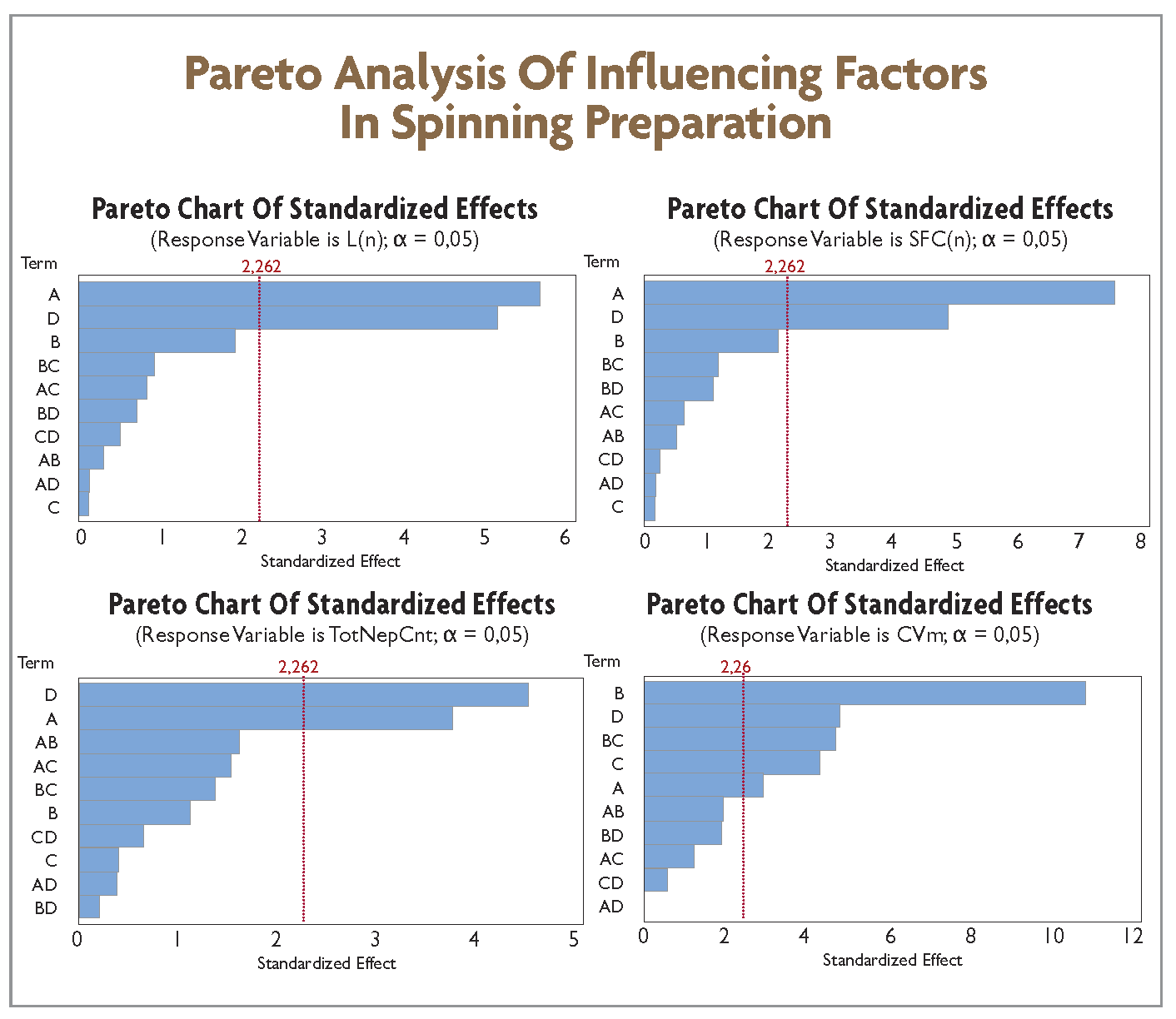
Statistical analysis showed that material type is the dominant factor affecting spinning preparation. Pareto analysis identified it as a significant influence on carding behavior, particularly for fiber-related parameters. Highly significant effects were observed for L(n) and SFC(n), with additional significant impacts on total nep count and yarn neps.
Relevant interactions between material and process parameters were also identified. Recycled materials respond differently to identical machine settings; parameters such as carding element configuration and cylinder speed have material-dependent effects.
Figure 2: Material type emerges as the dominant factor for carding behaviour and is therefore a central variable in process optimisation. A = Material; B = Number of Twintops; C = Distance of Twintops; D = Cylinder Speed Source: presentation “From Torn Fiber to Yarn” / Recycling Atelier Augsburg.
Consequently, a universal card setting is inadequate for recycled fibers. Material classification must precede process optimization. Only after characterizing a material in terms of origin, composition, fiber quality and processing behavior can suitable parameters be defined. While process adjustments can partially compensate for material differences, they remain dependent on the material itself. In practice, this requires adaptive parameter windows tailored to each material class.
Yarn Quality: Compensation In Spinning
Despite clear differences in fiber and sliver quality, yarn parameters did not always reflect these differences to the same extent. Variations in yarn evenness (CVm) were less pronounced, indicating that spinning processes can compensate for certain inconsistencies through blending, fiber guidance and twist.
However, this does not diminish the importance of fiber and sliver quality. Critical differences must be detected early, before they manifest as instability, increased waste, restricted process windows or yarn defects. Yarn quality parameters alone may not reveal underlying risks.
Based on eight key parameters —including L(n), SFC(n), total nep count, card sliver CVm, yarn CVm, thin and thick places, and yarn neps — a ranking of material performance was established. Pre-consumer materials performed best, followed by post-industrial and post-consumer materials. These results confirm that material homogeneity and low contamination improve processing conditions, while more challenging streams can be partly compensated through appropriate process control.
From Classification To Predictive Process Control
Material classification is not merely a sorting step but a process-defining factor. It determines the appropriate tearing route, cleaning stages and carding parameters. In mechanical fiber-to-fiber recycling, it is the foundation for reproducible quality.
Industrial implementation requires three key measures. First, material streams must be described in detail, including origin, construction, color, finishing, garment features, contamination and expected mechanical behavior. Second, material characterization must directly inform process control, influencing tearing, cleaning and carding decisions. Third, systematic data documentation is required to establish reliable process windows and predictive models.
With highly variable input materials, conventional machine optimization is insufficient. Applying uniform parameter sets inevitably leads to quality fluctuations. Predictive process control must therefore start with the material, integrating classification, characterization and process routing into a unified system.
Conclusion
The study demonstrates that the origin and classification of textile secondary raw materials strongly influence mechanical recycling, fiber quality and carding behavior. Material type and history affect fiber length, short fiber content, degree of opening and contamination, which in turn determine spinning preparation performance and required machine settings.
While process adjustments can partially compensate for material variability, effective control depends on systematic material characterization. Material classification must therefore be integrated into process development as the basis for adaptive carding strategies, stable processing windows and high-quality recycling.
High-quality mechanical recycling does not begin at the machine but with understanding the material. Only when both visible and hidden material properties are identified and translated into process control can recycled fibers become a reliable raw material for new yarns.
What This Means For Spinners
For spinners committed to a more circular textile industry, this report makes one point clear: recycled fiber performance starts with understanding the material origin. Post-industrial, pre-consumer and post-consumer inputs may share the same nominal fiber blend, but they can behave very differently in processing.
For spinning operations, that means recycled inputs cannot be handled with a single standard setting. Material origin, construction and condition all affect fiber quality, carding performance and yarn results.
Spinners most likely to succeed with higher recycled content will be those that classify incoming material carefully, track key fiber characteristics and match each stream to the right process route and machine settings.
— Textile World Editors
Editor’s Note: Acknowledgements. This report was submitted by Dr. Lukas Lechthaler, Expert R&D Technology, Trützschler Spinning, and authored by Bettina Cherdron, Amon Krichel and Mesut Cetin of Institut fuer Textiltechnik Augsburg gGmbH and Technische Hochschule Augsburg; Prof. Stefan Schlichter of Technische Hochschule Augsburg; and Lukas Lechthaler and Luisa Verbocket of Trützschler Group SE.
The Techtextil Forum featured “High-Performance Textiles for Space,” presented by Jane Gensler of NASA Headquarters and Wendy Gao of NASA’s Johnson Space Center. Photos courtesy of Messe Frankfurt/Pietro SuteraDespite a challenging market, co-located Frankfurt events delivered the expertise to turn ambitious ideas into real-world solutions.
Textile World Special Report
For those who have attended Techtextil and Texprocess in the past, the shows hold the promise of connecting with like-minded textile individuals who are driven by innovation, collaboration and the goal to take textiles to a new realm of form and function. In May, event organizer Messe Frankfurt Exhibition GmbH welcomed more than 36,000 visitors to Techtextil and Texprocess 2026 at the Messe Frankfurt fairgrounds, featuring 1,700 exhibitors.
The organizer characterized the event, saying: “In a challenging market, Techtextil and Texprocess provided the global industry with a stable meeting place.”
With participants from 112 countries represented at the exhibition grounds, the organizer reported that the top 10 visitor countries were Germany, Italy, France, Türkiye, the Netherlands, Spain, Belgium, the United Kingdom, Poland and Switzerland. The organizer reported growth in international attendance, underscoring the global reach of the Frankfurt shows.
Techtextil featured 1,500 exhibitors from 52 countries.
Innovation In A Challenging Market
Energy costs, geopolitical conflict and trade uncertainty were undercurrents of the May event.
Messe Frankfurt Executive Board Member Detlef Braun commented: “Volatile market developments are driving lasting changes in business models. Connectivity, flexibility and speed are key success factors in this environment. At Techtextil and Texprocess, relevant partners come together to rapidly translate ideas into applications.”
Global challenges leading up to the May 2026 event may have dampened turnout but were often overcome on the show floor — new ideas, innovations and cutting-edge companies were not in short supply.
On The Show Floor
Trützschler Nonwovens GmbH, Dülmen, Germany, acknowledged the lower turnout but was not surprised based on pre-show discussions with its clients.
“The overall situation reflects the current global uncertainty. Companies are cautious with investments and eager to cut costs,” said Matthias Schemken, managing director of Trützschler Nonwovens. “This is exactly where practical, efficient solutions become important.”
“We are seeing a clear trend toward refurbishments and retrofits,” explained Robert Koert, director of service at Trützschler Nonwovens. “Customers want to restore and exceed original performance levels.”
A Pavilion At Home
VDMA Textile Machinery had a strong presence with more than 50 exhibiting companies and seven companies at the VDMA group stand.
“The fact that Techtextil is held in Frankfurt, where our headquarters are based, has a very practical advantage for us: we can meet with our member companies face to face, practically on our doorstep. This saves both us and the companies a great deal of time,” VDMA said in a statement.”
The association also celebrated the 60th anniversary of the Walter Reiners Foundation, highlighting six decades of commitment to young engineers. VDMA representatives noted: “The event reflected on past award winners and their careers before introducing the 2026 recipients. Five graduates received awards for their bachelor’s and master’s theses, presented by Foundation chairman Peter D. Dornier.”
Innovation Awards
The presentation of the Techtextil and Texprocess Innovation Awards 2026 was a great source for discovering trends and standout members of the industry.
The organizers reported that “across 10 categories, 17 international winners were being recognized for pioneering research, innovative products and materials, as well as new processes and technologies. These innovations provide solutions far beyond the textile industry — including sectors such as automotive, aerospace, medical, architecture, construction and robotics.”
Techtextil and Texprocess 2026 welcomed to Frankfurt Germany more than 36,000 visitors and featured 1,700 exhibitors.
Show Floor Forums
The show floor forums were a highlight of the event, featuring what seemed like an endless progression of interesting presentations.
Sabine Scharrer, director of brand management technical textiles and textile processing at Messe Frankfurt and show director of Techtextil and Texprocess, commented: “The NASA presentation was undoubtedly one of the highlights of the trade fairs and attracted a diverse audience, ranging from textile engineers and material scientists to manufacturers, researchers, students and technology providers.
“We were particularly pleased to welcome Jane Gensler, Crew Health and Performance Domain Lead at NASA Headquarters, and Wendy Gao, Textile Material Lead at NASA’s Johnson Space Center.
“Their presentation demonstrated how critical advanced textiles are — from fire protection and thermal management to abrasion resistance, wearable technologies, and future habitat concepts. The clear message: many of the challenges of future Moon and Mars missions are, in fact, material and textile challenges.
“This resonated strongly with our audience because it highlighted the growing importance of technical textiles in highly demanding applications. The level of engagement was remarkable,” said Scharrer.
“The forum was packed, and many attendees stayed afterwards to continue discussions, meet the speakers in person, and take photos. At the same time, NASA made it clear that solving these challenges will require close collaboration between industry, research institutions, and technology providers.”
This post-presentation interaction was commonplace at both the Techtextil and Texprocess forums. The forums were a strong draw but also represented the real spirit behind Techtextil.
“The [NASA] session illustrated how material innovation developed for extreme environments can create opportunities beyond space exploration,” Scharrer added. “This reflects exactly what Techtextil and Texprocess stand for: bringing together the expertise needed to turn ambitious ideas into real-world solutions.”
Nazlı Ceylan Balcı Kurtul, vice chairwoman of the board at Nazar Tekstil, is satisfied with the performance of the R 70.
Rieter’s R 70 fully automatic rotor spinning machine combines quality, productivity and energy efficiency.
Textile World Special Report
Rotor spinning is a key technology for efficient yarn production with consistent quality and high output. With the fully automatic rotor spinning machine R 70, Rieter offers an advanced solution that combines excellent yarn quality, high productivity and energy efficiency. Successfully implemented at Nazar Tekstil in Türkiye, the machine demonstrates its capabilities in daily production.
Nazar Tekstil, a family-owned spinning mill in Türkiye, focuses on producing high-quality compact and rotor yarns with a daily capacity of up to 100 tons. By investing in the Rieter R 70, the company has further strengthened its production performance and quality consistency. Nazlı Ceylan Balcı Kurtul, vice chairwoman of the board at Nazar Textile, confirms the results: “We are extremely satisfied with the performance of the R 70.”
With the R 70, Nazar achieves very stable yarn-quality values. “This predictability is critical for meeting the expectations of our customers in the weaving and knitting sector,” emphasizes Nazlı Ceylan Balcı Kurtul. The mill produces yarn with a tenacity that is consistently 0.5 to 1 Rkm higher than the market average.
High Productivity At Maximum Rotor Speeds
The R 70 enables Nazar to operate at rotor speeds of up to 150,000 rpm in the production of Ne 30 cotton weaving yarn. These performance levels are made possible by high yarn quality and consistent package winding. Fibers from pre-processing stages can be used without compromising performance, which supports Nazar’s zero-waste principle.
Outstanding Yarn Quality And Tenacity
Efficient And Reliable Operation
Designed for fully automatic operation, the R 70 ensures high efficiency with minimal manual intervention. Rotor cleaning takes place without interrupting production, as automatic compressed-air cleaning occurs during each piecing. The R 70 is also characterized by low energy consumption thanks to modern rotor drives and optimized vacuum systems. This helps Nazar Textile to optimize operating costs and improve sustainability.

 Newark, Del.-based Covation Biomaterials LLC, doing business as CovationBio, has introduced Sorona elasterell-p fiber, its first branded fiber and first U.S.-produced bicomponent stretch fiber.