ATMI Names New PresidentParks D. Shackelford has been named president of the American Textile
Manufacturers Institute (ATMI), Washington. Shackelford will be responsible for the daily
operations of ATMI. He also will serve as chief lobbyist for the organization.Shackelford has held
a number of government and consultancy posts, including staff director for the House Agriculture
Subcommittee on Cotton, RiceandSugar. His titles at the U.S. Department of Agriculture have
included: deputy administrator for state and county operations; assistant deputy administrator for
farm programs; and associate administrator for farm policy. We are pleased and excited that Parks
will be joining us at ATMI, said Chairman Van May. His experience with Congress and the Executive
Branch, and in particular his knowledge of cotton and cotton textile issues, will be of real value
to our members. He fits our industry like a hand in a glove.Shackelford will succeed Carlos Moore,
ATMIs CEO since 1985. Moore will remain at ATMI until May 2003 on a part-time basis as senior vice
president.
August 2002
ATMI Names New President
High-Tech Textiles
By Jennifer Wheeler, Assistant Editor High-Tech TextilesThe second edition of Techtextil North America brought the thriving world of technical textiles and nonwovens to Atlanta. The world of technical textiles and nonwovens recently came to Atlanta with the second edition of Techtextil North America (TTNA). Held at the Cobb Galleria Centre, the trade show saw a 30-percent expansion in exhibitor space over the inaugural 2000 show, proving that the technical textiles market is no longer an emerging sector in North America, but a thriving one. We were very happy with the show. Feedback from visitors was positive, said Daniel McKinnon, director of textile fairs for Messe Frankfurt Inc., Atlanta, the trade shows producer.More than 290 exhibitors from 21 countries, along with more than 4,000 attendees from 40 countries, made contacts and filled orders during the show and at the companion Techtextil Symposium North America, which comprised three days of seminars covering a wide range of industry topics, including new and emerging technologies and research in technical textiles.

Yarns supplied by Italy-based Fil Man Made Group became the basic ingredient for various technical products, including fire protective clothing for Formula One drivers and firemen. Exhibitors specializing in the areas of machinery and technology, fibers, fabrics and finished products showcased their latest products and innovations during the event. MachineryandTechnologyLaminating machinery manufacturers were in abundance at TTNA. Paterson, N.J.-based Glenro Inc. presented its latest line of flatbed laminating machines, which use Conductaplane flat-faced heating modules and PressPlane+ pneumatically pressurized top beds. The company also showed Radplane® Rapid Response Electric Infrared Heaters-Series 80, which offer high conversion efficiencies of electrical power input to usable radiant energy.Schaetti AG, Switzerland, and Kannegiesser GarmentandTextile Technologies, Germany, showed the TLM-V flatbed laminating machine and TLM lamination modules, suitable for processing thin, delicate materials.Germany-based Klieverik Heli BV (Zima Corp., Spartanburg) displayed Ecosafe environmentally-friendly laminating systems for substrates used by the automotive industry. Cavitec AG, Switzerland, attended TTNA to promote its hotmelt coating and laminating lines for the automotive, technical textiles and garment sectors.Zimmer Machinery USA, Spartanburg, presented its Magnoroll finishing machine and the Zimmer Variopress. Applications for the Magnoroll include surface coating, dot coating, print bonding and impregnation of aqueous, paste and foam products. The Variopress is a brand-new machine that applies a full cover coating of foam or paste in working widths of up to 350 centimeters. Lacom Vertriebs GmbH, Germany (Zimmer Machinery USA), had information on its innovative and complete line of coating and laminating machinery using hot-melt adhesives.Other companies were promoting the latest in quality control and materials testing. Lawson-Hemphill Inc., Spartanburg, exhibited the Force Shrinkage Tester FST-3000, which is a new generation of force and force-shrinkage tester for yarn monofilament. Also offered was the ColorQuest® XE-Touch, manufactured by Reston, Va.-based HunterLab. ColorQuest is a self-contained reflectance/transmittance color-measurement spectrophotometer used in the measurement of fabric, yarn, fiber and dye colors.Germany-based Enka tecnica GmbH (Fi-Tech Inc., Richmond, Va.) promoted its Fraytec opto-electronic filament-break sensor models for the detection of filament breaks during high-speed spinning or processing of filament yarn. Mahlo America, Spartanburg, exhibited the Qualiscan QMS-A, a fully modular quality-control system that monitors moisture retention, applied coating thickness and weight per unit area.H. Stoll GmbHandCo., Germany, promoted its flat knitting machines for the production of customized, knitted-to-fit seat covers and suspension fabrics for use in the contract fabric and furniture industries, as well as to manufacture knitted-to-measure medical stockings and orthopedic products. Barmag AG, Germany, exhibited its line of spinning machines for polyester, nylon and polypropylene, as well as its texturing systems. Charlotte-based Dilo Inc. represented the nonwovens sector, displaying its Turbo Line for fine fleece nonwovens suitable for medical, hygienic and cosmetic applications. The line comprises Trutzschler opening and blending components, Spinnbau cards, the Spinnbau Turbo Unit air-laying system, Dilos Hyperpunch needling system and KTM Parotherm calendering.Christoph Burckhardt AG, Switzerland (Fi-Tech Inc.), showed pin rings and pin bars used in its perforating systems for nonwoven and woven fabrics, and films or laminates.

Left to right: Gerold Fleissner, president; Mrs. E. Fleissner; and Dipl. Ing. Alfred Watzl, vice president, FleissnerFleissner GmbHandCo., Germany, showcased production lines for nonwovens, including AquaJet spunlace lines and AquaTex enhancement technology. The company also showed nonwovens thermobonding lines and heat-setting lines, as well as production lines for the automobile sector, geotextiles, sanitary and hospital products, and other applications. Greensboro-based Rieter ICBT Greensboro Inc. presented fabrics produced using the Perfojet Perfobond and Jetlace 3000 spunlace systems, as well as fabrics made using both spunlace and spunbond technologies.The German company Eduard Kusters Maschinenfabrik GmbHandCo. KG (Zima Corp.), presented its extensive range of calenders, rolls and auxiliary equipment for nonwovens and technical textiles.Germany-based H. Hergeth GmbH exhibited its fiber bale solutions for the nonwovens and technical textile industries, as did Charlotte-based American Trutzschler. A+E Ungricht GmbHandCo. KG, Germany (Fi-Tech Inc.), a full-service engraver, showcased its design capabilities for the production of embossing and bonding rolls. Herbert Olbrich GmbHandCo. KG, Germany (Zima Corp.), had information on production machinery for wallpaper, technical fabrics, adhesive tapes, flooring and similar products. Jomar Softcorp International, Canada, gave attendees a chance to view its Enterprise+ebusiness (E+e) software, including solutions for preventive maintenance, supply chain and distribution logistics, and textile manufacturing. FibersandFinishesFlame-resistance properties have become essential in a wide range of nonwovens and technical textile applications, and were seen in many of the products presented by the exhibitors.Noveon Inc., Cleveland, displayed technological advances in flame retardancy and finishes for water, oil and soil repellency. The company also featured its urethane-based system for coating and laminating breathable fabrics, including Permax waterborne tie layers and coatings, and Estane® TPU resins for film.Minnetonka, Minn.-based Cargill Dow LLC presented its NatureWorks polylactide (PLA) fibers. Used in knitted and woven fabrics, as well as in nonwovens applications, the corn-based fibers have inherent flame-resistant properties.Non-halogenated flame retardants, as well as innovative barrier chemistry for protective apparel, bedding and upholstery, were shown by Glo-Tex International, Spartanburg. In conjunction with Outlast Technologies, Boulder, Co., Glo-Tex highlighted temperature-regulation coatings for bedding, apparel and other applications, as well as its renewable Halofresh/Haloshield antimicrobial chemistry for medical and filtration products. The Basofil® heat- and flame-resistant fibers business was recently purchased from BASF Corp. by McKinnon-Land-Moran LLC (MLM), Charlotte. These melamine fibers char rather than burn, and are used in home furnishing applications.Acordis Industrial Fibers Inc., The Netherlands, had samples of Diolen high-tenacity polyester yarns on hand. Diolen is suitable for a number of technical applications, including tires, mechanical rubber goods, broad and narrow fabrics, and ropes. Charlotte-based Clariant Corp. showcased Sanitized® Silver-Technology, a permanent antimicrobial solution that uses positive-charged silver in different kinds of plastics. Applications include household goods, transportation products, and hygienic and cleaning articles, among others.MillikenandCompany, LaGrange, Ga., highlighted its silver technology among others. AlphaSan® RC 5000, a zirconium phosphate-based ceramic ion-exchange antimicrobial resin containing silver, is designed to provide long-term protection when incorporated into textile products. Charlotte-based KoSa featured its technical filament and nonwovens, and industrial staple products, including its Type 785 marine finish product with abrasion resistance for high-performance deep-water mooring systems. Type 784 and 787 low-shrinkage products for the coated and laminated substrate market also were shown.Honeywell Performance Fibers, Kingston, N.Y., exhibited high-strength, lightweight Spectra® fibers, Securus® safety belt fibers and Beltec® fibers for tire cap ply reinforcement. Midland, Mich.-based Dow Chemical Co. highlighted the extended range of Covelle HF Weldable Films, which provide alternatives to PVC and other materials currently used by OEMs and trade welders in the technical textile, medical and high-performance packaging industries. FabricsandFinished ProductsExhibitors gave attendees a chance to view engineered and specialty products for a variety of end-uses.Xymid LLC, Chester, Va., displayed finished products made with Xymid Technology, which combines bulkable yarns with nonwoven substrates to produce LANX chemical protective apparel, Zyflex thermal sportgear and abrasion-resistant Wearforce composite fabrics. Union City, Ga.-based Southern Mills Inc. presented protective fabrics for the fire service industry, including: Zylon®/Technora®-blend Millenia; PBI/Kevlar®-blend Kombat; Nomex®/Kevlar-blend Advance; Basofil®/Kevlar-blend Barrage; and Defender, a fabric also made with Nomex.John BoyleandCo. Inc., Statesville, N.C. which specializes in custom fabric coating and finishing, wide-width multi-ply lamination and weft-inserted warp knitting displayed fabrics for use in canopies, awnings and marine fabric applications, among others. bluesign® technologies ag, Switzerland, made its TTNA debut with the presentation of its bluesign industry standard, a globally-recognized designation ensuring that all stages of apparel manufacture are as environmentally responsible as possible. For implementation, the company offers screening, an interdisciplinary network, and accompanying software.
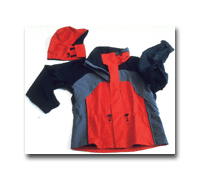
Apparel conforming to the bluesign standard is made using toxin-free materials and processes. Switzerland-based Schoeller Textil presented 3XDRY®, its new, ambivalent moisture treatment technology that produces a fast-drying, single-layer fabric that is hydrophobic on the surface and hydrophilic underneath. The company also showed its new NanoSphere® impregnating treatment to provide water- and dirt-resistance. NanoSphere meets the bluesign standard because it doesnt use halogens or heavy metals in its manufacturing process. Also shown were textiles incorporating Frisby Technologies ComforTemp® technology, which keeps the wearer at an ideal temperature level. Gehring Textiles Inc., Garden City Park, N.Y., is a producer of warp-knit fabrics for industrial, technical and apparel applications. Its Militex Inc. division presented D3, a spacer knit fabric made with three layers. Several D3 fabrics serve as neoprene substitutes in medical applications, such as braces and orthotic components. Rubans Gallant, France, exhibited technical webbings and tapes for multi-performance safety equipment, as well as webbings for textile membrane structures. New fabric technologies also were presented, including: lighting fabric using fiber optic filaments for garment and accessory decoration; and a microencapsulation technique ideal for the release of perfumes, mosquito repellents, and other active agents.Valley, Ala.-based Johnston Industries displayed several of its custom composite products for end-users, including a Haan device, which protects the head of a race-car driver; windmill blades; car seats; and body boards. The Future Of TechtextilRoland Bleinroth, president of Messe Frankfurt Inc., feels that the Techtextil show has surpassed expectations since its 2000 debut. No other platform in North America attracts attendees representing such a diversity of application areas. Techtextil North America offers an unparalleled platform to create new markets. We expect that the exhibitor base will continue to grow in diversity, he said.The next Techtextil North America will be held March 30-April 1, 2004, at the Cobb Galleria Centre in Atlanta. August 2002
FabricLink Forms Advisory Board For New Market
FabricLink FormsAdvisory Board For New MarketFabricLink.com, an educational on-line forum for the
apparel and textile industry, has begun to form an advisory board to help develop its new on-line
Technical Center for the outdoor industry.The center, to be launched in the fall, will allow
businesses and retailers to debut new products using FabricLinks educational and promotional
features. The board will include professionals in the fiber and fabric manufacturing, apparel
manufacturing and retail sectors.
August 2002
Apparel Supply Chain Forging New Links
By Jim Borneman, Editor In Chief Apparel Supply Chain: Forging New LinksCotton’s Sourcing Summit 2002 provided forum for retailers, apparel manufacturers and textile producers to explore CBTPA and African trade opportunities. With the Caribbean rhythms of Miami Beach, Fla., in the background, Cotton Incorporated, Cotton Council International (CCI), and the Importer Support Program jointly sponsored Cottons Sourcing Summit 2002: U.S. CBI Africa.Building new relationships to maximize Caribbean Basin and sub-Saharan African trade initiatives, the summit blended an array of presentations from apparel retailers, apparel manufacturers and textile producers. Additional presentations added the perspectives of legal, customs and banking issues.

Berrye Worsham, president and CEO, Cotton Incorporated, Cary, N.C., stated in his welcome letter, Each of us has experienced the challenges and rapid changes of the textile industry. We have made adjustments in our business operations to accommodate these changes and have looked to opportunities to prosper. Enactments of textile trade legislation continue to impact global trade. Your presence at this sourcing summit indicates a willingness to take advantage of those opportunities presented and to look for new business arrangements. The sponsors of this summit are dedicated to providing you with those opportunities and an excellent venue for building relationships.The event was punctuated with morning presentations, afternoon tabletop trade fairs, and evening receptions and networking opportunities. The first trade fair component featured U.S. cotton yarn and fabric manufacturers exhibiting product samples to U.S. importers and Caribbean Basin Initiative (CBI) and sub-Saharan African apparel manufacturing executives. The second day, Caribbean and African exhibitors, grouped by country, presented products and apparel manufacturing capabilities to U.S. importers and textile manufacturers.Vaughn Jordan, international program director and director of Mexico and CBI, CCI, Washington, coordinated the event. With attendance of 389 people, the summit brought together key players in the apparel supply chain. At the conclusion of the event, the initial surveys of 15-percent attendance revealed 799 new business relationships developed at the summit. Eighty-seven percent of respondents felt very comfortable with U.S.-CBI apparel trade. We believe this was about decision makers breaking down barriers. It was really about business and opportunity. CBTPA BasicsThe Caribbean Basin Trade Partnership Act (CBTPA) and the African Growth and Opportunity Act (AGOA) were passed by the U.S. Congress under the Trade and Development Act of 2000. In October 2000, then-President Bill Clinton signed proclamations designating 34 sub-Saharan African countries to participate in AGOA and extending benefits of 24 Caribbean and Central American countries from the 1984 CBI program.According to U.S. Department of State background information on Caribbean Basin trade enhancement, The main benefit of the CBTPA is duty-free and quota-free entry for U.S. imports of apparel sewn and assembled by CBI countries from U.S. cloth and yarn; this product sector had been excluded from the original CBI law but provided to Mexico by NAFTA. After 1994, CBI countries asserted that Mexicos superior trade terms were harming their trade. The CBTPA program was implemented in October 2000 and will last through September 2008, or before that if the Free Trade Area of the Americas (FTAA) enters into force first.Jonathan Fee, attorney at law with AlstonandBird LLP, provided the summit with an overview of the various classifications available under CBTPA and AGOA agreements. Known as preference groups, these classifications define how and what products qualify as duty-free and how customs relate to the final apparel import. The most widely known preference group, 807A+, provides for garments made of wholly U.S.-formed yarn, wholly U.S.-formed fabric, cut in the United States and assembled in a beneficiary country. CBI BeneficiariesProducts from Honduras, the Dominican Republic, El Salvador, Costa Rica, Guatemala, Jamaica, Haiti and Nicaragua make up the lions share of CBTPA beneficiary exports, according to Julia K. Hughes, vice president, international trade and government relations, United States Association of Importers of Textiles and Apparel. With CBTPA benefits from CBI countries totaling $5.3 billion and representing 2.2 billion square meter equivalents, CBTPA accounted for 22 percent of apparel imports into the United States for 2001. The majority of imports 93 percent qualified under CBTPA by utilizing U.S.-formed yarn and U.S.-formed fabric. Five percent used regionally formed fabric with U.S. yarn. Hughes stated, The yarn forward aspect of CBTPA has helped many North American manufacturers. Events like this, which bring the various parts of the supply chain together, go a long way to bolstering CBTPA and preparing for the changes ahead in 2005 with China and quota elimination. Marketing A New WayRepresentatives of major U.S. fabric and yarn producers were well-positioned at this years summit, with 40 producers showing fabric and yarn to potential clients. Carmer Robinson, international sales representative of Tee Jays Manufacturing Inc., Florence, Ala., said, Ive been to all the recent Cotton seminars by far, this has been the best and most effective of all. With the retailers, manufacturers and piece-goods folks at the same table, at the same time weve developed new contacts and specific inquiries for piece goods. These mini-trade shows are a great opportunity for eyeball-to-eyeball contact it doesnt get any better than that.Another manufacturer commented, People are beginning to understand whats in it for them. They are looking for new things, and as contractors purchase U.S. goods, the relationships are changing. Werner Bieri, president and CEO of Buhler Quality Yarns and member of the Cotton Board, addressed the summit. In a no-holds-barred analysis of U.S. manufacturers, Bieri stated, The industry as a whole is not prepared with adequate sales and marketing strategies. They maintain a sellers-market mentality versus the buyers market that exists in reality. There is a need to build alliances with subsequent manufacturers, sourcing agencies and retailers. We need to respond in time to have goods in the factories and finally on retailers shelves.Looking to the future, Bieri stated, What we need from the government is strict enforcement of existing laws and rules with respect to transshipment and smuggling and to press forward in opening closed markets. In conclusion, Bieri, also an American Textile Manufacturers Institute (ATMI) board member, said, I fully support ATMIs call for unity, but its time to define this unity in a much broader and inclusive context.As CBTPA and AGOA gain ground, establishing new relationships, improving banking and logistics, and forging new links in the apparel supply chain are essential for these programs to work. Communication and inter-industry marketing have never been the textile industrys strong suit maybe its time for a change.What Is “Sourcing”Rodney M. Birkins Jr., JCPenney Private Brands director of sourcing, states the goal of sourcing is to drive value into the products our customers purchase. Birkins defines value as having it right:the right item;the right price;the right quality;the right size;the right color; andthe right time.Birkins sourcing decisions are based on the primary factors of economics and logistics, and secondarily on political stability and the landscape of future events all culminating with the decision drivers of low price and high speed to market.Economic considerations for Birkins include duty avoidance, wage rate, worker productivity, manufacturer overhead, quota availability and cost, textile and trim access, and transportation costs.Logistics, on the other hand, is all about speed. Birkins five logistical considerations are:inbound transit time of textiles and trim;outbound transit time of finished goods;operational efficiency of ports and customs;internal transportation; andcarrier service.For Birkins, sourcing is about achieving the right balance between economics and logistics, which in turn yields the shortest time-to-market at the lowest price.On the issue of human rights, Birkins stated, We will not do business with any entity that is in violation of local laws affecting health, safety or labor these are non-negotiable. In comments echoed by many presenters, Birkins discussed the complexity and constant change sourcing managers confront. Currency, changes in resources, trade legislation and consumer demands all effect the process.Value is not the same as cheap. Birkins emphasized that the second order is the most important order. Achieving a flow of the right goods at the right time, having the flexibility to fulfill demands as they are established at the retail level and reducing closeouts maximize the apparel retailers profitability and are the primary benchmarks of successful sourcing.Material WorldExpanding Opportunities

Material World Miami Beach, to be held October 7-9 at the Miami Beach Convention Center, promises to be the international full-package and sourcing event for the sewn products industries in the Americas.Tim von Gal, executive vice president of Atlanta-based Urban Expositions, producers of Material World, explained, The show is open to the entire sewn products supply chain. This is an opportunity to establish the relationships necessary in todays textile industry. Bringing fiber, yarn, fabric, trim, components and equipment suppliers together in one place linking manufacturers and contractors with sourcing managers and retailers. Its really a great opportunity to host the integral parts of the apparel world from design to delivery.Miami Beach, Fla., was selected as the show site because of Miamis strategic location as an international trading hub and U.S. gateway to Latin America. In addition to exhibitors and attendees from the United States, Material World draws traffic from Mexico, the Caribbean, and Central and South America. Miami is also home to many of the largest sourcing operations in the United States, according to Urban Expositions.Recently, the Arlington, Va.-based American ApparelandFootwear Association (AAFA) proposed an alliance with Material World. Our supplier members whether they provide materials, equipment or computer systems need a place to show their wares to their major customers in the Americas. The fact that our new international network of sourcing executives has fully endorsed AAFAs relationship with Material World means that they will be there, looking for new and better ways to do business and for sourcing opportunities, stated Paul R. Charron, AAFA chairman, and chairman and CEO of Liz Claiborne Inc. AAFA President and CEO Kevin Burke said, We are delighted to be partnering with the only supplier trade show in the United States held specifically for the apparel industry.In addition to presenting major fabric and yarn suppliers, Material World will offer networking events and trend pavilions highlighting Autumn/Winter 2003/2004.Atlanta-based American Apparel Producers Network (AAPNetwork) Managing Director Mike Todaro also sees an alliance with Material World as positive for all sides. Our network sees Material World as one-stop shopping in a global business. Its really a win-win for everyone involved. Material World provides a physical face-to-face opportunity for the networking the AAPNetwork does electronically on the Web.AAPNetworks Fall Meeting 02 is scheduled for October 4-6 in Miami Beach for the convenience of its members attending Material World. AAPNetwork also will host a by invitation Sourcing Manager Appreciation Reception sponsored by AAPNetwork members Unifi and Lion Brothers.For details on exhibiting at or attending Material World Miami Beach, contact Urban Expositions (800) 318-2238; or visit www.material-world.com.August 2002
Kusters Acquires Calender Division Of Kleinewefers
Kusters Aquires CalenderDivision Of KleinewefersGermany-based Eduard Kusters Maschinenfabrik
GmbHandCo. KG has acquired the textile and nonwoven calender division of KKA Kleinewefers Anlagen
GmbH, also based in Germany. All employees, as well as the technology, will transfer to Kusters.
The Kleinewefers Group has agreed to assist Kusters in any way during the transfer and in the
future structuring of the calender business.
August 2002
Bruckner Sells Range To Ratti Spins Off Division
Bruckner Sells Range ToRatti; Spins Off DivisionItaly-based Ratti, a manufacturer of printed
fabrics for menswear, womenswear and home fashions, recently purchased an Opti-Shrink compressive
shrinking range from Bruckner, Germany. Ratti is processing a wide range of fabric types on the new
range, including cotton, linen, viscose, silk, Lycra®, and fiber blends.In other Bruckner news,
Dipl. Ing. Ulrich von Christen has purchased Apparatebau GmbH, the division of the Bruckner group
responsible for the planning and production of wet textile finishing lines. Christen will change
the name of the company to Erbatech GmbH. The new organization will operate independently, but also
will cooperate with the Bruckner group to develop and sell integrated machinery concepts for dry
and wet textile finishing. Existing projects and orders will be continued by Erbatech. The Scout,
Delphin, Galaxy and Supraflor product lines also will be continued.
August 2002
Donaldson Adds Footprints To Downflo Oval 1 Line
Donaldson Adds FootprintsTo Downflo® Oval 1 LineThree smaller footprints 1-1, 2-2 and 3-3 are now available in the Donaldson® Torit® Downflo® Oval 1 line of dust collectors offered by Minneapolis-based Donaldson Co. Inc., a provider of filtration systems and replacement parts.The new systems use Donaldson Torits patented oval-shaped cartridge filter technology, which increases collection capacity by up to 25 percent over conventional round-cartridge technology. In addition, the new collectors are easy to operate, quiet and easily moved.August 2002
Army Explores Wired Textiles
Army Explores Wired TextilesThe U.S. Army Soldier Systems Center Individual Protection Directorate, Natick, Mass., and the Objective Force Warrior Technology Program Office, Communications and Electronics Command, Fort Monmouth, N.J., are developing techniques to produce textiles containing fiber optics and electric wires for use in lightweight, non-bulky, high-tech battlefield gear. Research partners include military, academic and private organizations. Projects include: integrating invisible antennae into fabric vests; developing a connector system for use in a fabric-based bus or conventional cables; exploring alternative components for flat body conformal connectors and cables; and developing a soft switch fabric for use in a fiber keyboard as part of the Land Warrior soldier control unit. Photonics Laboratories Inc. and Philadelphia Universitys School of Textiles and Materials Technology, both in Philadelphia, are developing techniques to weave or knit wires and optical fibers directly into fabric. Clemson Universitys Clemson Apparel Research, Pendleton, S.C., is using stitchless seam technologies to entrap fiber optics and conductors, and provide electronic networks within and between battlefield apparel components.August 2002
Strength And Uncertainty
G
iven all that has been heaped on the U.S. textile industry in the last year, it’s a
relief to see signs of strength. Spinners, weavers and others note their companies are sold out,
and are participating in the much-reported “work through” during the summer holidays — all
reminiscent of better times.
Industry insiders point out there may be less competition by numbers — acknowledging plant
closings of the last year — but the remaining companies are the really tough competitors. As one
executive remarked, “These are the guys who made it through, and they are not about to take a rest.
If anything, the competition is tougher, and capacity is becoming an issue.”
With signs of relief due to a weaker dollar, strong consumer spending and low inventories,
this may be the beginning of a bit of a run for the industry.
Capital spending is still soft — it’s easy to see this period as an opportunity to enjoy
some positive cash flow and hold off on investment for a while.
But some machinery suppliers see a different picture. Machinery sales are strong for some of
the larger global suppliers, many of which also felt the sting of last year’s plant closings. Much
of their capacity is sold, so delivery times are longer than you might expect. Some suppliers are
adding capacity in Asia to better service and support that market, and note service contracts are
purchased as part of package deals rather than on an “on call” basis common with U.S. mills.
The U.S. market for textile equipment is significant, but it is not the growth or volume
market offered today by Asia. Suppliers are quick to emphasize they fully support U.S. mills, and
the United States continues to have significant sales value. However, machinery suppliers are
facing pressure to compete for their share of growth in China while maintaining sales and service
to U.S. mills.
If you assume better times are ahead, it’s important to realize the U.S. textile industry
will be competing with those machines very soon. Hopefully, U.S. capital spending will pick up to
ensure productivity and product quality to meet the challenge of imports.
But there’s more to it than that — the industry must start to aggressively market and brand
its products; invest in building the network of apparel sourcing managers, and the traditional
textile industry and apparel contractors; demonstrate the viability of U.S. manufacturing to the
financial markets; and push the envelope in nontraditional textile markets.
Sounds like a tall order under normal circumstances, but keep in mind — the remaining
companies are the really tough competitors.
August 2002
Cotton Incorporated Reorganizes Global Marketing Division
New York, August 1, 2002 Positioning itself to better service decision makers in an industry that
has become more global, and to more effectively reach an increasingly discerning consumer, Cotton
Incorporated is reorganizing its Global Product Marketing Division.Effective immediately, the
companys Global Product Marketing Division in the Western Hemisphere will consist of two
departments: Americas Mill Marketing and Brand Marketing.Mike Tyndall, previously senior director
of Global Product Marketing, will now hold the position of senior director of Americas Mill
Marketing. Tyndall will be responsible for strengthening Cotton Incorporateds support of the U.S.
textile industry, as well as the companys activities in Latin America and Canada. He will continue
to report to Dean Turner, senior vice president, Global Product Marketing.Dennis Horstman,
previously manager, Global Product Marketing, has been promoted to director, Brand Marketing.
Horstman will be responsible for strengthening Cotton Incorporateds influence on national and
private label brands in the U.S, which have been identified as the critical link to todays
consumer. The department will focus on reaching branded product management to assist with their
product needs, both from a development and a sourcing viewpoint. Horstman will also report to
Turner.The two departments will continue to coordinate activities with the companys research and
consumer marketing divisions, as well as its global operations covering Europe and Asia.Cotton
Incorporated, funded by U.S. growers of upland cotton and importers of cotton and cotton textile
products, is the research and marketing company representing upland cotton, the number one selling
fiber in the world.