Little Progress On US/China Issues


A
lthough US and Chinese trade officials have held two high-level negotiating sessions in
the past six months, little progress has been made on resolving a number of thorny issues. When the
two groups met in Washington this past May, the Chinese came to town complaining about US
protectionist policies, and US government officials and manufacturers complained about the
burgeoning trade deficit. Returning home after two days of meetings, the Chinese delegation still
was complaining about protectionist trade policies and US interests still were complaining about
the trade deficit.

After much rhetoric about agreement on fundamental principles, very little of a specific
nature came out of the meetings. Any meaningful resolution likely will be the result of
congressional concern over the trade deficit and its impact on US jobs.


The Currency Issue

A primary target is what many in Congress and the business community say is China’s alleged
illegal currency manipulation. They contend China’s refusal to let its currency float amounts to as
much as a 40-percent subsidy for Chinese exports entering the US market. Legislation has been
introduced in the House and Senate that would declare currency manipulation an unfair trade
practice and permit US manufacturers to seek relief under anti-subsidy countervailing duty laws
that could be applied to both market and non-market economies. The legislation enjoys the strong
support of textile manufacturers and other members of the China Currency Coalition, but it is
strongly opposed by retailers and other importers, who contend the legislation would result in
higher prices for consumer goods and would do nothing to save US jobs.

Fuel was added to the fire in June when the Department of the Treasury, in its semiannual
review of foreign currencies, declined to brand China a currency manipulator. The department said
that while Chinese currency is clearly undervalued, it does not meet the technical requirement that
it is being used as a means for gaining unfair competitive advantage in international trade. The
Bush administration, and particularly Treasury Secretary Henry M. Paulson Jr., are continuing to
support a go-slow policy that relies on negotiation rather than punitive tariffs or other measures.
Members of the House and Senate have introduced legislation to address the currency manipulation
issue, but it faces a difficult road in view of strong opposition from the president and consumer
groups. Its greatest strength is as a means to bring pressure on the Bush administration and China.
The international currency report said Treasury “forcefully raises the Chinese exchange rate regime
with Chinese officials at every available opportunity and it will continue to do so.” It also said
Treasury should not hesitate any longer to take “far more aggressive action to rebalance its
economy and achieve far greater flexibility with its exchange rate.

An area that could yield specific results with China relates to the Department of Commerce’s
recent decision to apply countervailing duty laws to nonmarket economies such as China and Vietnam.
While the initial case in this area involves coated paper products, the department’s leading trade
officials have said it could be applied to other industries. That has sent a signal to the US
textile industry, which is looking into opportunities to file countervailing duty cases following
the precedent set in the paper case.


Trade Legislation

Congress is looking into areas other than currency manipulation to attack trade problems. The
Senate Finance Committee is considering legislation that would strengthen anti-dumping and
countervailing duty laws. In launching the hearings on possible changes in trade remedy laws,
Finance Committee Chairman Max Baucus, D-Mont., said the United States must do all it can to
enforce trade remedy laws at home, but at the present time “we are falling behind.” He raised the
question of whether existing laws are adequate and if agencies such as the office of the US Trade
Representative have enough staffers, and if they have the capacity and tools to deal with
modern-day trade issues. “We need to back up our trade enforcement purposes with action,” Baucus
said.

At a hearing on Trade Enforcement for the 21st Century Economy legislation, Jennifer A.
Hillman — a highly respected former commissioner of the US International Trade Commission and
general counsel for the chief US textile negotiator — raised questions about existing trade
enforcement practices.

“The central question with respect to imports is whether we are making it possible for those
who are entitled to relief under our trade remedy laws to obtain that relief in a timely, effective
manner and at a reasonable cost,”Hillman said, concluding that for now the answer is “yes,” but she
expressed concerns about problems in the future.

She said both sides of the trade issue — enforcement of trade remedies against unfairly
traded imports, and enforcement of rights for access to foreign markets and the protection of
intellectual property rights — “are facing major challenges.”


Retailers’ Opposition

Appearing at the same Senate hearing, Eric Autor, the National Retail Federation’s vice
president and trade counsel, warned the proposed trade remedy law would “lead to more
protectionism.” He said there is no need to strengthen current laws to make it easier for
petitioning industries to obtain relief, and he added that US trade remedy laws are already “
vigorously and even zealously enforced.”

“Waving the banner of fair trade, some domestic industries have taken advantage of popular
anxiety over trade and globalization to push for protectionist measures and legislation to limit
foreign competition and pad their own profit margins at the expense of US consumers,” he added.

Another bill gaining support is the Border Tax Equity Act of 2007, which would provide US
exporters with relief from value-added taxes (VAT) that some 150 countries impose on US exports
entering their countries and grant a tax rebate for their exports. Introduced by a bipartisan group
of House members, the border tax bill was quickly endorsed by textile and apparel lobbyists in
Washington, but, predictably, importers don’t like the idea. The bill would direct the US Trade
Representative to negotiate a remedy for the VAT inequity on goods and services within the World
Trade Organization (WTO). If there is no negotiated solution by Jan. 1, 2009, the United States
would charge an offsetting assessment at the US border on imports of goods and services equal to
the amount of the VAT rebated by the country with a VAT. The United States also would issue rebates
equal to the amount of VAT taxes paid by US exporters. Because these practices would require
amendments to WTO rules, this idea faces pretty rough sledding.


Worker Adjustment Assistance

Legislation to liberalize the government assistance eligibility criteria for workers who lose
their jobs due to import competition is pending in the House and Senate. The legislation would
expand the long-standing trade adjustment assistance program, and by streamlining the process would
make it easier for displaced workers to receive retraining that could help them re-enter the work
force sooner. One important step would automatically qualify displaced workers for adjustment
assistance benefits in the event of layoffs or plant closings.

Displaced workers enrolled in training programs would receive up to two years of unemployment
benefits while in job training. Workers also could be eligible for relocation allowances and
re-employment services.


July/August 2007
US Textiles: Determined To Succeed


I
t is great to hear the message of optimism and determination shared by textile industry
leaders in the Executive Roundtable featured in this issue of

Textile World
. Thanks to those who took the time to speak with Contributing Editor Jim Phillips, the
recurring themes of challenge and opportunity facing the US industry — as well as a determined
commitment to success — come through loud and clear.

Often the very nature of news tends to be negative. Even in

TW
’s weekly e-newsletter, the most-read stories tend to be of plant closings and
bankruptcies. And

TW
still, unfortunately, has some of those stories today, but Phillips’ peek inside the
industry shows the bigger, healthier picture of an industry transforming its role in the global
economy.

US textiles continues to face an extremely — whether fairly or unfairly — competitive global
marketplace.

If you really listen to what successful companies are saying, you’ll hear they are
continuously looking for and finding their unique way to compete. Often it isn’t the traditional
way. Success seems to be linked to shifting customer demands, meaning significant change is an
integral part of the day-to-day business environment.

There is a strong theme of investment, a theme of global expansion, a theme of concern about
sustainable, renewable resources. Limited access to capital for many companies makes investment,
growth and acquisition an extremely creative process. In an ITMA year, with an expensive euro,
maybe more creative than ever.

Trade issues continue to cause shifts in business strategies and demand vigilant work by
NCTO and its member companies. It is striking how many CEOs have a significant knowledge of trade
policy, law and the intricacies of trade legislation. The days are gone of being strictly for or
against trade agreements. Today’s CEOs understand the nuances of an agreement as well as its effect
on existing agreements. For instance, NCTO raised the question of a new agreement with Korea, but
also the effect on existing agreements and trade flows linked to NAFTA, CAFTA-DR and the Andean
agreement. To see this in action, have a look at National Spinning CEO Jim Chesnutt’s comments.
Here is a company that is on solid footing, has invested in Central America — one of the primary
incentives for CAFTA-DR — and now is forced to look over its shoulder with concern for the overall
success of the region as it might be impacted by an agreement between the United States and Korea.
A far cry from focusing on making string and knitting sweaters.

Stories of innovation, product development and speed to market continue to draw attention.
With ITMA fast approaching, the current tone of the industry bodes well for the exploration of new
technologies and processes.

As Phillips writes with regard to the executives surveyed, “They may get knocked on their
heels from time to time, but they get up fighting and more determined than ever to make the US
textile industry a global force for the future.”


July/August 2007

World Fashion Exchange Launches Smart E-mail

Princeton, N.J.-based World Fashion
Exchange Inc. (WFX), a developer of online solutions for the apparel industry, has released its
Smart E-mail service, enabling WFX On-Demand customers to interact with their trading partners in
real time through the company’s Web PDM (product data management) and Web PLM (product lifecycle
management) On-Demand programs without buying additional program licenses.

The service allows users to send and receive requests for quotes, samples and approvals to
and from partners around the globe via personal e-mails containing style details. Partners’
responses are logged with the style in question in the user’s WFX program.


August 7, 2007

Bejimac Handles Sales For M-tec

Luxembourg-based Bejimac S.A.
recently took over the sales activities for Germany-based M-tec Textilmaschinen GmbH. Bejimac now
handles all sales and spare-parts inquiries for m-tec’s finishing machinery, which includes Sistig
and Menschner napping and shearing machines, Hemmer wet finishing systems, Kettling + Braun dry
finishing systems and Menschner making-up machines.

M-tec has moved its manufacturing to a new facility in Geilenkirchen, Germany.


August 7, 2007

SGIA Award Nomination Deadlines Near

The nomination deadlines are drawing
near for a number of awards to be presented at SGIA ’07, sponsored by the Fairfax, Va.-based
Specialty Graphic Imaging Association (SGIA) and scheduled to be held Oct. 24-27, 2007, in Orlando,
Fla.

The submission deadline for the DPI Innovator Award is September 7; the DPI Product of the
Year Award, September 14; the Golden Image/Andre Schellenberg award, September 21; and the DPI
Vision Award, September 30.

For more information, and to make nominations, visit www.sgia.org, keyword awards.

In other news, SGIA has made available the latest version of its Right-To-Know Training
Program, which aids specialty imagers in complying with government-mandated safety training for
their employees. It is now available for the first time on DVD, in English or Spanish.

SGIA also has made available its wage and salary survey and results of its market strategies
survey at www.sgia.org, keyword surveys.

The association is currently conducting its biennial wage and salary survey in an effort to
determine competitive pay rates for employees in the specialty imaging industry, according to Marci
Kinter, vice president, government and business information. “The Surveys Statistics area of
SGIA.org compiles data specialty imaging professionals need to make the best possible business
decisions — and compensation is one of the most important of those decisions.

SGIA’s Market Strategies Survey report, which gives an idea of how graphics producers and
garment decorators generate new clients, is now available at its website.

In addition, SGIA has made available results of digital equipment evaluations conducted by
SGIA staff on roll-to-roll printers and ultraviolet flatbeds from EFI/VUTEk, Océ and MacDermid
ColorSpan Inc. SGIA plans to add more manufacturers in additional digital equipment categories in
the future. The resource is available at www.sgia.org, keyword evaluations.


August 7, 2007

Honeywell Introduces Spectra Shield® II

Morristown, N.J.-based Honeywell has
developed Spectra Shield® II, a new line of ballistic materials for body and vehicle armor that
incorporates Honeywell’s Spectra S3000 fiber, produced from ultra-high molecular weight
polyethylene using a patented gel-spinning process. The materials provide up to 20-percent greater
ballistic performance than the company’s first Spectra Shield line, according to the company.

Spectra Shield products, which are produced by bonding parallel fiber strands in place with
an advanced resin system, are used in an array of advanced armor systems that incorporate such
products as bullet-resistant vests, breast plates, helmets, military aircraft and vehicles.

“Our armor materials have been used to protect military and police personnel for nearly 20
years,” said Joe Gelo, business director, Advanced Fibers and Composites, Honeywell. “We continue
to invest in improving our materials to meet the future performance requirements of advanced
military and law enforcement agencies. Our latest offering demonstrates our commitment to continued
innovation in the ballistic protection arena.”

Honeywell has upgraded several lines to produce Spectra Shield II and plans to invest in
additional upgrades as demand dictates.


August 7, 2007

Fiberweb Americas Sells Natural Fibers Business

Old Hickory, Tenn.-based Fiberweb
Americas has sold its Natural Fibers business to Barnhardt Manufacturing Co., Charlotte. At its
facility in Griswoldville, Mass., Natural Fibers bleaches cotton fiber to be used as a raw material
for other processes.

“Although this business is no longer one of Fiberweb’s strategic core competencies after the
sales of the Hygiene wipes business to Ahlstrom, it is a key business for Barnhardt,” said Dave
Rousse, president, Fiberweb Americas. “We can expect this business to continue under Barnhardt’s
ownership.”

The sale of Natural Fibers follows the announcement earlier this month of the impending
closure of the company’s spunbond polyester production facility in Gray Court, S.C. Fiberweb is
currently concentrating on reinvesting in its hygiene products manufacturing capability in North
America.


August 7, 2007

Democratic Leader Blasts Administration Policy

The chairman of the House Ways and
Means Committee’s Trade Subcommittee has sharply criticized the Bush administration’s trade
policies with China and says changes will have to take place.

At a Ways and Means Committee meeting August 2, Rep. Sander Levin, D-Mich., said the
administration has failed to deal with “China’s trade distorting policies that have led to a major
imbalance in trade.” He said that China, because of its size, human resources and its “major
combination of individual enterprise and government involvement in the economy,” has become a major
force in the global economy that has resulted in changes “more profound than we expected.”

Levin charged that the administration has failed effectively to use the special safeguard
mechanism Congress included in legislation granting permanent normal trade relations status to
China. He also said the administration has been unwilling to use the World Trade Organization’s
dispute resolution mechanism despite repeated requests from members of Congress that it do so.

He singled out the administration’s go-slow approach to resolving the Chinese currency
manipulation issue as a failure because Treasury department officials are relying on technicalities
to avoid branding China a currency manipulator. He concluded his statement by saying, “For years
there has been a hands off approach to trade policy while some of our trading partners have taken a
gloves off approach.”

Testifying at the same hearing, Auggie Tantillo, executive director of the American
Manufacturing Trade Action Coalition, said, “China’s predatory trade practices are crippling US
manufacturing, and hopefully this hearing is an indication that Congress intends to take prompt
action this fall against those policies.” He called for congressional enactment of legislation to
combat currency manipulation and a measure to offset what he said is a trade disadvantage to US
manufacturers and service providers caused by the imposition and rebating of foreign border
adjustment taxes, mostly in the form of value-added taxes.


August 7, 2007

Keeping An Eye On Demand


T
he volatility of the market of late has caused some yarn spinners to look at long-term
prospects with a somewhat jaundiced eye.

“I would love to be able to look down the road — six, 12, 18 months — and be able to plan
production,” said one noted Georgia specialty ring spinner. “But there are times these days when I
have problems seeing past next week. We started out the year with high expectations, based on the
way the market was running last year. But, so far, most of our expectations have failed to
materialize. Last year, everyone was fairly optimistic. Going into the first quarter of this year,
business was, maybe, okay. Now everybody, especially in the ring-spinning sector, is complaining
about business being soft. I don’t know much about open-end, I hear those guys are pretty busy —
but I don’t know how their volume of business relates to capacity. I just know that, for us, it’s
horrible right now.”

Said another Southeastern spinner: “I’ve been on the road for seven weeks of the past eight
visiting customers. And what I’ve found is that most big retailers expect their business to be down
substantially in the last quarter. And that, I believe, is the key. There is not enough demand on
the retail side for them to consider stocking up. If you look over the past year or so, we’ve been
used to retail growth from quarter to quarter in the high single digits to as high as 10 to 20
percent for some of them. If you look over the last two quarters, it has been very mixed. Minuses
have almost outpaced the pluses, and the pluses, with only a few exceptions, are in the lower
single digits to the mid-single digits. And that, of course, plays in the demand for our textile
products. It is the general uncertainty in economic growth that is now reflected in the order
situation. The stock market is jumping up and down like crazy. One day you’ve got housing numbers
that are bad and everybody kind of buries their heads in the sand. The more you are based on
commodity items, the worse it is. You just can’t compete here in commodity items anymore.”

The prospects of a slower fourth quarter are of less of a concern to some manufacturers than
the possibility of an extended decrease in demand. “I don’t know that I would say demand is
dropping,” said one North Carolina spinner. “But it seems obvious that the growth in demand is
slowing – and that may be a longer-term thing. If you look at the US economy from a historical
perspective, it seems we are near the end of a growth period and are not really certain about what
lies ahead. We are watching the market very closely right now to make sure we are managing our
inventory situation and keeping it in line with our expectations of demand over the next few
months.”

While there are no magic answers to generating business as demand slows, yarn spinners are
almost universally agreed that quick response and enhanced service provide the avenue to continued
growth. “You’ve got to be prepared to go the extra mile,” said an executive of a leading ring
spinner. “You have to provide turnaround times that others can’t or won’t. And you have to be
completely and totally focused on quality. Customers have more choices today about where and how
they buy products than ever before. And while price will always be the biggest driver for many
companies, response, quality and service come a close second. With the constantly changing demands
of the retailer, you can’t leave them hanging with product they can’t sell. Today, more than ever,
it’s about getting products on the shelf and off the shelf as quickly as possible and then doing
the same all over again with a new or differentiated product.”

The question is, should the US economy begin a downturn, is enhanced service and delivery
enough to offset what may become a tendency of retailers and second-tier customers to buy on price
alone?

“I don’t know the answer to that,” said one Georgia spinner. “But I just know that it had
better be, because that’s all we’ve got.”


August 7, 2007

Good News On Costs


C
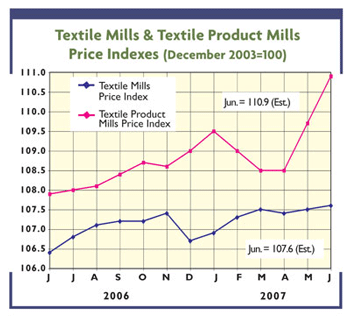
ontinuing cost containment could well be behind much of the 2007-to-date tolerably good
mill performance. Indeed, with both industry fiber and labor outlays not that much different from
last year’s levels, domestic textile companies are managing to hold their own in today’s
competitive one-world marketplace. Look at fibers first: While there have been some cost advances
over the past year in a few man-mades — most notably polyester — most other man-mades have either
eased a bit or not moved at all.

Not surprisingly then, Uncle Sam’s official man-made producer price index remains pretty much
where it was last summer. Moreover, there is little to suggest any appreciable near-term upward
drift. That’s because of today’s huge man-made fiber capacity glut. Backing this up, the Fiber
Economics Bureau — citing the June 2007 issue of Fiber Organon — notes that the global utilization
rate for these fibers is now hovering at the extremely low 75-percent level.

And another 2.8-percent increase in production potential is anticipated by the end of next
year. Coming next to cotton: True, quotes here have moved higher over the past 12 months — with
some further inching ahead possible this summer, before the new crop is harvested. Nevertheless,
there is little statistical evidence to indicate any significant runup — even with this year’s
reduced US plantings. For one, US cotton stocks — both overall and expressed as a percentage of
usage — are expected to remain well above the levels of recent years through the 2007-08 marketing
year. Also reassuring, the International Cotton Advisory Council’s latest production forecast puts
global ouput in the new marketing year just getting underway at or even slightly above that of the
previous 12-month period.


No Labor Cost Pressure Either

Wages, the other mill cost, haven’t been causing any serious problems for US mills either.
This can best be appreciated by comparing the industry’s current hourly wages with those reported
12 months ago. In the case of basic mills, the pay increase over the past year has only been
something in the order of 3.5 percent. And the comparable wage boosts are even smaller when it
comes to more highly fabricated textile mill products like home furnishings and carpets. Moreover,
those numbers tend to exaggerate the industry’s costs because they are being offset by productivity
gains. Bottom line: Adjust for these efficiency gains, conservatively put at nearly 3 percent per
year, and you end up with basically flat unit labor costs — and that’s the true measure of mill
payroll pressures.


Aug07BFgraph


Overall Costs – Another Perspective

Further confirmation of the lack of any overall cost pressures comes from recent estimates of
combined material and labor cost totals — just released by economic consulting firm Global Insight.
Adjust these cost totals for the modest decline in domestic mill production activity that has
occurred over the 2006-07 period, and resulting material and labor cost outlays — now on a
unit-of-production basis — remain virtually unchanged from last year. And this encouraging trend is
likely to continue, with Global Insight analysts suggesting these costs on a unit basis might even
show a fractional decline in 2008.

In any event, this lack of any major mill cost pressure could be one reason why industry
earnings and margins — while by no means robust — still remain positive and, even more important,
pretty much unchanged from last year’s levels.


The Economy Should Help, Too

Meantime, continuing gross domestic product (GDP) gains could put a floor under apparel
demand and hence overall textile mill operations. To be sure, these GDP increases have slowed down
a bit, but they’ll still be fairly impressive, judging from a recent Wall Street Journal survey of
60 leading business economists. Their prediction: The economy should grow at an annualized rate of
2.6 percent in the July-December period — and at 2.9 percent in 2008. That’s not much lower than
the 3.3-percent rate recorded for all of last year. Combine these projected increases with
continuing advances in worker take-home pay, and it’s almost a sure bet consumer spending totals
will keep rising. More importantly, with auto sales likely to remain on the sluggish side, the new
projections would seem to assure still-strong consumer purchases of apparel and other software
items. Hence, our latest domestic apparel manufacturing estimate sees industry revenues rising to
nearly $38 billion this year — up more than 2 percent from 2006 levels.


August 7, 2007

Sponsors